
Last updated: November 23, 2026
Quick answer: for a straightforward claim, one clear written thread, a complete file, and a prompt response in under 30 days are often enough; for a disputed or multi-party claim, freelance claims handling and insurer communication usually works better as a structured process than as ad hoc chat.
Freelance claims handling and insurer communication means managing an insurance claim on behalf of a client, while insurer communication means keeping the insurer informed with the right facts, in the right order, and in writing when it matters. In this guide to Freelance claims handling and insurer communication: The Complete Guide, the safest approach is usually to treat every claim like a document trail rather than a chat thread: clear notice, one point of contact, dated updates, and no guesswork.

Key takeaways
- A claim usually moves faster when the facts are grouped, dated, and sent once, not scattered across calls and texts.
- Freelance claims handling and insurer communication add value when a claim is messy, contested, or time-sensitive.
- Direct communication with the insurer is often better for simple claims, small losses, and clients who can keep records.
- A claim that drifts for 30 days with no written trail is more likely to become harder to manage.
- A clean claim file should usually include the policy number, claim number, loss date, photos, invoices, and a short timeline.
What does a freelance claims handler actually do?

A freelance claims handler manages the paperwork, follow-up, and insurer contact around a claim, usually as an outside specialist rather than an employee. The job is to keep the claim moving, cut down missing information, and stop avoidable back-and-forth that can slow settlement by days or weeks.
For a freelancer, the work often starts with the first notice of loss. That means collecting the policy details, the loss date, the facts of what happened, and any proof the insurer is likely to ask for, such as photos, invoices, witness notes, or repair estimates. It also means watching the claim file for gaps, because a missing date or unclear description can trigger another round of questions.
This role is not the same as selling insurance, and it is not the same as legal representation. It is closer to case management. In practice, that can be the difference between one clean message and six confused emails from three different people.
The subject matters most when the claim has moving parts. A broken laptop with a simple receipt is one thing. A public liability claim, a dispute over cause, or a loss with several parties is another. In those cases, the handler’s main value is organisation, not drama.
For background on formal complaint handling and escalation routes, the Financial Conduct Authority explains complaint handling rules here: FCA complaints handling. The Financial Ombudsman Service also sets out the complaint process here: Financial Ombudsman Service complaints.
How should a freelancer speak to an insurer?
A freelancer should speak to an insurer in short, dated, factual messages that answer the question asked and nothing else. That can sound strict, but it is often the fastest way to avoid confusion and preserve a clean record if the claim later gets disputed.
Start with the basics: policy number, claim number, loss date, what happened, what was damaged, and what you want the insurer to do next. If the claim is about liability, say who is alleging loss, what the alleged incident was, and whether anyone has already made a formal demand. If the claim is about property or equipment, list the item, the serial number if available, and the repair or replacement estimate.
Keep one thread per issue. If the insurer asks for a receipt, send the receipt and label it clearly. If the insurer asks for a statement, write a short timeline with exact dates. A 2-page statement that sticks to facts is usually stronger than a 10-page story with opinion mixed in.
Phone calls are useful, but they are not enough on their own. After any important call, send a short follow-up email: who spoke, what was agreed, what document is next, and by what date. That one habit saves a lot of future arguing about who said what.
If the insurer gives a deadline, treat it as serious advice and confirm it in writing. If the deadline cannot be met, say so before it passes, not after, and consider checking the position with a qualified claims professional or adviser. Silence is often read as delay, even when the real problem is that the freelancer is waiting on a client, a repairer, or a bank statement.
Freelance claims handling or direct insurer contact?

Freelance claims handling wins when the claim is complex, disputed, or likely to involve several rounds of requests. Direct insurer contact wins when the claim is simple, well documented, and the freelancer can keep a paper trail without help.
The choice is not about status. It is about friction. If the claim has one loss date, one invoice, and one clear answer, direct contact is usually enough. If the claim has multiple parties, unclear responsibility, or a shaky timeline, a freelance handler can stop the file from becoming a mess.
Here is the practical difference.
| Criteria | Freelance claims handling | Direct insurer contact | Winner for this condition |
|---|---|---|---|
| File organisation | Handler gathers and formats the evidence | Freelancer must organise everything alone | Freelance claims handling for complex files |
| Speed of follow-up | A handler can chase missing items quickly | Depends on the freelancer’s time | Freelance claims handling when deadlines matter |
| Cost | Adds a service cost | No separate handler fee | Direct contact for simple claims |
| Risk of mixed messages | Lower if one handler controls the thread | Higher if the freelancer writes ad hoc | Freelance claims handling for disputed claims |
| Control over wording | Handler may draft the claim language | Freelancer controls every sentence | Direct contact when the facts are simple |
| Knowledge of insurer process | Usually stronger process knowledge | Depends on the freelancer’s experience | Freelance claims handling for first-time claims |
| Speed on a clean claim | Can be as fast, but not always needed | Fastest when the file is straightforward | Direct contact for low-complexity claims |
| Escalation discipline | More likely to log dates and outcomes | Easy to miss follow-up dates | Freelance claims handling when delays are likely |
| Suitability for small losses | May be more effort than the claim is worth | Usually the better fit | Direct contact for small claims |
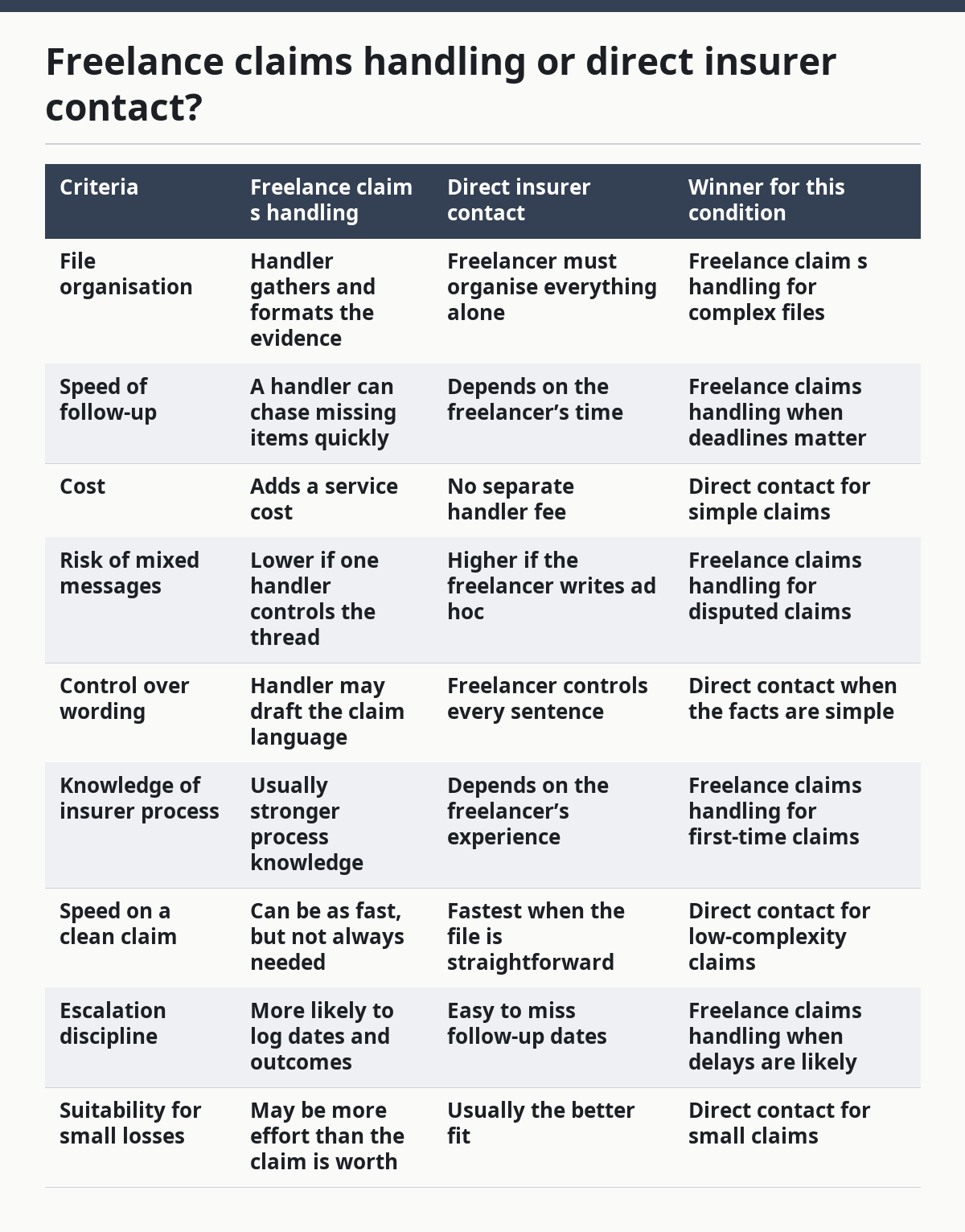
The clear rule is this: if the claim is worth a lot of back-and-forth, use a handler. If the claim is easy to prove and the insurer only needs a few documents, go direct. The wrong choice is paying for process help when the file only needs a receipt and a photo, or trying to do a contested claim entirely from memory.
What documents make insurer communication easier?
A claim moves much better when the freelancer can send a complete file in one go. At minimum, that file should include the policy number, claim number, incident date, short incident summary, photos or video, invoices, receipts, and any email chain that shows what happened before and after the loss.
The exact documents change by claim type, but the pattern does not. The insurer wants proof, timeline, and amount. If those three things are clear, the communication gets simpler.
A useful habit is to build the file in four parts. First, the identity section: policy, claim, contact details. Second, the timeline: what happened, in date order. Third, the proof: photos, invoices, reports, messages. Fourth, the ask: what the freelancer wants the insurer to do next.
For liability claims, the timeline matters as much as the money. Liability is about cause, responsibility, and notice. If the file says only “a customer fell” or “a client complained,” it leaves too much room for follow-up. A better file says when the event happened, who reported it, who was present, and what evidence exists.
For equipment or property losses, the invoice trail matters. A laptop claim without proof of purchase is weaker than one with a dated invoice and a photo of the serial number. A repair claim without a written estimate is slower than one with a clear figure and a named repairer.
The safest rule is usually simple: if a document could answer a question later, send it early. A claim file with 8 strong documents is usually better than a claim file with 20 loose files and no order.
What do insurers expect from a freelancer?
Insurers expect a freelancer to answer the question asked, supply facts that match the policy, and avoid changing the story midstream. That sounds obvious, but it is where many claims stumble.
The first thing insurers look for is consistency. If the first message says the incident happened on Monday and the next message says Tuesday, the file slows down. If the loss description changes from “damaged in transit” to “stolen from a car,” the insurer will want a fresh explanation. That is normal, but it costs time.
The second thing is cooperation within reason. That means providing documents, confirming dates, and responding to requests without dragging the process out. It does not mean agreeing with every request without checking the policy. A freelancer should still ask for the basis of any unusual request, especially if the insurer wants more evidence than the policy wording suggests.
The third thing is record-keeping. If the insurer says it needs a repair estimate by Friday, note the date and send the estimate with a short cover note. If the insurer says the claim is under review, ask what the next step is and when the next update is due. A claim can sit for weeks simply because nobody asked for the next date.
A good communication record also protects the freelancer if the insurer later questions delay. A dated email trail is stronger than a memory of a phone call. In a claim file, 1 clear email can matter more than 10 minutes of talking.
When does a freelance claims handler earn their keep?
A freelance claims handler earns their keep when the claim has enough moving parts that the freelancer would otherwise spend hours on admin instead of work. That is the point where the service becomes a time-saving tool, not a luxury.
The first strong use case is a disputed claim. If the insurer questions cause, timing, or responsibility, the handler can keep the file tidy and stop the conversation from drifting into noise. That matters because disputed claims often turn on small details, like who said what and when.
The second strong use case is a claim with multiple documents and multiple people. A freelancer may have to chase a client, a contractor, a repairer, and the insurer. That is a lot of coordination for one person who still has paid work to finish.
The third strong use case is a claim that has already started to stall. If 14 days have passed and the file still lacks a clear next step, a handler can force structure into the process. They can ask for a decision point, a missing document list, or an update in writing.
This service is not the right fit for every claim. A very small loss, a simple receipt-based claim, or a case where the insurer has already made the process clear may not justify outside help. In those situations, a handler can add cost without adding much value.
The clean way to judge it is to ask one question: is the claim hard because of the facts, or hard because of the admin? If it is hard because of admin, a handler can be useful. If it is hard because of the facts, a handler may not be enough on its own.
What goes wrong most often?
The biggest failure is slow, unfocused communication. A freelancer waits a week to answer, sends three separate emails, forgets the policy number, and the claim turns into a longer job than it should have been.
Another common problem is oversharing. Long explanations, guesses, and emotional language can create new questions. If the facts are enough, stop there. If an exact time matters, give the exact time. If it is unknown, say it is unknown.
A third problem is the missing paper trail. A phone call without a follow-up email is fragile. A promise to “send it later” is weak unless it turns into a dated file. A claim team can only work with what is in the record, not what someone meant to send.
There is also the problem of assuming the insurer already knows the story. It often does not. The person reading the file may only see a few lines and a document dump. A short summary at the top of the email helps a lot, especially when the claim file is already 10 or 15 messages deep.
One more mistake is waiting too long to escalate. If the file is stuck and the insurer is not answering basic questions, the freelancer should ask for the next step in writing. If the complaint stage becomes relevant, the formal complaints process and, where appropriate, the ombudsman route matter more than another casual phone call.
What are the exception scenarios?
The overall rule flips in a few situations, and those cases matter because they are the ones where people make the wrong call. The right answer is not always the one with the neatest process.
If the claim value is small and the paperwork is simple, direct communication usually beats freelance handling. Paying for admin on a minor loss is often poor value, especially when the claim only needs one receipt, one photo, and one call.
If the claim is already in formal dispute, the freelancer should be careful about handing everything over without checking scope. A handler can help with organisation, but not every dispute is just an admin issue. Some claims need legal advice, not better email management.
If the insurer has given a clear, short checklist and the freelancer can meet it inside a few days, direct handling is often faster. The fewer the moving parts, the less value there is in adding another person to the file.
If the freelancer has no time to manage a claim during a busy period, a handler can be the better choice even for a moderate claim. Time pressure changes the economics. A half-managed claim is usually worse than a delegated one.
How do I choose between handling it myself and hiring help?
Choose freelance claims handling if the claim is complex, disputed, time-sensitive, or likely to need repeated follow-up. Choose direct insurer contact if the claim is simple, well documented, and the freelancer can keep a clean record without help. Neither is right if the issue is really a coverage dispute that needs legal advice rather than admin support.
That is the practical split. The stronger the evidence trail and the simpler the loss, the more sense direct contact makes. The more people, dates, documents, and disagreements enter the file, the more a handler can help.
The wrong choice is to think in abstract terms like “professional” versus “not professional.” What matters is whether the claim needs coordination. A clean 3-document claim does not need a middle layer. A messy 12-email claim often does.
The best rule is simple enough to use under pressure: if the next step is obvious, handle it yourself. If the next step is not obvious, or the insurer keeps asking for the same missing item, bring in help.
FAQ
What is the first thing to send an insurer after a claim starts?
The first thing to send is a short, dated notice with the policy number, claim number if you have one, loss date, and a plain summary of what happened. That message should also say what documents are coming next. A clear first email sets the tone for the whole file.
Should every insurer conversation be by email?
No, but important parts of the claim should end up in email. Calls are useful for speed, yet the written record is what helps later if there is a disagreement about dates, requests, or promises. A short follow-up email after a call is usually enough.
When does a freelance claims handler become worth it?
A freelance claims handler becomes worth it when the claim has enough moving parts that admin is slowing the result. If the claim involves several documents, more than one person, or a dispute about facts, outside help can save time and reduce errors. A small, straightforward loss often does not need that extra layer.
What should never be left out of a claim update?
A claim update should never leave out the date, the claim number, what happened, what was sent, and what happens next. If the insurer is waiting on one document, say which one and by when. That keeps the file moving and reduces follow-up questions.
Can a freelancer still talk to the insurer directly after using a handler?
Yes, but only if the roles are clear. Mixed messages cause delays, so one person should own the main thread unless the insurer asks for a direct reply from the freelancer. The cleanest setup is one point of contact and one written record.
Drafted with AI; not yet reviewed by a person.
