

Last updated: November 19, 2026
Quick Answer: To request prior acts coverage as a freelancer, ask for it in writing during the application and give the underwriter your prior policy dates, declarations pages, and the earliest work date you want covered. If your records show a continuous claims-made history, the request is often easier to approve.
Prior acts coverage as a freelancer is usually requested by giving the underwriter a clean work history, your current claims-made policy details, and the date you want protection to reach back to. Ask for it at application time, in writing, and expect the insurer to verify your previous coverage dates before they agree. The steps below show what to gather, what to say, and what the underwriter will check. This guide explains how to request prior acts coverage as a freelancer in a claims-made policy.
What prior acts coverage request needs first
Picture this: you’re filling out a policy application and the form asks about old clients, past policies, and any gaps in coverage. You do not need a fancy script. You need dates, policy names, and proof that your work has been continuously covered, or a clear explanation of where it was not. The underwriter wants facts, not a story. That is the whole game.
Key Takeaways
- Ask for prior acts coverage during the application, not after a claim.
- Have your previous policy declarations pages ready.
- Be able to name the exact start date you want covered from.
- Expect questions about gaps, cancellations, and prior claims.
- If your old work was never covered, the insurer may refuse part of the request.
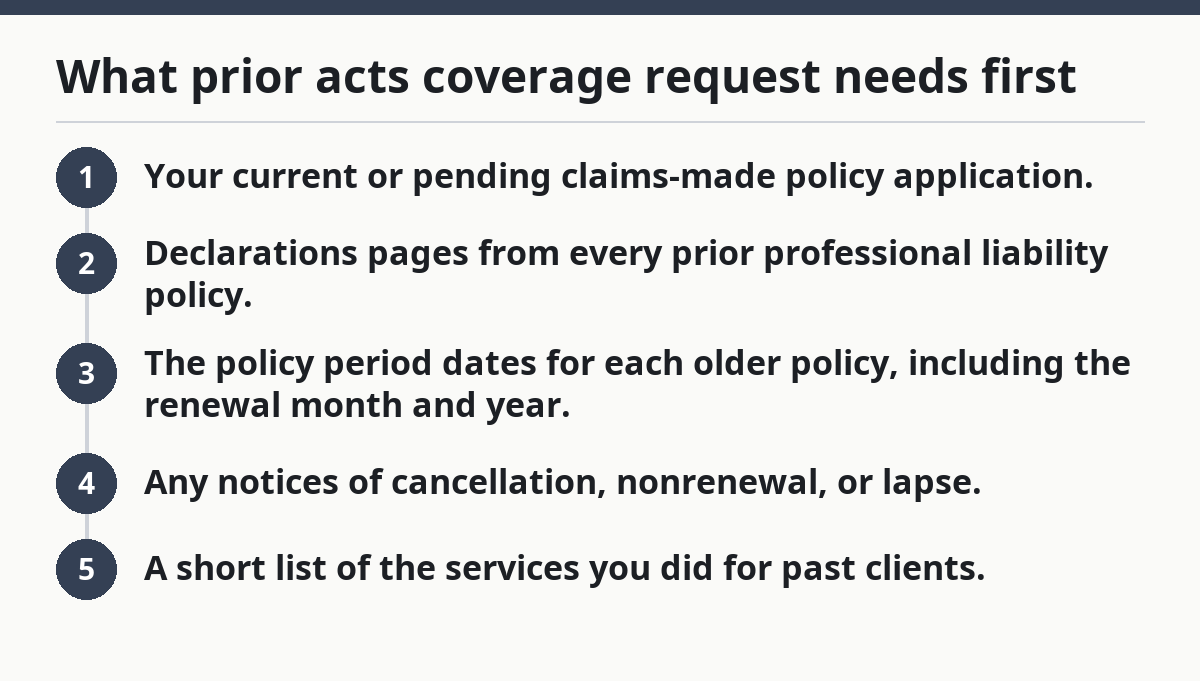
Before you start, gather these items in one folder:
- Your current or pending claims-made policy application.
- Declarations pages from every prior professional liability policy.
- The policy period dates for each older policy, including the renewal month and year.
- Any notices of cancellation, nonrenewal, or lapse.
- A short list of the services you did for past clients.
The catch is that a missing date can stall the whole review. If you can only say “sometime in 2021,” the underwriter has no clean way to align your coverage start date with the work you want protected. A complete set of documents usually makes the request faster and cleaner. Not guaranteed, but often much better.
How do you ask for prior acts coverage on a policy application?

You ask for prior acts coverage by stating the earliest work date you want included and backing that request with your old policy records. The request belongs in the application, in the underwriting notes, or in a broker email that becomes part of the file. Say it plainly: you want the policy to cover qualifying work done before the new policy’s effective date.
Here is the core process:
- List the oldest project date you want covered. Use the month and year if you do not know the exact day, and note that it is approximate.
- Attach prior declarations pages or certificates that show each previous policy’s effective and expiration dates.
- State whether there were any gaps longer than 24 hours, even if the gap was just a missed renewal.
- Describe your freelance services in 1 to 3 lines so the underwriter can match the work to the policy class.
- Ask for written confirmation of the prior acts date once the policy is issued.
You should see the request get routed to underwriting review instead of sitting as a vague note. If the insurer accepts it, the quote or binder will usually reflect the date tied to the prior acts grant. If it does not, the underwriter may ask for more records or narrow the date.
A good request is specific. “Please extend coverage back to January 1, 2022, based on continuous claims-made coverage shown on the attached declarations pages” is strong. “Please cover all my old work” is not.
What the underwriter checks before agreeing
The underwriter checks continuity, class of work, and the risk of old, unreported mistakes. You are not just asking for a date; you are asking the insurer to take on claims tied to work that already happened. That means the file has to make sense on paper.
Here’s the catch: the insurer usually looks for three things at once. First, that your previous policy periods line up. Second, that the services you performed fit the policy’s professional services description. Third, that there is no obvious reason the old work should be excluded because of a known dispute, loss, or gap. One weak point can slow the file.
What the underwriter often wants to verify:
- The names of your previous carriers
- Policy numbers, if you have them
- Effective and expiration dates on prior policies
- Any coverage gaps, even short ones
- Whether you know of any claims or incidents that were not reported
- Whether you changed from one service line to another, such as design work to consulting
A common mistake is sending only a certificate of insurance. That can show coverage existed, but it often does not show the full policy period or the exact terms. The declarations page is better because it gives the underwriter the 2 dates that matter most. If you can include both, do it.
If the underwriter sees a clean chain of claims-made coverage, the request is easier to approve. If the file shows a break, the request may still be considered, but the insurer may limit how far back the prior acts date goes. Sometimes the answer is simply no.
How previous policies affect the start date

Previous policies matter because prior acts coverage usually depends on where your claims-made history begins, not on when you first started freelancing. The insurer wants the earliest point at which work may already be subject to a claim under a continuous chain of coverage. That is why the dates on old policies matter so much.
Picture this: you renewed a policy every year from 2020 through 2024, then you apply for a new one starting July 1, 2025. The prior acts request often starts by matching the earliest uninterrupted policy period the underwriter can verify. If there was a lapse in 2023, that gap can break the chain.
Do these things before you submit:
- Put your prior policies in date order.
- Mark the first policy that covered the type of work you now want protected.
- Flag any break in coverage longer than the grace period in the policy documents.
- Note whether you changed insurers or kept the same carrier.
- Save the emails or PDFs that show renewal confirmations.
The truth is, the insurer cares less about how long you have freelanced and more about whether the old work was exposed during a covered period. A project from 2019 may be fine if your claims-made continuity reaches back that far. A project from 2019 may also be excluded if the chain starts later. Same work. Different outcome.
This is where many freelancers get stuck. They assume the right answer is the date they launched their business. It usually is not. The right answer is the first date the insurer can tie to covered professional services without a break in the record.
What to say if you had a gap or a switch in carriers
You disclose the gap or carrier switch directly and let underwriting decide whether the request still works. Hiding a break is a bad trade. It can delay the quote, trigger rescission questions, or leave the policy file messy when a claim comes in.
On the flip side, a short gap does not automatically kill the request. Some insurers will still offer prior acts coverage from a later date, or they may accept the file with restrictions. The underwriter needs the truth on the page, not a polished version of it.
Use plain language in your note:
- “I had a 17-day gap between policies because I changed insurers during a move.”
- “I did not carry professional liability coverage from March 2021 to January 2022.”
- “I changed from editorial consulting to UX writing in 2023, and I want the request reviewed for both service types.”
That level of detail helps the underwriter see what happened without guessing. It also shows that you understand the difference between a clean renewal and a gap in claims-made continuity. Good files get answered faster.
If the gap was long, be ready for a narrower result. The insurer may agree to a later prior acts date, ask for a higher premium, or decline to backdate coverage for the older work. Consult a professional if the gap is significant, because the result depends on the policy and the underwriting file.
How to get written confirmation before the policy starts
You get written confirmation by asking for the prior acts date on the quote, binder, or policy schedule before you bind coverage. Do not rely on a phone call alone. If the date matters, it needs to show up in writing where you can save it.
Picture this: the quote looks fine, the premium is paid, and the policy arrives 2 weeks later with a different start date than you expected. That kind of surprise is exactly why the confirmation step exists. It is easier to fix before binding than after a claim.
Ask for one of these in writing:
- The prior acts date on the declarations page
- An endorsement naming the date
- An email from the broker or insurer confirming the date
If the insurer cannot confirm the date, stop and ask again. A clean confirmation should match what you asked for and what the underwriter approved. If it does not, the file is not finished.
The best part is that a written confirmation also helps if you later switch insurers. It becomes part of the record you can use to show the next underwriter your coverage history. Keep it with the policy, not buried in your inbox.
Common mistakes that cost freelancers coverage
The most common mistake is asking for prior acts coverage after the policy is already bound. That can cost you time, and sometimes the answer becomes “no” because the insurer did not price the risk that way. Ask during the application. Early is better.
Another mistake is leaving out old policy periods because “they were all the same.” If the underwriter cannot see the chain, the chain does not exist for underwriting purposes. That can shrink the start date or force more questions.
Other mistakes to avoid:
- Using a certificate instead of a declarations page
- Forgetting a short lapse because it seemed harmless
- Describing work too broadly, such as “marketing” when the policy class is actually copywriting or consulting
- Assuming all old projects are covered just because the new policy says claims-made
- Failing to ask for the date in writing
One more costly error: not telling the insurer about a known dispute on an older project. If the claim was already brewing before the new policy started, the underwriter may treat that differently from ordinary prior work, so consult a professional and review the underwriting rules carefully. That is a real risk issue, not a paperwork issue.
The honest rule is simple. The cleaner your record, the easier the request. The messier the record, the more you need exact dates and exact wording. Sloppy files get priced like sloppy files.
Where prior acts coverage fits in your broader insurance setup
Prior acts coverage fits inside a claims-made policy, so the request only makes sense if your current or new policy works that way. If your coverage setup changes from one insurer to another, the prior acts date is the bridge that keeps older freelance work inside the protection you are buying now.
That is why this page pairs with the broader freelancer insurance basics and coverage choices hub. The bigger question is not just “Can I ask for prior acts coverage?” It is also “Does my current policy structure let old work stay covered without a break?” This page handles the request process. The hub handles the bigger map.
You will usually see the issue come up in 3 situations:
- You are buying your first claims-made policy and want old freelance work included.
- You are switching insurers and want the new carrier to honor your earlier coverage history.
- You had a gap and need the underwriter to review how far back the new policy can reasonably reach.
If you only remember one thing, make it this: request prior acts coverage as part of the underwriting file, not as a last-minute favor. The insurer needs dates, prior policies, and a clear story about continuity. Give those up front, and the review has a real chance of going your way.
Do all insurers offer prior acts coverage?
No, not every insurer offers the same prior acts setup. Some will write it as part of a claims-made policy, and some will limit how far back they will go based on your prior coverage record. The exact offer depends on the carrier, your work type, and the underwriting file.
Will prior acts coverage cover work before my current policy?
Yes, if the insurer agrees to a prior acts date that reaches back far enough and the work fits the policy terms. The coverage usually applies to past work that would otherwise fall outside the current policy period. It does not erase exclusions, gaps, or known issues.
What information do insurers need for prior acts coverage?
Insurers usually want previous policy dates, declarations pages, policy numbers if available, details about coverage gaps, and a description of your freelance services. They may also ask about prior claims or known incidents. The cleaner and more specific the records, the faster the review tends to go.
Drafted with AI; not yet reviewed by a person.
