
Last updated: November 22, 2026
Quick Answer: a 12-page packet with dated records from the last 3 to 12 months is usually enough to show a freelancer’s business continuity after a gap in client work. For underwriters, that usually means recent activity, a live proposal pipeline, updated portfolio items, and clean records such as invoices and tax files. If you need a broader checklist, this guide to freelance invoice records, portfolio updates, and tax record keeping shows how those pieces fit together in How to Show a Freelancer’s Business Continuity After a Gap in Client Work.

Key takeaways
- A gap in paid client work does not end a freelance business by itself; the record trail matters more than the empty weeks.
- The strongest proof is current: portfolio updates, recent invoices, proposal emails, and active admin records from the last 3 to 12 months.
- A short explanation beats a long excuse. Underwriters usually want a clear timeline, not a defence.
- If the break came with a closed business bank account, missing tax returns, or no current pipeline, the usual proof set becomes weak fast.
- Different countries use different record rules, so tax and insurance expectations should be checked against local guidance.
What counts as business continuity evidence?

Business continuity evidence is any dated proof that the freelance business kept functioning during the gap. It is not the same as proving a long career history, which belongs on a different page; this page is about showing the business is still alive now, not building the full backstory.
The clearest signals are simple: a portfolio updated in the last 30 days, a proposal pipeline with active prospects, invoices issued after the gap, and tax records that still show business activity. Underwriters read those items as operational evidence, not as a story. A 6-month pause in client payments looks less serious when the file also shows ongoing quotes, revisions, and admin work.
A generic mistake is to send old testimonials and hope they fill the gap. They do not. A testimonial from 2 years ago can help context, but it does not prove current continuity.
How do you show the gap without making it look worse?
You show the gap by giving it a short, dated explanation and then moving the file back to present-day activity. The point is not to hide the break; it is to show that the break was limited, explained, and followed by active work.
Use a simple timeline with 3 parts: last paid project date, what happened during the quiet period, and the first signs of resumed activity. Keep the explanation to a few lines. If the gap came from illness, caregiving, a contract ending, or a market slowdown, say so plainly and stop there. Long narratives invite more questions than they answer.
A useful comparison helps here:
| Approach | What it shows | Main drawback |
|---|---|---|
| Only old client contracts | Past work history | Says little about current continuity |
| Timeline plus recent invoices | Past and present activity | Needs clean dates and document matching |
| Timeline plus pipeline and portfolio updates | Present activity and future work | Takes more effort to assemble |
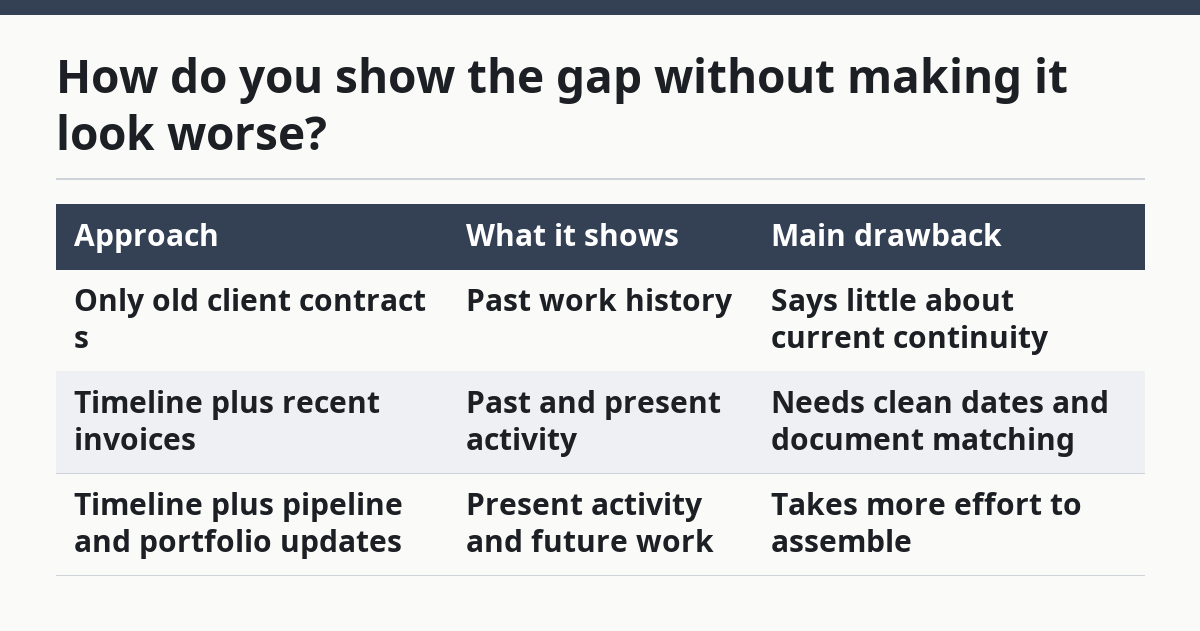
The strongest file usually combines the second and third rows. The weak file is the one that relies on a single dated contract from years ago and nothing current.
What should go in the file?
The file should show activity from at least 3 angles: money, work product, and forward motion. That means invoices, a portfolio, and a proposal pipeline. If one of those is missing, the rest need to be stronger.
Start with invoices. Even one invoice after the gap can show that the business remained open and billing resumed. Then add portfolio material that reflects recent work, such as a new case study, revised sample, or updated service page. Finally, add pipeline evidence: sent proposals, follow-up emails, discovery calls, or calendar notes that show active pursuit of work.
For records, tax or bookkeeping files matter because they anchor the timeline. The IRS guidance on record keeping and HMRC’s records guidance both point in the same practical direction: keep dated business records and keep them organised. For general reading, see IRS Publication 583, HMRC’s records guidance, and bookkeeping basics. Rules differ by country, so the exact retention period is not universal.
How do you build a continuity packet step by step?
You build it by arranging recent, dated proof in a way an underwriter can scan in under 10 minutes. The packet should be short, consistent, and free of gaps inside the gap.
- Write a one-paragraph timeline. Keep it to 5 to 7 lines and name the gap in months, not vague terms like “a while.” Verify that the dates match your invoice and calendar records. A problem is any timeline that cannot be lined up with documents.
- Collect 2 to 4 recent invoices. Include the invoice date, client name, and service description, with the latest one no older than the most recent quarter if you have it. Verify that invoice numbers run in order. A problem is a missing sequence or a blank month with no explanation.
- Pick 3 portfolio items. Choose recent work samples, updated case studies, or refreshed service pages. Verify that at least one item shows activity after the gap. A problem is using only stale samples from before the quiet period.
- Add proposal pipeline evidence. Include sent proposals, follow-ups, call notes, or CRM entries from the last 30 to 90 days. Verify that the dates are current. A problem is pipeline evidence with no response history or no recent action.
- Attach bookkeeping or tax records. Use bank entries, bookkeeping exports, or filed tax summaries that match the business name. Verify the records cover the quiet period and the months after it. A problem is mixing personal and business activity without labels.
- Include one short explanation for the gap. Limit it to the cause, the date range, and what resumed afterward. Verify that it does not sound defensive. A problem is over-explaining or asking the underwriter to infer the facts.
- Check every date for consistency. Compare the invoice dates, portfolio dates, and pipeline dates on one page. Verify that the story moves forward in time. A problem is a portfolio update dated after a proposal it was meant to support.
- Trim the packet to the strongest 8 to 12 pages. Keep only what proves continuity; do not include every old file. Verify that the packet is easy to read on a phone. A problem is a 40-page dump that buries the useful evidence.
A 12-page packet can be enough when the dates line up and the documents are current. A 2-page packet can fail if it is all old work and no recent activity.
What are the mistakes people make most often?
The biggest mistake is sending only historic proof and calling it continuity. That shows experience, not current operation, and it can leave a quiet period looking like a shutdown. The fix is to add recent invoices, updated portfolio items, and dated pipeline activity from the last 30 to 90 days.
A second mistake is using a portfolio that was last updated years ago. That makes the business look dormant, even if work resumed. The fix is to refresh at least one sample, case study, or service page so the file shows movement.
A third mistake is mixing personal and business records in the same stack. That can blur the timeline and create avoidable questions. The fix is to separate business bank entries, business invoices, and business correspondence from household records.
A fourth mistake is writing a long explanation for the gap. Underwriters usually need a factual timeline, not a 2-page story. The fix is a short note that states the dates, the reason, and the restart.
A fifth mistake is leaving the proposal pipeline out because no contract is signed yet. That leaves future activity invisible. The fix is to show sent proposals, follow-ups, and recent calls, even if none has closed.
When should you stop and get help?
You should stop using a simple continuity packet when the records no longer tell a clean story. In that case, a qualified adviser who understands local insurance and tax rules can help you decide what the file should show.
The gap is longer than a few months and there is no recent client activity: the file may look inactive — get help before sending partial records.
The business bank account was closed and reopened: the continuity line may need extra explanation — use professional help to avoid mismatched dates.
Tax filings are missing for one or more periods: the record trail is broken — do not rely on portfolio pages alone.
The work changed from freelancing to employment and back again: the continuity question becomes more complex — separate the freelance period carefully.
The business name, trading name, or legal structure changed during the gap: continuity may exist, but the entity may not be the same on paper — get help with the paperwork.
The only proof is informal messages or screenshots: that is usually weak evidence — ask for guidance on what stronger records exist.
A continuity packet works best when the business stayed recognisably the same. When the structure changed, the usual approach may fit poorly.
What counts as weak evidence, and what works better?
Weak evidence is anything that proves the person exists but not that the business kept running. That includes old social posts, a static website, or a single testimonial from years ago. Those items can support the story, but they should not carry it.
Stronger evidence is dated and operational. An invoice dated after the gap, a proposal sent in the last 2 weeks, and a portfolio item updated this month all point in the same direction. If the underwriter can trace the activity from one document to the next, the file gets easier to read.
A simple rule helps: if a document cannot be placed on a calendar, it does less work. If it can be dated, matched, and linked to another document, it does more. That is why continuity evidence is usually a set of records, not one perfect page.
FAQ
Does a work gap hurt insurance approval?
A work gap can make the file harder to read, but it does not automatically end the case. The key issue is whether the records show the business is active now, with dated proof from invoices, portfolio updates, and current pipeline activity.
How do I prove I am still operating?
You prove it with current records that fit together. Recent invoices, proposal emails, updated portfolio samples, and bookkeeping or tax files are the usual mix, because they show money, work, and ongoing admin in the same period.
What evidence shows business continuity after a break?
The strongest evidence is often dated activity after the break, not just before it. A recent invoice, a fresh portfolio update, and a live proposal trail are usually stronger than old testimonials or an unchanged website, because they show the business resumed and stayed active.
Drafted with AI; not yet reviewed by a person.
