
Last updated: November 21, 2026
Quick Answer: a freelancer is usually claim-ready when they can produce at least four dated records for each job: the agreement, the change trail, the delivery proof, and the payment record. In Freelancer claims readiness and evidence — The Complete Guide, the most useful evidence is not one magic document; it is a chain of messages, files, invoices, contracts, and notes that makes the timeline hard to dispute.
Key takeaways
- Claims usually turn on proof, not promises. A clean timeline beats a memory.
- The most useful records are the ones created during the job, not after a dispute starts.
- A signed scope, change requests, delivery proof, and payment records do more work than a long email thread with no dates.
- If a claim happens, the first job is to protect evidence and stop the paper trail from getting messy.
- The freelancers who struggle most are the ones who mix informal chats, late edits, and missing approvals into one job file.
What does “claims readiness” mean for a freelancer?

Therefore, claims readiness means you can show, fast, what happened on a project and why you did what you did. For a freelancer, that usually means having records that back up the scope, the deliverables, the client’s instructions, the approval points, and any warning you gave before a problem grew.
This matters because many disputes are not really about a missing file or a late invoice. They are about blame: Did the freelancer follow the brief? Did the client change the brief? Was the defect there from the start? A dated record answers those questions better than memory, which gets weak the longer the dispute lasts.
For freelancer liability insurance, claims readiness also means evidence that helps the insurer understand the file quickly. A policy may cover legal defence or settlement costs, but only if the facts can be shown. That is why insurers often care about contracts, work logs, correspondence, and proof of delivery.
Specifically, the short version is simple: if you cannot show the work trail in 10 minutes, you are probably not ready.
What evidence matters most in a freelancer claim?
The most useful evidence is the material that shows the project from first instruction to final handoff. That usually starts with the signed contract or proposal, then moves through emails, chat logs, drafts, invoices, and acceptance records.
A contract is the anchor. It shows scope, deadlines, payment terms, ownership terms, revision limits, and any exclusions. If the contract is weak, the rest of the evidence has to do extra work.
Email and message threads matter because they capture instructions and changes. A client who says “Can you just add one more page?” may later forget that the extra page changed the deadline. A dated message can settle that.
Project files matter too. Drafts, version names, comments in shared documents, and timestamps show what was produced and when. If the dispute is about whether the freelancer delivered the right thing, file history can help.
Invoices and payment records matter because they show which milestones were completed and accepted. A paid invoice does not prove perfection, but it does show that the job moved forward as planned.
For example, a simple evidence set for one project often includes:
- signed proposal or contract
- statement of work or scope notes
- email chain with instructions and approvals
- draft files with version dates
- delivery email or upload confirmation
- invoice and payment record
- written note of any change request or delay
The missing piece is often the easiest one: a clear approval from the client. Without it, even a strong delivery trail can feel incomplete.
Which records should you keep before a dispute starts?
Because the job is still fresh, you should keep records before a claim letter lands. The best time to build evidence is when the work changes, gets approved, or gets delivered.
Start with a contract that names the exact service. If you are a designer, writer, developer, consultant, or photographer, the service should be described in a way that leaves little room for later rewriting. “Brand assets” is weaker than “logo, colour palette, and two concept rounds.”
Keep every change request in writing. If a client asks for extra work on a call, send a short follow-up email that confirms the new request, the added time, and any effect on cost or deadline. That one habit can prevent a large amount of trouble later.
Keep dated backups of drafts and final files. Version history in cloud tools helps, but exported copies are safer if a platform account changes or access is lost. Store them with the job name and date, not “final-final-v3.”
Keep proof of delivery. A sent email, uploaded file confirmation, shared folder notice, or signed handoff note can matter more than the file itself. What matters is being able to show the exact point at which the client got the work.
Keep payment and billing records. If a client disputes the quality of work after paying the final invoice, the payment trail shows that the project reached a formal close, or at least a milestone.
One useful rule: if a record would be hard to explain to a stranger six months later, it probably needs a clearer label now.
Freelancer claims readiness and evidence: what goes wrong most often?
Claims usually go wrong in the same few ways: there is no signed scope, the work changes but nobody records the change, or the final approval never gets written down. Those gaps do not always lose a claim, but they can make the claim slower, more expensive, and harder to defend.
The most common failure is a loose brief. The client thinks one thing was promised, and the freelancer thinks another. If the brief is only a call and a few messages, the dispute becomes a memory contest.
The next failure is mixed communication. A freelancer uses email for some parts, chat for others, and a project tool for the rest. The result is a trail spread across several places, with key approvals buried in a chat thread no one exports.
Late file changes are another problem. If drafts are edited after delivery without a version trail, it becomes hard to show what was original and what was changed later.
A final problem is silence after a warning. If a freelancer spots a risk and tells the client, but never saves that warning in writing, the warning may disappear from the record. That can turn a managed risk into a disputed one.
The trade-off is clear: good record-keeping takes time during the job. But that time is far cheaper than trying to rebuild a project from scraps after a complaint arrives.
Which is better: a clean contract or a full paper trail?
A clean contract wins for clarity, but a full paper trail wins when a dispute becomes real. The contract sets the rules; the paper trail proves how the rules were applied.
| Criteria | Clean contract only | Full paper trail | Winner for condition |
|---|---|---|---|
| Shows agreed scope | Strong at the start | Strong at the start and throughout | Full paper trail if the job changes |
| Captures client changes | Weak unless updated | Strong through dated messages | Full paper trail |
| Proves delivery | Limited | Strong with sent files and timestamps | Full paper trail |
| Helps with “who said what” | Moderate | Strong because approvals are written | Full paper trail |
| Helps in a small, simple job | Often enough | Can be more than needed | Clean contract only for tiny fixed jobs |
| Helps when there are revisions | Weak if revisions are informal | Strong if revisions are logged | Full paper trail |
| Helps an insurer understand the file | Basic | Much better | Full paper trail |
| Takes time to maintain | Low | Higher | Clean contract only if speed matters most |
| Shows payment history | No | Yes | Full paper trail |
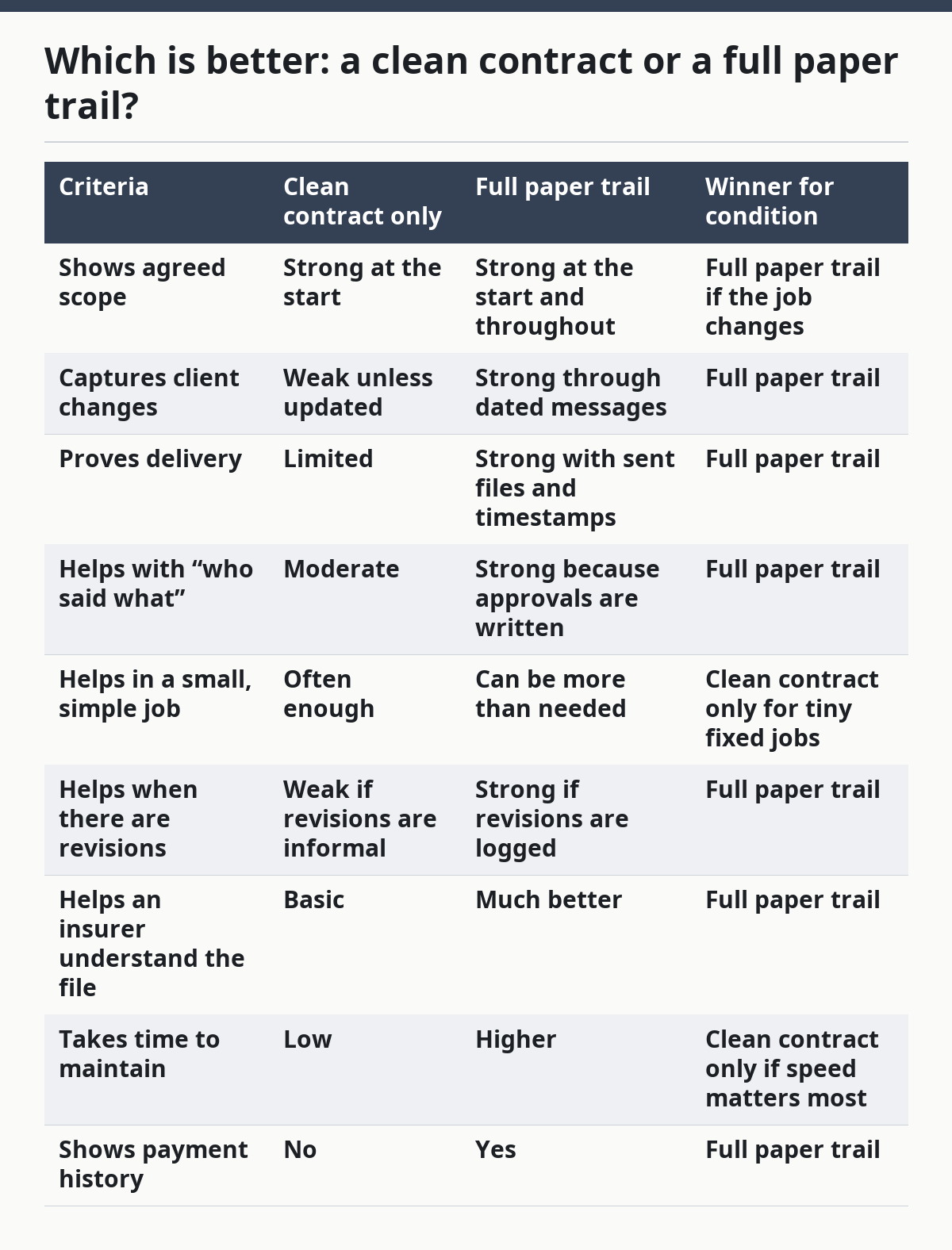
A clean contract is the minimum. A full paper trail is the safer choice whenever the work is custom, the budget is larger, the deadline is tight, or the client is changing the brief midway through the job.
The mistake is to think the contract alone is enough. It is not. A contract without later proof of approvals can still leave a freelancer exposed.
What should you do the day a claim or complaint arrives?
Therefore, you should freeze the evidence, organise the timeline, and avoid changing the record. The first 24 hours matter because small mistakes can make a later defence harder.
Start by saving every file tied to the project. Export email threads, download chat logs if possible, and copy the final files, drafts, invoices, and delivery proof into one folder. If a platform can overwrite files, back up the version you had before any dispute started.
Write a short timeline for yourself. List the date of the brief, the date of any change request, the date you delivered, the date the client replied, and the date the complaint arrived. Keep it factual and brief.
Do not edit old messages, rename files in a way that hides their date, or clean up the trail to make it “look better.” A claim investigator or lawyer needs the messy truth, not a polished rewrite.
If the matter involves injury, professional advice, copyright, data loss, or money at risk, get proper help quickly. Liability issues can involve legal duties that are too important to guess at, and a professional can tell you what must be preserved next. For external guidance on record-keeping and dispute preparation, see the U.S. Small Business Administration and ACAS guidance on workplace disputes.
For insurance purposes, the key question is simple: can the file be handed over in a form that tells the story without guesswork? If the answer is no, more work is needed before the claim can move.
When does this evidence approach fail?
This approach fails when there is no reliable paper trail, when the work was done entirely by casual chat, or when the freelancer never kept copies of the final files. It also fails when the dispute is really about a contract term that was never written down at all.
It is weakest on very small jobs with no formal scope. If a client asked for “a quick fix” and there was never an email, quote, or acceptance note, the evidence may be too thin to help much. In that case, the best move is to create better records on the next job, not to assume a weak file can be rescued later.
It is also weak when records exist but are scattered. A folder of screenshots, a half-finished invoice, and a forgotten chat thread can be enough to show something happened, but not enough to show the whole story cleanly.
This is the point where freelancer liability insurance and evidence meet in practice. Insurance can pay for help, but the file still needs enough structure to explain what happened. Strong evidence does not stop every claim, but it can make the difference between a clear defence and a long argument.
What record-keeping habits make the biggest difference?
The biggest difference comes from four habits: writing the scope, confirming changes, saving versions, and asking for approval in writing. Those habits do not require special software, only discipline.
Write the scope in plain language before work starts. Put the deliverables, the deadline, the number of revision rounds, and the exclusions in the same document if possible. For a longer project, that document can sit beside a statement of work so the scope is easier to find later.
Confirm changes the same day. A short note that says, “This update adds two extra sections and moves delivery to Friday,” can save a lot of later dispute.
Save versions with dates. A final file named with the project and the date is easier to defend than a file called “final2.”
Ask for explicit approval. A client reply that says “approved” is stronger than silence, and silence is weaker than a clear yes.
These habits are simple, but they do the heavy lifting. They turn a freelancer’s memory into a record, and that record is what a claim often depends on.
Which proof belongs in every freelancer file?
Every freelancer file should contain the agreement, the change trail, the delivery proof, and the payment record. Without those four pieces, a claim can become a guessing game.
The agreement shows what the job was supposed to be. The change trail shows how the job moved. The delivery proof shows what was sent. The payment record shows how the job closed, or where it stalled.
If a project also involves copyright, data handling, or regulated advice, keep the extra documents that apply to that work. A writer may need proof of source use and brief approval. A developer may need version logs. A photographer may need licensing notes. A consultant may need written notes of advice and follow-up warnings.
The best file is not the thickest one. It is the one that answers the basic questions in order, with dates attached.
When should a freelancer rethink the whole setup?
A freelancer should rethink the whole setup when every job depends on memory, informal chat, or a shared sense of trust that is never written down. That setup feels quick at the start, but it becomes fragile the moment a client questions the work.
If a freelancer regularly takes custom work over several weeks, handles sensitive data, or works under shifting briefs, the evidence burden rises fast. In that setting, casual records are not enough. A firmer contract process and better file storage are necessary, not optional.
If the current system makes it hard to find a signed agreement, a final approval, or the latest version in under a minute, the setup is already too loose. The fix is not more confidence. The fix is a better process.
This is also where limits matter. Some disputes are about facts that cannot be proven from paperwork alone. In those cases, good records help, but they do not erase every risk. That is why freelancers should treat evidence as protection, not as a promise of victory; for legal or insurance questions, consult a qualified professional and check your policy terms.
How does this help with freelancer liability insurance?
It helps because insurers and claims handlers need a clear story, and the evidence trail is the story. A good file shows what was promised, what was changed, what was sent, and when the problem first appeared.
This matters for several kinds of liability disputes. A client may say the work caused financial loss. A third party may say the work was inaccurate or damaging. A claim can also turn on whether the freelancer followed instructions or warned the client about a risk. In each case, documents matter.
If a freelancer has never thought about evidence until after a complaint arrives, the file is usually weaker than it should be. That does not mean the claim is lost. It means the freelancer has less room for error and should get organised fast.
For readers comparing coverage, the lesson is simple: the policy may be the safety net, but the evidence is the rope that holds the story together. Without it, the net has less to work with.
FAQ
What is the most important evidence in a freelancer claim?
The most important evidence is the written agreement plus the change trail. Together, they show what was supposed to happen and what changed before the dispute.
Do emails count as evidence?
Yes, emails count as evidence because they are dated records of instructions, approvals, and warnings. They are stronger when they are complete threads instead of scattered single messages.
What if the client only gave verbal instructions?
Verbal instructions are weak unless they were later confirmed in writing. A follow-up email or message that repeats the instruction can help, but a written record from the start is much better.
How long should a freelancer keep records?
Keep them long enough to cover the time a dispute could still surface and the time needed to defend it. The exact period depends on the work, the contract, and any legal or insurance requirement that applies.
Can good evidence stop a claim from becoming a problem?
Good evidence can make a claim easier to defend, but it cannot stop every dispute. It improves the chance that the facts are clear and that the claim can be handled with less confusion.
Drafted with AI; not yet reviewed by a person.
