
Last updated: November 28, 2026
Quick Answer: for a sole proprietor, freelancer liability insurance usually changes 3 things: the named insured, the risk path to personal assets, and the paperwork that ties the policy to the business. In freelancer liability insurance for sole proprietors: what actually changes is usually not the basic coverage itself, but how the policy matches the legal name, trade name, and exposure path. A sole proprietorship has no legal separation between you and the business, so a claim can reach personal property as well as business assets if insurance does not cover it. Consult a qualified adviser about your own situation. For background on sole proprietorships, see the IRS and SBA guidance on sole proprietorships and starting a business.
Key takeaways
- A sole proprietor and the freelance business are usually the same legal person in the eyes of the law.
- That means policy names, ownership details, and who is exposed to a claim matter more than they do in a separate company.
- Liability insurance does not erase personal risk; it helps transfer some of it.
- The main job here is to match the policy to the real business name and the real risk path.
- If the paperwork is vague, a claim can get messy fast.
What changes for a sole proprietor?
For freelancer liability insurance for sole proprietors, the main change is that your personal and business identities are not separated by a legal wall. The IRS treats a sole proprietorship as an unincorporated business owned by one person, and the SBA describes it as the simplest business structure. That structure matters because a claim against the freelance business can also become a claim against you. For a plain-language overview, consult the IRS and SBA pages above.
Because of that structure, the practical effect shows up in three places. First, the policy may need to list your own name and your trade name, if you use one. Second, ownership of the policy and the named insured on the declarations page matter more than the marketing language on the front. Third, your personal assets can be part of the exposure if the claim is larger than the insurance response.
A generic article often skips the part that matters most: the legal form of the business can change who is exposed, but it does not change what the insurer owes unless the policy wording says so. That is why sole proprietors should read the declarations page, endorsements, and named insured line with care. For a useful overview of the business form itself, the IRS sole proprietorship page and the SBA’s sole proprietorship guidance are good starting points.
How do personal assets and business assets differ here?
Because personal assets and business assets can point to the same person in a sole proprietorship, this is the part people miss. A separate company can own a bank account, equipment, and contracts in its own name. A sole proprietor usually owns the freelance business assets personally, even if those assets are used for work.
That distinction matters after a claim. If a client says your work caused damage or loss, the insurer may defend the claim and pay covered amounts up to the policy limit. If the claim is bigger than the coverage, the unpaid part can still reach assets that are legally yours. In a sole proprietorship, that can include personal savings, a car, or other property, depending on local law and the claim type.
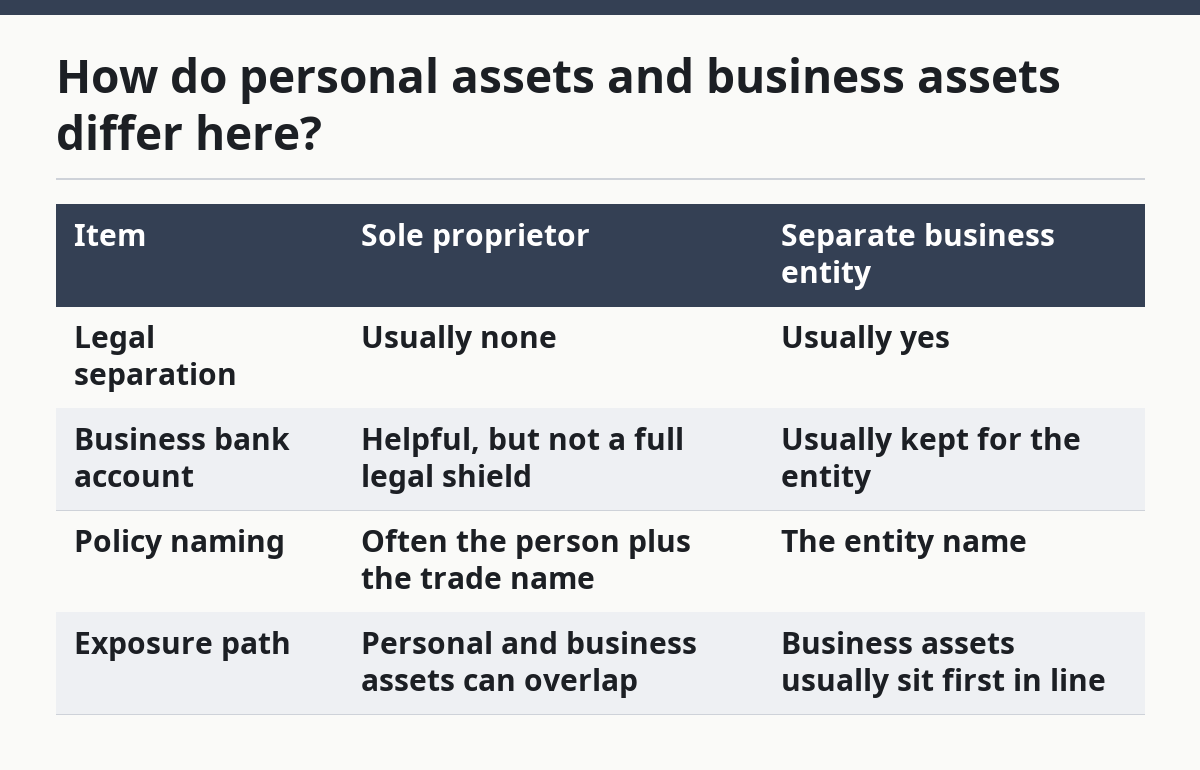
Here is the cleanest way to think about it:
| Item | Sole proprietor | Separate business entity |
|---|---|---|
| Legal separation | Usually none | Usually yes |
| Business bank account | Helpful, but not a full legal shield | Usually kept for the entity |
| Policy naming | Often the person plus the trade name | The entity name |
| Exposure path | Personal and business assets can overlap | Business assets usually sit first in line |
This is also where a lot of generic advice goes wrong. People hear “business insurance” and assume the business itself is protected in the same way a company protects a shareholder. That is not how sole proprietorship works. The structure is simple, but the risk can be less forgiving.
How should the policy be named and owned?
The policy should match the legal reality of the business name, ownership, and billing details. If you operate under “Jane Doe Design,” the insurer may need to know that Jane Doe is the sole proprietor and that the trade name is just the operating name. A mismatch does not always stop coverage, but it can slow a claim review or create avoidable arguments about who the insured is.
Ownership is not a small detail. The named insured is the person or entity the policy protects. If the declarations page lists only the trade name and the insurer treats that name as informal, a claim can become harder to sort out than it needed to be. The same problem can happen in reverse if a contract names the business one way and the policy names it another. For naming and ownership questions, consult the insurer, the policy form, or a licensed professional.
A simple check list helps here. Use the exact name from your business records, then compare it with the contract name on client agreements, invoices, and tax records. If the names differ, the difference should be deliberate, not accidental. A sole proprietor does not need a separate legal entity to have insurance, but the policy has to match the way the business actually exists.
The policy language also matters when a client asks for proof of insurance. Many freelancers only learn about this at the last minute, after a contract asks for a certificate of insurance. That is usually not a coverage problem by itself, but it is a paperwork problem that can delay work for days if the records are sloppy.
What should you check before the policy is issued?
You should check the legal name, trade name, insured name, business activity, and any client contract wording before the policy is issued. That sounds basic, but this is the point where sole proprietors avoid most avoidable errors. The insurer needs the business facts to line up with the real freelance business, not with a guess.
Start with the legal name used for the sole proprietor. Then match it to the trade name, if there is one, and check whether the policy uses one or both. Next, look at the description of work. If you write code, design graphics, or do consulting, the job description should not be vague enough to cover a completely different line of work. If the description is too broad, it can hide the real risk; if it is too narrow, it can leave out work you actually do.
Then check the client contract. Some clients require certain wording, additional insured status, or a certificate that uses the exact business name. If the policy and the contract do not agree, the claim or the compliance check may stall.
A useful rule is to keep a one-page record with four items: legal name, trade name, business address, and the exact work description. A 10-minute mismatch check now is better than a 10-day scramble after a client asks for proof. This is not about buying more insurance for its own sake. It is about making sure the policy you have can actually respond to the work you do.
How do you check the fit step by step?
You check the fit by comparing the business, the paperwork, and the exposure point by point. A sole proprietor does not need a complicated structure, but the review still needs to be exact.
- Write the legal name used for tax and business records. Put it on one line, exactly as filed or used in records. Verify that the name is consistent across invoices and the policy draft. A problem shows up when the insurer uses a shortened or different name.
- List the trade name, if any. Record the public-facing freelance business name, even if it is only used on a website or invoice header. Verify that it appears where the insurer expects it. A problem is a policy that leaves the trade name out entirely.
- Describe the work in one sentence. Use the actual service line, such as design, writing, consulting, or development, rather than a vague “professional services” label. Verify the wording matches what you sell. A problem is a description that excludes a real client task.
- Identify where the claim could hit. Separate personal assets and business assets on paper, even if the law does not separate them for you. Verify that you understand which assets sit in the exposure path. A problem is assuming the business account alone is at risk.
- Check the named insured line on the declarations page. Make sure the person and business name are written the way the insurer intends. Verify that the named insured is the right legal party. A problem is a certificate that looks right but the policy itself does not.
- Review client contract demands. Compare the contract wording with the policy wording before the work starts. Verify that the policy can support the contract’s naming and certificate requirements. A problem is discovering the mismatch after the client signs.
- Ask how endorsements change the form. An endorsement is a written change to the policy. Verify whether any endorsement alters the insured name, business activity, or additional insured language. A problem is assuming the original form still controls after a change.
- Keep the final documents together. Keep the declarations page, endorsements, and certificate in one folder. Verify that the dates and names match the same version. A problem is relying on an old certificate after the policy changed.
The point of this process is not perfection. It is to make sure the policy responds to the real business structure. If you can explain the business name, the work, and the ownership in one minute without changing details, the paperwork is probably aligned well enough to review.
When does sole proprietor status matter most?
Sole proprietor status matters most when a claim, contract, or asset check depends on legal identity. If you run a freelance business under your own name and nothing else, the structure may seem invisible day to day. It becomes visible the moment a client, insurer, or creditor asks who exactly is responsible.
It matters when a contract wants the insured name to match the business name exactly. It matters when you own the equipment personally and want to know whether it sits inside or outside the claim path. It matters when you assume “the business” and “the person” are separate, because for a sole proprietor they often are not.
It also matters when you compare the setup with a separate entity such as an LLC or corporation. Those structures can change ownership and exposure patterns, but this page is not about choosing one. The relevant point here is simpler: if you are a sole proprietor, the policy must be read through that lens, or the coverage picture can be misleading.
That is why this topic belongs in a liability insurance guide and not in a general insurance summary. The form of the business changes the exposure line, the naming line, and the claim path. A 2-minute glance at the label is not enough.
When should you stop and get qualified help?
You should stop and get qualified help when the paperwork or exposure is more complicated than a plain sole proprietorship. A claim, contract, or tax structure can change how the policy should be read, and money rights can turn on small wording differences.
If your freelance work is done through more than one name: that means the policy may need to reflect both the legal name and the trade name — get qualified help before relying on the policy alone.
If a client contract requires specific certificate wording: that means a mismatch could block payment or approval — ask for help before signing.
If you have assets that are not clearly business-only: that means the personal-versus-business line may be blurred — get the structure checked before a claim arrives.
If the policy form uses words you do not understand: that means the named insured, endorsement, or exclusion may not mean what you think — ask for a plain-language review.
If your business has changed since the policy was issued: that means the old paperwork may no longer describe the real freelance business — update the records before the next renewal or contract.
What are the common mistakes here?
The most common mistake is treating the sole proprietor like a separate company. The consequence is false comfort, because the legal separation is usually not there. The better alternative is to read every insurance form through the lens of personal liability exposure. For the legal structure, consult the IRS and SBA references above or a licensed professional.
A second mistake is using a trade name on invoices but never checking the policy name. The consequence is a paperwork mismatch that can slow a claim or a certificate request. The better alternative is to keep the legal name and trade name aligned in every document.
A third mistake is describing the work too broadly. The consequence is that the policy language may not fit the real service being sold. The better alternative is a short, accurate description of the freelance business activity.
A fourth mistake is assuming business assets are the only ones at risk. The consequence is underestimating how far a claim can go if the policy does not fully respond. The better alternative is to separate the asset picture on paper and read the policy with that in mind.
A fifth mistake is ignoring endorsements. The consequence is that a later change can rewrite part of the policy without the reader noticing. The better alternative is to review every written change, not just the first page.
FAQ
Do sole proprietors need a separate business entity for liability insurance?
No, a sole proprietor does not need a separate business entity to have liability insurance. The key issue is that the policy has to match the legal name and the way the freelance business is operating. A separate entity can change exposure patterns, but it is not required just to buy or hold a policy.
Can a sole proprietor buy liability insurance in their own name?
Yes, a sole proprietor can often hold liability insurance in their own name, sometimes with a trade name also listed. The exact naming depends on the insurer and the policy form. The important part is that the named insured matches the real legal owner of the freelance business and the documents used with clients.
Does sole proprietor status change liability coverage?
Yes, sole proprietor status changes how liability risk attaches to the person and the business. Because there is usually no legal separation, personal assets and business assets can both be part of the exposure path. The coverage itself still depends on the policy wording, exclusions, and endorsements, which can vary by country and insurer.
Drafted with AI; not yet reviewed by a person.
