

Last updated: November 25, 2026
Quick answer: comparing a freelance insurance quote in 7 steps is the fastest way to judge price, cover, excess, exclusions, and trigger. Freelance insurance pricing, quotes, and buying decisions depend on the work you do, the cover you choose, where you work, and the claims history behind your application. This guide to Freelance insurance pricing, quotes, and buying decisions — The Complete Guide keeps the focus on what the price means in practice. A quote is useful when it matches your real risks; the cheapest policy can still leave gaps that matter after a claim. This is information, not financial advice; for your own situation, a qualified adviser or broker can help.
Key takeaways
- Freelance insurance is priced around risk, not job title alone.
- A quote only means something when the policy type, exclusions, and excess are compared side by side.
- The right buying decision is not “lowest price”; it is “best fit for the work you actually do.”
- A policy can look broad and still exclude the one event that would hurt most.
- Country rules, tax treatment, and legal minimums vary, so the same policy can mean different things in different places; consult a professional and check the rules that apply to you.
Who this guide is for
This guide is for freelancers who need to understand how insurance quotes are built, why prices differ, and how to judge one policy against another. It assumes the reader already knows the basic idea of insurance and wants help reading the quote, not a sales pitch. If the work involves regulated advice, physical risk, client data, or contracts with strict cover clauses, a qualified adviser should review the policy wording before anything is signed. For a source point, the UK’s Financial Conduct Authority explains how firms should treat customers and communicate fairly, and the Insurance Information Institute has plain-language explanations of liability cover types; consult a professional if you are unsure how those general rules apply to your own policy. See the FCA at https://www.fca.org.uk/ and the Insurance Information Institute at https://www.iii.org/.
Freelancer insurance is usually priced from a mix of trade type, turnover, cover limits, deductible or excess, and whether the policy is written on an occurrence basis or claims-made basis. A claims-made policy covers claims first made during the policy period, while an occurrence policy responds to incidents that happen during the period, even if the claim comes later. That difference matters more than many clients expect, especially when switching insurers or stopping work.
The useful question is not “What should freelancer insurance cost?” because that answer changes by country, profession, and contract terms. The better question is “What is this quote actually protecting, and what is missing?” A designer, IT contractor, consultant, photographer, and virtual assistant do not all face the same loss pattern, even if they all call themselves freelancers.
This guide is not for someone looking for a universal price list or a single recommended insurer. It is also not for anyone trying to reduce insurance to a race to the bottom on monthly cost. If the decision involves public liability, professional indemnity, cyber cover, equipment cover, or employer duties, the policy wording and exclusions matter more than the headline premium.
What affects freelance insurance price?
Freelance insurance price is driven by risk class, cover scope, limits, excess, and the wording in the policy. Two freelancers with the same turnover can still get very different quotes if one works on-site with clients, handles personal data, or gives advice that can cause financial loss.
The biggest price drivers are usually the nature of the work, where the work is done, and what kind of claim the policy is meant to answer. A freelance web developer who stores client logins faces different exposures from a copywriter who only edits text. A consultant who signs off recommendations can face professional indemnity pressure that a delivery-based creative job may not have.
Underwriting is the process the insurer uses to judge the risk before setting a premium. That process often looks at your business description, annual revenue, past claims, subcontractors, countries served, and contract size. If the proposal form is vague, the insurer may either load the premium or narrow the cover later through exclusions.
The policy limit also affects price. A higher limit usually costs more because the insurer is taking on a larger worst-case claim. The deductible or excess works the other way: a higher excess often reduces the premium, but it shifts more of the first loss to the freelancer. That trade-off matters when cash flow is uneven.
Claims history can push price up or make some insurers decline the risk. Even one prior claim can matter if it suggests the work pattern is unstable. Some occupations also attract stronger underwriting because the claim frequency or the size of potential loss is higher. That does not mean the work is uninsurable; it means the insurer is pricing the probability and size of future claims, not the name of the business on the invoice.
Geography matters too. Country, state, and even contract law can shape what insurers expect. Tax rules differ by country and can change, so the way a premium is treated on a return is a separate question from the insurance quote itself; consult a professional or tax adviser if you need a country-specific answer.
How do I compare freelance insurance quotes?
Comparing freelance insurance quotes means matching the same cover type, the same limit, the same excess, and the same exclusions before looking at price. A cheaper quote that changes any of those terms is not a like-for-like comparison.
Start by checking the policy name and the cover section. Professional indemnity, public liability, product liability, cyber cover, business equipment, and legal expenses are not interchangeable. A quote that bundles several covers can still be weaker than a quote that sells one cover well, if the bundle excludes the main risk. The right comparison is the policy wording, not the brochure title.
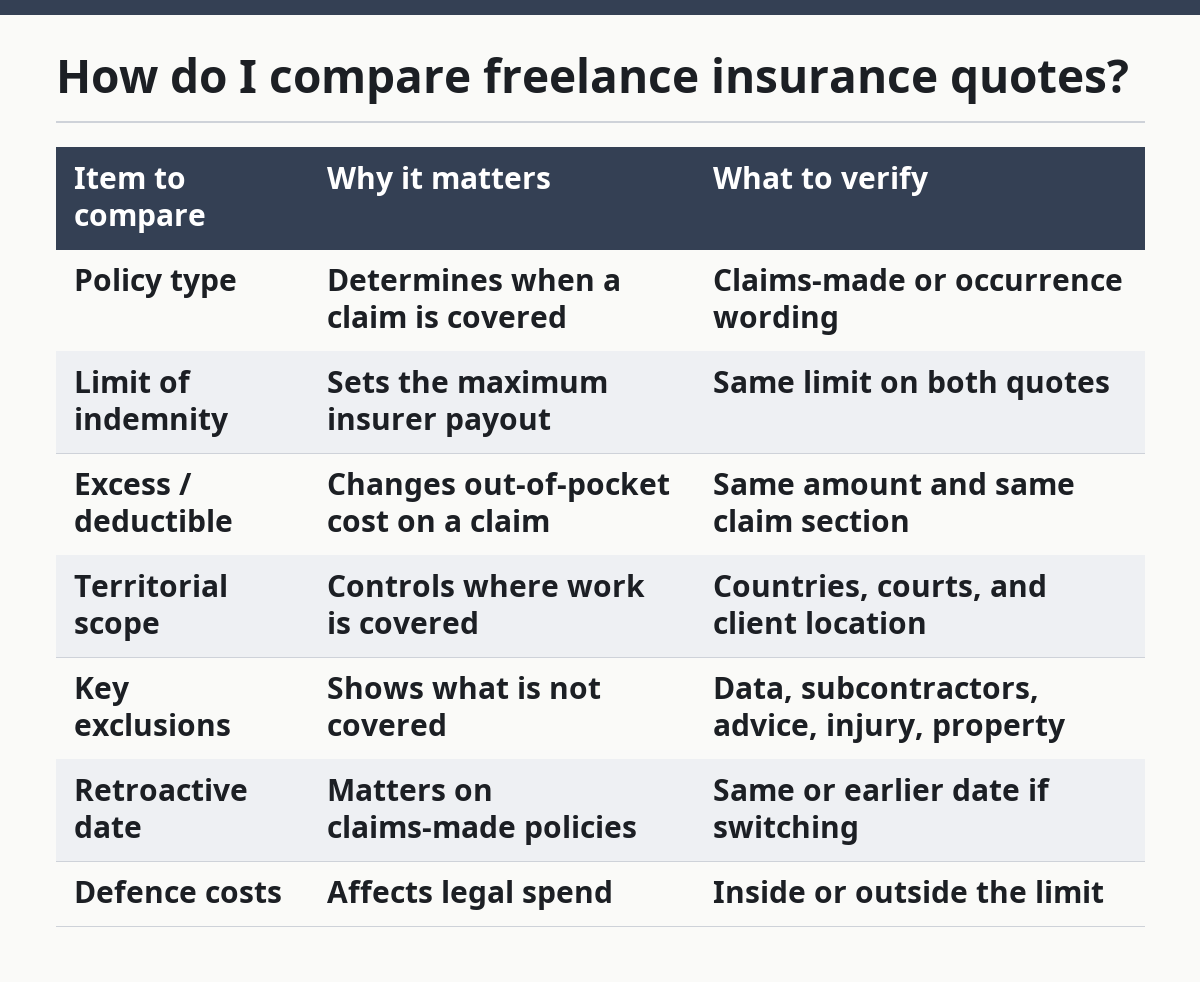
A useful side-by-side check looks like this:
| Item to compare | Why it matters | What to verify |
|---|---|---|
| Policy type | Determines when a claim is covered | Claims-made or occurrence wording |
| Limit of indemnity | Sets the maximum insurer payout | Same limit on both quotes |
| Excess / deductible | Changes out-of-pocket cost on a claim | Same amount and same claim section |
| Territorial scope | Controls where work is covered | Countries, courts, and client location |
| Key exclusions | Shows what is not covered | Data, subcontractors, advice, injury, property |
| Retroactive date | Matters on claims-made policies | Same or earlier date if switching |
| Defence costs | Affects legal spend | Inside or outside the limit |
After that, check the trigger for cover. If one policy covers claims first made during the period and another follows a different trigger, the prices cannot be weighed the same way. This is where many first-time clients get misled by a lower annual premium. The lower price may simply reflect narrower timing.
Then look at the excess wording for each section. Some policies apply one excess to each claim, while others apply separate excesses to different parts of the claim. A policy can appear cheap until a claim lands and multiple excesses stack up. The quote should state this clearly, and if it does not, that is a warning sign.
The last step is to read exclusions line by line. If you do data work, check cyber wording. If you meet clients in person, check injury and property. If you subcontract, check whether subcontractor work is included or excluded. If any exclusion removes the main thing that could go wrong, the quote is not the right one no matter how low the premium is.
How do I get a quote without missing anything?
A good quote starts with a precise business description, the right revenue figure, and honest answers about work type, territory, and past claims. The insurer can only price what it can see, so vague answers often create either an inflated quote or a policy that does not match the real work.
Use a 7-step process.
- Write the business activity in one sentence: State the main service in plain language, such as “freelance graphic design,” “independent software consulting,” or “virtual assistant services.” Verify that the description matches your contracts and invoices. If the wording is too broad, the problem is underclassification and the quote may miss the right risk band.
- List every revenue stream: Separate core freelance services from training, retainers, speaking, subscriptions, or commission-based work. Verify the insurer has the full picture of annual turnover or expected turnover for the policy period. If one revenue line is missing, the premium or cover class may be wrong.
- Count where work happens: Note whether work is remote only, on client sites, at events, or across borders. Verify the territorial scope and any country exclusions. If the quote assumes one country but you contract in several, that is a coverage gap.
- Identify the claim types that matter: Mark whether your risk is professional error, client injury, property damage, data loss, equipment theft, or defamation. Verify the policy includes the correct section for each risk. If the main exposure is absent, the quote is not fit for purpose.
- Set a realistic limit and excess: Choose limits that reflect contract demands, then compare the premium impact of a higher excess. Verify the amount applies per claim or per section, as written. If the quote hides multiple excesses, the cost on a claim may be higher than expected.
- Disclose claims and circumstances: List any past claims, complaints, or incidents that could turn into a claim. Verify that the insurer has acknowledged them in writing. If disclosure is incomplete, the policy can later be challenged.
- Check the start and end dates: Confirm the policy period, renewal date, and any retroactive date on claims-made cover. Verify there is no unwanted break in cover during a switch. If the date trail is unclear, the transition risk is too high.
A quote is only as good as the input. Missing one subcontractor or one overseas contract can change the risk class enough to matter. The cleanest application is the one that reads like a real business file, not a marketing profile.
Which policy type fits freelance work?
The right policy type depends on whether the main risk is injury, client loss, data loss, or a mistake in advice or delivery. Most freelancers end up comparing professional indemnity, public liability, and sometimes cyber or equipment cover, but those names do not mean the same thing in every country.
Professional indemnity, sometimes called errors and omissions cover, is designed for claims that a service caused financial loss because of a mistake, omission, or negligent advice. That is often the core policy for consultants, designers, developers, and other service professionals. Public liability is for third-party injury or property damage, such as a client tripping over equipment at a meeting. Cyber cover may address data breaches, ransomware response, or certain privacy claims, though the exact scope varies widely.
Here is a practical comparison:
| Policy type | Typical trigger | Common fit | Main limit issue |
|---|---|---|---|
| Professional indemnity | Advice, error, omission | Consultants, designers, developers | Client contract demands |
| Public liability | Injury or property damage | On-site or face-to-face work | Venue and event exposure |
| Cyber | Data loss or breach | Anyone handling client data | Incident response costs |
| Equipment cover | Theft or damage to tools | Photographers, makers, mobile workers | Replacement value |
| Legal expenses | Dispute support | Any freelancer with contracts | Scope of covered disputes |
The wrong fit usually happens when a client assumes “freelancer insurance” is one product. It is not. A remote writer may need very little public liability but may still need professional indemnity if a client can sue for publication errors. A photographer may need equipment cover more urgently than cyber cover, depending on how the business runs. A bookkeeper may need cyber and professional indemnity because both advice error and data exposure can create loss.
Some quotes bundle several sections into one premium, but bundling is not the same as full protection. The question is whether each section is strong enough for the real risk. A policy with a long list of names can still be thin if the exclusions are broad or the sub-limits are low. The quote should say what is covered, what is capped, and what is left out.
When should I stop and get help?
The standard DIY comparison stops when the policy wording, contract terms, or business risk becomes hard to match on your own. Insurance is not the place to guess, because a misunderstanding can show up only after a claim.
You work under a client contract that names a minimum limit or special wording: the contract may require cover terms that a standard policy does not meet — ask a qualified adviser to check the wording before you accept the job.
You have had a prior claim, complaint, or circumstance that could become a claim: the application can be affected by disclosure rules and retroactive wording — get help if you are unsure how to describe it.
You work across more than one country or serve overseas clients: territorial scope, jurisdiction, and local law can change the cover — get advice before assuming one policy applies everywhere.
You subcontract work to others or rely on subcontractors yourself: liability can shift depending on who performs the service — check whether the policy covers vicarious liability and subcontracted work.
You handle personal data, payment details, or regulated records: cyber and privacy exposures can make a standard freelance policy too thin — ask for a review of the cyber section and any incident response limits.
You are in a high-risk trade or do site visits, installations, or hands-on work: injury and property claims can grow fast — make sure the public liability wording matches the actual tasks, not the job title.
You cannot explain the excess, retroactive date, or claims-made trigger in one sentence: the policy may be more complex than it looks — pause and get a professional to translate the wording.
That is not a sign of failure. It is a sign that the insurance decision has moved beyond a basic comparison. The cost of a 30-minute review can be less than the cost of buying the wrong structure and finding out at claim time.
What mistakes cost freelancers the most?
The most expensive mistakes are the ones that leave the main risk uninsured or underinsured. Price matters, but the damage from a wrong policy can be far larger than the savings from a cheaper premium.
-
Comparing only the premium. The consequence is buying a low price with weak exclusions or a high excess. The better alternative is to compare the limit, excess, trigger, and exclusions in one sheet.
-
Using the wrong job description. The consequence is a policy priced for one trade while the real work sits in another risk band. The better alternative is to describe the business as it actually operates, not as it sounds simplest.
-
Ignoring the claims-made date. The consequence is losing cover for an older issue when switching or renewing. The better alternative is to check the retroactive date and make sure continuity is preserved.
-
Assuming a general liability policy covers professional mistakes. The consequence is discovering that advice, design error, or contract loss is excluded. The better alternative is to confirm whether professional indemnity is present and what it actually answers.
-
Leaving subcontractors out of the disclosure. The consequence is a claim dispute if work was handed off but not declared. The better alternative is to state who does the work and under what arrangement.
-
Choosing an excess that is too high for cash flow. The consequence is a claim that the business cannot absorb, even if the insurer pays the rest. The better alternative is to set the excess at a level that matches realistic liquidity, not wishful thinking.
These mistakes are common because the words look familiar. “Insurance,” “liability,” and “cover” sound simple until the policy is tested by a real claim. The safest buying habit is to ask what event caused the loss, which section responds, and what is excluded; that question is usually stronger than guessing from the quote summary alone.
What if the standard quote does not fit?
The standard quote needs adjustment when the work is seasonal, project-based, international, or contract-heavy. In those cases, the issue is not that insurance fails; it is that the first quote usually reflects an average business, not a specific one.
If work volume changes sharply across the year, an annual turnover estimate can misprice the policy. Underestimating revenue may lead to a problem at renewal or in a claim review, while overestimating can inflate the premium. The better approach is to use the most realistic expected turnover for the policy period and update it if the business changes.
If the business is project-led, check whether the cover applies during the project and after delivery. A claims-made professional indemnity policy can be especially sensitive here because the claim may arrive long after the work is finished. That makes the policy period, renewal continuity, and retroactive date more important than the business’s current size.
If the work includes speaking, teaching, or publishing, the exposure can move between professional advice, defamation, and intellectual property claims. A plain freelancer package may not cover those exposures in the way the client expects. This is where the wording around media activities and advisory services should be read line by line.
If equipment is carried to jobs, the question is not just theft. Damage, accidental loss, and whether the item is insured at replacement value or another basis all matter. The quote should state the basis of settlement, and if it does not, the policy may not pay what the owner assumes.
If the freelancer uses subcontractors, overseas servers, or client-owned tools, the policy must reflect that chain of responsibility. Standard wording often assumes a simpler setup than real freelance work involves. That is the point where a quote should be revised before it is bought, not after.
What does a good buying decision look like?
A good buying decision matches cover to risk, accepts the real trade-offs, and avoids overpaying for features that do not solve the main problem. It is not the cheapest quote, and it is not the thickest bundle of cover names.

The client should be able to answer five questions before signing: what event is covered, what is the limit, what is the excess, what is excluded, and what date trigger applies. If any of those answers are vague, the quote is not ready. That is true even when the premium looks attractive.
A good result also leaves no obvious mismatch between the policy and the contract. If a client requires a specific limit, the quote should meet it. If the work is mostly advisory, the policy should answer advice error. If the work is mostly face-to-face, public liability should not be an afterthought. If data is handled, the cyber section should not be a tiny add-on with broad exclusions.
The best decision also fits the business stage. A new freelancer with low turnover may need a simpler structure than a contractor with multiple clients and overseas work. A solo writer and a freelance engineer will not need the same package, because the loss patterns are different. That is why “freelance insurance” is a category, not a product name.
For readers comparing quotes, one simple rule helps: if the policy wording changes the story, the price should not be judged alone. A 1-page summary can hide more than it reveals about the actual freelance insurance pricing, quotes, and buying decisions that matter at claim time. The full wording, schedule, and exclusions are the documents that matter when the claim starts.
Frequently asked questions
Is the cheapest freelance insurance quote usually the best one?
No, the cheapest quote is only best if it matches the same cover, limit, excess, and exclusions as the others. A lower premium can mean a narrower policy, a higher deductible, or a claims trigger that does not fit the work. The better question is whether the policy protects the event that would actually cause the loss.
What information do I need before asking for a quote?
You usually need a clear description of the work, expected turnover, where the work is done, any subcontractors, past claims, and the cover limits you want to compare. If the insurer asks about data handling, overseas clients, or on-site visits, answer those carefully. Missing one detail can make the quote less accurate.
Why do two quotes for the same freelance job cost different amounts?
They can differ because the insurers use different rating rules, different exclusions, different excesses, or different assumptions about risk. One quote may include defence costs inside the limit while another keeps them separate. The headline premium does not show those differences by itself.
Do I need different insurance if I work with clients abroad?
Possibly yes, because territorial scope and jurisdiction can change the cover. Some policies restrict where claims can be brought or where work is performed. If overseas clients are part of the business, the policy wording should be checked before the quote is accepted.
Should I renew the same policy every year automatically?
Not automatically. Renewal is the moment to check whether the work changed, the turnover changed, the client mix changed, or the contract terms changed. A policy that fit 12 months ago may be too narrow now, especially if the business has added subcontractors, travel, or data-heavy work.
Drafted with AI; not yet reviewed by a person.
