

Last updated: November 25, 2026
Quick answer: in many cases, you can buy freelance insurance with no prior policy if you have a business formation date, a clear business description, and proof that you are actively freelancing. For How to Buy Freelance Insurance as a New Freelancer With No Prior Policy, the first application is usually the main hurdle. Gather your startup paperwork, line up your effective date, and compare quotes before you bind coverage. If you are unsure how to answer a question, consult a licensed insurance professional or your state insurance department; underwriting rules vary by carrier and state. See the National Association of Insurance Commissioners and the USA.gov state consumer guide for general insurance help.
Key takeaways
- A first-time application is normal. The insurer mainly wants to see what you do, when you started, and whether the business is real.
- Your business formation date and business description matter more than a “perfect” insurance history you do not have.
- The smoothest path is to prepare proof of activity before you ask for a quote.
- The common failure point is not the price. It is a mismatch between the application and the actual work you do.
- If the form asks about prior policies or loss history, answer honestly and use the space provided for “none” or “not applicable” where that fits.
Who this applies to
This applies to a new freelancer who needs to complete a freelance insurance application with no prior policy and no established insurance trail. It assumes you know your business name, when you started, what services you sell, and roughly what kind of clients you serve. It does not assume you already have a broker, a loss-run report, or a long tax history.
Therefore, the same approach fits many first-time buyers of freelancer liability insurance, including sole proprietors and early-stage freelancers who are just moving from side work to paid work. The application usually asks about your business formation date, your business description, prior coverage, and the date you want the policy to begin. That is enough to start in many cases.
However, this is not the right do-it-yourself path if your work is unusually high-risk, your contracts require special wording, or the insurer asks for details you cannot support with records. In those cases, the issue is not just filling out a form; it is matching the coverage and the underwriting questions to the actual work. A licensed insurance professional can help sort that out.
Because no prior policy does not mean no options, the underwriter still has to evaluate you from startup paperwork, proof of activity, and the application itself. The cleaner those pieces are, the fewer delays you are likely to face.
For background on how the market works, the NAIC commercial insurance guidance and your state insurance department are the kinds of public sources worth checking, since rules and forms vary by place.
What should you have ready before you apply?
You should have your business details, proof of activity, and your target effective date ready before you ask for a quote. A blank application slows the process and creates avoidable follow-up questions. The insurer is not guessing whether you exist; it is checking whether your work is active enough to insure.

Start with the basics: your legal name, business name if you use one, business formation date, mailing address, and a short business description. The business description should say what you actually do in plain language, such as design, writing, consulting, editing, coding, or marketing. If the description is too broad, the underwriter may not know what exposures are being covered.
Then collect proof of activity. That can include a website, client invoices, contracts, business bank records, registration documents, or tax records if you already have them. According to the IRS recordkeeping guidance, keeping organized business records helps support business activity and tax reporting. You do not need a long history, but you do need something that shows the business is real and operating. If your only evidence is an idea and a social media page with no client work, that may be a problem.
Set your target effective date before you start shopping. The effective date is the day the policy begins. If a client contract needs proof of insurance on a certain date, that date should guide your timing. Waiting until the last minute can leave a gap between when you need coverage and when the insurer is ready to issue it.
This is also the point to check whether your work fits the kind of policy being quoted. A freelance writer, a web designer, and a consultant may all need liability coverage, but their business descriptions are not interchangeable. If the application does not match the work, the quote can be misleading.
How do you buy it step by step?
You buy freelance insurance by matching the policy type to your work, completing the application honestly, and checking the effective date before you pay. The process usually moves faster when your paperwork is organized first.
- Write your business description in one sentence. Use the exact service you sell and the type of client you serve. Verify that it matches your contracts and website. If it sounds vague, like “creative services,” the underwriter may ask for more detail.
- List your business formation date and start date for paid work. Use the date your business began operating, not the date you first thought about freelancing. Verify that the date is consistent across your form, tax records, and registrations. A mismatch is a sign the file needs review.
- Collect proof of activity from the last 12 months if you have it. Bring invoices, contracts, a website, or registration documents. Verify that the documents show your name or business name. If nothing shows current activity, talk to a licensed insurance professional; some carriers may treat the application as thin or incomplete, depending on underwriting guidelines.
- Answer underwriting questions exactly as written. Underwriting means the insurer’s review of risk before it issues the policy. Verify whether the question asks about past work, client size, revenue, or prior claims. A vague answer can trigger more questions or a changed quote.
- State whether you have had prior insurance, even if the answer is no. Use the application’s prior-coverage field honestly. Verify that “none” is entered where appropriate. The second mistake is treating “no prior policy” like a problem to hide. It usually is not, but if you are unsure how to answer, confirm it with a licensed insurance professional or the carrier before you submit.
- Choose an effective date that gives you enough processing time. Pick a start date that works for your certificate or contract deadline. Verify that the policy begins before the work starts. If the date is after the job begins, the application does not solve the timing problem.
- Compare the quote to the actual work you do. Check that the policy language and business description line up. Verify that the quote covers the work you plan to perform, not a broader or narrower service category. A cheap quote that excludes your real work is a problem, not a win.
- Review the final application before you submit payment. Read every answer once more, including dates and names. Verify that there are no blank fields where a response is required. If the form still has gaps, the underwriter may send it back instead of binding coverage.
If you want the broader buying framework after this first application, the hub on freelance insurance buying decisions is the right next stop.
What will the insurer ask about?
The insurer will ask about your work, your start date, and whether your application tells a coherent story. That is true even when you have no prior policy. The goal is not to trap you; it is to place the business in the right risk class before issuing coverage.

Expect questions about what you do, how long you have done it, where you work, and what kind of clients you serve. You may also see questions about prior coverage, claims, revenue, subcontractors, and whether you work under contract terms that shift risk. These are underwriting questions, and they are standard for a first-time buyer.
If you have no prior insurance, the most important thing is consistency. The business description should match your website, invoices, and contracts. The start date should match the story the rest of the paperwork tells. If your form says you started in one month but your first invoice is from a much later date, the underwriter may ask for clarification.
A good rule is to answer with the shortest accurate statement that still makes sense. “None” is a valid answer when the form asks about prior policies and you truly have none. “Not applicable” can be valid where the application does not fit your situation. What hurts you is not the lack of history; it is the mismatch between the answer and the file.
Because the better prepared you are, the less the insurer has to guess, a new freelancer who can show a real business description, a sensible formation date, and proof of activity usually has a cleaner path than someone with a longer history but vague records.
Where does this go wrong?
It goes wrong when the application and the actual business do not match. That is the most common failure point, and it can create delays, rescissions, or a policy that does not fit the work. The problem is usually not the absence of a prior policy; it is poor documentation.
| Option | What it means | Good fit | Risk if done wrong |
|---|---|---|---|
| Apply with clear startup paperwork | You show formation date, business description, and proof of activity | New freelancer with invoices, website, or registration | Slower if records are missing, but usually workable |
| Apply with thin or vague details | You give broad answers and few documents | Only if the insurer allows follow-up later | More questions, possible quote change, or delay |
| Wait until after a contract deadline | You apply after coverage is already needed | Only if timing is flexible | No active coverage when the client asks for proof |
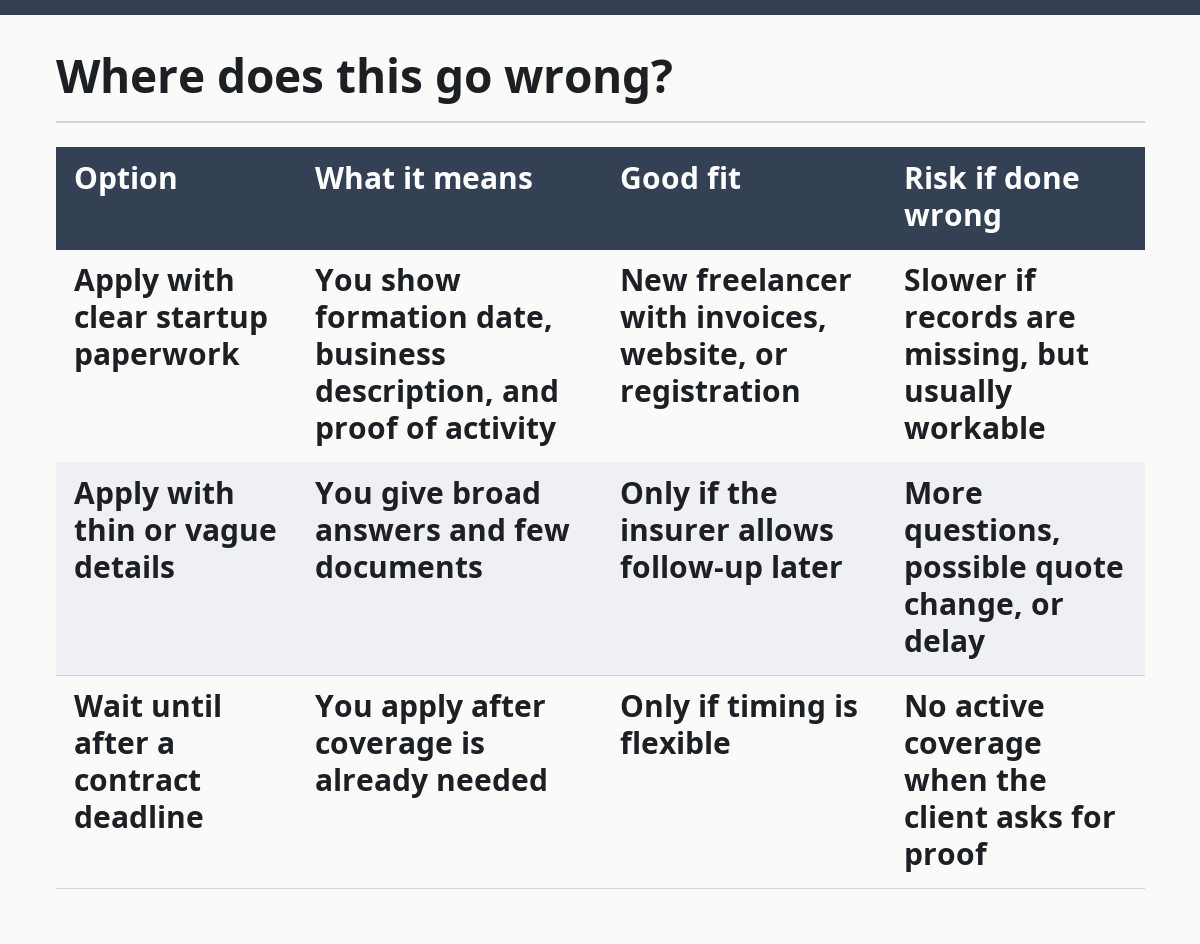
The first mistake is using a generic business description. That can lead to the wrong class of work being quoted. The correct alternative is a plain description of what you sell, who buys it, and how you deliver it.
The second mistake is treating “no prior policy” like a problem to hide. It is not. The correct alternative is to answer the prior-coverage question directly and let the underwriter work from the facts.
The third mistake is picking an effective date too late. That can leave you uninsured during the period when the contract starts. The correct alternative is to set the start date before the work begins and confirm it on the final paperwork.
The fourth mistake is sending in an incomplete application and hoping the insurer will fill in the blanks. It will not. The correct alternative is to attach the records that show the business is active.
The fifth mistake is choosing coverage based on price alone. That can leave you with a policy that does not fit your actual service. The correct alternative is to compare the quote against the work you really do.
When should you stop and get help?
You should stop and get qualified help when the application no longer matches a simple first-time freelance setup. That is where a generic online process can create a bad result.
Your work is highly specialized: A narrow service with unusual risk, such as work tied to regulated advice or technical errors, may need more than a standard form can capture — get help before you bind anything.
The insurer asks for documents you cannot support: If you cannot show a business formation date, client records, or a basic business description, the application is too thin — pause and organize the file first.
Your client contract demands specific policy wording: A contract may require terms that a standard quote does not include — review the contract before buying, because the policy may not satisfy the client even if it is active.
Your work history is mixed with personal projects: If paid freelance work, hobby work, and side income are mixed together, the underwriter may read the risk wrong — separate the business facts before you apply.
You need coverage by a fixed date and the paperwork is not ready: If the effective date matters in days, not weeks, delays can leave a gap — get help now rather than guessing on the form.
The application asks about prior claims or prior coverage and you are unsure how to answer: Uncertainty here can change the way the file is rated — stop and confirm the facts before submission.
That does not mean you failed. It means the standard first-time process is the wrong tool for a more complicated file. The fix is better documentation, not a rushed application.
What a good first application looks like
A good first application usually looks boring in the best way: the dates line up, the business description fits the work, and the effective date is already set. There are no missing fields, no unexplained gaps, and no story changes from one document to the next.

For a new freelancer, that often means one page of business facts, a few documents that show activity, and a quote that reflects the actual service. It does not require a long insurance history. It does require a record that the business exists now and is not just a draft idea.
The useful result is not always “the cheapest policy.” It is a policy that starts on the right day and matches the work you perform. If the application is clean, the underwriter has less reason to slow the file down. If it is messy, the process usually drifts into follow-up questions and corrections.
Because the process works best when you have the basics in order, the next move is to gather your startup paperwork, write your business description in plain language, and apply with the effective date you actually need.
Drafted with AI; not yet reviewed by a person.
