

Last updated: November 25, 2026
Quick answer: most freelancers need 2 or 3 core cover types, not 1 blanket policy. Freelance niche insurance is not one policy for every job, and this guide to Freelance niche insurance by work type — The Complete Guide explains how the right mix changes with the work, the contract, and the tools used. A writer, a web developer, a videographer, and a consultant face different loss patterns, so the cover that matters most changes with the work, the contract, and the tools used. This guide explains how those differences work, what each common policy does, and how to think through the right mix for your own freelance setup. This is information, not financial advice; for your own situation, a qualified adviser should be consulted.
Key takeaways
- Different freelance jobs create different risks, so the same policy mix will not fit every freelancer.
- Liability cover usually sits at the center, but some work types need cyber, media, or professional indemnity cover more than others.
- Claims-made policies and occurrence policies work differently, and the difference matters when you change insurers or stop freelancing.
- Contracts can shift risk back to you with indemnity clauses, insurance wording, and required limits.
- The better question is often “What loss could this work create, and who would pay for it?”
Who this guide applies to
This guide applies to self-employed people who sell work, not products, under a freelance contract, a retainer, or a short project. It fits solo operators and small freelance teams who already know their trade, but want to map that trade to insurance types such as general liability, professional indemnity, public liability, and cyber cover. If your work is regulated in a country with licensing rules, or your contract already names minimum limits, those terms matter as much as the policy label. For those cases, a qualified adviser should be consulted, and the insurer’s wording should be checked against the contract and any local rules. Authoritative source: UK FCA insurance guidance
The reader this helps most is a freelancer who does one of these 6 things: writes, designs, codes, consults, films, photographs, or advises on client work that can cause money loss if something goes wrong. The guide also helps freelancers who work from home, use client data, travel to job sites, or send contracts with insurance clauses attached. Those are the settings where “niche insurance” stops being a slogan and becomes a risk map.
This is not a page for someone looking for a price quote, a sales pitch, or a one-size-fits-all “best” policy. It is also not for someone who needs a legal opinion on a contract clause or tax treatment; for that, consult a qualified professional, since contract and tax issues depend on the wording and jurisdiction. A qualified adviser should be consulted where the work is regulated, the contract is unusually strict, or the policy language uses terms such as “claims made,” “retroactive date,” or “additional insured” and the meaning is not clear. Source: Law Society guidance on legal advice
The basic assumption here is that you already know your line of work, your usual client type, and whether you touch data, people, property, or intellectual property in the course of a job. Those 4 facts drive most of the insurance choice. If you do not know them, start there before you compare policy names.
What changes by work type?
What changes by work type is the kind of mistake that can trigger a claim and the kind of policy that responds. A freelance copywriter can face an allegation of defamation or copyright misuse. A web developer can face a data breach, a code failure, or a missed deadline that causes business interruption. A photographer can face damage to rented gear, a client injury on location, or a dispute over image rights. The work looks different, so the loss pattern does too.
The cleanest way to think about this is by the four things your work can touch: people, property, data, and money. If your work can injure a person or damage a venue, general liability or public liability matters more. If your work can cost a client money because advice, code, or a deliverable was wrong, professional indemnity or errors and omissions cover matters more. If your work stores client records or sends files across email and cloud tools, cyber cover starts to matter. If your work uses a camera, laptop, drone, or specialist tool, equipment cover may matter more than the job title suggests.
Here is the comparison that usually helps most.
| Work type | Main loss pattern | Cover that often comes up | Typical issue to check |
|---|---|---|---|
| Writer / editor | Defamation, libel, copyright, deadline disputes | Media liability, professional indemnity | Does the policy cover content published online and offline? |
| Designer / brand consultant | IP disputes, client loss from wrong advice, file loss | Professional indemnity, media liability | Does it cover revisions and third-party assets? |
| Web developer / IT freelancer | Code failure, downtime, privacy breach | Professional indemnity, cyber liability | Is data breach response included or separate? |
| Photographer / videographer | Injury on set, damage to equipment, rights disputes | Public liability, equipment, media liability | Are hired items and location shoots covered? |
| Business consultant / coach | Advice error, missed process step, contract dispute | Professional indemnity | Are verbal recommendations treated the same as written advice? |
| Trades-adjacent freelancer | Injury, damage to premises, tools theft | Public liability, equipment cover | Does the policy exclude hazardous work sites? |
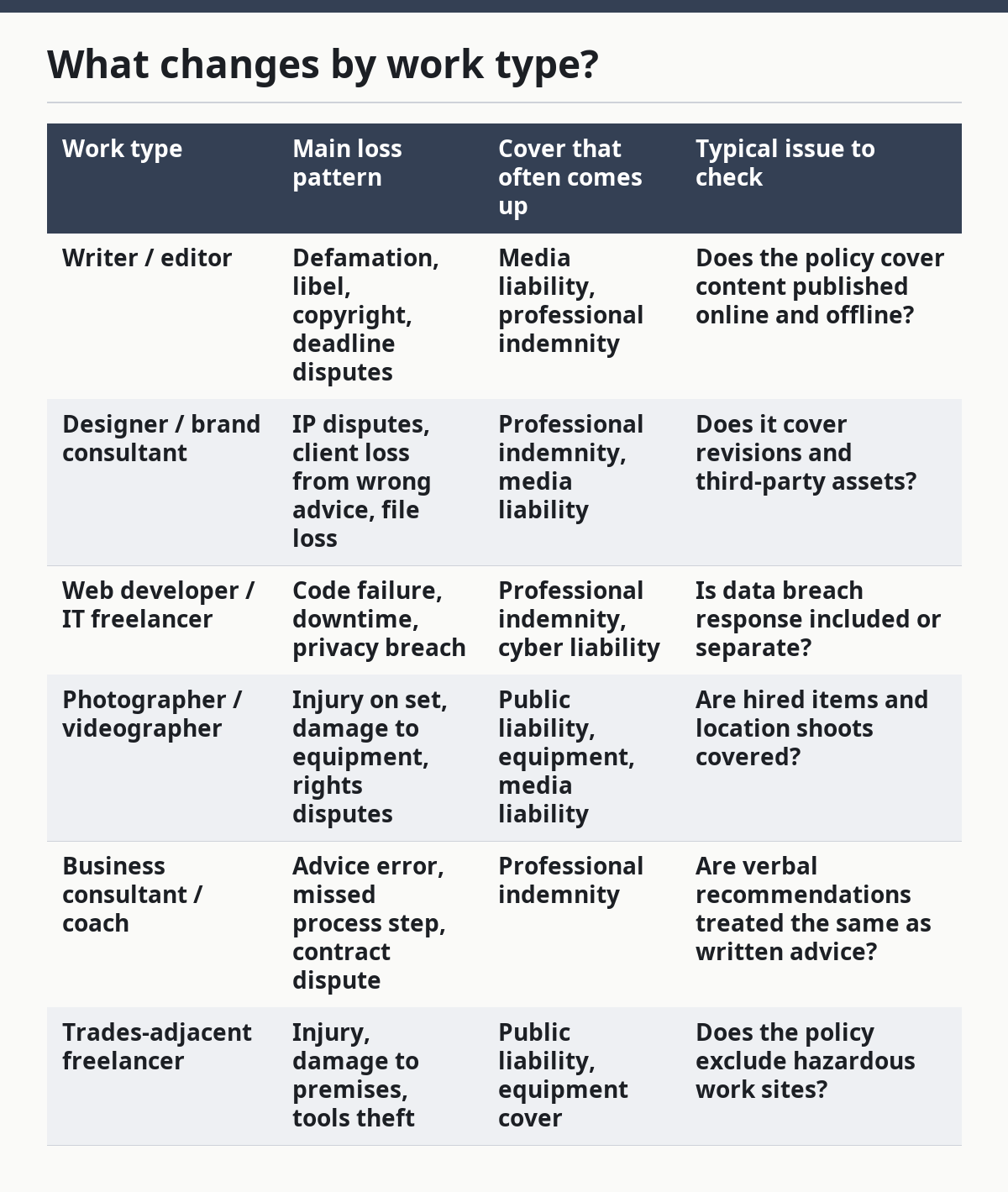
The important trade-off is that a policy named for one freelance type may still miss the real risk. A web developer who never visits clients in person may still need cyber and professional indemnity more than public liability. A photographer who works mostly outdoors may still need liability for location access, even if the gear is expensive. The job title is a clue, not the answer. For a broader look at public liability, see our public liability insurance page.
Which coverages matter most?
The coverages that matter most are the ones that match the loss, not the headline on the policy pack. Most freelance setups revolve around 5 core forms: general liability, professional indemnity, media liability, cyber liability, and equipment cover. In some markets, the names differ. “Public liability” often means harm to people or property; “errors and omissions” is another name for professional indemnity; and “media liability” usually focuses on content risks such as copyright, libel, and privacy.

General liability is the broad floor. It usually deals with third-party injury or property damage tied to your business activity. A client slipping at a studio visit, a light stand knocking over a display, or a spilled drink damaging venue property are the kinds of losses that sit in this zone. If your work never involves public contact, it may still matter less than the next layer.
Professional indemnity covers financial loss caused by a mistake, omission, or negligent advice in your service. This is the cover many freelancers need when the client’s complaint is not “you broke my chair” but “your work cost me money.” A consultant who misses a key data point, a developer who ships code with a flaw, or a designer who uses the wrong file version can all face this kind of claim.
Media liability is a closer fit for content-heavy work. It often matters for writers, editors, podcasters, videographers, publishers, and social media freelancers because the risk comes from what is said, shown, or reproduced. Copyright infringement, defamation, invasion of privacy, and trademark use can sit here, though wording differs by insurer. External source: UK IPO copyright basics
Cyber liability is about digital harm, not just hacking headlines. It can involve client data, ransomware, lost access to files, phishing, or the cost of responding to a breach. A freelancer using 2-factor authentication, cloud backups, and shared drives can still face a claim if a client file leaks or an account is misused. External source: ICO security guidance
Equipment cover is narrower but practical. It can apply to laptops, cameras, lenses, audio kit, tablets, or specialist tools. Some policies limit theft conditions, travel, or unattended equipment, so the terms matter more than the label. A $3,000 camera body means nothing if the policy excludes the place it was stolen from. For gear-heavy work, see our business equipment insurance page.
How do you match cover to your freelance work?
You match cover to your freelance work by mapping 7 facts before you compare policy language: what you do, where you do it, what you touch, what your contract says, what tools you use, whether you hold data, and how much client loss your work could trigger. That process is slower than buying whatever the first quote offers, but it is often the soundest way to connect the work to the cover. A freelancer with 2 client types may need only a narrow mix. A freelancer with 5 clients, sensitive data, and content publication risks may need a wider one.

-
List your 3 main services and 1 side service. Write the exact service names you sell, such as “brand copy,” “front-end development,” or “location photography.” Verify that each one is truly part of your paid work, not a hobby. If the side service is missing, a policy can be shaped around the wrong risk.
-
Mark every touchpoint with people, property, data, and money. Note if you visit client sites, hold access cards, store customer emails, or advise on budget decisions. Verify whether the job can cause bodily injury, physical damage, privacy loss, or financial loss. If you cannot place the work in one of those boxes, your risk map is probably too vague.
-
Read the contract’s insurance clauses line by line. Look for required policy names, minimum limits, additional insured wording, waiver of subrogation, and indemnity clauses. Verify whether the clause requires a specific form such as professional indemnity or cyber liability. If the clause is silent, the contract may still shift risk by implication.
-
Check whether the policy is claims-made or occurrence-based. A claims-made policy usually responds when the claim is made during the policy period, while an occurrence policy usually responds to an incident that happened during the policy period, even if the claim comes later. Verify the retroactive date on claims-made cover. If that date is too late, past work may not be covered. Authoritative source: FCA claims-made explanation
-
Match your data exposure to your tools. If you store client data, billing details, or project files in cloud apps, email, or shared drives, that is a cyber issue as much as a tech issue. Verify whether the policy covers incident response, data restoration, and notification costs, or only third-party claims. If the cover only pays for one side, the gap can be large.
-
Check your equipment and travel pattern. A freelancer moving between home, studio, and client site faces different theft and damage patterns than one who works at a fixed desk. Verify whether gear is covered off-site, in transit, and overnight. If the policy only protects items at your business address, mobile work may be underinsured.
-
Test the contract against the policy wording. Some contracts demand cover for subcontractors, rented premises, or prior acts. Verify that the policy does not exclude the exact thing the contract requires. If the wording conflicts, the policy may be valid but still useless for the job.
When does the standard setup not fit?
The standard setup does not fit when the job crosses into regulated work, high-value advice, hazardous sites, or content that can trigger a major dispute. In those cases, the ordinary “liability plus equipment” approach is too simple and can miss the real loss path.
Regulated advice or licensed work: This means the work is governed by rules beyond a normal freelance contract — for example, advice tied to finance, health, engineering, or legal rights — so the claim can involve a specialist standard. The right move is to get a qualified adviser who understands the relevant licensing and insurance wording before you rely on a generic policy.
Cross-border clients or overseas shoots: This means the work may be governed by another country’s contract law, liability rules, or venue terms. The right move is to verify territorial limits, jurisdiction clauses, and whether the policy applies outside your home country.
Client data in bulk: This means you hold more than a few contact details, such as payroll files, customer lists, or sensitive records. The right move is to check for cyber cover that includes breach response, not just a token data clause. For privacy basics, see ICO guidance on personal data security.
High-publicity content work: This means a single piece of work can spread widely and create a libel, privacy, or copyright dispute. The right move is to look closely at media liability wording and the treatment of published material, not just general liability. A professional adviser should be consulted if the work is regularly published or syndicated.
On-site work with tools or equipment: This means you work where a third party could be injured or their property could be damaged, such as a studio, office, venue, or client premises. The right move is to confirm third-party liability terms and any exclusions for rented space, contractors, or hazardous work.
Contract-driven insurance requirements: This means a client contract names a policy type, limit, or endorsement such as additional insured status. The right move is to treat the contract as a checklist, because a policy that is cheaper but off-spec can fail the job. If the clause is unclear, consult a qualified professional before you sign.
Past work that is still exposed: This means your previous projects may create a later claim, especially with claims-made cover. The right move is to check retroactive dates, tail coverage terms, and whether switching insurers leaves a gap. Source: ABI explanation of claims-made cover
These are the situations where the usual freelance template stops being enough. They do not mean the work is impossible to insure, but they do mean the policy terms need closer reading than a quick comparison site can provide.
What mistakes cost freelancers the most?
The mistakes that cost freelancers the most are the ones that sound minor until a claim arrives. They usually show up as wording gaps, not dramatic disasters, and they are common because the policy name looks familiar even when the cover shape is wrong.
-
Choosing by job title instead of risk. A “designer policy” may not cover media liability in the way a content-heavy designer needs it. The consequence is a claim denial or a partial payment. The better move is to compare the actual exposures: advice, publication, data, and premises.
-
Ignoring contract wording. A client may require a specific policy form, an extra insured endorsement, or a certain limit structure. The consequence is a breach of contract, even if you have insurance. The better move is to read the contract first and align the policy wording second.
-
Missing the claims-made detail. A claims-made policy can leave old work exposed if the retroactive date is too recent or if you stop renewing without protecting prior periods. The consequence is a gap for work that happened years earlier. The better move is to track dates, not just premium.
-
Assuming home insurance covers freelance work. Home policies often treat business use differently, and some exclude it or cap it. The consequence is that a business loss lands outside the personal policy. The better move is to separate home, business, and equipment questions instead of assuming overlap.
-
Overlooking digital exposure. A freelancer who emails files, stores cloud documents, or handles client login details can still face cyber loss. The consequence is underestimating the cost of breach response, data loss, or account compromise. The better move is to treat small digital habits as real exposure, even if the business is one person and a laptop.
-
Buying cover that fits the gear but not the work. A photographer may insure cameras and lenses but skip liability for location work or media rights. The consequence is a policy that protects the tool and leaves the claim untouched. The better move is to think in 2 layers: the thing you use and the loss your work can cause.
The same pattern runs through all 6 mistakes: the policy exists, but not in the shape the job needs. That is why “cheapest” is a poor filter for freelance insurance. A narrow policy can be acceptable if the work is narrow, but it can be a bad fit if the work has 3 or 4 different loss types.
How claims usually happen
Claims usually happen when a small work mistake turns into a cost, a complaint, or a legal demand. The trigger can be a finished deliverable, a site visit, a missing file, or a data incident, but the claim itself usually arrives later through a letter, email, or formal notice from a client, third party, or insurer.
For content freelancers, the path often starts with publication. A paragraph, image, caption, or clip can raise a defamation, privacy, or copyright complaint. For developers and consultants, the path often starts with advice or code that a client says caused business loss. For photographers and videographers, the path can begin on location, where a person or property is harmed before the final edit is even delivered. The same 1 project can create 2 kinds of exposure at once.
The timing matters as much as the cause. A claim made 18 months after a job can still be relevant if the policy uses claims-made wording and the wrong date sits in the background. That is why freelancers should keep a record of 4 things for every project: contract date, delivery date, client name, and any error notice or complaint. A simple file folder or spreadsheet beats memory when a claim is months old.
The process is also easier to manage when the freelancer knows what evidence matters. Emails, signed briefs, version history, invoices, scope changes, and access logs can all help show what was agreed and what happened. If the work touched a venue, equipment, or third-party file, photos and timestamps matter too. This is not about building a legal case from day one; it is about preserving the record if the claim arrives.
A realistic takeaway is that insurance does not prevent disputes, and it does not erase bad processes. It changes who pays for certain losses, subject to the policy wording. That is why the cleanest claim history usually comes from clear scope, clear records, and cover that matches the work type rather than the logo on the policy.
What should you check before you renew?
You should check 5 things before you renew: work changes, contract changes, data changes, equipment changes, and policy wording changes. Renewal is not just a price review; it is the point where the business may have outgrown the old cover without noticing.
Start with the work itself. If you added consulting, publishing, video, training, or subcontracting in the past 12 months, the risk profile has changed. Verify whether the current cover names those activities or only the older ones. A freelancer who once only edited text but now also publishes articles faces a different liability pattern.
Then check the client side. A single retainer can come with stronger insurance clauses than 10 small projects. Verify whether any client now requires additional insured wording, proof of cyber cover, or a minimum limit that was not there before. If one contract drives most of the income, it should drive the cover review too.
After that, check your records and tools. A new cloud drive, payment platform, or device set can introduce data and cyber exposure that did not exist at the last renewal. Verify who has access to files, where backups sit, and whether lost-device procedures are in place. If the business now runs through 3 connected apps instead of 1 laptop, the old answer may be stale.
The policy wording itself deserves a slow read. Look for exclusions tied to prior acts, subcontractors, location work, bodily injury, or certain content claims. Verify whether the declarations page still matches the current business name, address, and services. If the wording changed but you only focused on the premium, the renewal may hide a gap.
Finally, check whether the current policy still fits the way the work is billed. Fixed-fee work, retainers, project bundles, and hourly advisory work can create different dispute patterns. A cover that matched a small, one-off job may not fit a larger, ongoing service. Renewal should answer 1 question: if a claim came from this year’s work, would the policy respond the way you expect?
FAQ
Do freelancers need different insurance for each type of work?
Yes, often they do, because the risk changes with the work. A writer’s main exposure is not the same as a developer’s or a photographer’s, so the policy mix can shift between media liability, professional indemnity, cyber, public liability, and equipment cover. A generic policy may fit a narrow business, but it can miss the real loss if the work is mixed.
What is the difference between professional indemnity and public liability?
Professional indemnity usually deals with financial loss caused by your service, advice, or omission, while public liability usually deals with injury or property damage to a third party. The split matters because a client complaint about missed advice is not the same as a venue damage claim. Some markets use different names, so the policy wording matters more than the label.
Does home insurance cover freelance work?
Sometimes only in a limited way, and sometimes not at all. Many personal home policies treat business use differently, especially if client visits, stock, equipment, or data are involved. The safest check is the policy wording, because the answer can change with the country, insurer, and type of work. Source: MoneyHelper home and contents insurance basics
Why does claims-made wording matter so much?
Claims-made wording matters because the policy usually responds when the claim is made, not just when the work happened. That means the retroactive date, renewal history, and any tail coverage can affect whether a later claim is covered. A freelancer with past projects should treat dates as part of the cover, not a footnote.
Can one freelancer need more than 1 policy type?
Yes. A photographer who also consults, a developer who also advises, or a writer who also publishes may need more than 1 type of cover because each activity creates a different loss path. The right mix depends on whether the work touches people, property, data, money, or published content. A qualified adviser should be consulted for the reader’s own situation.
Drafted with AI; not yet reviewed by a person.
