
Last updated: November 25, 2026
Quick Answer: Prepare 5 core facts for every freelance insurance quote — business description, revenue, services, claims history, and coverage limits — so the offers can be compared on the same basis. If anything about your coverage needs is unclear, treat this as a data-prep job first and a buying decision second, and consult a qualified insurance adviser or broker before you rely on the quote. This page explains How to Prepare for a Freelance Insurance Quote So You Can Compare Offers Accurately by keeping the same facts in every application.
Prepare the same facts for every insurance quote application, and the offers become easier to compare. Use one business description, one revenue figure, one services list, one claims history summary, and one set of coverage limits so the underwriter is pricing the same risk each time. This is information, not financial advice, and a qualified adviser should be consulted for your own situation. For consumer guidance on comparing insurance, see the NAIC and, for underwriting basics, IRMI.
What should I line up first?
First, line up the facts that shape the quote, not the policy itself. A freelance insurance quote is built from the business description, revenue figures, services list, claims history, operations details, and the coverage limits you ask about.
Key takeaways:
- Give each insurer the same core facts so the quote application is being filled from the same baseline.
- Keep your wording plain and specific; broad labels hide risk.
- Treat this as a data-prep job, not a buying decision unless and until you have checked the wording with a qualified insurance adviser or broker.
- If a detail changes the risk, note it before you request the quote.
How do I prepare for a freelance insurance quote?
Next, you prepare for a freelance insurance quote by filling one clean set of business facts and checking it against your real operations before you send it. Use the same details for every insurer, because a 2024 quote based on one service mix and a 2025 quote based on a different one are not comparable. For a broader overview of shopping for coverage, see freelance liability insurance and compare insurance quotes.
- Open your quote application and list your legal business name, trade name, and business type exactly as used in your records; verify the name matches your invoices and contracts, and note any mismatch that could confuse the underwriter.
- Write the business description in 2 to 4 sentences that explain what you do, who you serve, and where you work; verify that the description matches your actual freelance services, and flag any vague wording such as “consulting” if it hides a specific service.
- Record revenue figures for the period the insurer asks about, using one consistent unit such as annual revenue; verify that you are using the same time frame for each quote, and note a problem if one application asks for gross revenue while another asks for payroll or fees.
- List your services one by one, including any advisory, creative, technical, or client-facing work; verify that the list includes your highest-risk work, and stop if you are tempted to leave out a service that could lead to a claim.
- Summarise claims history for the period requested by the insurer, including the date, type of claim, and whether it was open or closed; verify that the dates line up with your records, and note any claim that involved professional error, property damage, or injury.
- Describe operations details such as whether you work at home, on client sites, or through subcontractors; verify that the setup reflects your current work pattern, and mark it as a problem if your work has changed in the past 12 months and the older setup is still being used.
- Set coverage limits before you ask for the quote, even if you are still deciding later; verify that every insurer is quoting the same limits and deductible structure, and stop if one application uses different limits, because the prices will not compare cleanly.
- Check supporting details like your website, client contracts, and policy dates for consistency; verify that every source says the same thing about what you do, and fix any contradiction before the quote is submitted.
The hard part is not gathering a mountain of paperwork. It is keeping the details consistent. A quote can look cheaper simply because the insurer priced a narrower description of work, a lower limit, or a cleaner claims file. For more on the way small wording changes affect coverage, see professional liability insurance.
What information changes the quote the most?
Then, the information that changes the quote the most is the part that changes the risk profile: what you do, how much work you do, and how often claims have happened. Revenue figures, services list, claims history, and operations details all shape the price the underwriter may offer.
| Input you give | Why it matters | What to keep consistent across quotes |
|---|---|---|
| Business description | Tells the insurer what kind of freelance work you do | Use the same wording and level of detail |
| Revenue figures | Helps size the exposure | Use the same period and unit on every quote |
| Services list | Shows which jobs may create claims | Include the same services, in the same order |
| Claims history | Signals past loss patterns | Report the same incidents every time |
| Coverage limits | Sets how much protection you are asking for | Match the limits and deductible structure |
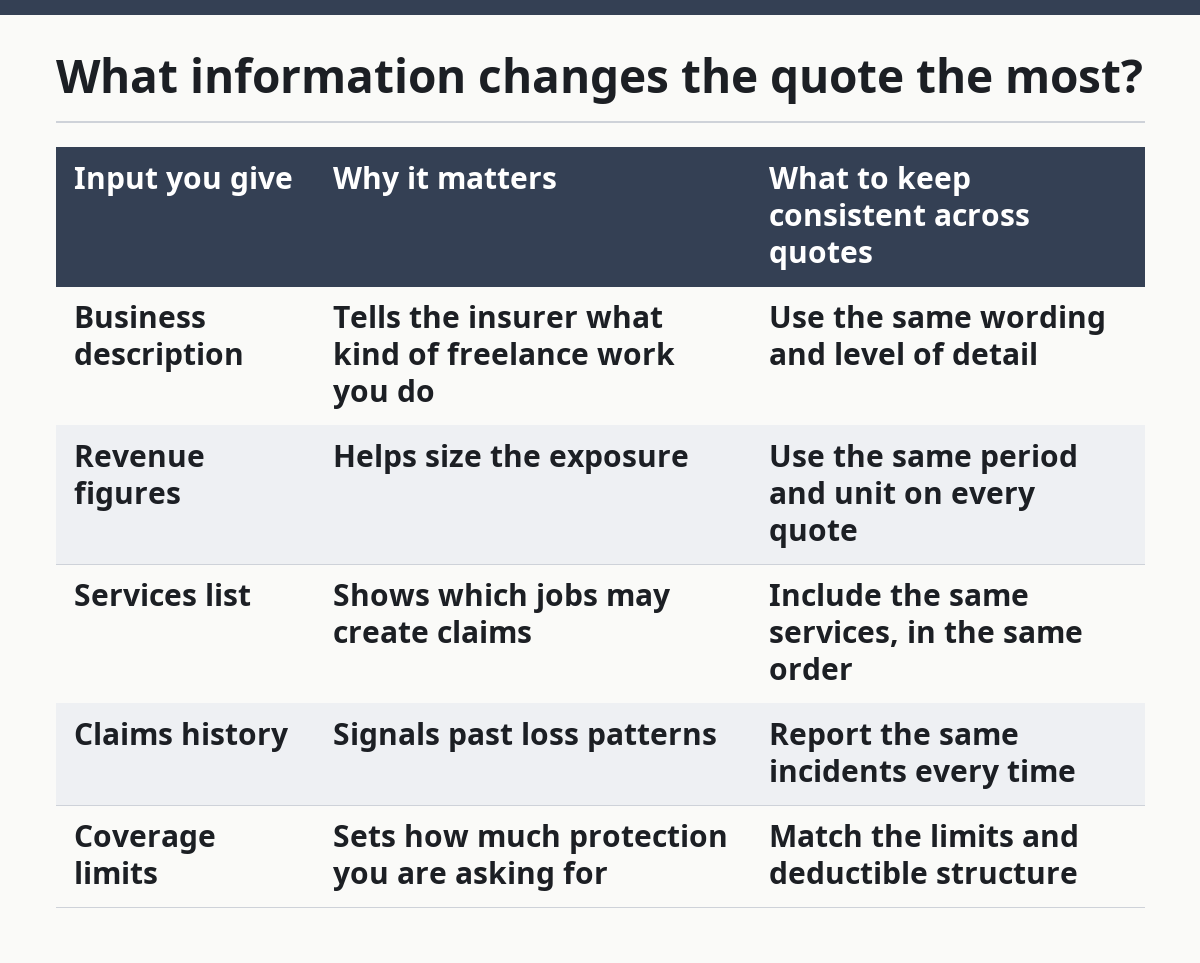
This is where many people go wrong. They compare one quote that includes a narrow scope of work against another that covers a broader scope, then assume the lower number is the better deal. It is only useful if the inputs are aligned first.
For a plain-language guide to the next stage, the hub on freelance insurance buying decisions belongs nearby, but this page stays with quote readiness. If you want a broader buying checklist, see freelance insurance buying guide.
What should I check before I send the form?
Before you send the form, check that the quote application tells one clear story about your business. The underwriter should not have to guess whether you are a designer, consultant, copywriter, developer, or a mix of all four.

Check these points before you submit:
- Your business description matches your website and invoice headers.
- Your revenue figures use the same time period the insurer asked for, not a nearby estimate.
- Your services list includes the work that creates the most exposure, not just the easiest work to describe.
- Your claims history is complete for the requested period, even if a claim was small.
- Your coverage limits are the same on every quote request.
- Your operations details explain where work happens and whether subcontractors are involved.
A mismatch does not automatically mean the quote is wrong, but it can mean the underwriter may have priced a different risk. That leads to a useless comparison later.
One useful habit is to keep a one-page intake sheet. Put your business description, revenue figure, services list, claims history, and operations details on that page before you start requesting quotes. Then every insurer sees the same baseline.
How do underwriters read my answers?
Because underwriters read your answers as risk signals, not as branding copy, wording matters. An underwriter is the person or system that decides how much risk the insurer is willing to take and on what terms.

A phrase like “digital services” may be too broad if your real work includes paid advice, code changes, or client-facing decisions. A phrase like “web design for small businesses” is clearer because it narrows the service. The same is true for revenue figures: a rounded estimate can be fine for a first quote, but a later mismatch can change the offer.
Claims history also matters more than many freelancers expect. A 2-year-old claim, even if it was settled, can affect how the risk is read. If a form asks for a specific period, answer that period only and do not drift into extra years unless the question asks for them. For the general role of claims history in pricing, see the Insurance Information Institute.
When should I stop and get help instead?
So, you should stop and get qualified help when the quote application cannot describe your work without guesswork. The wrong answer here is not “push through”; the wrong answer is “hope the insurer figures it out.”

Your services include regulated advice: this can change the kind of liability the insurer wants to price — ask a qualified insurance adviser or broker for help before submitting the form.
You have multiple business lines: one freelance business description may not cover all your work — separate the lines of work before you request quotes.
Your claims history is incomplete: missing dates or unclear outcomes can distort the offer — pull the records together first or get help locating them.
You work across borders: country rules and policy terms can differ — ask a qualified adviser who understands the markets involved before you compare offers.
Your revenue changes sharply from year to year: the quote may need a clearer period and a better explanation — use the insurer’s requested time frame and do not average without checking whether that is what the form asks for.
You plan to add subcontractors soon: the current quote may not match the near-term risk — wait until the operations details are settled or ask how that change affects the application.
Freelance liability insurance is not a one-size answer. If the business structure is unusual, the cleaner move is to slow down, not to force the quote through.
What mistakes ruin a fair comparison?
Ultimately, the mistakes that ruin a fair comparison are the ones that change the inputs without anyone noticing. A quote can look better on paper and still be worse for your situation if the facts behind it are not the same.
-
Changing the business description from one insurer to the next. The consequence is that each quote may reflect a different risk class. The correct alternative is to use one master description and reuse it.
-
Using different revenue figures. The consequence is a price difference that says more about the input than the insurer. The correct alternative is to use the same period and the same unit every time.
-
Leaving out a service you actually sell. The consequence is a quote that may not fit your real work. The correct alternative is to list every service that could appear on a client contract.
-
Summarising claims history too loosely. The consequence is that the underwriter may fill gaps with assumptions. The correct alternative is to report each claim with the date and type, even if the amount was small.
-
Asking for different coverage limits in each request. The consequence is that the prices cannot be compared on equal terms. The correct alternative is to fix the limits first and keep them constant.
-
Ignoring operations details like client-site work or subcontractors. The consequence is a quote that may miss a material part of the exposure. The correct alternative is to describe how the work actually happens today, not how it used to happen.
A fair comparison starts before the quote arrives. If the inputs are uneven, the offers will be uneven too.
What if my freelance work is unusual?
Because your freelance work does not fit a simple service label, your quote prep needs adjustment. A solo bookkeeper, a podcast editor, and a freelance software developer do not face the same exposures, even if they all call themselves freelancers.
The main adjustment is to write a more precise business description and a fuller services list. If your work includes advice, review, approvals, client systems access, or any task that can create a loss, spell that out. If you use subcontractors for part of the work, say so in the operations details.
If your work changes through the year, use the current version, not last year’s version. A 2023 service mix is not a clean basis for a 2025 quote if the real business has moved on. The underwriter needs the present picture, not the old one.
How do I know the quote is ready to compare?
Then, a quote is ready to compare when the same question produced the same kind of answer from each insurer. That means the business description, revenue figures, services list, claims history, operations details, and coverage limits were stable across the requests.
If one quote is based on a broader service description, a different deductible, or a different limit, it is not apples-to-apples. Hold those inputs steady first. Then the offers are easier to read for cost, scope, and fit.
Frequently asked questions
What information do insurers need for a freelance quote?
For a freelance quote, they need the facts that define the risk. That usually means your business description, revenue figures, services list, claims history, operations details, and the coverage limits you want quoted. If the insurer asks for a date range or a specific period, use that exact period.
How do I get accurate freelance insurance quotes?
You get accurate freelance insurance quotes by using the same information in every request. Keep the business description, revenue figures, services list, claims history, and coverage limits consistent, and make sure your answers match your current work pattern.
What should I have ready before requesting a quote?
Before requesting a quote, you should have a clear business description, a current revenue figure, a full services list, a short claims history summary, and a note of where and how you work. It also helps to know the coverage limits you want quoted so every offer starts from the same point.
Drafted with AI; not yet reviewed by a person.
