

Last updated: November 25, 2026
Quick Answer: review 3 things after a formation or ownership change — the named insured, the business description, and the contract wording — because they are the parts most likely to stop matching the business on paper. Freelance Insurance for Business Formations and Ownership Changes matters because when your business structure changes, your ownership changes, or both, the legal entity and who controls the work can shift at once. If you formed an LLC, added a partner, switched from sole proprietor to company, or changed the split on an ownership stake, the policy may no longer match the business on paper.
Key takeaways
- A new business entity does not automatically inherit an old freelance policy.
- Ownership changes can affect who is covered, who must be listed, and which contracts still fit.
- The policy name, entity name, and tax records should line up after any formation change.
- Some policies are built around the person doing the work; others are built around the company doing it.
- Before assuming coverage stayed the same, check the declarations page, endorsements, and any contract wording.
What changes when your freelance business changes?
A business formation or ownership change can alter the insured person, the insured entity, and the work the policy is meant to cover. That matters because a freelancer’s insurance usually follows the legal name on the policy and the risks tied to that name, not just the person’s trade name or website.

A sole proprietor who later forms an LLC has changed more than a tax form. The LLC is a separate legal entity in many places, and insurance paperwork often has to be changed to match that entity. If a partner is added, the business may need a different arrangement for liability limits, management control, and who is treated as an owner or employee, so it is wise to consult a professional and verify the policy wording.
This is also where contract language can cause trouble. Client agreements often ask for proof of coverage under a specific legal name, a certificate of insurance, or a named additional insured. If the policy still lists the old setup, the paperwork can look right while the actual coverage is off.
For a quick rule of thumb, read the declarations page, the named insured line, and the endorsements after any change to a sole proprietorship, LLC, partnership, S corp, or shared ownership model. The policy does not care what you call yourself on your invoice if the legal entity changed underneath it.
The U.S. Small Business Administration explains that business structure affects liability and taxes, and the IRS notes that businesses should report entity changes through the right tax records. Those two moves usually need to be checked alongside insurance, not after it.
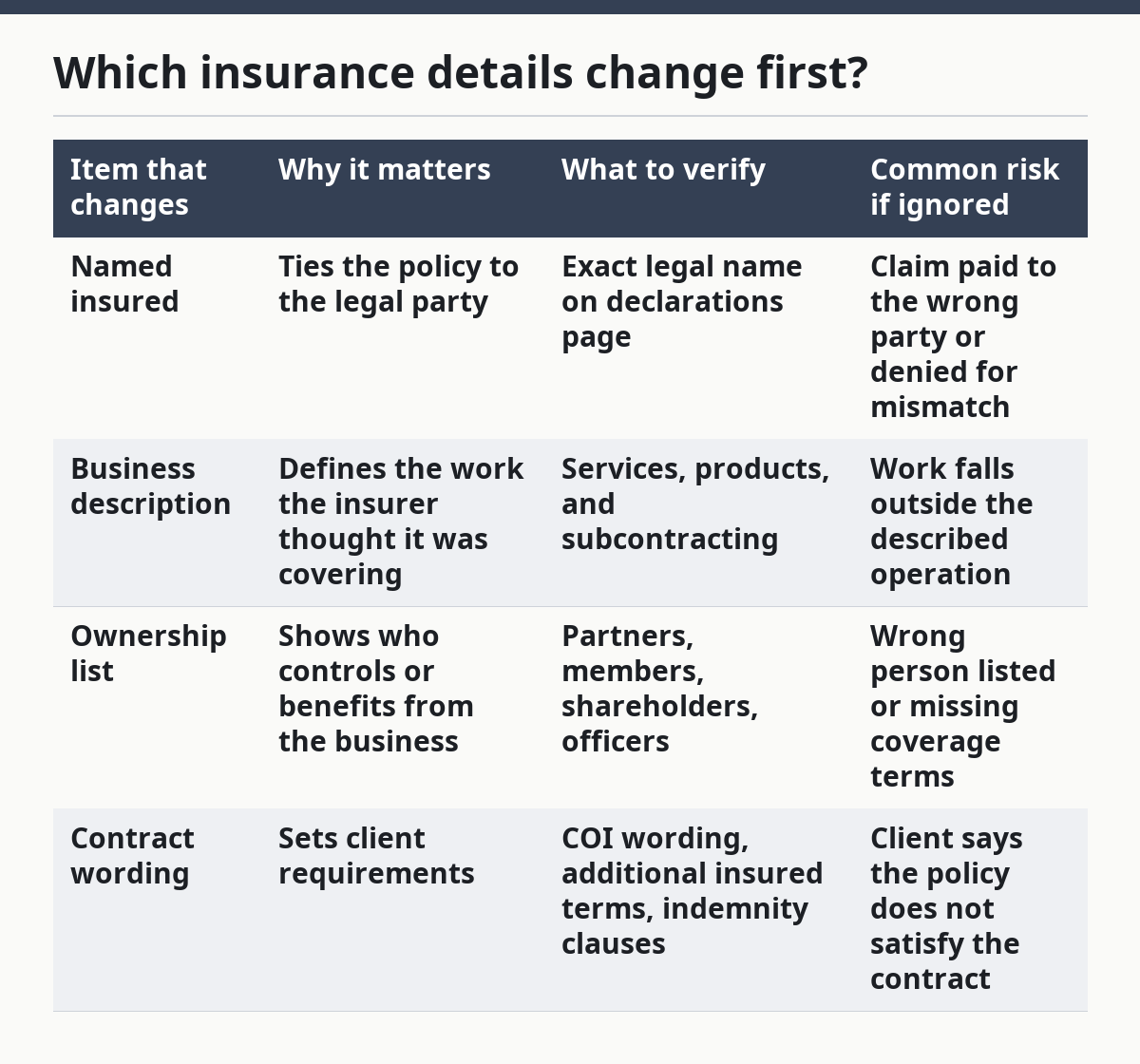
Which insurance details change first?
The named insured, the business description, and who counts as an owner usually change first. Those three items drive how the policy reads, which means they can affect coverage faster than the premium or renewal date.
The named insured is the person or legal entity listed on the policy. If you move from “Jane Smith, sole proprietor” to “Jane Smith Design LLC,” that is not a cosmetic edit. It may be a different insured party in many policy forms, and the carrier may need an endorsement to reflect it.
The business description matters too. A policy written for freelance graphic design is not the same as one written for a design studio that now subcontracts motion work, employs assistants, or takes on product liability exposure. If the work changed, the description should change with it.
Ownership changes can also affect additional insured status, especially on client contracts. An additional insured is a person or organization that gets some protection under your policy because a contract requires it. If a partner joins, leaves, or buys in, the list of covered people and contract obligations may need a fresh review.
| Item that changes | Why it matters | What to verify | Common risk if ignored |
|---|---|---|---|
| Named insured | Ties the policy to the legal party | Exact legal name on declarations page | Claim paid to the wrong party or denied for mismatch |
| Business description | Defines the work the insurer thought it was covering | Services, products, and subcontracting | Work falls outside the described operation |
| Ownership list | Shows who controls or benefits from the business | Partners, members, shareholders, officers | Wrong person listed or missing coverage terms |
| Contract wording | Sets client requirements | COI wording, additional insured terms, indemnity clauses | Client says the policy does not satisfy the contract |
If the change is only a DBA, the issue may be lighter. A DBA, or “doing business as” name, is an assumed name that may not be a separate legal entity. Even then, the insurer may still want the trade name added to the policy record so certificates and invoices match.
How do you update insurance after a formation change?
You update insurance after a formation change by matching the policy to the new legal entity, the new ownership record, and the new work profile before the next claim or contract signature. The process is paperwork-heavy, but the order matters.

- List the exact legal change. Write down whether the business moved from sole proprietor to LLC, partnership to corporation, or one ownership split to another. Verify the filing name, the effective date, and the tax ID or EIN used for the business. If you cannot state the exact entity name in one line, the insurer may update the wrong record.
- Pull the current declarations page. Check the named insured, policy number, coverage sections, and renewal date. Verify whether the policy names a person, a trade name, or an entity. If the declarations page still shows the old structure, that is a sign the policy has not caught up with the formation change.
- Match the business description to the actual work. Read the operations language and compare it to what the business now does. Verify whether subcontracting, consulting, training, or product sales are included. If the description is too narrow, the policy may not fit the new business model.
- Check every endorsement. An endorsement is a written change to the policy. Verify whether the policy has a name change endorsement, additional insured endorsement, hired/non-owned auto language, or other add-ons that should still apply. If the endorsement refers to the old owner name, the policy may need to be rewritten rather than edited.
- Review who owns the work product and who signs contracts. Confirm which person or entity now signs proposals, invoices, and service agreements. If the signer changed, the insured party may have changed too. A mismatch here can create a gap between the contract and the policy.
- Update proof documents. Ask for a revised certificate of insurance if clients need one, and verify that it shows the current legal name and any required wording. If the certificate still uses the old entity name, the client may reject it even if the policy was updated behind the scenes.
- Align tax and banking records. Confirm that the business name used on insurance matches the name used on the EIN, W-9, and business bank account. If the records do not line up, the insurer and the client may both question which business is actually insured.
- Confirm the renewal date and any waiting period. Some changes are processed immediately; others only take effect at endorsement issuance or renewal. Verify the effective date in writing. If the change is not dated correctly, the old structure may still control a loss that happens in the gap.
The clean result is simple: the legal business name, the tax record, the contract name, and the policy record all tell the same story. If one of those four says “LLC” and another says “sole proprietor,” the record is not clean yet.
The U.S. Small Business Administration’s business structure guide and the IRS business structure pages are the most common public references for formation. They do not tell you what insurance to buy, but they do show why the legal entity itself changes the paperwork.
What should you check before a partner joins?
You should check liability language, ownership percentages, and contract control before a partner joins because a 50/50 split on paper can still leave one person exposed under the wrong policy. A new owner changes the risk profile even if the service menu stays the same.
Start with the operating agreement or partnership terms. If the business is an LLC, the operating agreement can say who manages the company, who can bind contracts, and how losses are allocated. Those details matter because some insurance forms care about management authority, not just the existence of an owner.
Then check the policy structure. A policy that worked for one freelancer may not fit a two-owner setup if one partner handles client work and the other handles billing or code deployment. If one owner now supervises subcontractors, the business may need broader professional liability language or different insured-party wording. For background on how ownership and legal form affect the business record, see the IRS business structures page and the SBA business structure guide.
Also check whether each owner needs to be named on the policy or whether the entity itself is enough. That depends on the policy form, the carrier, and the contract demands from clients. A certificate of insurance that names only one owner when two people now sign contracts is a red flag.
A small change in ownership can also change what is excluded. For example, a claim tied to one owner’s old freelance work may not fit the new company if the entity was formed after the work was performed. Timing matters. The safer record is the one that shows who did what, under which name, and on what date.
When should you stop and get qualified help?
You should stop and get qualified help when the change is bigger than a name update, because some ownership shifts can create gaps that simple endorsements will not fix. This is a money and contract issue, not a guess-and-see task.
The business changed from sole proprietor to LLC after client work already started: the old and new entities may both matter for different claims — get the policy reviewed before assuming the new LLC covers past work.
A new partner bought in and now signs contracts: the authority to bind the business changed — ask for a policy review so the signer, the insured, and the contract party line up.
The business sold part of the ownership interest: the insured risk may have shifted in the middle of a policy term — confirm whether the policy needs endorsement, replacement, or backdated correction.
The work changed from pure freelance services to product sales, software, or subcontracted work: the exposure changed, not just the name — check whether the policy still describes the actual operations.
A client requires specific wording on a certificate or in an additional insured clause: the contract may require more than a standard certificate — get the wording checked before signing.
The policy was written in one country but the business now operates in another: rules differ by country and by insurer — confirm that the policy still applies in the place where the work is done.
If you are unsure whether the change is only administrative or actually legal, consult a qualified adviser, broker, or attorney. The right answer depends on the policy form, the jurisdiction, and the exact legal change.
What mistakes cost freelancers the most?
The most expensive mistake is assuming a new entity automatically inherits the old coverage. That is wrong often enough to matter, and it can leave a freelancer holding the wrong policy after a formation filing, ownership transfer, or trade-name update.
Another common mistake is treating a DBA like a legal entity. A DBA can help with branding, but it does not always create a separate insured party. If the contract names the LLC and the policy names only the DBA, the paperwork may not match the risk. If there is any doubt, consult a broker or attorney and compare the policy to the business filing.
A third mistake is forgetting to update subcontractor arrangements. If a freelancer starts sending work out to others, the policy may need to account for vicarious liability, contract work, or who is actually delivering the service. Ignoring that change can turn a routine claim into a coverage fight.
A fourth mistake is leaving old names on certificates of insurance. That can confuse clients, delay payment, or make the certificate useless for contract compliance. The fix is simple: ask for a certificate that uses the current legal name and any required additional insured wording.
A fifth mistake is changing the business formation but not the records behind it. The EIN, W-9, bank account, invoice footer, and policy should all tell the same story. When they do not, the problem is not just administrative; it can become a claim problem.
A final mistake is waiting for renewal to raise the issue. A claim can happen the day after the formation filing. If the policy still names the old setup, the timing can matter more than the annual renewal date.
What changes when the business is only partly changing?
A partial change means the usual advice needs to be narrowed, not thrown out. If the business keeps the same legal entity but changes owners, adds a DBA, or changes the share split without a new filing, the policy may need a lighter update than a full rewrite.
If the ownership change is internal and the entity stays the same, the insurer may only need the owner list, contact details, and business description updated. But if the old owner leaves and a new one takes over control, the named insured and contract authority may still need revision. The legal form matters more than the word “change.”
If the business keeps the same owners but starts a new line of work, the issue is not ownership at all. It is scope. A freelance editor who begins offering marketing strategy or course sales may need to check whether the policy description still fits. The wrong instinct is to focus only on the LLC paperwork and ignore the work itself.
If the business operates across more than one state or province, the situation gets even more specific. Rules for formation, registration, and insurance filings can differ by location, so a change that is simple in one place can be messier in another. The policy should reflect where the work is actually done, not just where the mailing address sits.
A good shortcut is this: if the legal entity stayed the same, the update may be mostly administrative; if the entity changed, the insurance review should be treated as a fresh setup. That distinction can save time and reduce blind spots.
How do you know the update worked?
The update worked when the legal name, tax record, contract name, and insurance documents all match without explanation. That is the cleanest sign that the policy is aligned with the new formation or ownership structure.
Check the declarations page first. The named insured should match the current legal entity or current owner structure, and the business description should match the actual work. If the page still shows the old sole proprietor name after an LLC filing, the update is incomplete.
Then check the certificate of insurance, if clients use one. The certificate should show the current insured name and any required additional insured language. If a client can tell from the certificate that the business changed, and the form still looks old, the update is not done.
Next, check the administrative trail. The EIN, W-9, invoice name, and bank account should point to the same entity. If they do, and the insurer has issued the matching endorsement, the business records are in sync. If they do not, there is still a gap somewhere.
A good result is not “the premium stayed the same.” A good result is that the policy now describes the business that actually exists. Sometimes the price changes, sometimes it does not, and there is no honest way to predict which way it will go without the carrier’s view of the new exposure. For process details, see the SBA business structure guide and the IRS business structures page.
What questions do freelancers ask most?
These are the questions that usually come up after the filing is done and the first client asks for proof. They are short because the answers should be short too.
Do I need new insurance if I form an LLC?
You often need the policy updated, even if you do not need a brand-new kind of insurance. The key question is whether the insured name and legal entity changed. If the old policy names you as an individual and the business is now an LLC, the record usually needs to be changed so the insurance matches the new entity.
Does a DBA count as the same business for insurance?
A DBA is often only a trade name, not a separate legal entity. That means the policy may still belong to the same person or company, but the trade name should be added if clients use it. If the DBA is being used as if it were a new company, the paperwork needs a closer look.
What if a partner joins after I already have coverage?
A partner joining later can change the insured party, contract authority, and how liability is shared. The policy may need an endorsement or a rewrite, depending on how the business is formed. The safest step is to compare the new ownership record with the declarations page before the partner signs anything.
Can I keep the old policy and just update the certificate?
Usually no, not by itself. A certificate of insurance is proof of coverage, not the coverage itself. If the policy still names the wrong business or person, a fresh certificate will not fix that mismatch.
What is the biggest risk after an ownership change?
The biggest risk is that a claim lands under the old business name while the contract, bank account, and filings now show a new entity. That kind of mismatch can delay a claim review or create a coverage dispute. The fix is to align the legal, tax, and insurance records before the next job starts.
Sources that explain the formation side
The U.S. Small Business Administration’s business structure pages explain why the legal form of a business affects liability and tax treatment, and the IRS business structure pages explain how entity form changes the business record. Those pages do not replace policy review, but they help show why an insurance update is not optional paperwork.
- U.S. Small Business Administration: https://www.sba.gov/business-guide/launch-your-business/choose-business-structure
- Internal Revenue Service: https://www.irs.gov/businesses/small-businesses-self-employed/business-structures
If the formation or ownership change is already in motion, the next step is not to guess whether the old policy still fits. It is to compare the legal entity, the named insured, and the actual work line by line before the next claim or contract does it for you.
Drafted with AI; not yet reviewed by a person.
