

Last updated: November 25, 2026
Quick answer: in 3 steps, check the policy wording, compare it with the client request, and then decide whether an endorsement, replacement policy, or written decline fits the deadline. In other words, How to Respond When a Client Asks for Insurance That Your Current Policy Does Not Cover starts with the policy form, not the certificate. This is information, not financial advice, and a qualified adviser should be consulted for your own situation. This sits under the freelance client contract insurance requirements hub.
Key takeaways
- A client request for coverage that your policy does not include is a contract issue first and an insurance issue second.
- The safest move is usually to read the policy wording, not the certificate of insurance, because the certificate is only proof of some coverage.
- A policy endorsement changes an existing policy; a replacement policy starts a new contract of insurance.
- The renewal date matters because a request made 2 days before renewal is not the same as one made after the policy period changes.
- If the gap changes the deal, the cleanest answer may be to pause, revise the contract language, or decline the work in writing.
What is a coverage gap request?
A coverage gap request is when a client asks for insurance terms that your current policy does not include. In plain terms, the client wants proof of something your policy wording does not actually promise.
That request can show up as a demand for a policy endorsement, a particular limit, or a named party on a certificate of insurance. The certificate of insurance shows what is on the policy today; it does not create new coverage by itself. For background on certificates, see the Insurance Information Institute and the NAIC consumer guide for general insurance contract basics.
The first thing to check is the exact phrase in the client request. If the contract says one thing and the policy says another, the gap is real even if the request sounds routine. A 1-page certificate can look tidy while still hiding a mismatch in the wording.
How do I respond step by step?
You respond by confirming the request, reading the policy, and matching the answer to the contract timing. So the order is: request, wording, timing.

- Copy the client request into one clean note. Write the exact wording, including the requested coverage type, any endorsement language, and the deadline. Verify the request is specific, not vague. A problem is anything that says “standard insurance” without naming the policy form or the required term.
- Pull the policy declarations page and the full policy wording. Check the declarations page for the active policy period and any listed endorsements. Verify the policy is still in force. A problem is a request tied to a policy period that has already ended or a coverage type that is absent from the form language.
- Look for the missing term in the policy itself. Search the form for the exact coverage the client wants, not a similar-sounding item. Verify whether the gap is an exclusion, a limit issue, or a missing endorsement. A problem is assuming one broad liability section covers every request.
- Check the certificate of insurance against the policy. Make sure the certificate matches the policy and does not overstate coverage. Verify whether the certificate can be updated without changing the policy. A problem is sending a certificate that implies protection the policy does not provide.
- Compare the request to the renewal date. Note whether the request lands before renewal, on renewal, or after renewal. Verify how much time is left in the current policy term. A problem is waiting until the last day, because then the response window may be too short for a policy endorsement or replacement policy.
- Ask whether an endorsement request fits the existing policy. A policy endorsement is a written change to the policy. Verify whether the carrier even offers the change on the current form. A problem is treating every gap as fixable by a simple add-on; some forms do not allow that change, and a licensed broker or qualified adviser should confirm the option before you promise it. See the NAIC consumer page for general guidance on policy changes.
- Decide whether a replacement option is needed instead of a change to the old policy. Compare the current policy term with the proposed replacement policy term. Verify whether the new policy would actually cover the client requirement from the needed date forward. A problem is letting two policies overlap or leaving a 1-day gap between them.
- Put the answer in writing. State what is covered, what is not, and what has to happen next. Verify the client understands the timing and any condition attached to the response. A problem is a verbal yes that the paperwork cannot support.
What should I check before I answer?
You should check the policy wording, the contract deadline, and the certificate of insurance before you say yes or no. Those three items usually tell you whether the issue is a true coverage gap or just a paperwork mismatch.
The policy wording matters most because it controls the real contract. The certificate of insurance is only a summary, and summaries can miss the detail that decides the claim. If the client request depends on a policy endorsement, the endorsement has to exist before the certificate can honestly reflect it.
Because insurance changes do not always happen the same day you ask for them, the contract deadline should be checked against the policy date first. A request made before renewal gives more room for a change. A request made after renewal may require a different policy action, or no action at all if the carrier will not change the form.
What are the replacement options?
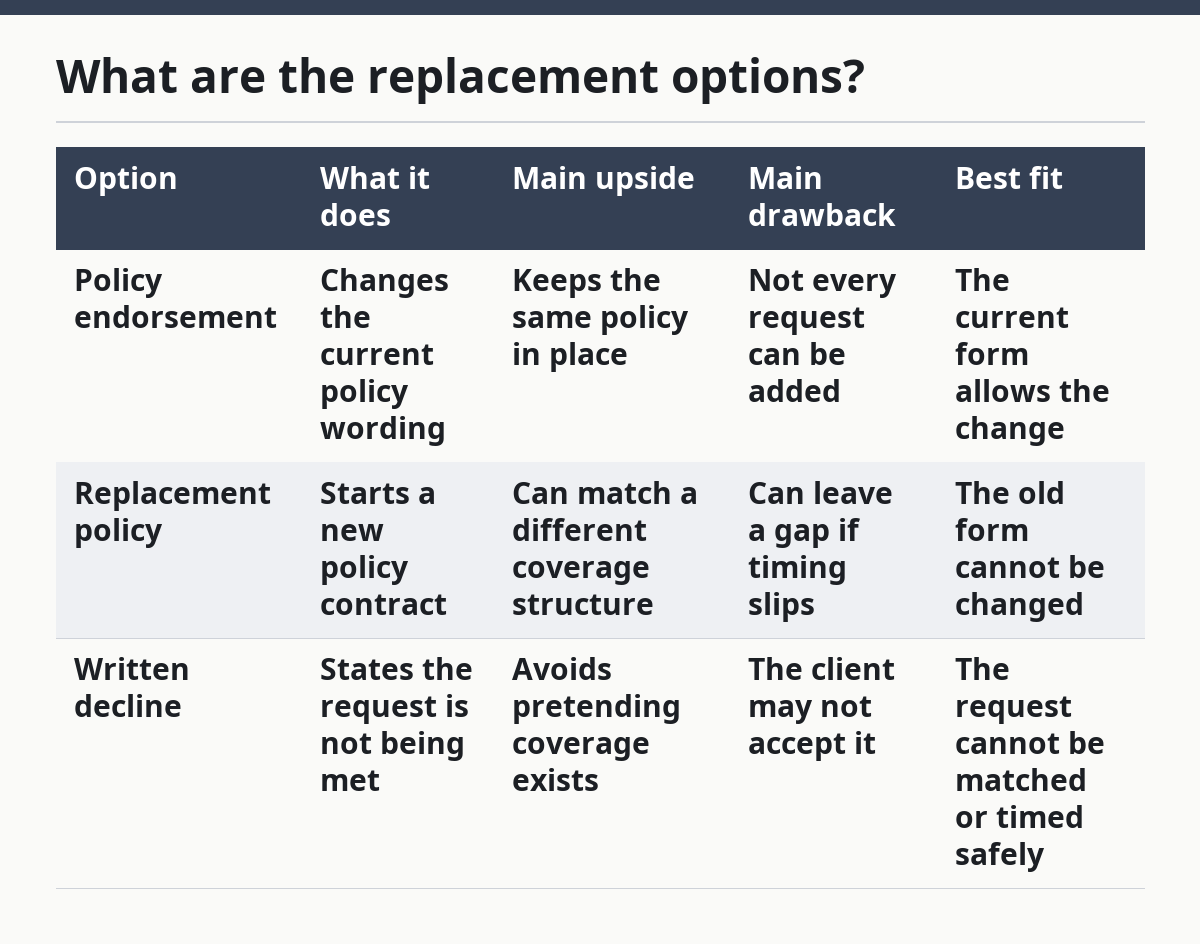
The main replacement options are an endorsement, a new policy, or a written refusal of the requested term. Which one fits depends on the policy form, the renewal date, and whether the client requirement can be matched at all.
| Option | What it does | Main upside | Main drawback | Best fit |
|---|---|---|---|---|
| Policy endorsement | Changes the current policy wording | Keeps the same policy in place | Not every request can be added | The current form allows the change |
| Replacement policy | Starts a new policy contract | Can match a different coverage structure | Can leave a gap if timing slips | The old form cannot be changed |
| Written decline | States the request is not being met | Avoids pretending coverage exists | The client may not accept it | The request cannot be matched or timed safely |
A certificate of insurance can be reissued after a valid change, but it should not be used to suggest a policy change that has not happened. Some requests are policy-fit problems, not form-filling problems.
When should I stop and get help?
You should stop when the request cannot be matched cleanly to the current policy or when the timing could leave you uninsured for the wrong period. On a money issue, guessing is the expensive move.

- The request names a coverage type that is missing from the policy form: This means the policy wording does not currently promise what the client wants — ask a qualified adviser or carrier contact about the real options before replying.
- The client deadline lands before the renewal date and there is no time for review: This means the timing is too tight for a careful change — pause the reply and avoid sending a certificate that overstates coverage.
- The policy period is ending within days: This means a fast fix can create a gap at the boundary — check whether the next term, not the current one, is the right place to solve it.
- The client wants a change that would alter the risk more than the policy allows: This means the request may be outside the carrier’s rules — do not assume an endorsement can do the whole job.
- The certificate of insurance is being used as proof of coverage that is not in the policy: This means the paper trail is drifting away from the real contract — stop and correct the wording before sending anything.
A qualified adviser is the right next step when the request affects money risk, contract rights, or the start and end of a policy period. That is especially true if the client wants same-day proof and the renewal date is close.
What mistakes actually cause trouble?
The most common mistake is answering the client from memory instead of checking the policy wording. That can turn a 10-minute email into a coverage problem that lasts for the whole policy term.
Another mistake is treating the certificate of insurance like the policy itself. The certificate is a snapshot, not the insurance contract, so it cannot fix a missing term. A third mistake is waiting until the last hour before the deadline; that leaves no room to confirm the change or correct the paperwork.
A fourth mistake is saying “yes” because the request sounds standard. Some standard-sounding requests are not standard for your policy form at all. The correct move is to ask for the exact wording, then compare it to the policy.
A fifth mistake is ignoring the renewal date. If the old policy ends and the new one starts without a clean handoff, a gap can open even when everyone meant well. The safer alternative is to line up the dates first, then issue the certificate.
What if the contract timing is tight?
Tight timing means the response has to be about dates as much as coverage. If the client needs proof before a 1-day deadline, the first question is whether the policy can be changed before that deadline without creating a gap.
If the answer is no, the response should say that the request is still under review and that the paperwork cannot confirm the coverage yet. A rushed certificate is worse than a delayed one if it states something the policy does not support.
If help is needed while the timing is tight, a certified enroller or agent may be able to help with health coverage questions in some states. According to Covered California, in-person help is available from a certified enroller or agent near you, in multiple languages, and a free callback from a certified enroller is available within 15 minutes. According to GetCoveredNJ, free local help is also available from a certified assister or agent.
How do I handle the gap without guessing?
You handle the gap by matching the request to what the policy can actually support and by putting the result in writing. If the current policy cannot cover the request, the honest answer is not to force the wording; it is to state the limit, note the timing, and keep the contract from outrunning the insurance.
This is the part most generic advice skips: the problem is often not “Can insurance be found?” but “Can the coverage be changed in time, under this form, for this contract?” That is why the renewal date, the endorsement request, the certificate of insurance, and the policy wording all have to line up.
For readers dealing with freelance client contract insurance requirements, the goal is simple: do not let the client’s paper demand outrun the actual policy. If the gap cannot be closed cleanly, the correct answer is a clear written explanation, not a guess.
What if a client requires coverage I don’t have?
If a client requires coverage you do not have, the first step is to verify whether the request is a true coverage gap or just a wording mismatch. If the policy does not include the needed term, do not say it does. The next step is to ask whether a policy endorsement or replacement policy is even possible before the deadline.
Can I add coverage after a client asks for it?
Yes, sometimes a policy endorsement or other change can be requested after the client asks. The key issue is whether the policy form allows the change and whether the timing works before the contract deadline or renewal date. If the policy cannot be changed cleanly, the request may need to be answered with a written limitation instead.
How do I handle a coverage gap in a contract requirement?
Handle the coverage gap by checking the policy wording, comparing it with the client request, and stating the result plainly. If the gap cannot be closed in time, say so in writing and do not issue a certificate of insurance that implies more than the policy provides. A qualified adviser should review your own situation if money risk or contract timing is unclear.
Drafted with AI; not yet reviewed by a person.
