

Last updated: November 26, 2026
Quick Answer: A freelancer insurance policy setup usually starts with 2 core coverages—professional indemnity and public liability—and then adds cyber, equipment, or income protection when the work requires it. Freelancer insurance policy setup and core coverages work best when they match your real risks to the coverages that respond to them: liability for client claims, cyber if you handle data, equipment cover if your tools are expensive, and income protection if a claim or illness would stop billing. The right setup is not one policy name; it is a small stack of coverages that fits your contracts, your clients, and how you actually earn money. This is information, not financial advice, and a qualified adviser should review your own situation.
Key takeaways
- Your insurance setup should start with the work you do, not the policy names you recognize.
- Client-facing work usually needs liability cover first; data-heavy work raises cyber risk fast.
- The best policy mix can change if you work from home, visit clients, subcontract, or use expensive gear.
- A cheap policy can still fail you if the wording excludes the kind of claim you are most likely to face.
- The point is to cover the loss you could actually suffer, not every risk in the abstract.
What does freelancer insurance actually need to cover?
Freelancer insurance needs to cover the losses that can hit your business when a client, third party, or criminal event causes a bill you cannot absorb. For most solo workers, that starts with liability cover, then branches into property, cyber, professional indemnity, and sometimes income protection depending on the work and the contract.
If your work only involves a laptop and a few invoices, your setup may be light. If you advise clients, handle private data, enter homes, carry gear, or sign contracts with liability clauses, the setup gets more specific. A generic “business insurance” label can hide very different policy wording, so the name matters less than the trigger, exclusions, and limits.
The cleanest way to think about it is this: insurance exists to answer, “What happens if someone says my work caused them a loss?” It also answers, “What happens if my own tools, data, or health take me offline?” That is why the core coverages are usually split across separate policies rather than one catch-all product.
Here is the practical version:
| Situation | Best Path | Why Other Options Fail |
|---|---|---|
| You give advice, design, code, write, or consult | Professional indemnity or errors and omissions cover | General liability usually does not cover bad advice or bad work product |
| You meet clients, visit sites, or have people come to you | Public/general liability cover | Professional cover does not usually pay for slips, trips, or property damage |
| You store customer data or use cloud tools | Cyber cover | Liability cover may not pay breach response, restoration, or ransomware costs |
| You own cameras, laptops, tools, or specialist gear | Equipment or business property cover | Liability policies rarely replace your own damaged gear |
| You rely on weekly client income to pay bills | Income protection or business interruption style cover | Property cover does not replace lost earning time |
| You subcontract work | Check subcontractor wording and contract liability | A standard solo policy may not cover a subcontractor’s mistake |
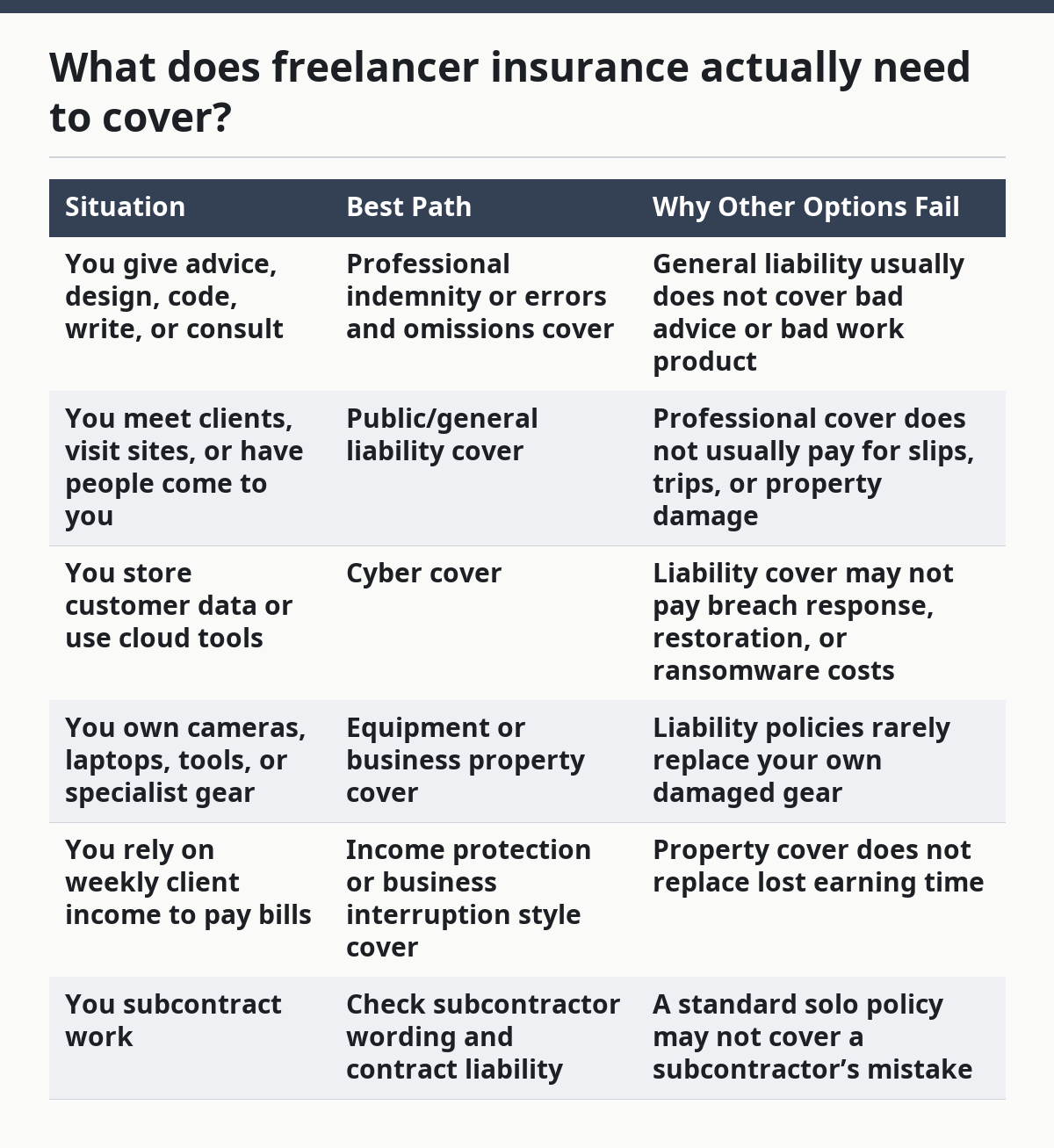
A good setup starts with the client contract, then the work process, then the policy wording. The order matters because many disputes begin with a promise in a contract that the policy never intended to insure. For guidance on financial products and consumer rights, the UK Financial Conduct Authority and the Australian Securities and Investments Commission both publish plain-language insurance guidance; those bodies are useful reference points even when the exact rule set differs by country. FCA insurance guidance and ASIC insurance information are both credible starting points.
Quick check: if you cannot name the three biggest ways your work could cause a claim, your policy setup is probably too vague.
Which core coverages matter most for freelancers?
The core coverages that matter most for freelancers are professional indemnity, public liability, cyber, equipment cover, and income-related protection, but the right order depends on how you earn. If you sell expertise, start with professional indemnity. If you move around the public, start with liability. If your work lives in email, cloud apps, or client databases, cyber rises fast.
Professional indemnity cover responds when a client says your advice, design, report, or service cost them money. Public liability responds when someone is injured or property is damaged because of your work setup or activity. Cyber cover is aimed at privacy breaches, ransomware, fraud, and recovery costs tied to digital systems. Equipment cover protects the tools you own and rely on. Income protection or similar cover can matter when illness or injury stops you from working for a period of time.
The trap is assuming one policy does all of this. It usually does not. A policy built for a photographer, for example, may suit camera gear and public liability but still be weak on design mistakes or data-handling risk. A consultant’s policy may do the opposite.
Use the table below to separate the main coverages:
| Core coverage | What it is for | Common gap to watch |
|---|---|---|
| Professional indemnity | Mistakes in advice, design, strategy, or service | Excludes bodily injury and many contract penalties |
| Public/general liability | Injury to others or damage to someone else’s property | Usually does not cover your bad work or advice |
| Cyber | Data breach response, malware, fraud, recovery work | May exclude poor password habits or old systems if conditions are not met |
| Equipment/business property | Laptops, cameras, tools, and portable gear | Often limited by item type, location, or theft conditions |
| Income protection | Personal income loss after illness or injury | Waiting periods and medical rules can change the benefit outcome |
A useful check is to line up each policy against a real incident, not a policy brochure. Ask: if a client sues because a report was wrong, which policy pays? If a courier trips over your equipment bag, which policy pays? If a hacker locks your cloud files for 48 hours, which policy pays? If you cannot answer that in one sentence per event, the setup is incomplete.
One more thing matters: wording on exclusions. Policies often exclude known issues, intentional acts, fines, and certain contract promises. That means the cheapest option can leave the exact loss you feared most outside the cover. In finance and insurance, the label on the cover is less useful than the trigger language inside it.
Quick check: if your work touches advice, the public, or private data, you likely need more than one core cover.
How do you set up a freelancer insurance policy step by step?
You set up a freelancer insurance policy by mapping your work, checking your contract, choosing the cover triggers, and then matching limits and exclusions to the biggest plausible loss. If you skip that sequence, you can end up with a policy that sounds right and fails at claim time.
Use this 6-step path if you are starting from zero or rebuilding an old policy:
- List your income sources. Write down every service you sell in one line each: consulting, writing, design, coding, photography, tutoring, coaching, editing, or something else. The policy should match the service that creates the claim.
- List who can blame you. Note clients, members of the public, suppliers, hosts, and subcontractors. Each group points to a different kind of loss, such as advice error, injury, property damage, or digital breach.
- Read your contract clauses. Look for indemnity wording, caps on liability, confidentiality promises, data rules, and insurance requirements. If a contract asks for a policy type by name, that clause can shape your setup more than your preference.
- Check the exclusions first. Ignore the polished summary and read the wording that says what is not covered. Pay special attention to professional services, cyber events, subcontractors, deliberate acts, and retroactive dates if they appear.
- Match limits to the loss, not the premium. A lower premium can mean a lower limit, a bigger excess, or narrower wording. None of those is free; they move cost from the insurer to you if a claim lands.
- Store proof and review it when your work changes. Save the schedule, wording, certificates, receipts, and contract copies in one place. Review the policy after a new client type, a new tool, a new country, or a new subcontractor arrangement.
The reason this matters is simple: many freelance claims are not about the day-to-day task, but about the promise attached to it. A writer can face a claim over a missed claim about rights or defamation. A developer can face a claim over downtime or data handling. A photographer can face a claim over equipment damage, access issues, or privacy. The policy setup should track the promise, not the job title.
A good rule is to ask for the policy wording before you need it. That is where the real answer lives. A broker, insurer, or adviser can help interpret it, but the policy document is the source of truth. If you do not understand one clause, treat that as a risk, and consider asking a qualified insurance professional or legal adviser before you sign; the FCA insurance guidance is a useful starting point for consumer reading.
Quick check: if your current setup was chosen because a policy page sounded easy to read, it probably needs a second look.
When is general liability not enough?
General liability is not enough when the claim is about your advice, your finished work, or your digital data rather than a slip, trip, or physical accident. If the loss is financial rather than physical, the answer often moves to professional indemnity, cyber, or both.
This is where freelancers get caught. The words “liability” and “insurance” sound broad, but the policy split is very narrow in practice. Public liability usually handles bodily injury and property damage. It does not normally pay because a client says your strategy failed, your code broke a launch, or your draft missed a critical legal point. Professional indemnity is built for that kind of claim.
If you only move around public spaces or clients rarely ask for advice, general liability may still be central. If you advise, recommend, design, calculate, assess, or produce work that clients rely on, it becomes only one piece of the setup. Cyber adds another layer when email, cloud storage, payment links, or client records are part of the job. According to the National Institute of Standards and Technology, cyber risk management depends on identifying the system, the data, and the impact of failure; that same logic fits freelancer insurance well.
A simple test helps:
- If a person is hurt, think liability.
- If a client loses money because your work was wrong, think professional indemnity.
- If a system, file, or account is breached, think cyber.
- If your own gear is broken or stolen, think equipment cover.
The hidden risk is contract wording. Some contracts try to push unlimited responsibility onto the freelancer. Insurance may not follow that promise if the wording in the policy is narrower than the wording in the contract. That mismatch can turn a small project into a large personal financial problem, so it is worth checking the clause carefully before you sign.
This is also where country matters. Insurance definitions, minimum requirements, compulsory schemes, and contract rules differ by country and change over time. A policy structure that fits one market may not fit another, so local advice matters if you work across borders.
Quick check: if your main risk is a client blaming your work, general liability alone is usually the wrong first answer.
What should freelancers watch for in the fine print?
Freelancers should watch for exclusions, claims-made wording, retroactive dates, excesses, and contract liability limits because those details decide whether the policy pays. A policy can look complete and still miss the exact event you are worried about.
Claims-made wording is a common trap for professional cover. It often means the claim must be made while the policy is active, not just when the mistake happened. That is very different from the way many people expect insurance to work. If you stop the policy and a claim appears later, the timing can matter a lot.
Retroactive dates matter for old work. If the policy starts covering only work done after a certain date, earlier jobs may not be included. That can be a problem for freelancers with long client histories or repeated contracts. Excesses matter too, because a low premium can hide a payment you must make on each claim.
Watch these items before you sign:
| Fine print item | Why it matters | What to ask |
|---|---|---|
| Claims-made basis | Timing can decide whether the claim is covered | When must the claim be made? |
| Retroactive date | Older work may be outside the cover | Does past work count? |
| Contract liability | Some promises are wider than the policy | Which contract clauses are excluded? |
| Excess / deductible | You may pay part of the claim yourself | What is owed per claim? |
| Geographic scope | Cross-border work may fall outside cover | Which countries are included? |
The best habit is to read the schedule and wording side by side, then compare them with your contract. If the contract says you are responsible for something broad, ask whether the policy actually follows that promise. If the answer is unclear, the setup is not finished.
A second habit is to keep evidence of your work process. Version history, email trails, signed briefs, and delivery notes can matter if a claim turns on what was agreed, when it was delivered, and who approved it. Insurance does not replace good records; it works better when they exist.
Quick check: if you have never read the exclusions or the claim timing, you do not yet know what your policy really does.
How do you choose cover if your freelance setup is unusual?
You choose cover for an unusual freelance setup by starting with the one thing that makes your risk different, then adjusting the policy around that feature. If your work is unusual, standard advice can be wrong in the first minute.
- If you work across borders, check territorial limits and local claim rules first. A policy written for one country may not follow you everywhere, even if the client lives elsewhere.
- If you subcontract, confirm whether the policy covers work done by others under your direction. Some policies only respond if the named freelancer personally makes the mistake.
- If you hold client data, place cyber higher on the list and ask about breach response, privacy events, and social engineering. A single stolen inbox can create a large mess.
- If your gear is expensive, check whether the tools are covered away from home, in transit, and after theft. A home policy often does not behave like business equipment cover.
- If you sign tight contracts, check whether liability caps and indemnities are consistent with the policy wording. A contract can expand your exposure faster than the policy expands its cover.
- If you work part time, do not assume your risk is small just because your hours are limited. One mistake on a single project can create a claim that outlives the job itself.
The main trade-off is cost versus specificity. A narrow policy may be cheaper, but a wider set of protections may be needed if your work is unusually exposed. That is especially true for freelancers who split time between advisory work, client visits, and digital delivery. One policy often cannot do all jobs equally well.
A useful example is a designer who also manages client ad accounts. That person may need professional indemnity for creative work, cyber for account access and data, and possibly public liability if they visit offices or events. Another example is a tutor who meets students in homes and may need public liability if lessons happen on site or if students visit the tutor’s space. The right answer depends on the actual risk pattern, not the title on a website profile.
If your setup includes several countries, several subcontractors, or several revenue streams, the policy question gets harder. At that point, the cheapest option is often the weakest guide. A qualified adviser who knows the market can help interpret wording, but the final decision still has to fit your own contract stack and cash flow.
Quick check: if your work has one unusual feature that changes the risk, build the policy around that feature first.
What are the edge cases where normal advice breaks down?
Normal advice breaks down when the risk driver is not the obvious one, and the policy has to answer a more specific question. In those cases, the “standard freelancer package” may be the wrong starting point.
-
Situation: you only do one small project a month.
What changes: a single claim can still be serious because the exposure is tied to the work, not the calendar.
What to do instead: treat the policy as project risk cover, not a volume product, and check whether the contract creates a larger exposure than your billings suggest. -
Situation: you advise clients without producing final deliverables.
What changes: the main exposure is advice error, not physical damage.
What to do instead: focus on professional indemnity wording, especially the definition of “professional services” and the claim trigger. -
Situation: you store private customer details or payment data.
What changes: a data breach can cause notice, recovery, and response costs that are not the same as a normal liability claim.
What to do instead: make cyber cover part of the core setup and check whether it includes breach response and data restoration. -
Situation: your gear is rented, borrowed, or shared.
What changes: equipment cover may not respond the same way it would for owned assets.
What to do instead: confirm whose policy is primary, who owns the item, and whether the loss is theft, damage, or accidental loss. -
Situation: your client contract has broad indemnity language.
What changes: the contract can demand more than the policy will pay.
What to do instead: line up the contract and the policy before signing, and get advice if the wording is not clear. -
Situation: you work through a marketplace or platform.
What changes: the platform’s rules may shape who is liable and what evidence exists if something goes wrong.
What to do instead: save terms, screenshots, and project records, then ask how the platform treats disputes, cancellations, and liability claims.
The pattern in all six cases is the same: the normal label on the insurance is not enough. You need to know what event starts the claim, what wording excludes it, and whether your work structure changes the answer.
Quick check: if one odd feature makes your work unlike most freelancers, stop using generic policy advice as your main guide.
How should you review a policy before buying or renewing?
You should review a policy by comparing the wording to three things: your current work, your last 12 months of projects, and the largest claim you could realistically face. A 20-minute review can reveal more than a polished sales page, especially at renewal time.
Start with your work list from step one and update it. Add new clients, new countries, new tools, and any service that began after the last policy period. Then compare each item to the policy schedule and exclusions. If a service is not named, do not assume it is included.
Next, compare the policy with your contract archive. If three clients asked for insurance proof or specific clauses, those requests are the strongest hint that your exposure is no longer generic. A policy that matched a solo side gig may not fit a full-time freelance business with repeat retainers and custom contracts.
Then ask four direct questions:
- What claim type is this policy built to handle?
- What claim type is it not built to handle?
- What changed in my work since the last renewal?
- What would hurt me most if this policy failed?
Those questions work better than asking whether the policy is “good.” Good is too vague. Fit is the real test.
If you want a neutral framework for understanding insurance duties and complaint routes, the Financial Ombudsman Service in the UK and the Insurance Council of Australia are both useful reference organisations for learning how claims and disputes are handled in broad terms. Their guidance is not a substitute for policy wording, but it helps explain process and consumer rights.
One honest limitation: no article can tell you which exact policy belongs to every freelancer. Country rules vary, contract terms vary, and claims histories vary. That is why the safest setup process is a review process, not a one-time purchase decision.
Quick check: if your renewal review is shorter than your last contract review, it is probably too short.
FAQ
Do freelancers need both public liability and professional indemnity?
Freelancers often need both when they can cause either physical harm or financial loss through their work. Public liability deals with injury and property damage, while professional indemnity is built for advice or work-product mistakes. If your work is purely desk-based with no client visits, public liability may matter less, but that depends on the contract and the work setting.
Is cyber insurance only for tech freelancers?
No, cyber insurance can matter for any freelancer who uses email, cloud storage, client files, online payments, or password-protected accounts. A writer, coach, designer, or accountant can still face a data breach or account compromise. The real question is whether a digital incident would cost time, money, or client trust.
What is the biggest mistake freelancers make with insurance?
The biggest mistake is buying a policy by name and skipping the wording that shows what it actually covers. A policy can look broad while excluding the exact claim you are most likely to face. The second big mistake is forgetting to update the policy when the work changes, especially after a new service, new client type, or new country.
Should a part-time freelancer still bother with insurance?
Yes, part-time work can still create a claim that is bigger than the income from the project. A small side gig can involve the same legal and client exposure as a full-time job. The better question is not how many hours you work, but what kind of loss your work could cause.
What should I check first if I already have a policy?
Check the exclusions, the claim trigger, and the dates first. Those three items decide whether the policy fits your current work and whether an old project might still be inside the cover. If any of those are unclear, the policy should be read again before renewal or before you sign a new contract.
Drafted with AI; not yet reviewed by a person.
