
Last updated: November 19, 2026
Key Takeaways
- Protect your records and coverage window immediately; the demand-letter dispute does not need a full solution tonight.
- The insurer can only act once it has the letter.
- The file matters more than a first draft because the claims representative will read the record later.
- A reply should stay calm, brief, and controlled because others may review every sentence later.
A demand letter means act fast, save everything, and tell your insurance carrier the same day. What to do when a freelancer receives a demand letter is the focus here: this guide shows what to send, what not to say, and how to keep the letter from turning into a bigger mess.
The first 24 hours after the demand letter
Therefore, if you open your inbox and see a formal letter from a client, or from their attorney, asking for payment, fixes, or both, you do not need to solve the whole dispute tonight, but you do need to protect your records and your coverage window right away.
Your first move is notice to the insurer if you carry professional liability insurance, sometimes called errors and omissions coverage. If the letter mentions a deadline, treat that date as real, but check the wording carefully and consult your insurer or a lawyer if you are unsure. A 10-day response window is common in legal letters, but the exact timing in your case may be shorter, so read every line. According to the American Bar Association, deadlines in legal correspondence can carry real consequences, so a lawyer’s guidance is wise when the stakes are unclear.
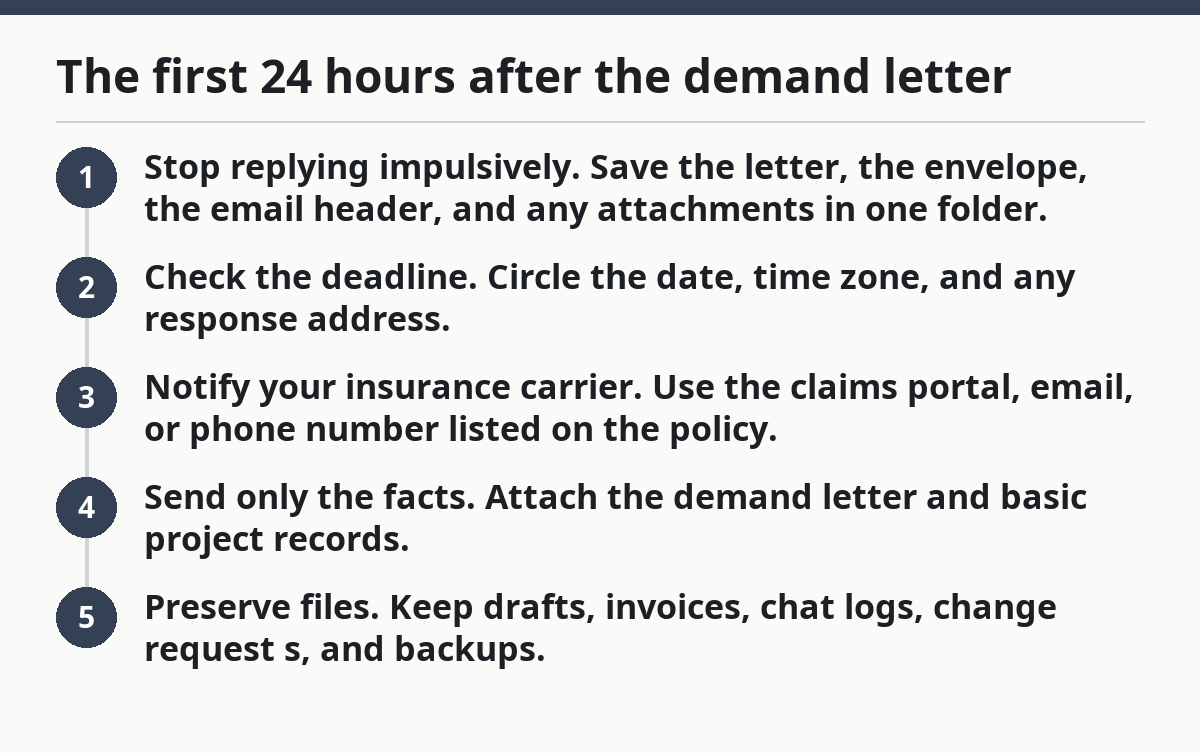
- Stop replying impulsively. Save the letter, the envelope, the email header, and any attachments in one folder.
- Check the deadline. Circle the date, time zone, and any response address.
- Notify your insurance carrier. Use the claims portal, email, or phone number listed on the policy.
- Send only the facts. Attach the demand letter and basic project records.
- Preserve files. Keep drafts, invoices, chat logs, change requests, and backups.
As a result, the outcome you want is simple: a clean paper trail and a live claim file, if your policy applies. No side comments.
Should I forward the demand letter to my insurer?
Yes, you should forward the demand letter to your insurer if the policy might apply, and you should do it before you try to talk your way out of the dispute. The carrier cannot help with a letter it never sees.
Here’s the catch: some policies require prompt notice, and late reporting can complicate coverage. A claims representative may ask for the full letter, the project scope, the contract, and the date you first learned about the issue. That is normal. It is also why a 2-minute phone call and a clean email are better than a 2-hour message chain.
When you notify the insurer, send a short summary:
- who sent the demand letter
- what project it concerns
- the date you received it
- the deadline in the letter
- whether any payment, fix, or refund is being demanded
- whether you have already replied
Keep the summary tight. Do not argue the merits in that first note unless the carrier asks for it. The claims representative wants the documents first, then the story.
If your policy includes a reservation of rights, the carrier may keep reviewing coverage while defending or advising you. That phrase means the insurer has not fully agreed that every part of the matter is covered. It is not a refusal, but it is not a promise either.
What to preserve before you answer
Next, if the client says your work caused a loss, and you can already feel the urge to “just explain it,” do not. The file matters more than your first draft, because the record is what the claims representative will read when the details blur later.
Preserve everything tied to the project, even if it feels small. A single message about a changed deadline can matter more than a polished proposal. Keep the original version and the edited version if you have both. A missing draft can create the wrong impression.
Save these items in at least two places, such as a cloud folder and a local backup:
- the contract or statement of work
- invoices and payment records
- emails, chat logs, and meeting notes
- files showing scope changes or approvals
- screenshots of client instructions
- the demand letter and any reply
Do not edit old files to make them look cleaner. A timestamp from last month is useful. A file “updated” after the dispute starts can raise more questions than it answers. If a platform deletes message history after 30 days, export it now.
Likewise, if a document explains why you did what you did, keep it. If it only makes you look busy, keep it anyway if it records a decision. Busy records are still records.
How to reply without making the dispute worse
After that, if the letter asks for a refund by Friday and you want to fire back line by line, resist the urge. A reply should be calm, short, and controlled, because every sentence may be read by the client, the insurer, and maybe a lawyer later.
Your first reply should usually do three things: acknowledge receipt, confirm you are reviewing the matter, and avoid admitting fault. If your carrier wants you to route all communication through the claims representative, do that. If the letter came from counsel, do not start debating legal theories in email.
Use this as your model:
- “I received your letter on [date].”
- “I’m reviewing the issues and gathering the project records.”
- “I’ll respond through the proper channel once I have confirmed the facts.”
That is enough for an initial response in many situations. It is not a confession, and it is not a fight.
Avoid these mistakes:
- Do not say “I was wrong” unless you have checked the facts and your carrier is aware.
- Do not promise a refund, repair, or redo before the insurer sees the demand.
- Do not delete messages or ask the client to “forget” earlier calls.
- Do not copy a bunch of extra people into the reply just to look formal.
A demand letter is not the time for emotional cleanup. It is the time for control.
Demand letter and insurance carrier: the claim file in plain English
Meanwhile, once you have sent the letter to your insurer, the process can feel vague. That is normal. A claims representative is building a file around three things: what happened, what the policy says, and what records support either side.
The carrier may issue a reservation of rights letter. That document usually means the insurer is preserving its right to deny some or all coverage later, even while it reviews the matter now. Read it carefully. If it asks for information by a certain date, treat that as a hard deadline, not a suggestion, and ask a lawyer or the carrier if the instruction is unclear.
You may be asked for:
- the original contract
- the demand letter
- invoices and proof of payment
- the communication log
- project files and backups
- any steps already taken to fix the problem
Keep your own communication log from this point forward. A basic log with the date, time, person, method, and topic is enough. For example, “2026-11-08, 2:15 p.m., email from client, request for refund update.” That kind of note helps when messages pile up.
This is also where professional liability coverage matters. That policy is designed for claims tied to services, mistakes, missed deadlines, or alleged work errors. It usually is not the right place to store a general business dispute with no service-related issue.
For related guidance, see the internal pages on professional liability insurance, freelance contract basics, and how to document client communication. For the broader risk picture, the hub page on Freelancer Financial Protection sits upstream of this topic and helps place this letter in context. The ABA also explains how lawyers and clients handle written deadlines and disputed claims, which is why outside guidance can matter here.
The mistakes that cost freelancers the most
Because the letter lands on a Tuesday, by Wednesday you may already have sent three emails, posted in a forum, and told the client they “don’t have a case.” That kind of scramble can hurt the defense, the insurance review, or both.
The biggest mistake is talking too much. A casual apology can read like an admission. A half-true explanation can turn into a contradiction later. A deleted message can look worse than the original mistake. The cost is simple: more friction, more delay, and less room for the insurer to help.
A few others show up again and again:
- Ignoring the deadline. Cost: default, escalation, or a missed coverage notice. Fix: calendar every date the same day you receive the letter.
- Calling the client to “clear it up.” Cost: a messy verbal record. Fix: reply in writing and keep it brief.
- Waiting to tell the insurer. Cost: coverage trouble. Fix: forward the demand letter as soon as you can.
- Mixing files. Cost: lost proof. Fix: keep one folder for the dispute and one backup copy.
- Editing old records. Cost: credibility loss. Fix: preserve originals exactly as they are.
This is not the time to be generous with detail. It is the time to be exact. Exact wins more often than clever.
When a demand letter is bigger than a small fix
However, if the demand is for a refund and the letter also mentions missed deadlines, bad data, or client losses, the issue is bigger than a quick payment, and the file may need a stronger insurance response.
If the letter alleges serious financial harm, repeated errors, or a dispute that could turn into a lawsuit, escalate the matter inside your carrier’s process right away. Ask whether a claims representative wants all contact routed through them. If a deadline is 48 hours away and the request is unclear, say so in writing and keep the reply narrow.
This is also the point to reread your contract for notice clauses, dispute steps, and any limitation on what the client can demand. You do not need to become a contract lawyer to spot the basics. Look for the part that says how notice must be given, who receives it, and whether informal fixes count as settlement.
If you are uncertain about exposure under the policy, ask the insurer to explain the next step in writing. That is normal. So is getting a formal position later.
For broader planning on protection, the hub page on Freelancer Financial Protection sits upstream of this topic and helps place this letter in the bigger risk picture.
Is a demand letter the same as a lawsuit?
No, a demand letter is not the same as a lawsuit. A demand letter is a written request to pay, fix, or settle a dispute before court papers are filed. A lawsuit usually starts with formal legal filing and service, which creates a different response clock and a higher-stakes process.
Should I forward a demand letter to my insurer?
Yes, forward it to your insurer if your policy might cover the issue. Send it as soon as you receive it, because notice timing can matter under professional liability coverage. Include the letter, your contract, and the date you first learned about the complaint.
What should I not say after receiving a demand letter?
Do not admit fault, promise payment, or argue in anger. Those three moves create avoidable risk. Keep your reply short, factual, and written, and avoid talking about the matter in casual messages or phone calls unless your claims representative tells you to do so.
Drafted with AI; not yet reviewed by a person.
