
Last updated: November 23, 2026
Freelance insurance buying works best when the path matches the risk. In this complete guide to Freelance Insurance Buying Paths and Channels — The Complete Guide, a freelancer can buy through a direct insurer, an independent agent or broker, a comparison site, or a business platform that bundles coverage; the right channel depends on how complex the work is, how much wording matters, and whether the policy is personal or business-related. This guide is information, not financial advice, and a qualified adviser should be consulted for your own situation.
Key takeaways
- Freelancers usually choose among four buying channels: direct, broker, comparison site, or bundled platform.
- The channel matters because insurance is not just a price tag; wording, exclusions, and add-ons can change the value of the policy.
- A cheap quote is not always the best fit if the policy leaves out the work you actually do.
- A good buying process starts with your risks, then your documents, then the policy wording, not the other way around.
- If your work crosses borders, uses subcontractors, or involves client contracts with insurance clauses, the simple route often stops being enough.
What does a freelance insurance buying path mean?
A freelance insurance buying path means the route you use to find, compare, and place coverage. The path is the process; the channel is the person or platform that carries it, such as a direct insurer, broker, comparison site, or membership marketplace. For a freelancer, that route can shape both the price and the policy wording, so the choice matters as much as the cover itself.
The main reason this topic is confusing is that “insurance” sounds like one product, but freelance cover is usually a mix of different policies. A freelancer may need liability cover, professional indemnity, equipment cover, cyber cover, or health-related cover depending on the country and the work. The channel you use can make those pieces easy to combine or hard to understand.
This guide applies to solo freelancers, side-hustlers, and small one-person businesses who need to compare options before buying. It assumes you already know your line of work and have at least a rough idea of the risks your clients, tools, and contracts create. It does not assume you know insurance jargon such as exclusions, endorsements, or aggregate limits.
It also assumes you are not trying to guess your way through a contract clause. If your client agreement names minimum coverage, a certificate of insurance, or a specific policy form, that is a sign to slow down. When the requirement is written into a contract, the buying path needs to be checked against that contract, not against a marketing page.
For general background on how self-employed coverage and small-business insurance questions are handled, government and standards bodies such as the IRS self-employed tax resources and the National Association of Insurance Commissioners are useful starting points. One useful place to begin is the IRS self-employed individual page at irs.gov/businesses/small-businesses-self-employed, and the NAIC consumer material on naic.org. Those are not substitutes for policy wording, but they help anchor the terms.
Which buying channel fits a freelancer?
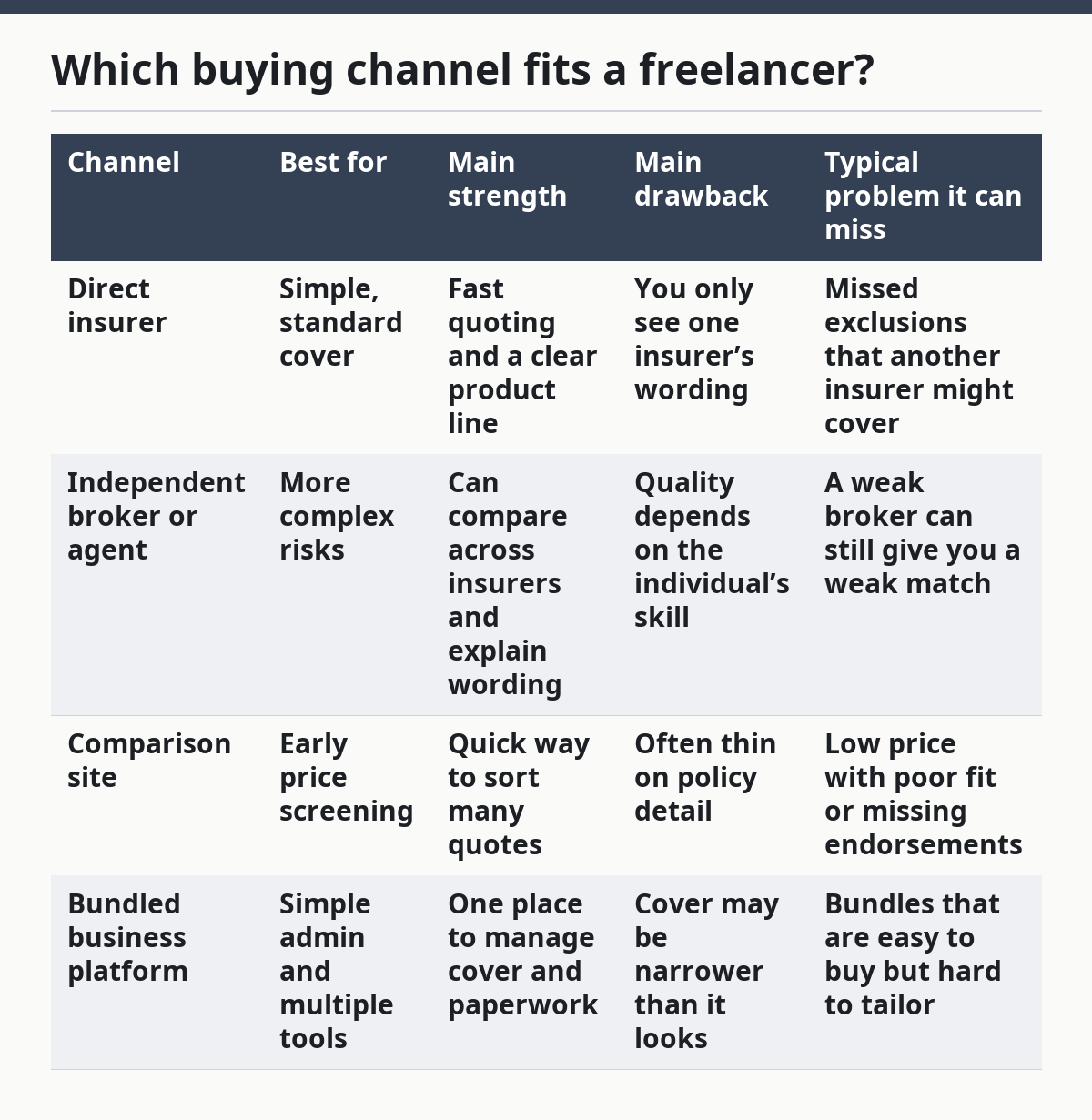
The best channel often depends on how simple or unusual your risk is. A direct insurer works well for straightforward needs, a broker helps when the wording or market is more complex, a comparison site is useful for broad screening, and a bundled platform can be convenient when you want one account and one bill. Each option has a trade-off, and each one is wrong for some freelancers.
| Channel | Best for | Main strength | Main drawback | Typical problem it can miss |
|---|---|---|---|---|
| Direct insurer | Simple, standard cover | Fast quoting and a clear product line | You only see one insurer’s wording | Missed exclusions that another insurer might cover |
| Independent broker or agent | More complex risks | Can compare across insurers and explain wording | Quality depends on the individual’s skill | A weak broker can still give you a weak match |
| Comparison site | Early price screening | Quick way to sort many quotes | Often thin on policy detail | Low price with poor fit or missing endorsements |
| Bundled business platform | Simple admin and multiple tools | One place to manage cover and paperwork | Cover may be narrower than it looks | Bundles that are easy to buy but hard to tailor |
A direct insurer is a good fit when the work is standard and the policy line is built for it. That can mean a freelance designer, tutor, writer, or consultant buying a product that is meant for solo service work. The risk is that the quote may look neat while hiding a wording gap, especially if your work is international, technical, or contract-heavy.
An independent broker or agent is often better when the policy needs to handle edge cases. That includes subcontractors, client data, work on site, or professional advice that can trigger a claim if a mistake causes a loss. The downside is simple: the broker’s value depends on whether they understand your work and whether they actually compare more than one market.
A comparison site helps when the first task is to sort the field. It can show a few prices and basic features in minutes, which is useful if you are trying to understand the market before you speak to anyone. The weak point is that many comparison pages compress the policy into a short summary, and a 30-second summary can hide a lot.
A bundled platform is attractive when you want fewer logins, fewer renewal dates, and less admin. It may combine invoicing, payments, and cover in the same account. The trade-off is that convenience can mask a narrower policy, especially when the bundle is designed for speed rather than for unusual contracts.
The wrong channel is usually the one that hides the detail you need. If you need proof of cover for a client contract, a low-friction buying flow may not be enough. If your work is simple and your risk is ordinary, a broker can be more help than you need and may slow down a decision that should stay simple.
How do you choose a path step by step?
You choose a path by matching your risk, your documents, and your tolerance for policy reading to the channel that handles them best. The useful order is to define the risk, verify the wording, and then compare the channels. That order keeps you from buying the wrong product just because the monthly price looked tidy.
- Write down the exact work you do. List the services, not the job title, in 3 to 5 plain phrases, such as copywriting, app consulting, photography, or course creation. Verify that each phrase matches how a client would describe your work, because that wording usually appears in policy questions. A problem sign is a quote form that does not recognize the service or pushes you into “other” too early.
- List the loss that could trigger a claim. Separate client injury, property damage, advice error, data breach, and lost equipment into different lines. Verify that you are not mixing liability with equipment cover, because they are not the same thing. A problem sign is assuming one policy will cover every loss from a single incident.
- Collect the documents that control the choice. Gather the client contract, platform terms, subcontractor agreements, and any certificate wording you have been asked to provide. Verify whether the contract names a limit, a deductible, or a policy type, because the requirement may be more specific than the sales page. A problem sign is buying before reading the contract language that makes the cover necessary.
- Choose the first channel that can answer the hardest question. If your hardest question is wording, start with a broker. If it is basic price discovery, start with a comparison site or direct insurer. Verify that the channel can explain exclusions in writing, not only on a call. A problem sign is a channel that can quote but cannot explain what the policy excludes.
- Compare at least 3 quotes or product sheets. Use the same assumptions for each quote: same work type, same limit, same deductible, and same territorial scope. Verify that you are comparing like with like, not a broad policy against a stripped-down one. A problem sign is a quote that looks cheaper only because it removed coverage you actually need.
- Read the exclusion section first. Look for named exclusions, subcontractor exclusions, cyber exclusions, and territorial limits before you look at the premium. Verify whether the exclusion applies to the whole policy or only to one part of it. A problem sign is a policy that looks cheap but excludes the very event you are trying to insure.
- Check how claims are reported. Some policies are claims-made, which means the claim must be made during the policy period or extended reporting period; others are occurrence-based, which focuses on when the event happened. Verify which one you have, because timing changes everything after a renewal or cancellation. A problem sign is not knowing whether a past job can still be covered after the policy ends.
- Confirm the paperwork before you pay. Ask for the full wording, declaration page, and any endorsement pages in one file. Verify that the named insured, address, business name, and effective date are correct. A problem sign is a mismatch between the application and the document that arrives after payment.
This process sounds slow, but it is faster than fixing a bad fit later. A 15-minute quote can hide a 15-page wording problem. The main job is to stop the buying path from becoming a price-only decision.
What should you check before you compare quotes?
You should check the policy form, not just the premium, before comparing quotes. The premium is the visible number; the form is the legal container that defines what the insurer owes, what it excludes, and when a claim counts. A freelancer who skips the form is not really comparing insurance, only comparing prices.
The first thing to verify is the limit structure. A policy may use one limit for each claim, a total annual limit, or both, and those terms matter when more than one claim appears in the same period. If the wording says “aggregate,” that means the total can be used up across multiple claims, which is very different from a single-event limit. If the policy has a deductible, check whether it applies per claim or per incident.
The second thing is the territory and jurisdiction. A freelancer who works from one country but serves clients in another may need cover that follows the work, the claim, or both. Some policies only respond to work done in a named country, while others extend to a wider region with conditions. That detail is not cosmetic; it can decide whether the policy answers at all.
The third thing is who is insured. A freelancer who uses subcontractors, part-time help, or a business entity should check whether the policy covers only the named person or also the trading name, the company, and any temporary helpers. A mismatch here can turn a paid policy into the wrong policy. If a client contract demands a certificate of insurance, the certificate should match the legal entity and the covered activity.
The fourth thing is the scope of the work description. A designer who only makes static graphics is not the same risk as one who also handles ad campaigns, websites, or source files with client data. A consultant who gives advice is not the same as one who only provides implementation. The job title can stay the same while the risk changes completely.
The fifth thing is the claims rule. Claims-made forms often need continuity, meaning the cover has to stay in force or be replaced without a gap if you want protection for older work. That is why the renewal date matters as much as the monthly or annual price. If the policy ends and the new one starts later, the gap can matter more than the rate.
The final thing is whether the sales channel can produce the wording you need before purchase. Some direct sites show only a summary, and some comparison pages hide the fine print behind a quote button. If the channel will not show the full wording early, that can be a warning sign; consult a professional if you are unsure, and check whether the channel can provide the full policy form before you pay. The policy may still be fine, but the process is not transparent enough for a money decision.
For U.S. freelancers, small-business guidance from the SBA and self-employment resources from the IRS can help clarify the difference between business structure and personal tax issues, but they do not replace policy terms. In the UK and many other countries, similar guidance may come from the local financial regulator or trade association. The rule is the same everywhere: the channel is only as useful as the wording it can show you.
When should you stop and ask for help?
You should stop and get qualified help when the policy question stops being standard. Insurance is not a place to force a simple path through a complex risk, because the wrong shortcut can leave a gap that only appears after a claim. The moment the work, contract, or entity structure changes the meaning of the policy, the buying path needs a second set of eyes.
You have a contract that names a specific policy form: that means the client cares about wording, not just cover type — ask a broker, specialist agent, or qualified adviser to check the clause before you buy.
Your work crosses borders or uses clients in multiple countries: that means territorial scope and jurisdiction can change the response — get help before relying on a policy summary.
You hire subcontractors or temporary help: that means the “who is insured” question gets harder — verify the policy’s treatment of subcontracted work and whether additional insured wording is needed, and consult a qualified adviser if the wording is unclear.
You handle client data, payments, or files with personal information: that means cyber and privacy exposure may sit beside liability cover — check the policy wording rather than assuming the base policy is enough.
You have a prior claim, a pending dispute, or a gap in prior coverage: that means timing matters more than price — ask for a review of continuity, retroactive dates, and any exclusion tied to known events.
Your business is changing structure within 12 months: that means the named insured, trading name, or legal entity may not stay the same — confirm how the policy handles a move from sole trader to company, or a similar change in your country.
These are not signs of failure. They are signs that the standard path is too small for the job. A simple online quote can still be part of the process, but it should not be the whole process when the risk has teeth.
What mistakes do freelancers make most often?
Freelancers usually make the same five mistakes, and each one has a predictable cost. The pattern is less about bad intentions and more about speed: the client gets a quote, sees a price, and stops before reading the consequences. The right correction is to slow down long enough to compare the policy form, not only the cost.
First, many clients compare premium before comparing exclusions. That can lead to a policy that looks affordable but leaves out the very work that creates the risk. The correct alternative is to read the named exclusions first, then compare prices only among policies that still fit the work.
Second, many clients assume the same insurance label means the same protection. “Liability” can mean different things depending on whether the policy is general liability, professional indemnity, public liability, or a business package. The cost of this mistake is a false sense of coverage. The correct alternative is to match the label to the loss you are trying to cover.
Third, many clients forget that a claims-made policy needs continuity. They may cancel, switch, or let coverage lapse and then assume older work is still protected. The consequence can be a gap when a late claim appears. The correct alternative is to check renewal timing, retroactive dates, and whether an extended reporting option exists if the policy ends.
Fourth, many clients ignore the contract and trust the sales page. That can cause a mismatch between what the client asked for and what the policy actually provides. The correct alternative is to read the client requirement before choosing the channel, especially if the contract asks for a certificate, a named limit, or a specific endorsement.
Fifth, many clients choose a channel that cannot explain the fine print. A fast comparison tool is useful at the start, but it can become a trap if it is treated like the final answer. The consequence is a polished quote with no real understanding of the wording. The correct alternative is to use the channel for what it does well and not ask it to do what it cannot.
Sixth, many clients forget to update the policy when the business changes. New services, higher turnover, new jurisdictions, or subcontractors can change the risk within a year. The cost can be an underwritten mismatch at renewal. The correct alternative is to review the policy at each renewal and after any major change, not only when a claim happens.
A freelancer who avoids these mistakes does not need to know every insurance term. They only need to know where the policy can fail, because that is where the money and the claim live.
What if your freelance setup is unusual?
Unusual freelance setups need a modified buying path because the standard quote flow often assumes a simple solo service business. The more your work departs from that model, the more likely it is that a one-page quote summary will miss a useful restriction. This is where the buying channel matters as much as the policy.
If you work through an agency or platform, check who the contract says is responsible for insurance. Some platforms offer cover, some require you to carry your own, and some only provide a narrow layer that does not replace a business policy. The fact that a platform mentions cover does not mean it covers your exact work. The details matter more than the badge.
If you work part time, with seasonal gaps, or from multiple business names, verify whether the policy can follow the actual trading pattern. A policy bought for one brand may not fit another brand if the legal entity is different. That becomes especially important when the policy is tied to a named insured rather than to a broad group of activities.
If you need to show proof quickly to a client, ask how certificates are issued before you buy. Some channels can produce documentation in minutes, while others need manual processing. A quick certificate request is not the same thing as a policy fit, but if the document is needed for onboarding, the channel’s document speed is part of the buying decision.
If you do advisory work, build software, or handle media that can trigger delayed claims, the claims-made question is not optional. These work types can produce disputes long after the invoice is paid. A policy that looks cheap today can be expensive later if it cannot handle late notice or prior acts. The right modification is to ask specifically about those two items before you compare anything else.
If you operate across country lines, do not assume that a policy sold in one market works unchanged in another. Rules, contract norms, and policy forms differ by country and change often. That is one reason this guide stays with the mechanism rather than universal limits. A local adviser or broker can help interpret the rule set where you work.
How long does the process take, and what does a good result look like?
The process can take a short phone call or several days, depending on how complex the work and wording are. A simple purchase may be quick, but the useful measure is not speed; it is whether the policy matches the work, the contract, and the claim timing. A good result is one where the policy can be explained in plain words without hand-waving.
A good result starts with a clear policy fit. The work description matches the services you actually sell, the territory matches the places you work, and the limit structure matches the size of the exposure. If the policy is only good on paper, the buying path has failed. A useful policy is one you can describe to a client, an accountant, or a broker without changing the story.
A good result also includes clean paperwork. The declaration page, full wording, and endorsements should agree on the named insured, effective date, and any special conditions. If the quote says one thing and the document says another, the process is not finished. This is especially important when a certificate is needed for a client contract or marketplace approval.
A good result leaves you knowing what is not covered. That sounds negative, but it is the real test of a serious buying path. A freelancer who can name the exclusions, the deductible, and the claim-reporting rule has a better handle on the policy than someone who only remembers the premium. Insurance works best when the client knows where the edge is.
A poor result looks different. The quote is cheap, the summary is short, the wording is unread, and the client cannot say whether the policy is claims-made or occurrence-based. That setup often feels fast at the point of sale and expensive later. The path was chosen for convenience, not for fit.
The best channel is not always the fastest, and the best policy is not always the one with the lowest premium. For freelancers, the real goal is a buying path that makes the policy match the work without making the decision impossible to understand. That is the point where price, wording, and paperwork all line up.
What is the best route for most freelancers?
The best route for most freelancers is to start broad, then narrow to the channel that can explain the wording. A comparison site or direct insurer can help with early screening, but a broker or specialist agent is often the better final step when the work is complex, contract-driven, or international. The wrong route is the one that hides exclusions until after payment.
For a straightforward solo service business, a direct insurer may be enough if the product is clear and the wording is easy to read. For work with client contracts, multiple markets, or subcontractors, an independent broker or agent usually offers more useful interpretation. The channel should fit the risk, not the other way around.
The safest decision rule is simple: use the channel that can show the actual policy wording early, explain the exclusions clearly, and match the legal entity on the paperwork. If any of those pieces is missing, the route is not finished. That is true whether the quote takes 10 minutes or 10 days.
What questions do freelancers ask most often?
Do I need to buy from a broker or can I use a direct insurer?
A direct insurer can be enough when the work is standard and the policy form is easy to read. A broker becomes more useful when the work, contract, or jurisdiction adds complexity. The test is not the channel itself; it is whether the channel can explain the exclusions and paperwork clearly.
Is the cheapest quote usually the best choice?
No, because the cheapest quote can be cheap for a reason that matters, such as a narrower scope, a higher deductible, or a key exclusion. A low premium only helps if the policy still matches the work and the contract. Compare wording first, then compare price.
What if a client asks for a certificate before I buy?
That means the paperwork requirement is part of the buying decision, not a separate admin task. The channel needs to be able to issue a certificate that matches the legal entity and the covered activity. If that cannot be confirmed before purchase, the process needs more checking.
How do I know if a policy is claims-made?
The wording usually says so directly, and the declaration page or policy form often shows the claim-reporting rule. A claims-made policy depends on when the claim is made, not only when the work happened. If the language is unclear, ask for the full form before paying.
What should I do if my freelance work changes during the year?
Review the policy at renewal and after any major change in services, territory, or business structure. New work can change the risk faster than the policy updates itself. If the change is large, the buying path may need a new quote rather than a simple renewal.
Drafted with AI; not yet reviewed by a person.
