
Last updated: November 23, 2026
Quick answer: for most freelance claims, incidents, and documentation issues, create a one-folder file the same day and make the first facts note in about 10 minutes. In Freelance Claims, Incidents, and Documentation — The Complete Guide, the safest approach is to document the incident the same day, keep one clean file, and send the insurer only facts, dates, names, and copies of records. That is the core of this guide: the claim is easier to defend when the paper trail starts at hour zero, not after memories blur.
Key takeaways
- Write down the first version of events as soon as possible, before messages get deleted or details drift.
- Keep one incident file with the contract, emails, screenshots, invoices, and any notice from the client or insurer.
- Separate facts from guesses. A short timeline beats a long story with shaky details.
- A full record helps with both client disputes and insurance claims, especially when deadlines are tight.
- If the incident involves injury, data loss, or a legal threat, treat it as urgent and contact the insurer or a qualified professional quickly; see your policy wording and a licensed professional’s advice as appropriate.
What counts as a freelance claim or incident?

A freelance claim or incident is any event in Freelance Claims, Incidents, and Documentation — The Complete Guide that could lead to money being demanded, a complaint being filed, or an insurer being asked to step in. That can include missed deadlines, alleged errors in work, accidental damage at a client site, a data breach, copyright claims, or a dispute over payment or scope.
The important point is that not every incident starts as a formal claim. A vague email from a client saying “we need to discuss losses” can become a claim later, and the first 24 hours matter because that is when records are easiest to preserve. A clean timeline helps show what happened, when it happened, and who knew what.
Freelancers often assume only big mistakes need documentation. That is wrong. Small incidents turn into larger disputes when there is no written record of the scope, approval, revision rounds, or handoff date. A late invoice, a missing file, or a changed brief can all become part of a claims file if the client says the work caused a loss.
A good rule is simple: if the event could lead to a refund request, a liability question, or a coverage question under a freelancer liability policy, treat it as an incident; if you are unsure, consult your insurer, lawyer, or other qualified professional and check the policy wording. If it creates a record in email, chat, project software, or insurance mail, keep it. If it happened in a meeting, write it down the same day while the exact words are still fresh.
For a plain-English view of recordkeeping expectations, the IRS keeps a long-running recordkeeping guide in Publication 583, “Starting a Business and Keeping Records,” and the FTC’s IdentityTheft.gov explains what to preserve after fraud or identity misuse. Those are not freelance claims guides, but they show the same principle: the record matters more than memory.
What should be written down first?
The first record should be a short, dated facts note with names, times, the project name, the exact issue, and the next step. That note is the backbone of the whole claim file, because it locks in the first version before anyone starts rewriting the story.
A useful first note includes:
- the date and time the problem was noticed
- the project or client name
- what happened in one plain sentence
- who reported it
- what evidence already exists
- what the freelancer did next
Do not write guesses into this note. “The client probably misunderstood” is not a fact. “Client emailed at 3:10 p.m. saying the draft missed the brand guidelines” is a fact. That difference matters when an insurer, mediator, or client reviews the file later.
If the incident involves a physical event, add the location, the people present, and any obvious damage. If it involves digital work, add file names, version numbers, screenshots, timestamps, and the system or platform used. If it involves payment, include the invoice number, the amount billed, and the date the invoice was sent.
One mistake to avoid is mixing the incident note with a defense memo. A freelancer can write both, but they should be separate. The incident note is for facts. The defense memo is for analysis. Keeping them apart helps prevent confusion if the file is later shared with an insurer or adviser.
A second mistake is waiting for a “better” version. There may never be one. A rough note made in 10 minutes on the same day is usually more useful than a polished summary written a week later from memory. Claims adjusters and lawyers care about timing, not style.
How do you build an incident file?
An incident file is a single folder that holds every record tied to one event, from the contract to the final resolution. The goal is not volume for its own sake; the goal is a file that another person can read in 5 minutes and understand what happened.
Use one folder name that is obvious and dated, such as “ClientName_ProjectName_Incident_2026-03-14.” Keep the same structure for every claim so nothing gets lost in random desktop folders. The folder should hold:
- the contract or statement of work
- the original brief
- all change requests
- emails and chat exports
- drafts, versions, screenshots, and file metadata
- invoices and payment records
- the incident note
- the client’s complaint or demand
- any insurer notice or claim form
- the resolution record
Here is the part many generic guides skip: the absence of a document can matter as much as the document itself. If the contract does not mention a deliverable, that omission may explain the dispute. If the client approved a draft in writing, that approval is gold. If a claim is about delayed work, the file should show the dates of submission, feedback, and resubmission.
A good incident file also keeps the evidence in order. Put the earliest record first, then the next event, then the latest. Do not bury the lead in a mass of attachments. A clean chronology turns a messy file into a usable one.
Cloud storage is helpful, but only if the file is organized before trouble starts. If the incident hits first and the records are scattered across three inboxes and two chat apps, the first job is to gather and label the evidence. The second job is to back it up. The order matters because deleted messages and overwritten files are common failure points.
For a freelancer, an incident file is not paperwork for its own sake. It is the difference between “I think this is what happened” and “Here is the record.”
Quick note or full incident file?
A full incident file wins for almost every claim because it holds the contract, the timeline, the communication trail, and the outcome in one place. A quick note is only enough for very small, low-risk issues that are already resolved and unlikely to resurface.
| Criteria | Quick note | Full incident file | Winner for this condition |
|---|---|---|---|
| Time to create | Fast, often under 10 minutes | Slower, because it gathers several records | Quick note for harmless admin issues |
| Usefulness in a dispute | Weak if the other side pushes back | Strong because it shows dates and proof | Full incident file |
| Help for an insurer | Limited, because it may miss attachments | Better, because it gives a clean claim packet | Full incident file |
| Risk of missing key facts | Higher if written in a hurry | Lower if built from source records | Full incident file |
| Best for a small invoice typo | Good enough | More than needed | Quick note |
| Best for deadline, scope, or damage claims | Not enough | Usually the right choice | Full incident file |
| Ease of sharing | Simple but thin | More work, but clearer | Full incident file |
| Long-term storage | Easy to forget or lose | Easier to keep and reuse | Full incident file |
| Best when the issue is already closed | Fine for a record | Helpful but may be overkill | Quick note |
| Best when liability is possible | Weak | Much stronger | Full incident file |
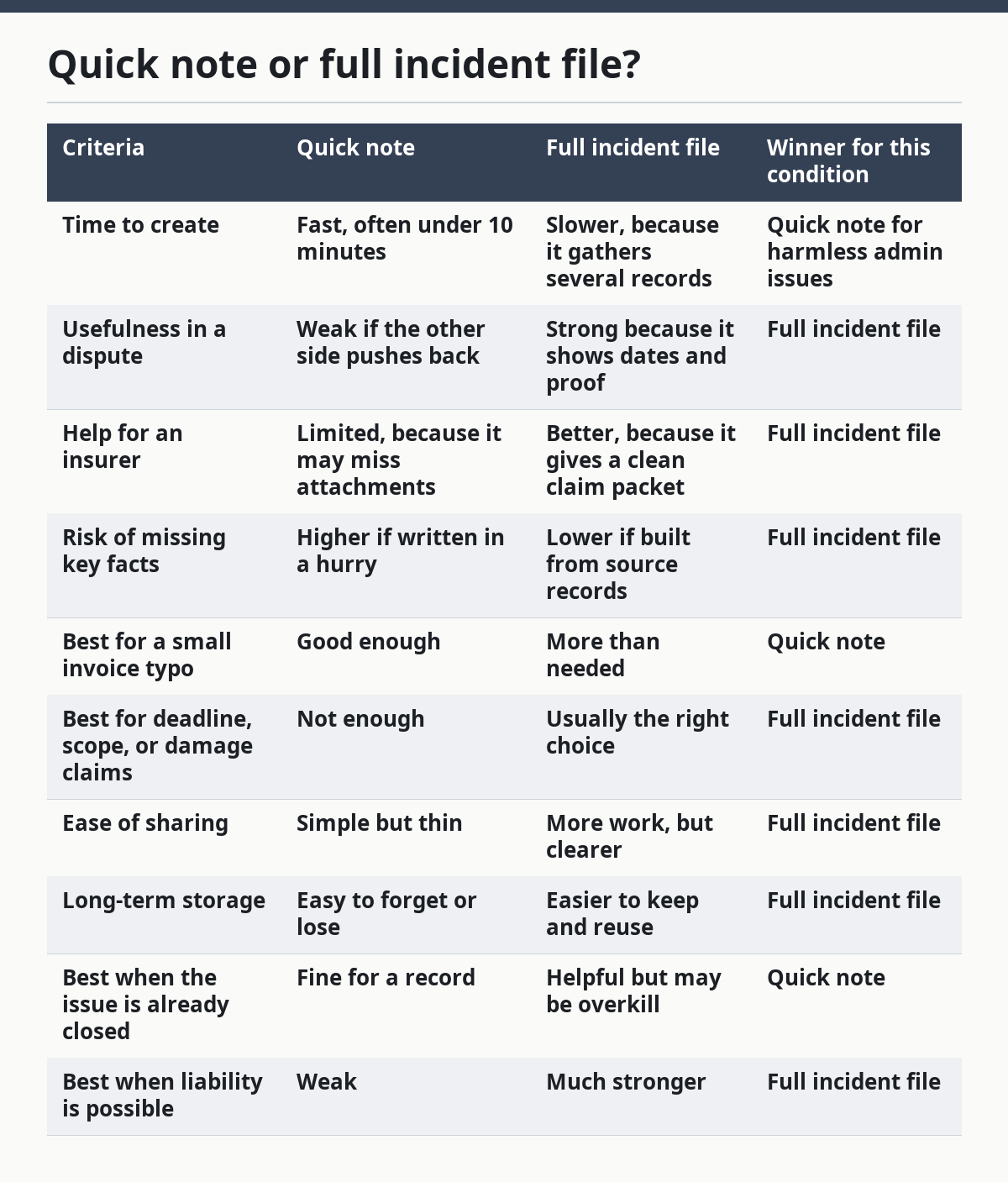
The recommendation is plain: use the quick note only for tiny issues that end in the same day and never threaten payment, scope, or liability. Use the full incident file when the client is unhappy, the work may be blamed for a loss, or the insurer may need to review the record later.
The drawback of the full file is time. It can feel heavy when the issue seems small. That is the cost of being ready for the second email, the surprise chargeback, or the claim that appears 3 weeks later. Small trouble is often where freelancers get sloppy, and sloppy records are expensive.
What changes if a client is involved?
A client changes the file because the client’s words, approvals, and deadlines become part of the evidence. Once the other side is involved, the record is no longer private notes; it is a dispute file.
The first move is to preserve the full communication chain. Save email threads, chat logs, meeting notes, and any file comments tied to the project. If the client gave a verbal approval in a call, write down the date, time, and exact point approved as soon as the call ends. A 2-line note made the same day is much better than a vague memory 2 weeks later.
The second move is to avoid editing the story after the fact. If the client says one thing and the freelancer remembers another, the file should show both versions separately. Do not rewrite old notes to match the new story. If the file is ever questioned, altered records become a problem on their own.
The third move is to keep the tone calm and factual. Angry messages can make a claim file harder to read and easier to misread. A clean claim packet usually includes plain language: what was delivered, what changed, what was approved, what failed, and what was asked for next.
Client issues also create a common trap: over-sharing. A freelancer may send too much commentary, too many apologies, or long explanations that do not help the record. If the issue might become a claim, the safer route is short, factual, and consistent. That does not mean rude. It means disciplined.
The file should also note whether the client raised the issue before or after payment. That detail often changes the pressure level, the document trail, and the chance that the matter turns into a formal demand. If the client has already withheld payment, the invoice record becomes part of the same file.
When should you file the claim?
A claim should be filed as soon as the policy or client process says the incident may lead to a covered loss, a demand, or a dispute that the insurer needs to know about. Waiting for the final amount to appear can make the record weaker and may create coverage problems if the policy requires prompt notice.
The safe habit is to read the notice requirement before a problem happens. Many liability policies and contracts care about when the issue was first discovered, when the claim was first made, and when notice was sent. Those dates are not trivia; they can decide whether the matter gets reviewed at all.
If the event involves bodily injury, property damage, a serious data loss, or a direct legal threat, treat it as urgent and, if needed, consult your insurer and a qualified professional right away. Document the facts, preserve the evidence, and send notice through the proper channel quickly. If the matter is unclear, the safer step is to ask the insurer in writing what they want and keep that exchange in the file; see your policy wording and professional guidance as needed.
A common mistake is trying to “fix it first” and report later. That can work for small service issues, but it is risky when a policy may require earlier notice. Another mistake is filing a claim without the basic records attached. A bare-bones notice can start the process, but a claim packet with the contract, timeline, and client messages is much easier to review.
The good news is that a claim does not need to be dramatic to deserve documentation. A freelancer can have a claim-worthy incident even when no one is shouting. A missed milestone, a bad file upload, or a client complaint can be enough if the loss is real and the policy terms are triggered. The paperwork should match the risk, not the noise.
What does a strong claim packet look like?
A strong claim packet gives the reader a straight line from the contract to the incident to the outcome. It should answer five questions fast: what was promised, what happened, when it happened, who knew, and what proof exists.
A clear packet usually includes:
- the signed contract or statement of work
- the original scope and any amendments
- the incident note with date and time
- emails, chat logs, and meeting notes
- the relevant file versions or screenshots
- invoices, payment records, and refund requests
- the client’s complaint or demand
- any response sent by the freelancer
- the final resolution or pending next step
The packet should not be bloated with duplicate files. Three copies of the same email do not help. One readable thread does. A lot of freelancers think more attachments equal more proof, but a messy packet can bury the useful parts.
A strong packet also makes the sequence easy to follow. If the client approved a draft on Monday, changed the brief on Wednesday, and complained on Friday, that order needs to be obvious. Chronology is not decoration. It is the logic of the claim.
This is where standardized file naming helps. A label like “2026-04-02_ClientEmail_Approval.pdf” is far better than “final_final2_reallyfinal.pdf.” A poor filename can waste time and create confusion when the packet is shared with an insurer or adviser.
If the claim is complex, add a one-page cover note that lists the key dates in order. Keep it factual. The cover note should not argue the whole case. It should help the reviewer get to the right documents faster.
For recordkeeping standards, the broad lesson from the IRS and the FTC is the same: the cleaner the file, the easier it is to prove the story later. That principle matters even more when money, liability, or deadlines are on the line.
What should a freelancer never leave out?
A freelancer should never leave out the first notice, the exact dates, and the original scope, because those three items anchor almost every claim. If those are missing, the rest of the file loses weight.
The first notice shows when the issue began. The exact dates show whether the timeline fits the contract and the policy. The original scope shows whether the complaint is really about a mistake or about a changing brief. Without these, the file becomes a pile of clues instead of a record.
Another item that often goes missing is the client’s own language. If the client says “urgent,” “incorrect,” “not usable,” or “we need a refund,” that wording belongs in the file. It may sound harsh, but exact wording is useful because it shows the nature of the complaint without guesswork.
Freelancers also forget to save versions. A design draft, copy draft, code commit, or spreadsheet snapshot can prove what was delivered on a specific date. If the final file changed after the complaint, the earlier version may be the one that matters most.
One more omission is the resolution. Many people save the problem and forget the ending. If the issue was fixed, paid, refunded, or closed without payment, record that outcome. A closed incident file is often useful later when a similar issue appears.
The best habit is to save any document that could change the meaning of the dispute. If a message could prove notice, approval, delay, rejection, or settlement, save it. If a file might be overwritten, copy it now.
What are the exception scenarios?
The overall rule flips in a few cases, and those are the situations where a smaller file or a faster escalation makes more sense. These exceptions are rare, but they matter because a wrong move here can cost more than ordinary admin mistakes.
First, if the incident is purely clerical and fully fixed within the day, a short note may be enough. A typo on an invoice that is corrected before payment and never questioned again usually does not need a large claim packet. Even then, keep the corrected invoice and a one-line note.
Second, if there is a legal threat, suspected fraud, or possible injury, the file should move faster than the normal project record. Do not wait for a perfect timeline. Preserve the evidence, send notice, and get the right professional help if needed. A delay of even a few days can make the record harder to defend.
Third, if the client has already accepted the work in writing and the complaint arrives much later, the acceptance record can matter more than the incident summary. In that case, the approval email or sign-off note becomes the center of the file, and the rest of the evidence serves that point.
Fourth, if the claim is clearly outside the policy or contract, the incident file still matters, but the main goal changes from coverage to proof. The record may be needed for negotiation, payment defense, or a future dispute. A file can be useful even when it does not lead to insurance recovery.
The rule of thumb is blunt: the more serious the incident, the less you should improvise. Minor admin issues can live in a short note. Anything that could affect money, liability, or notice should get the full file.
What is the best way to handle freelance claims and incidents?
The best way to handle freelance claims and incidents is to treat every serious issue as a documentation problem first and a negotiation problem second. A good record does not solve the dispute by itself, but it gives the freelancer something solid to stand on.
Choose a full incident file if the matter touches scope, deadline, damage, payment, data, or insurance notice. Choose a short note only if the issue is tiny, corrected, and unlikely to resurface. Do not guess your way through a claim. Use the contract, the timestamps, the messages, and the file versions.
The downside of careful documentation is time. It takes discipline to save every relevant record while the workday is already full. The upside is bigger: fewer missing facts, fewer contradictions, and a much better chance that the file makes sense to a client, an insurer, or a reviewer later.
The wrong approach is to wait until the dispute gets loud. By then, the best evidence may be gone, the timeline may be fuzzy, and the story may already be hardened into positions. A claim file built on the same day is usually stronger than one patched together after a week of back-and-forth.
FAQ
What is the first thing to do after a freelance incident?
The first thing is to write a dated facts note and save the related messages or files. That note should say what happened, when it happened, and who was involved, without theories or blame. A note written the same day is usually more useful than a polished summary written later.
Do I need to file a claim if the client only complained once?
Not always, but you do need to document the complaint right away. A single complaint can stay minor or turn into a demand for money, a correction request, or a formal notice. If the complaint touches a covered loss or a contract issue, keep the records and check the policy or contract terms.
What records matter most in a freelancer liability claim?
The contract, the scope, the timeline, the messages, and the file versions matter most. Those records show what was promised, what was delivered, what changed, and what the client said. Without them, it is much harder to explain the dispute clearly.
How long should I keep incident records?
Keep them for as long as the contract, policy, or business recordkeeping rules require, and longer if the issue is still open. A closed file can still matter later if the same client raises a related problem. When in doubt, keeping the full file is safer than deleting it early.
Can screenshots be used as evidence?
Yes, screenshots can help, especially when they show timestamps, approvals, comments, or a complaint in a chat thread. They are strongest when paired with the original file, email, or platform record. A screenshot alone is helpful, but a screenshot plus the source record is better.
Drafted with AI; not yet reviewed by a person.
