
Last updated: November 21, 2026
Quick Answer: most freelance photographers need 2 core policies—general liability insurance and equipment insurance—and event work usually makes the liability side more important because venues, guests, and rented spaces add third-party risk. If you are deciding what insurance do freelance photographers need for studio and event work, the short answer is usually those 2 policies, but the mix depends on the assignment. Studio work leans more on property and client-visit exposure; event work leans more on venue rules, accidental injury, and damage claims. This is information rather than financial advice, and you should consult a qualified adviser or broker for your own situation. For a broader small-business overview, see the U.S. Small Business Administration.
Key takeaways
- Studio jobs and event jobs do not create the same risks, so the same policy setup does not fit every assignment.
- General liability insurance matters most when a person, client, or venue blames the photographer for injury or property damage.
- Equipment insurance matters when cameras, lights, laptops, and other gear move between locations or sit in a studio.
- Venue contracts can add insurance demands that are different from a private studio or a home office.
- A policy with a lower price is not the same thing as a policy that matches the job’s exposure or the venue’s rules.
What changes between studio and event work?
The main difference is where the risk sits. Studio work concentrates risk in a controlled space, while event work spreads risk across people, property, and venue rules.
A studio photographer may face claims tied to slips, light stands, cords, backdrops, props, or damage inside a rented or owned space. That is still liability risk, but it is usually tied to a fixed location and a smaller set of moving parts. Equipment insurance also matters here because a studio often holds more gear in one place for long periods.
An event photographer works in a less controlled setting. Guests move through the frame, vendors share space, and the assignment often happens under a venue contract that may require proof of certain coverage. That makes third-party property risk more visible. A spilled drink, knocked-over stand, or damaged rented item can matter more at an event than in a studio.
The practical takeaway is simple: studio work leans toward property and premises exposure; event work leans toward liability and venue compliance. A photographer who only shoots portraits in a private studio has a different risk profile from one who shoots weddings, corporate events, or live shows in rented spaces.
Which insurance matters most for studio photographers?
General liability insurance is the core policy for studio photographers because it addresses claims tied to injury or damage involving other people or their property. If a client trips over equipment, if a light stand falls, or if a backdrop damages a rented room, liability is the policy family most likely to be involved.
Equipment insurance is the other big piece. Studio photographers often keep cameras, lenses, flashes, modifiers, computers, and storage devices in one place, so loss or damage to gear can interrupt work fast. A studio also creates a longer exposure window because gear may stay on-site during off-hours, not just during a single appointment.
The weakness of a studio-only setup is that it can feel complete when it is not. A photographer may assume the fixed location lowers risk enough to skip liability protection, but studio incidents can still lead to claims. A home studio can also create gaps if the business shares space with personal property, but you should consult a professional or broker because the exact treatment depends on the policy wording.
This setup fits a photographer who mostly works indoors, controls the space, books clients into one location, and does not spend much time in rented venues. It is a weaker fit for anyone who regularly leaves the studio for shoots, installs sets in borrowed spaces, or moves gear through crowded event sites.
Which insurance matters most for event photographers?
General liability insurance is usually the first policy event photographers should examine because event work creates the widest third-party exposure. Guests, venue staff, vendors, and rented property all increase the number of ways a claim can start.
Venue contracts are one reason event work often needs more attention than studio work. A contract may require the photographer to carry specific coverage before the venue allows the job to happen. That is not a small detail; it can decide whether the assignment goes forward at all. Even when a contract does not set a number, it can still demand proof of coverage type.
Equipment insurance also matters more for event work than many beginners expect. Gear moves from car to curb to ballroom to outdoor site, and every transfer increases the chance of loss or damage. Offsite shoots add more handling, more weather exposure, and more opportunities for a fall or theft.
The drawback is cost structure and complexity. Event photographers often need to think about multiple locations, rented spaces, and different client requirements, which can make a simple studio-style policy feel too narrow. A policy that covers a desk, a camera bag, and a portrait room may not fit a wedding hall or conference floor.
This setup fits a photographer who works weddings, corporate functions, concerts, galas, or any assignment where other people’s property and the venue’s rules matter. It is a poor fit for a photographer who never leaves a controlled studio and never signs venue paperwork.
General liability or equipment insurance: what does each one do?
General liability insurance handles the outside-facing risk; equipment insurance handles the gear. They solve different problems, and one does not replace the other.
| Criteria | General liability insurance | Equipment insurance | Winner for this condition |
|---|---|---|---|
| Injury claims | Better fit for client or guest injury claims | Usually not the main tool | General liability insurance |
| Damage to a venue or rented room | Better fit for third-party property damage | Usually not the main tool | General liability insurance |
| Cameras, lenses, lights, laptops | Not the main protection | Better fit for gear loss or damage | Equipment insurance |
| Studio floors, cords, stands, backdrop accidents | Stronger fit for claim risk | Weak fit unless gear is damaged | General liability insurance |
| Moving gear to an offsite job | Helps if a third party is involved | Better for the gear itself | Equipment insurance |
| Venue contract requirements | More likely to satisfy liability wording | Less likely to answer venue liability terms | General liability insurance |
| A home studio with valuable gear | Needed for outside claims | Needed for the kit itself | Both |
| A one-off event in a rented hall | Very important | Also important if gear is expensive | Both |
| Pure desk-based editing work | Less central | Still useful if gear matters | Equipment insurance |
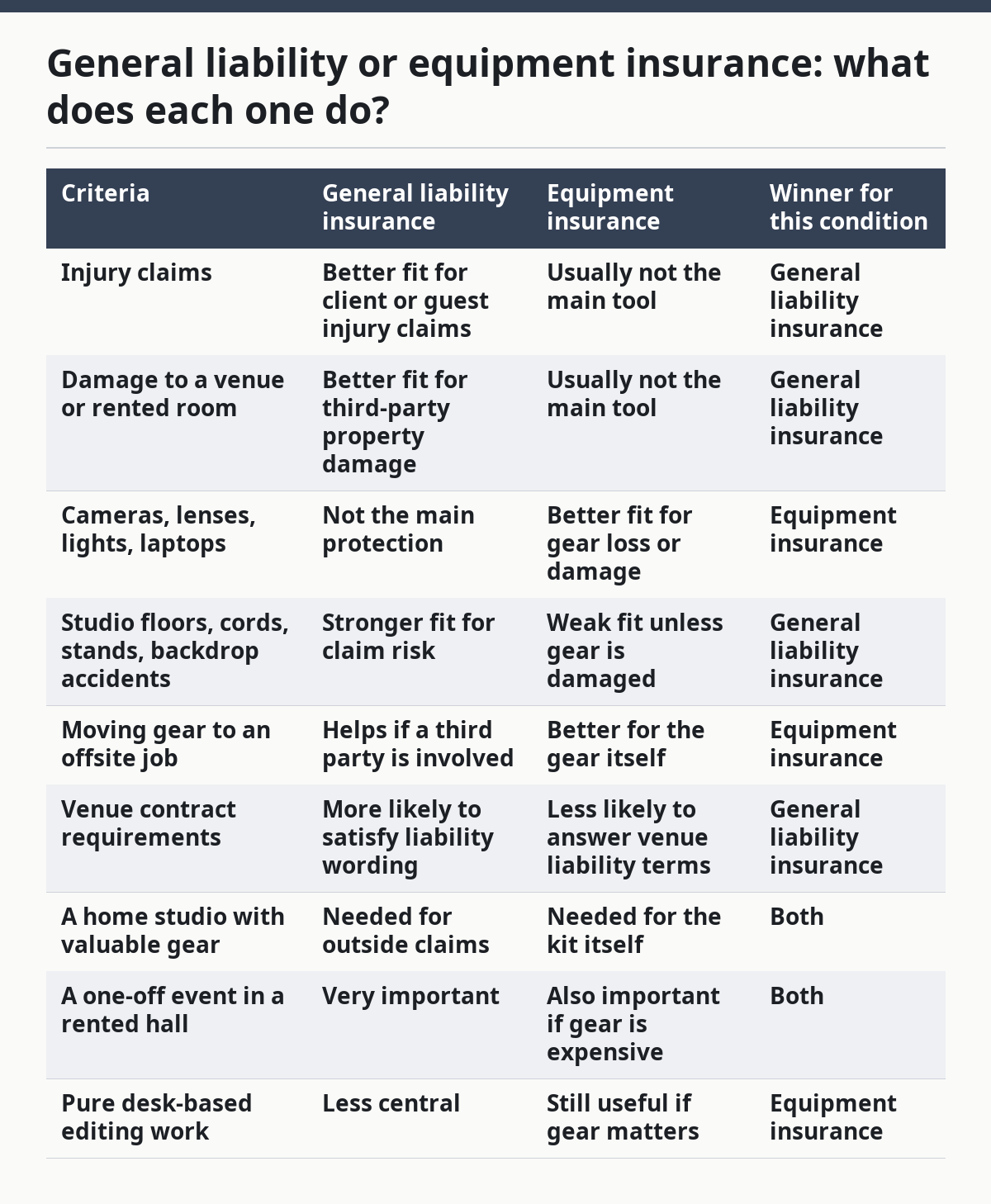
The real lesson is that the policies answer different questions. If the issue is, “Who pays if a guest is hurt or a rented wall gets damaged?” the answer sits in liability coverage. If the issue is, “Who pays if the camera body or lighting kit is lost or damaged?” the answer sits in equipment coverage.
A generic article often gets this wrong by treating gear insurance as enough for everything. It is not, so check the wording with a broker or adviser before you rely on it. It also gets it wrong by treating liability as something only big commercial studios need. A freelance photographer can face a claim in a small room just as easily as in a large hall; for a broader source on business liability planning, see the SBA insurance guide.
How do venue contracts change the decision?
Venue contracts can change the decision by making insurance a condition of entry, not just a financial backup. That is why event photographers need to read the coverage language before the job is accepted.
A studio contract is often simpler because the space is fixed and the exposure is local. A venue contract for an event can name a third party, define responsibility, or require that the photographer carry certain insurance terms. That shifts the issue from “What do I want to protect?” to “What does this site require before I can work here?”
This is where the common mistake shows up. A photographer may have a working policy but still fail to meet a venue’s requirements because the contract asks for a specific form of coverage or a particular liability structure. The policy may still be useful, but it may not satisfy the venue. That creates a real operational problem.
The safest mental model is not that studio work is always simple; it is that studio work is usually more controllable, while event work often means meeting someone else’s rules while managing public risk. If a contract is attached, read it before assuming the policy is enough. If the assignment is offsite, the venue’s terms may matter as much as the photography brief.
What should a freelance photographer check before buying?
A freelance photographer should check the policy wording, the business location, the kind of shoots taken, and whether the insurer understands studio and event work. That matters because insurance prices are based on rating plans that may vary by state, and those rating structures reflect market trends rather than individual loss experience, according to industry rating-plan rules and state oversight practices. In plain terms, two photographers can get different pricing because the plan is built differently, not just because one had a better year.
The insurer’s financial strength also matters. Independent rating agencies provide information and rate insurers’ financial strength, and insurance companies are rated by agencies such as AM Best. That does not tell a photographer which policy to choose on its own, but it does help frame the comparison.
One more wrinkle: retrospectively rated insurance sets premiums on large commercial accounts, and the insurance contract guarantees the rating formula. That is not the common setup for every freelance photographer, but it shows why the structure of the contract matters as much as the label on the policy.
The trade-off is straightforward. A cheaper-looking policy may not fit the way the photographer actually works, especially if the work shifts between studio and event assignments. A more specific policy can be better matched to the job, but it may also come with tighter terms or a different pricing plan. A qualified adviser can help compare the wording against the actual workflow.
The verdict: which setup fits which photographer?
Choose general liability insurance plus equipment insurance if you shoot both studio and event work, sign venue contracts, or move gear offsite for jobs. Choose liability-heavy coverage first, with equipment insurance as the second piece, if you spend most of your time in rented venues, public spaces, or crowded event settings. Neither if you are trying to use a personal-contents mindset for a business that handles clients, gear, and rented spaces.
That is the cleanest call because studio work and event work create different claims. Studio photography tends to expose the photographer to fixed-space damage and gear loss, while event photography adds third-party property risk, guests, and venue requirements. A mixed freelancer usually needs both sides covered because the job changes with the booking.
The wrong choice is the one that assumes one policy family solves every assignment. It does not. A studio portrait session and a wedding reception can look similar on the invoice, but they do not look similar to a claim adjuster or a venue manager.
When should the answer flip?
The answer flips when the work is not truly mixed. If a photographer only edits at home and rarely shoots on location, equipment coverage may matter more than broad event-style liability language. If the photographer works almost entirely in a private studio with no public foot traffic, the liability profile is narrower than a wedding or conference job.
The answer also flips if the venue contract is unusually demanding. A rented hall can force the insurance conversation before the job starts, and that can make event coverage the deciding factor even for a small assignment. A second flip happens when the gear value is high relative to the rest of the business; then equipment coverage becomes central because the operating risk lives in the kit.
A final flip happens when the photographer is moving into larger commercial accounts. Retrospectively rated insurance exists for large commercial accounts, and that changes how premiums are set. Most freelance photographers will not be in that lane, but if they are, the contract structure deserves closer review than a standard small-job policy description.
Is event photography riskier than studio work?
Yes, event photography is usually riskier because more people, more property, and more venue rules are involved. That creates more chances for a third-party claim, and it also raises the odds that the venue will ask for specific insurance terms before the job begins.
What insurance do photographers need for rented venues?
Photographers usually need general liability insurance that matches the venue’s requirements, plus equipment insurance if the gear is worth protecting. The contract can matter as much as the policy name, because the venue may care about the wording of liability coverage and not just whether the photographer is insured in general.
Do photographers need separate coverage for studio and event jobs?
They often need the same policy families for both, but the emphasis changes. Studio work leans on equipment and controlled-space liability, while event work leans on third-party property risk and venue compliance. A mixed freelancer should check that the policy fits both settings instead of assuming one job type covers the other.
Drafted with AI; not yet reviewed by a person.
