

Last updated: November 24, 2026
To cancel a freelance insurance policy without creating a coverage gap, cancel the old policy only after the replacement policy has a confirmed effective date, and send the insurer a written policy cancellation notice that matches that date. If the old policy ends before the new one starts, even by 1 day, you can create a coverage gap. For the process overview, see Freelance insurance policy administration and the related page on policy effective dates.
Key takeaways
- The safest order is usually: confirm new coverage, set the start date, then cancel the old policy.
- The cancellation notice should name the policy, the insurer, the requested end date, and who is sending it.
- Keep proof of every step: the notice, the insurer’s reply, and the final documents.
- A gap often happens because people assume a quote, renewal draft, or payment plan means coverage is already active.
- If the policy has a notice period, a retroactive date, or a special clause, the usual timing may not work.
Who should use this approach?
This approach fits a freelancer who already has one policy and wants to end it without leaving a break in coverage. It assumes you know the policy number, the insurer’s contact details, and the date you want the new policy to begin.
However, it is not the right move if you are unsure whether the new policy is actually in force. A quote, an application, or a draft declaration page is not the same thing as an active policy. That difference matters because the effective date is the date coverage starts, not the date you hoped it would start.
Therefore, if your policy has a renewal notice, a cancellation fee, or a required notice period, the timing may be fixed by the contract. That is common in insurance administration, and it is the main reason people should slow down before they send a cancellation request. For background on the wider process, the hub article, Freelance insurance policy administration — The Complete Guide, sits above this page in the site structure.
How do you cancel a freelance policy without a gap?
You cancel a freelance policy without a gap by lining up the replacement policy first, then sending a written cancellation notice with the right effective date. The order matters because the insurer stops charging for risk only after the cancellation takes effect.
- Confirm the replacement policy is active. Check the declaration page or written confirmation for the effective date, policy number, and insurer name. If the start date is missing or unclear, the problem is that you may be cancelling first and hoping the new policy follows.
- Match the old policy’s end date to the new policy’s start date. Ask for the old policy to end at the last minute of the day before the new one begins, or on the exact date your insurer uses for a clean handoff. The verification step is to compare both dates in writing; a mismatch of even 1 day can leave a gap.
- Read the cancellation section before you send anything. Look for notice periods, required methods, and any early-termination terms. If the policy says written notice is required, a phone call alone is weak evidence and may not start the process.
- Prepare a policy cancellation notice. Include your name, policy number, insurer, requested cancellation date, and the reason if the insurer asks for one. The notice should be direct and short. If the date is missing, the insurer may use its own timing rules instead of yours.
- Send the notice using a trackable method. Use the channel the insurer accepts, such as email, portal upload, or mail with proof of delivery. Verify that the insurer received it and logged it. If you only keep a draft on your phone, the request may not count.
- Wait for written confirmation. The confirmation should state the cancellation effective date and any final premium or refund terms. If the date on the confirmation is different from what you asked for, stop and fix it before the old policy ends. For consumer guidance, the NAIC consumer resources page explains why written proof matters.
- Check the final documents. Keep the cancellation confirmation, final invoice, and any refund notice together. These papers matter if there is a billing error or if another insurer asks for proof that prior coverage ended on a certain day.
- Do not let both policies overlap without checking the cost. A short overlap can reduce gap risk, but it may also mean paying for 2 policies at once. If you do that, verify the overlap length and the billing dates so you know exactly what you are paying for.
What should you check before sending the notice?
You should check the effective date, the policy wording, and the replacement policy documents before you send the notice. Those 3 items decide whether the handoff is clean or messy.
First, confirm whether the new policy starts at 12:01 a.m., end of day, or another insurer-defined time. If the old policy ends at midnight and the new one starts the next day, you may still have a break depending on how the insurer defines the clock.
Second, look for any cancellation notice period in the old policy. If the contract requires advance notice, sending the request on the same day you want coverage to end may not work. The insurer may still cancel later than you planned.
Third, check whether the replacement policy is for the same kind of risk. A freelancer liability policy and another insurance line are not interchangeable. If the new policy does not cover the same exposure, then there is no true continuity even if the dates look tidy.
Fourth, keep proof of identity and policy details together. Policy number, named insured, address, and contact email should all match the insurer’s record. A mismatch can delay processing by several business days, which is enough to create a gap if you planned too tightly.
What documents confirm cancellation?
Cancellation is confirmed by written proof from the insurer, not by your own note that you asked for it. The useful papers are the cancellation confirmation, the final bill or refund notice, and any revised declarations page if the insurer issues one.
If the insurer sends a cancellation acknowledgment, read the effective date first. That date is the key line, because it tells you when coverage actually ended. If the date is wrong, the file is still open.
Keep the policy cancellation notice you sent, too. If there is a dispute later, that document shows what date you requested and what method you used. An email thread or portal receipt is often better than memory alone.
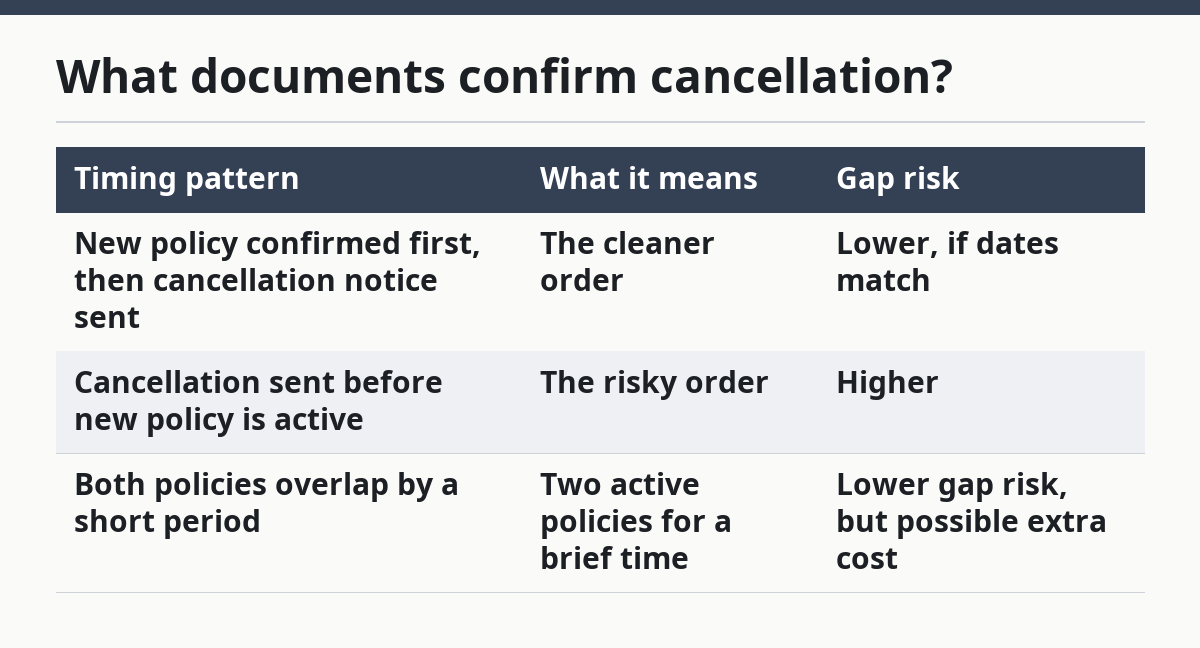
For comparison, the timeline below shows the 3 most common handoff patterns.
| Timing pattern | What it means | Gap risk |
|---|---|---|
| New policy confirmed first, then cancellation notice sent | The cleaner order | Lower, if dates match |
| Cancellation sent before new policy is active | The risky order | Higher |
| Both policies overlap by a short period | Two active policies for a brief time | Lower gap risk, but possible extra cost |
When should you stop and get help?
You should stop and get qualified help when the policy terms do not match your plan. In money matters, a small timing error can affect coverage rights, billing, and later claims, so guessing is a bad trade. For a more detailed consumer explanation, review your state insurance department and the NAIC consumer guidance.
The new policy has no confirmed effective date: You do not yet know when the replacement starts — wait for written confirmation before you cancel the old one.
The old policy requires advance written notice: The insurer may not end the policy on your requested day — follow the notice rule or ask a qualified adviser how the timing works, using the policy wording and the insurer’s written instructions.
The insurer will not accept your preferred cancellation channel: A portal message may not be enough in every case — use the method the insurer recognizes or ask a qualified adviser how to document the request. If you need a source, check the insurer’s service guide or your state insurance department’s filing rules.
The policy has an open claim or pending issue: Cancellation may affect how the insurer handles the file — pause and get the status explained in writing.
The replacement policy covers a different risk: You may think you have continuity when you do not — get the coverage terms checked before you end the old policy.
You need the end date tied to a contract or client requirement: A wrong date can affect business paperwork — have a qualified adviser or broker review the timing before you send the notice.
What mistakes create the gap?
The most common mistake is cancelling after reading a quote instead of waiting for active coverage. A quote is only an offer, and an offer does not protect you if something happens the next day.
Another mistake is sending the notice without a date. That leaves timing in the insurer’s hands, and the insurer may use its own notice rules instead of your preferred handoff date.
A third mistake is trusting a phone call alone. Phone calls can help, but they are weak evidence if the insurer later says no cancellation request was logged. Keep something written when you can.
A fourth mistake is forgetting billing dates. If the insurer bills monthly or by installment, the cancellation may not stop every charge unless the effective date is set correctly. That can create confusion over whether you still had active coverage or just an unpaid balance.
A fifth mistake is assuming a short overlap is always bad. Sometimes a 1-day overlap is the cleaner option if it prevents a gap, but it can also mean paying twice for part of a period. Consult a qualified adviser or broker if you are unsure, and verify the dates before you choose overlap.
When does the standard timing not work?
The standard timing needs adjustment when the policy or the insurer uses special rules. That is normal, and it is why a clean cancellation is about paperwork, not guesswork.
If the policy renews automatically, the insurer may treat the renewal date as the start of a new term. That means your cancellation request should arrive before that point, not after the renewal is already in force; if the dates are tight, consult a qualified adviser and check the insurer’s rules.
If the insurer specifies business days, weekends may not count toward the notice period. A Friday request may not work the way a Monday request does, even if the calendar date looks close.
If the replacement policy starts at a different time of day, align both documents to the same clock. One policy may begin at 12:01 a.m. and another may end at the close of business, and that small difference can matter if you need uninterrupted coverage.
If you are changing carriers at renewal, do not assume the old policy ends automatically when the new one starts. Read both documents, because the handoff is often based on each policy’s own effective date language.
If you are ending coverage for more than one line of insurance, cancel each policy separately. A liability policy, a health policy, and a property policy do not all follow the same rules, even when they sit under the same client file.
How can you tell the handoff worked?
You can tell the handoff worked when the old policy has a written cancellation date and the new policy shows the matching start date. Those 2 dates should meet without a break.

The clean result usually includes 3 things: a cancellation confirmation, a final billing statement, and a replacement policy document. If all 3 show consistent dates, the process is probably correct.
If anything conflicts, stop and ask the insurer to explain the file in writing. Date mismatches are not minor clerical details in insurance; they are the difference between continuous coverage and a gap.
How do i end a freelance policy safely?
You end a freelance policy safely by confirming the replacement policy first, then sending a dated cancellation notice to the insurer, and then collecting written confirmation. That sequence is the simplest way to avoid a break in coverage.
The safest result is a clean date match between the old policy’s end and the new policy’s effective date. If those dates do not line up, do not assume the insurer will fix it on its own.
Should i wait until new coverage starts before canceling?
Yes, if you can, because waiting until the new coverage is active lowers the chance of a gap. The key is not the application date or the quote date; it is the effective date shown on the replacement policy.
A short overlap can be less risky than a gap, but it can also cost more. If you choose overlap, make sure you know exactly which dates you are paying for and why.
What documents confirm cancellation?
The main proof is the insurer’s written cancellation confirmation with the effective date. A final bill, refund notice, or revised declaration page can support it, but the confirmation is the central document.
Keep the notice you sent and the proof that it was received. If the timing is ever questioned, those records show both your request and the insurer’s response.
Drafted with AI; not yet reviewed by a person.
