

Last updated: November 24, 2026
Quick Answer: give a 1-sentence reply, verify it against your application, and keep it to 1 fact plus 1 detail when the underwriter asks a follow-up. In How to Answer Underwriter Follow-Up Questions for Freelance Insurance, the safest answer is plain, consistent, and matched to the same facts already in your application and risk questionnaire. Keep the reply focused on your business operations, client types, work locations, tool use, and security controls, and leave out extra detail that does not change the risk picture. This is information, not financial advice; for your own situation, a qualified adviser should review anything unclear. For a second layer of guidance, see the internal pages on freelance insurance application and underwriting and freelance business risk controls.
Key takeaways
- Match your follow-up answer to the application, not to what you wish the answer were.
- Short, factual replies usually help more than long explanations.
- If you do not know something, say so and offer a source or document instead of guessing.
- The underwriter is checking whether your business setup changes the risk, not testing your writing skills.
- When the question reaches tax, legal, or coverage consequences, get qualified help before you commit to an answer.
What is an underwriter asking for?
An underwriter is asking for missing facts that help them finish the insurance application interview and risk questionnaire. The point is to clarify how your freelance work operates on a day-to-day basis, not to catch you out.
For a freelancer, follow-up questions often focus on 5 areas: where the work happens, who the clients are, what tools or software you use, how you control access to files, and whether your business operations change the risk in a material way. If the underwriter asks twice, it usually means the first answer was incomplete, vague, or not aligned with another part of the application.
A clear answer does 3 things. First, it gives the fact asked for. Second, it stays inside the same story as the original application. Third, it avoids extra detail that can create a new question. If your application says you work from a home office and your follow-up says you split time across 3 locations, that mismatch matters more than the number itself.
For broader context on the application side, this page fits the hub on freelance insurance application and underwriting. For security controls, NIST’s Cybersecurity Framework and the FTC’s online security guidance are useful reference points:
NIST Cybersecurity Framework
FTC: Identity theft and online security
How should I answer the follow-up, step by step?
You should answer in 7 steps: read the question, check the application, gather the record, state the fact, add the smallest useful detail, flag uncertainty, and send the reply in the same channel. The goal is consistency, not performance.
- Read the email, call note, or portal message carefully: Identify the one question being asked before you answer; verify whether it is about business operations, client types, work locations, tool use, or security controls; a problem is when the message asks for 2 different facts and you answer only one.
- Check the application and risk questionnaire: Compare the question with what you already submitted; verify the answer matches the original form; a problem is any new detail that changes the story, such as a different work address or a different type of client. See the [insurance application checklist](/insurance-application-checklist/).
- Gather the record before you reply: Open the document, invoice, policy note, or system record that supports the answer; verify the date, name, or setting; a problem is guessing from memory when the file is available.
- State the fact in one sentence: Put the direct answer first; verify that the sentence can stand alone without a long explanation; a problem is starting with reasons, history, or opinions before the fact appears.
- Add only the detail the underwriter asked for: Give the smallest useful context, such as the number of work locations or the name of a control you use; verify that the detail answers the exact follow-up; a problem is adding 3 extra examples the underwriter did not request.
- Flag what you do not know: If you are missing a number, document, or date, say that plainly and offer to send it later; verify that you do not fill gaps with estimates; a problem is sounding certain about an uncertain fact.
- Send the reply through the same channel: Use the portal, email, or phone follow-up route already opened by the underwriter; verify the message is complete and readable; a problem is replying in a different place and assuming the underwriter will connect the threads.
- Save the final version: Keep a copy of what you sent and any attachment names; verify you can match your reply to the original question later; a problem is losing the thread if the underwriter asks again 2 days later.
A good answer often sounds plain: “I work from a home office in one location and use password-protected cloud storage for client files.” That is enough when the underwriter asked about work location and security controls. A weak answer sounds busy but says little: “I’m flexible and handle things wherever I can.” That may feel friendly, but it leaves the risk picture blurry.
What should I say if I do not know an answer yet?
You should say that you do not know yet, name the missing piece, and give a date or method for follow-up if you have one. Guessing is worse than saying “I need to check,” because the underwriter may treat a wrong answer as a reliability problem, so it is better to consult a professional if the fact affects coverage, tax, or legal statements.
Use a short structure: fact you know, fact you do not know, next step. For example, if the question is about a client type or a tool version and you are not sure, do not invent it from memory. Say you need to check the source record, then send the answer from the file, invoice, contract, or system log. A 24-hour delay for verification is usually better than an inaccurate reply.
This is also where tone matters. Sounding evasive can create more follow-up questions, while sounding precise buys trust. “I do not have that detail in front of me” is cleaner than a long story about being busy. If the missing fact affects coverage terms, exclusions, or a legal statement, stop and get qualified help before you answer.
Which mistakes cause the most trouble?
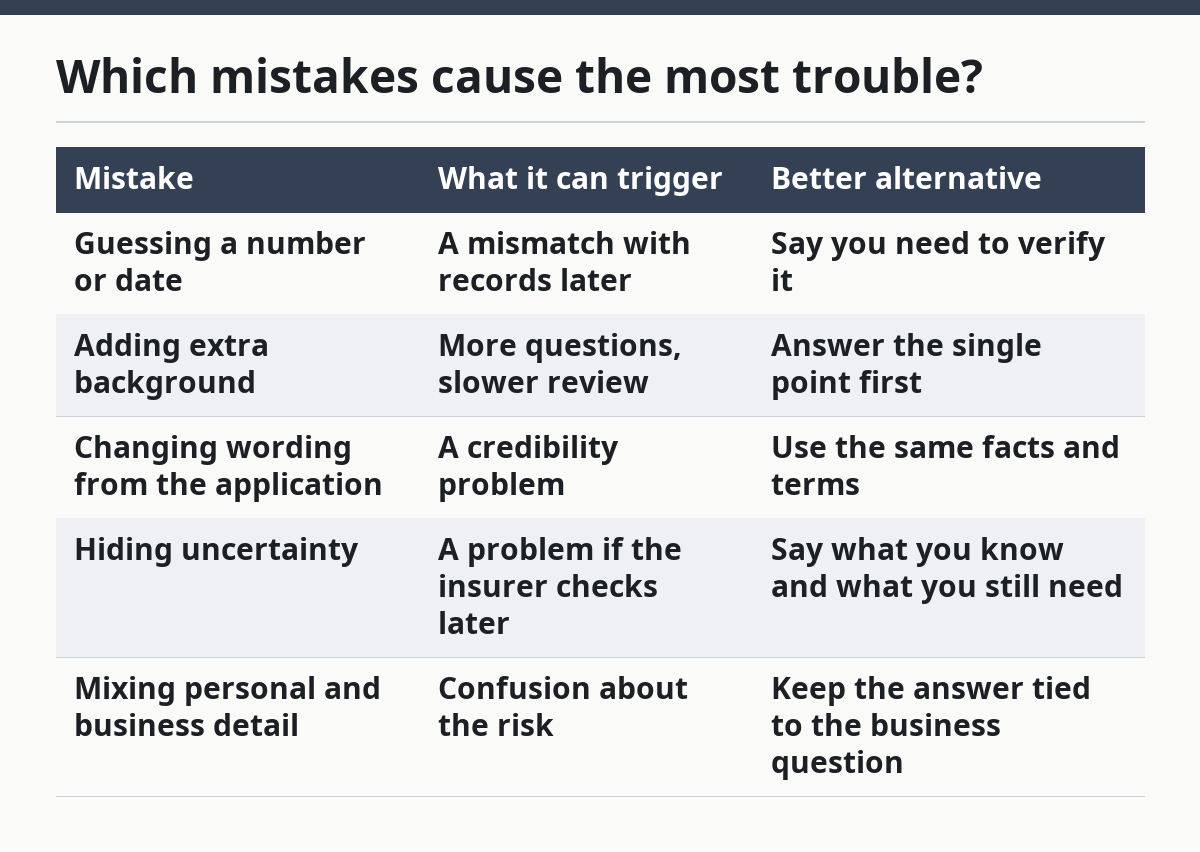
The biggest trouble comes from inconsistency, overexplaining, and answering a different question than the one asked. The follow-up is usually narrow; your reply should be narrow too.
| Mistake | What it can trigger | Better alternative |
|---|---|---|
| Guessing a number or date | A mismatch with records later | Say you need to verify it |
| Adding extra background | More questions, slower review | Answer the single point first |
| Changing wording from the application | A credibility problem | Use the same facts and terms |
| Hiding uncertainty | A problem if the insurer checks later | Say what you know and what you still need |
| Mixing personal and business detail | Confusion about the risk | Keep the answer tied to the business question |
A common example is the work location question. If the application says “home office” and the follow-up asks where files are stored, do not answer with a story about coffee shops, client sites, and travel days unless those points truly matter. The underwriter is usually trying to understand exposure, access, and control, not your weekly routine.
Another common error is overdescribing security controls. If you use 2-factor authentication, say that and stop unless asked for more. A long list of tools can distract from the one control the underwriter wanted to confirm. For security controls, the FTC and NIST both stress simple, consistent protection habits over random complexity. See the page on client file security basics.
When should I stop and ask for help?
You should stop and get qualified help when the question affects coverage, legal statements, or facts you cannot verify from records. That is the line between a routine follow-up and a situation where a wrong answer can create real money risk.

The question asks about a tax treatment or income pattern: That can affect underwriting and other filings, so a qualified adviser should review it before you answer.
The underwriter wants a written explanation for something you do not understand: The wording can matter as much as the fact — ask for help before you sign or send it.
Your answer would contradict the application: That inconsistency can delay or complicate the file — pause and reconcile the records first.
The question asks for a security control you do not actually use: Do not describe a control that is only planned — say what is in place now, or get advice on how to frame the gap.
The issue touches a client contract, a platform rule, or a legal promise: Those terms can change the risk analysis — do not guess at the meaning.
You are being asked to explain a complex business structure in one sentence: A compressed answer can be misleading — ask for a chance to send a written follow-up.
This is not about being difficult. It is about not turning a 1-minute reply into a long-term problem. If the answer would change if a document arrived tomorrow, say so and wait.
What does a good answer look like?
A good answer is short, factual, and tied to the exact question. It usually names the fact first, then one detail that proves or clarifies it.

If the underwriter asks about tool use, a strong reply might mention the specific software or access method, then stop. If the question is about business operations, a strong reply might state whether work is done from a home office, a shared office, or another fixed location, and whether that has changed recently. If the question is about security controls, a clear reply might mention password protection, access limits, or a backup process, but only if that control is real and in use.
A weak answer tries to sound helpful by being broad. A strong answer sounds less dramatic and more exact. That is often what moves the file forward.
FAQ
Why does an insurer ask follow-up questions after an application?
They ask because the first form did not answer everything they need for the underwriting decision. Follow-up questions help them confirm business operations, client types, work locations, tool use, and security controls. That is normal in an application interview, especially when a reply is unclear or incomplete.
What should I say if I do not know an answer yet?
Say that you do not know yet and explain what you will check. Keep the answer short and do not guess. If the missing fact is important, send the verified detail later rather than filling the gap with an estimate.
Can I send documents after the underwriting call?
Yes, if the underwriter asks for them or if you need time to verify a fact. Send the documents through the same channel used for the call or message, and make sure the file names are clear. If the documents affect a legal or coverage statement, get qualified help before you submit anything.
Drafted with AI; not yet reviewed by a person.
