

Last updated: November 24, 2026
Quick answer: fill out a freelance insurance application by matching 7 key items — your legal name, entity type, services, revenue period, subcontractors, prior claims, and coverage limits — to records the insurer can verify. In How to Fill Out a Freelance Insurance Application Without Leaving Gaps, use your real business entity, class codes, prior carriers, services, revenue details, subcontractor use, prior claims, and coverage limits. If a line does not fit your work, write “not applicable” only when that is true, and never leave a blank unless the form itself allows it.
Who this applies to
This applies to freelancers filling out a freelance insurance application for liability coverage, professional liability, or a similar policy form, and it assumes you already know your legal business name, basic service list, and rough revenue figures for the period the form asks about. It also assumes you can read an application form line by line and match each answer to your own records. This is information, not financial advice, and a qualified adviser should be consulted for your own situation.
A freelance insurance application is not a place for polished marketing copy. The underwriter is trying to see what you do, who you do it for, whether a class code fits, and whether any prior carriers, claims, or subcontractors change the risk. If the form asks for a number, a name, or a date, give the most accurate answer you can support with records.
This guide is for people who want to avoid gaps, not for people trying to stretch the truth to fit a lower premium. It is not the right approach if your work crosses into regulated advice, if your business structure is unclear, or if you cannot tell where one service ends and another begins. Those cases usually need a qualified adviser who can help you word the application accurately.
Key takeaways
- Put the same business name everywhere the form asks for identity, ownership, and billing details.
- Match your service description to the work you actually do, not the most flattering version of it.
- Use the figures the underwriter asked for, even if they are ranges or estimates.
- Disclose prior carriers and claims clearly; missing history causes more trouble than a plain answer.
- If a field does not fit your business, explain why instead of leaving a blank.
How do you fill it out step by step?
You fill it out by moving through each field in the same order the application presents it and checking that every answer matches the rest of the form. A clean application is usually built from 7 linked parts: identity, entity type, business description, services, revenue, subcontractors, and loss history.
- Enter the legal name exactly as it appears on your business entity records, and confirm the spelling matches every other page in the application. Verify that trade names and assumed names are placed only where the form asks for them; a mismatch here can make the file look inconsistent.
- Select the business entity that actually conducts the work, such as sole proprietor, LLC, or corporation, and confirm the selection matches tax and registration records. A wrong entity type can change who is insured and how the underwriter reads the risk; if the form offers only one choice and yours is different, stop and ask for a corrected version.
- Write the business description in plain terms that fit the class code and the application form, using 1 or 2 short sentences. Verify that the description covers the main service line and does not introduce extra work the insurer did not ask about; if the text becomes broad enough to include unrelated services, it is too loose.
- List services offered one by one, using the exact kind of work you sell rather than a brand phrase. Check whether the form wants the primary service only or all services; a problem shows up when the list contains work that would belong in a different class code.
- Complete revenue details using the period the application asks for, such as annual or trailing revenue, and use the units shown on the page. Verify that the total lines add up; if one line is blank and the totals still claim a full figure, consult a professional or the insurer before you submit it.
- Disclose subcontractor use if you hire others, even part time or on a project basis, and state whether they are independent contractors or employees if the form asks. Verify the answer against how work is actually performed; a problem exists if the form says “none” but you routinely pass tasks to another worker.
- Record prior claims and any prior carriers exactly as the form requests, including dates, claim types, and loss runs if the application asks for them. Confirm that the history is consistent with the records the insurer may later review; omitted claim history can create a gap.
- Choose coverage limits only within the options shown on the application, and make sure the selected limit matches the protection you are trying to quote. Verify whether the form asks for per-claim, aggregate, or another limit structure; if you cannot tell which limit is which, the page needs clarification before you sign.
The mechanical part matters because the underwriter reads the whole file as one story. If your entity says one thing, your revenue lines say another, and your services hint at a different class code, the form can look unreliable even when none of the answers are intentionally wrong.
What information do insurers ask for?
Insurers ask for identity, work type, revenue, history, and risk details because those fields tell the underwriter what kind of freelance business is being insured. The form usually asks for the business entity, class codes, prior carriers, revenue details, subcontractor use, prior claims, and the coverage limits you want quoted.
A useful way to think about the form is that each field answers a different underwriting question. Identity says who the insured is. Services and class codes say what kind of work is being done. Revenue and subcontractor use hint at scale and exposure. Prior carriers and claims show what happened before. Coverage limits show how much risk the policy would be asked to carry.
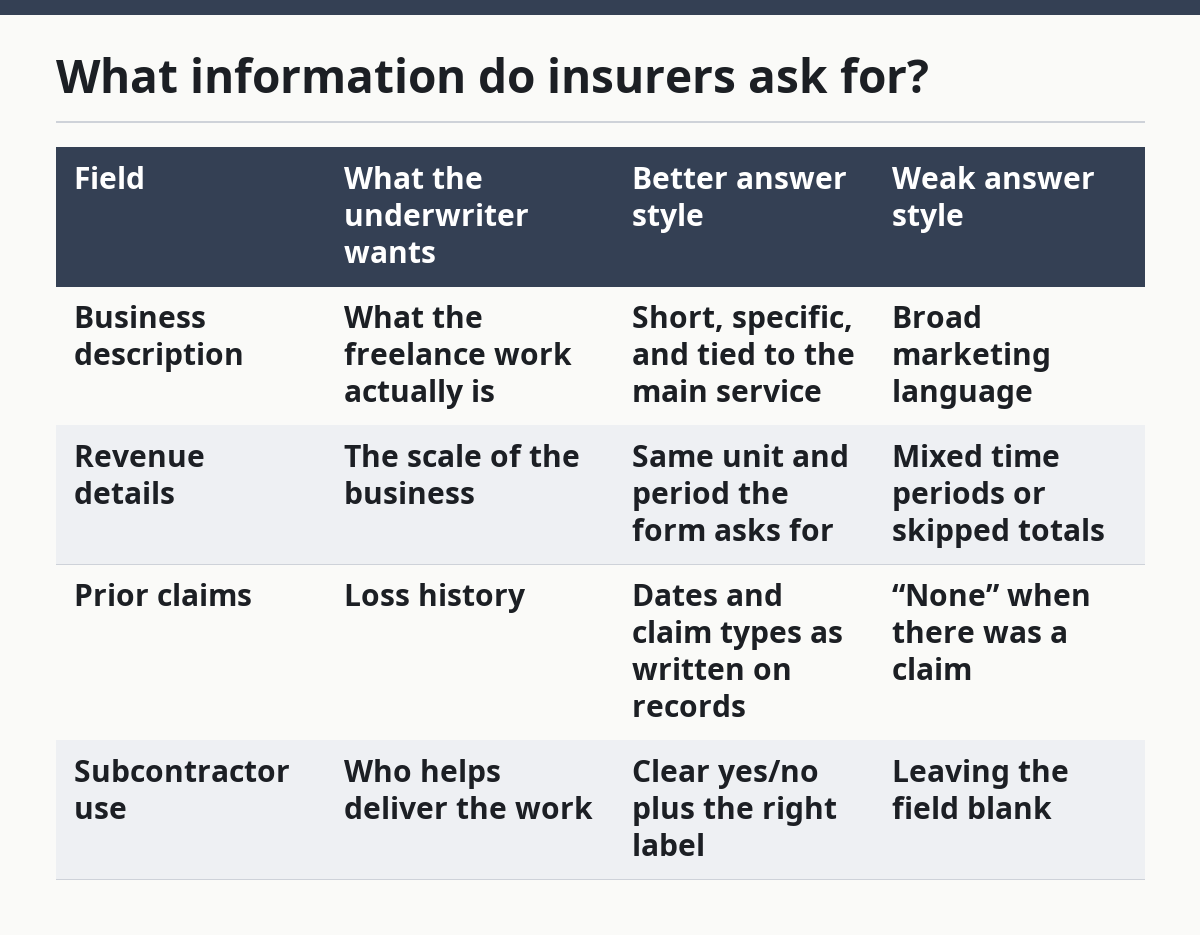
Here is a simple comparison of how to think about some common answers:
| Field | What the underwriter wants | Better answer style | Weak answer style |
|---|---|---|---|
| Business description | What the freelance work actually is | Short, specific, and tied to the main service | Broad marketing language |
| Revenue details | The scale of the business | Same unit and period the form asks for | Mixed time periods or skipped totals |
| Prior claims | Loss history | Dates and claim types as written on records | “None” when there was a claim |
| Subcontractor use | Who helps deliver the work | Clear yes/no plus the right label | Leaving the field blank |
A generic article often misses the point that the application is an underwriting tool, not a brochure. The insurer is not trying to admire the business. It is trying to decide whether the file makes sense line by line.
How specific should the business description be?
The business description should be specific enough to match the class code, but short enough that it does not wander into extra services. Two sentences are usually enough if the form does not ask for more, and a 1-line description is often better than a paragraph that invites confusion.
For that reason, write the main service first, then add the narrowest useful detail. For example, if the application asks for a description of the business, the answer should tell the insurer what the freelance business does, not every project type ever accepted. If the form has a separate services section, keep the description tighter and let that later field carry the detail.
This is where many applicants drift into trouble. A description that is too broad can imply a class code mismatch, and a description that is too thin can look like the work is being hidden. The middle path is plain wording that a claims adjuster and an underwriter would understand without guessing.
Which mistakes create gaps?
Small omissions create the biggest problems because they make the application form look unfinished or inconsistent. The issue is not only the missing line itself; it is what the missing line suggests about the rest of the file.
- Leaving a field blank instead of marking it clearly: The insurer may treat the answer as missing information, which can slow the file or send it back. Use “not applicable” only when it truly does not apply, and consult a professional if the form is unclear.
- Using a business name that differs from the entity name: That can cause confusion about who is insured and whether the right business entity is on the form. Copy the legal name exactly.
- Giving one service description and a different services list: The underwriter may think the application is incomplete or that the class code is wrong. Keep the wording aligned across the form.
- Skipping prior carriers because the policy lapsed or changed names: Prior carriers help show the insurance trail, and gaps in that trail raise questions. List the carrier history as requested, even if it feels old.
- Underreporting subcontractor use: If others help on jobs, that can change the risk profile. A “no” answer that is not true can create a later coverage dispute.
- Guessing at revenue without checking the form’s time period: Mixing monthly, yearly, and project totals can distort the number. Use the exact period and unit the application asks for.
The correct alternative is slow consistency. Every answer should fit the rest of the file, and every number should come from the same period. If a line looks hard to answer, that usually means it needs attention, not a guess.
When should you stop and ask for help?
You should stop and get qualified help when the form asks for something you cannot answer without making assumptions. That is especially true on a YMYL topic like insurance, where a wrong answer can affect coverage, claims handling, or the ability to bind a policy.
Your business entity is not settled: If you are not sure whether the application should show a sole proprietorship, LLC, or corporation, the wrong selection can change the insured party — pause and confirm the entity before filing.
The class code does not fit your actual work: If the listed code seems close but not right, the underwriter may read your business description differently — ask for clarification rather than forcing a near match.
Your prior carriers are hard to trace: If you changed insurers several times or had a lapse, the carrier history can look incomplete — gather the timeline before you submit the form.
You had prior claims that you do not fully understand: If the form asks about claim dates or outcomes and you cannot match them to records, a wrong answer can create a coverage dispute later — verify the history before you sign.
You use subcontractors in some projects but not others: If the work mix changes by job, a simple yes/no answer may not capture the real setup — clarify the pattern instead of guessing.
The coverage limits line is unclear: If you cannot tell whether the form asks for a per-claim limit, an aggregate limit, or another structure, the number alone is not enough — ask for the label to be explained before you choose.
This is the point where a qualified adviser or the insurer’s own underwriting contact can help, because the issue is not filling in a blank. It is making sure the form describes the business truthfully enough to be useful.
What if the work does not fit the standard form?
The standard form needs modification when the business has more than one service line, uses regular subcontractors, or has a history that does not fit a neat template. In those cases, the right answer is usually to make the form more specific, not more creative.
A narrow class code problem is common. So is a business that has one main service and a second, occasional service that changes the risk picture. When that happens, the application should not hide the extra work in general language. It should state the main service clearly and note the exception only where the form asks for it.
Another edge case is a freelancer who changed structure during the year. If the entity changed, the revenue period, prior carriers, and claims history may not line up neatly. That does not mean the application is wrong; it means the answers need to be tied to the exact period the form asks about, not to a vague idea of “this year.”
For that reason, the NAIC is a useful reference point, and the insurer’s own underwriting instructions matter too. The National Association of Insurance Commissioners and the insurer’s own guidance are better anchors than guesswork when a form turns technical. See also: what to check before you sign and which mistakes create gaps.
What should you check before you sign?
You should check that the application reads like one consistent record, not five separate drafts. The legal name, entity type, services, revenue details, prior carriers, and prior claims should all point to the same business.

Look for three last mismatches. First, make sure the business description does not promise less or more than the services list. Second, check that the revenue figures use the same period everywhere the form references money. Third, confirm that any “none” answers are true and not placeholders for forgotten information.
This is also the moment to review any instructions attached to the form. Some insurers ask for loss runs, prior carrier details, or class code clarification in the same packet, and the application may not be complete without those pieces. A missing attachment can create the same problem as a missing answer.
For general consumer guidance on insurance terms and complaint handling, the Consumer Financial Protection Bureau and the NAIC are solid starting points:
- https://consumerfinance.gov/consumer-tools/insurance/
- https://content.naic.org/consumer
What information do insurers ask for on a freelance insurance application?
Insurers usually ask for the business entity, business description, services offered, revenue details, subcontractor use, prior carriers, prior claims, and the coverage limits requested. They use those fields to see what kind of freelance business they are insuring and whether the answers fit the class code and risk profile. If a field does not apply, the form should say so clearly.
How detailed should a freelance business description be on an application?
The description should be detailed enough to match the work, but not so long that it starts listing every side service. A sentence or two is often enough if the form does not ask for more. The best description tells the underwriter what the business does and keeps the wording aligned with the rest of the application.
What happens if I leave something off an insurance application?
Leaving something off can make the form look incomplete, slow the underwriting review, or create a mismatch that matters later. If the missing item is a prior claim, carrier, or subcontractor detail, the problem can become more serious because the insurer may think the file was not fully disclosed. If you discover an omission, correct it before the form is signed and submitted.
Drafted with AI; not yet reviewed by a person.
