

Last updated: November 24, 2026
The named insured should match the legal business that owns the risk and signs the work. For a freelance business, that usually means your own legal name for a sole proprietorship, or your limited liability company if you formed an LLC. If you use a dba, the policy still needs the real business entity underneath it so the insurer knows exactly who is covered.
Key takeaways
- The named insured is the person or entity the policy actually protects, not just the brand name on your invoices.
- A sole proprietorship, LLC, and dba can all appear in different ways, but the legal entity has to be clear.
- The wrong entity name can delay claim handling, create clean-up work on the paperwork, or leave a gap between your business records and your policy.
- A dba is a trading name, not a legal person by itself.
- If your structure is unusual, your ownership is split, or the policy wording needs to match contracts, get a qualified adviser to review it before you bind coverage.
This is information, not financial advice, and a qualified adviser should be consulted for your own situation.
What is the named insured?
The named insured is the person or business entity listed first on the policy as the main insured party. In plain language, it is the name the insurer uses to decide who the contract belongs to, who gets the policy declarations, and whose operations the policy is built around.
That matters because freelance businesses often use more than one name at once. A designer may trade as a studio name, file taxes as a sole proprietor, and later form an LLC. Those are not the same thing. If the policy names the wrong one, the paperwork can look tidy while the legal fit is wrong.
A quick way to think about it is this: the named insured should match the thing that actually does the work and takes the contract risk. If that is your own legal name, use that. If it is an LLC, use the LLC. If the policy names only the dba, that can be too thin unless the insurer also ties it back to the real entity.
For a clean starting point, the IRS explains sole proprietorships here: IRS: Sole Proprietorships. The SBA also has a plain-language overview of business structure choices here: SBA: Choose your business structure.
Which structure should the policy match?
The policy should match the business structure that signs the contract and earns the income. That is the rule that keeps the insured name aligned with the legal entity, not just the public-facing brand.
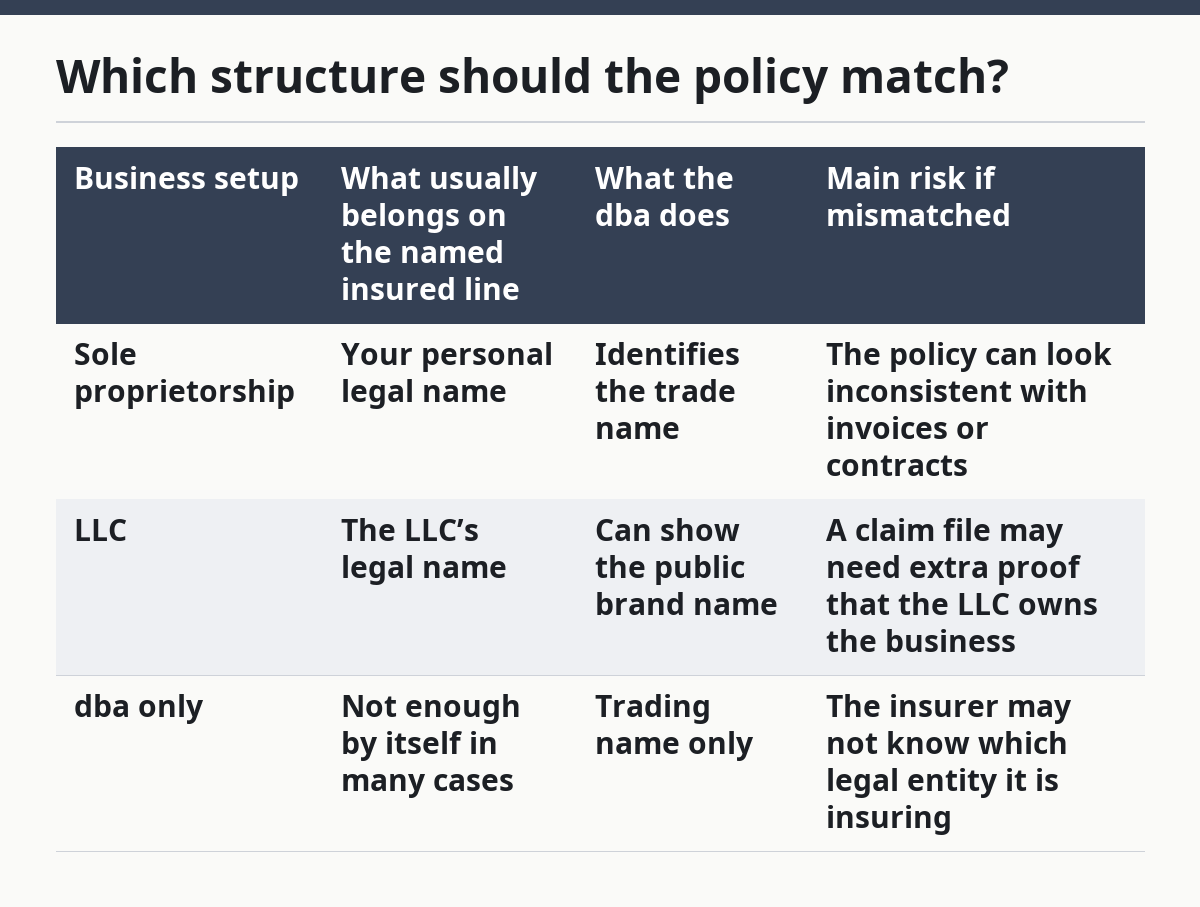
For a sole proprietorship, the named insured is often your personal legal name. A sole proprietorship and the owner are the same legal person, so the policy may read as the individual, with or without the dba attached. For an LLC, the named insured should usually be the LLC itself, because the LLC is the separate business entity. If you operate under a dba, the dba can be listed as an “also known as” name, but it should not replace the real entity.
| Business setup | What usually belongs on the named insured line | What the dba does | Main risk if mismatched |
|---|---|---|---|
| Sole proprietorship | Your personal legal name | Identifies the trade name | The policy can look inconsistent with invoices or contracts |
| LLC | The LLC’s legal name | Can show the public brand name | A claim file may need extra proof that the LLC owns the business |
| dba only | Not enough by itself in many cases | Trading name only | The insurer may not know which legal entity it is insuring |
The best fit is the one that matches your formation papers and business records. If your tax filing, bank account, and client contract all use different names, slow down and line them up before the policy is issued.
How do I choose the right named insured structure?
You choose the right named insured structure by tracing the work back to the legal entity that owns it, then making the policy declarations mirror that entity exactly. This is a 7-step check, and each step should be done before the policy is bound.
- Write the exact legal name of the business. Use the name on formation papers, tax records, or the sole proprietor’s personal name, not the marketing name. Verify that the spelling, punctuation, and entity type match. A problem sign is a nickname, shortened brand, or missing LLC designator.
- Identify the business entity type. Mark whether it is a sole proprietorship, LLC, partnership, or another form. Verify the entity type against the formation document. A problem sign is not knowing whether the business is separate from you or just you doing business.
- Add the dba only as a trade name. If you use a “doing business as” name, place it after the legal name or in the insurer’s trade-name field if offered. Verify that the dba does not replace the legal entity. A problem sign is a policy that names only the studio name and nothing else.
- Match the policy declarations to the legal entity. The declarations page is the summary that identifies the named insured, limits, and basic policy facts. Verify that the named insured line matches the entity that signs work. A problem sign is one name on the contract and another on the policy.
- Check client contracts and vendor forms. Compare the policy name with the name used in at least one client agreement. Verify that the insured party named on the contract can reasonably be the same party on the policy. A problem sign is a contract signed by an LLC while the policy names only the owner’s personal name.
- Confirm ownership and control. If the LLC has one owner, the result is usually simple. If there are multiple owners or layered entities, verify who actually controls the freelance work and billing. A problem sign is split ownership with no clear operating entity.
- Ask for the policy wording in writing before issuance. Request the exact name format the insurer will use. Verify that the issued document repeats that format in the same order. A problem sign is any verbal promise that the paperwork can be “fixed later.”
The practical goal is consistency. Your formation record, invoices, contracts, and policy declarations should all point to the same legal thing, even if your logo says something else.
Can a dba be listed as the named insured?
A dba can be listed on the policy, but it should not act as the only legal name if the dba is not a real business entity. A dba is a trading name, not a separate person or company.
That difference matters because the insurer needs to know who it is contracting with. If your policy says “Bright Pixel Studio” and nothing else, that may leave out the sole proprietor or the LLC behind the brand. The cleaner version is often “Legal Name dba Bright Pixel Studio,” or the insurer’s equivalent format.
This is where small wording errors cause real friction. A client may invoice one name, a bank account may hold another, and the policy may carry a third. None of that automatically breaks coverage, but it can slow claim review and make it harder to show that the named insured owns the freelance business.
If you use a dba, keep the legal entity at the front unless the insurer says otherwise. The brand name can sit beside it; it should not stand alone unless the business really is that name in law.
What is the difference between named insured and additional insured?
The named insured is the main policyholder; an additional insured is a different party added for limited protection under specific terms. They are not interchangeable, and mixing them up is a common setup error.

The named insured owns the policy relationship. The additional insured usually appears because a client, landlord, or partner wants protection for their own interest in your work. That does not make them the business owner, and it does not replace the legal entity that should be listed first.
| Item | What it is | Why it matters |
|---|---|---|
| Named insured | The main person or business entity on the policy | It should match the freelance business structure |
| Additional insured | A third party added by endorsement or wording | It protects that party only in the way the policy allows |
This distinction is worth getting right because the wrong name on the wrong line creates a false sense of order. A policy can look active while still naming the wrong party as the one running the business.
When should you stop and get qualified help?
You should stop and get qualified help when the business structure and the insurance paperwork do not line up cleanly. That is a naming problem, but it can also be a legal-entity problem, which is larger than a simple form correction.

You formed an LLC but still sign freelance contracts in your personal name: the policy may not match the entity actually taking the work — get the names aligned before binding coverage.
You use one dba for client work and another for billing: the paper trail is split — ask for a review of which name should be primary.
The business has more than one owner: ownership may affect who should be listed and how the insurer views control — do not guess.
Your client contract names a different entity from your policy: the mismatch can create dispute fuel if a claim arises — fix the structure first.
You recently changed entity form, but the policy was issued under the old structure: the old form may not reflect the current business — have the documents checked before renewal or endorsement.
Your work crosses borders or uses local registration rules you do not know: naming rules differ by country and can change — use a qualified adviser familiar with the place where the business operates.
The rule is simple: if the answer takes more than one sentence, or if you need to interpret formation papers to decide, the issue is bigger than a quick checkbox.
What mistakes do freelancers make most often?
Freelancers most often make four naming mistakes, and each one creates paperwork trouble that can spread into a claim file. These are the ones that show up again and again.
First, they list only the dba. That can leave the legal entity hidden, which makes the policy less clear than it should be. The fix is to put the actual entity first and treat the dba as a trade name.
Second, they leave the LLC off the policy because they “go by” the studio name. That can make the coverage record disagree with the formation record. The fix is to use the LLC’s full legal name, even if the website never shows it.
Third, they use the owner’s personal name for a business that is no longer a sole proprietorship. That turns a neat filing shortcut into a mismatch. The fix is to mirror the current business form, not the old one.
Fourth, they assume the declarations page is only administrative. It is not. The declarations page is where the policy’s basic identity is set, so a wrong name there is not a typo to ignore.
A fifth mistake is failing to keep contracts and insurance aligned. If a client agreement names one business and the policy names another, the gap can slow the path from claim to resolution. The correct alternative is consistency across the formation document, contract, and policy.
How do I keep the policy clean as the business changes?
You keep the policy clean by reviewing the named insured any time the business form changes, not just at renewal. A freelance business can move from sole proprietorship to LLC, pick up a dba, or add a partner, and each change can alter the right name on the policy.

The easiest check is a 3-document review: formation record, client contract, and policy declarations. If all 3 show the same legal entity and the same basic business name, the setup is usually cleaner than one that mixes formats. If one document is off, do not assume the insurer will sort it out later.
A good result is boring in the best way. The policy should show one legal entity, one clear trade name if needed, and no uncertainty about who the insurer is dealing with. If the name on the policy feels like a puzzle, it probably needs another pass before the paperwork is final.
Who should be the named insured on a freelance policy?
The named insured should be the legal person or business entity that actually does the freelance work. If you are a sole proprietor, that is often your personal legal name; if you formed an LLC, it is usually the LLC. A dba can sit alongside that name, but it should not replace the real entity unless the insurer’s paperwork clearly says otherwise.
Can a dba be listed as the named insured?
A dba can appear on the policy, but it usually should not stand alone if it is only a trade name. A dba is not a separate legal business by itself; it is the name the public sees. The policy should still identify the real owner or entity behind it so the contract matches the business structure.
What happens if the policy names the wrong business entity?
If the policy names the wrong business entity, the paperwork no longer matches the business that is actually operating. That can create claim delays, requests for more documents, and confusion about who the insurer intended to cover. The fix is to correct the entity name as soon as the mismatch is found, with help from a qualified adviser if the structure is unclear.
Drafted with AI; not yet reviewed by a person.
