

Last updated: November 22, 2026
Choose an umbrella policy only after you know which underlying liability policies it sits over, what your current liability limits are, and whether your work creates claims that are covered by that excess layer. For a freelancer, umbrella insurance is usually about adding another layer above an existing general liability insurance or professional liability insurance policy, not replacing those policies.
Key takeaways
- Umbrella insurance is an excess layer, so it matters most when the underlying policy limit is already in place.
- The policy has to attach above the right base coverage; if the carrier will not follow your general liability or professional liability policy, the umbrella may not help where you expect.
- The cheapest-looking option can be the wrong one if it excludes the kind of claim your freelance work can create.
- Rules vary by jurisdiction, and this is general information, not legal advice. A qualified lawyer should be consulted for a specific matter.
- The safest choice is the one that fits the full liability stack, not just a single number on the declarations page.
Who should use umbrella insurance for freelance work?

Umbrella insurance is for a freelancer who already has one or more primary liability policies and wants extra protection above those limits. It makes sense when a contract, client requirement, or work profile creates claims that could run past the base limit on a general liability insurance policy or, in some cases, a professional liability insurance policy.
This page applies to people who already know the difference between a primary policy and an excess layer, even if only roughly. An underlying policy is the first policy that pays a covered claim; an umbrella sits above it after the underlying limit is used up. A liability limit is the most the insurer will pay under that policy, before defense costs or after them depending on the policy wording.
This is not a page about buying a first policy from scratch. It also is not the right guide if the real question is whether your freelance business needs a higher limit on the base policy itself. That is a different decision from choosing an umbrella. For a full map of the topic, the hub on freelancer insurance policy selection — The Complete Guide — covers the wider coverage choices.
Rules vary by jurisdiction, and this is general information, not legal advice. A qualified lawyer should be consulted if a contract, local rule, or dispute turns on how excess coverage works in a specific place.
How does umbrella insurance attach to freelance liability limits?
Umbrella insurance attaches after the underlying policy limit is exhausted, but only for claims the umbrella policy says it covers. That is the key point for freelance liability limits: the umbrella is not a blank second copy of the first policy.
In plain terms, the carrier looks at the first layer, such as a $1 million general liability insurance policy, and then checks whether the claim still fits within the umbrella terms after that layer is used up. If the umbrella is written to sit over a listed underlying policy, it may follow that policy’s form for some claims and add its own rules for others. If the umbrella does not attach to the right line of coverage, the extra limit can be useless for the loss you care about.
The phrase excess coverage means coverage that pays above another policy. A liability stack is the order in which policies respond to a claim, from the first dollar layer to the later excess layers. Freelancers need to look at the whole stack, not just the top layer, because the umbrella can only help if the lower layer exists and matches the umbrella’s attachment rules.
A practical rule: if the underlying limit is too low, the umbrella may still leave a gap before it starts. If the underlying policy is the wrong type, the umbrella may not attach at all. That is why the word “over” in umbrella insurance is not just a metaphor; it is the structure of the contract.
What should be checked before choosing a limit?
The limit should be chosen by checking the underlying policy, the work you do, and the claims the umbrella will actually follow. A limit that looks large can still be too small if the attachment point is wrong or the policy stack is incomplete.
-
Read the declarations page of each base policy. Confirm the exact limit and the policy form number, if shown. Verify that the underlying limit is what the umbrella expects. A problem is any gap between the umbrella’s required underlying policy and the policy you actually hold.
-
List every policy the umbrella must sit above. Include general liability insurance, professional liability insurance, and any other liability policies the umbrella names. Verify that each one appears on the umbrella schedule. A problem is a carrier that only recognizes one policy type while your risk sits in another.
-
Check the attachment point. Find the dollar amount where the umbrella starts. Verify that it is higher than the base policy limit, not lower. A problem is a mismatch that leaves the first layer uncovered or partially uncovered.
-
Compare covered claim types. Look for whether the umbrella follows bodily injury, property damage, personal and advertising injury, or professional claims, depending on the policy wording. Verify that the claim type fits your freelance work. A problem is assuming one umbrella covers every loss the same way.
-
Look for excluded acts and business activity limits. Read the exclusions tied to your trade, your online work, or your contract work. Verify that the exclusion does not wipe out the main risk in your business. A problem is a policy that seems broad but excludes the exact service you sell.
-
Check for defense cost treatment. Some policies handle defense costs differently from indemnity payments. Verify whether the limit is eroded by defense costs or sits on top of them. A problem is a small-looking limit that disappears faster than expected.
-
Match the umbrella to your contracts. Some client agreements require proof of a specific underlying limit and excess amount. Verify that the certificate wording and policy schedule match the contract. A problem is buying the right policy on paper but failing the contract test.
-
Review how many layers you already have. If you carry one base policy and one umbrella, the stack is simple. If there are 2 or 3 layers, verify the order and the drop-down rules. A problem is overlap that creates confusion about who pays first.
A good result is a stack where the umbrella sits above the correct policy, starts where you expect, and answers the claims your freelance work can actually generate. A bad result is a policy with a bigger number but the wrong attachment point.
Which policy should the umbrella sit over?
The umbrella should sit over the policy that covers the liability you are most worried about, and the answer is not always the same for every freelancer. For some people that is general liability insurance; for others it is a policy that includes professional liability insurance.
Here is the practical difference:
| Base policy | Common role in the stack | What the umbrella may add | Main risk if chosen badly |
|---|---|---|---|
| General liability insurance | First layer for bodily injury and property damage claims | Extra dollars above the base limit | No help for service-based disputes if the claim is professional in nature |
| Professional liability insurance | First layer for errors, omissions, or professional services claims | Extra dollars above covered professional claims, if the umbrella follows that form | The umbrella may not attach to the kind of claim a freelancer actually faces |
| Both policies | Two-layer stack with separate trigger points | Broader protection when both lines are recognized | Confusion if each policy has a different underlying limit or exclusion |
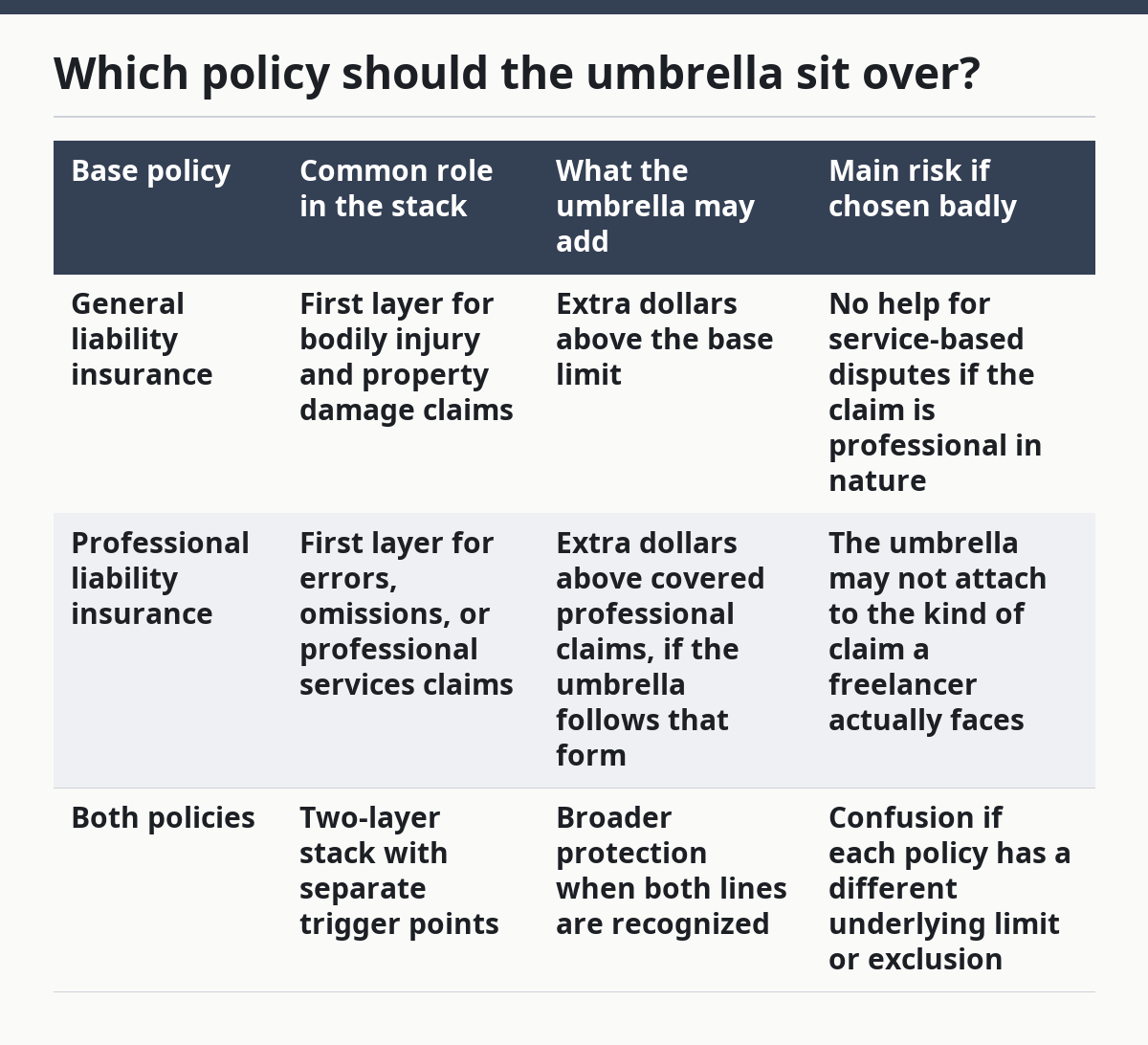
The important check is not the label alone. It is whether the umbrella follows the same type of claim and the same underlying policy structure. If the umbrella only follows general liability, a design mistake, advice error, or missed deadline may still sit outside it. If the umbrella only follows professional liability, a slip-and-fall claim at a client site may be treated differently.
This is where a generic article often gets it wrong: it talks about umbrella insurance as if one policy fits all freelance work. It does not. The right policy is the one that matches the liability stack already in place, not the one with the broadest-sounding name.
What mistakes cost freelancers the most?
The biggest mistakes are buying excess coverage before checking the underlying policy, treating every umbrella as interchangeable, and assuming a higher number always means better protection. Those mistakes can leave the claim in the wrong layer or outside the stack entirely.
Choosing an umbrella without a matching underlying policy: This means the excess layer has nothing proper to attach to — the fix is to confirm the primary policy first. A $1 million umbrella is not useful if the carrier requires a different base policy than the one you carry.
Ignoring the attachment point: This means the umbrella starts above a limit you do not actually have — the fix is to line up the schedule and the declarations page. If the attachment point is off by even one policy layer, the claim can stall.
Assuming professional liability and general liability are interchangeable: This means a contract dispute can be treated differently from a property or injury claim — the fix is to identify the exact claim type. A freelance editor, developer, or consultant may need a very different stack from a photographer or event worker.
Reading only the limit, not the exclusions: This means the headline number hides a narrower policy — the fix is to read the exclusions section before buying. A policy with a larger limit can still be worse if it excludes the service that creates the loss.
Forgetting that rules vary by jurisdiction and contract: This means a clause that works in one place may not help in another — the fix is to check the local rule set and the client agreement. For a matter that turns on law or contract wording, a qualified lawyer should be consulted.
When does the standard approach not apply?
The standard approach does not apply when the umbrella will not follow the policy you actually need, when the underlying policy is missing, or when a contract requires a different liability structure. Those situations change the decision from “buy extra layer” to “rebuild the stack.”
The underlying policy is not in place: The umbrella has nothing to sit over — get the base policy first.
The claim is outside the umbrella’s covered class of loss: The excess layer may not respond to the type of loss you expect — get the wording checked before relying on it.
The contract requires a specific limit or a specific insurer form: A generic umbrella may fail a contract test — confirm the requirement in writing before you rely on it.
The freelancer has several separate lines of work: One limit may not fit all services — split the stack by exposure and check each policy’s schedule.
The policy wording uses unfamiliar trigger language: If the attachment point, follow-form language, or defense-cost rule is unclear, the risk is that the umbrella pays later than expected or not at all — get the wording interpreted before purchase.
A dispute is already in motion: A policy bought after a problem starts may not help with that problem — do not assume new coverage will solve a live claim.
What does a good freelance umbrella setup look like?
A good setup is simple on paper and matched to the real liability stack beneath it. The policy schedule should name the correct underlying policy, the limit should sit clearly above that layer, and the covered claim types should line up with the work the freelancer actually does.
In practice, that usually means three things. First, the base policy limit and the umbrella attachment point fit together without a gap. Second, the umbrella recognizes the right policy type, such as general liability insurance or professional liability insurance. Third, the exclusions do not hollow out the main reason for buying the policy.
A useful test is to imagine a claim that starts in one layer and then climbs. If the claim can move from the underlying policy to the umbrella without a fight over form, trigger, or excluded work, the stack is working. If the answer depends on guesswork, the stack is not ready.
This is the point where a freelancer should slow down, not speed up. A bigger limit on the wrong structure is still the wrong structure.
FAQ
Can freelancers buy an umbrella policy?
Freelancers can often buy umbrella insurance, but availability and wording vary by jurisdiction and insurer. The question is not only whether the policy is available; it is whether it attaches to the right underlying policy and the right kind of claim. A lawyer should review any contract or legal issue tied to that decision.
What policies does an umbrella sit over?
An umbrella sits over the underlying policy or policies named in its wording, often a general liability insurance policy and sometimes other listed liability policies. It does not automatically sit over every policy a freelancer owns. The schedule and attachment language control the order of payment.
When is an umbrella useful for a freelancer?
An umbrella is useful when a covered claim could exceed the limit of the primary policy and the umbrella is written to follow that same risk. It is most useful after the base liability limit is already in place. If the umbrella does not match the claim type, the extra layer may not help.
Drafted with AI; not yet reviewed by a person.
