
Last updated: November 22, 2026
Quick answer: add cyber coverage as a separate layer in 7 steps, then review it once a year. How to Add Cyber Coverage to a Freelance Insurance Program is about matching the cyber form to the data you handle, not replacing professional liability or general liability. For a freelancer handling client files, payment details, logins, or other personal data, the usual liability policy often leaves data breach response, ransomware, and privacy liability exposed. This is information, not financial advice; a qualified adviser should review your own situation.
Key takeaways
- Cyber insurance fills gaps that liability policies usually do not cover, especially for data breach response and ransomware.
- The cleanest setup starts with a list of what client data you touch, where it lives, and who can reach it.
- A policy can look broad on paper and still miss key losses if the wording excludes privacy liability, system restoration, or social engineering.
- The right fit depends on your file flow, contract terms, and whether you store data in one place or across several tools.
- If you cannot clearly describe your data handling in 5 minutes, the policy review is not ready yet.
Who needs cyber coverage in a freelance policy stack?

Cyber coverage belongs in a freelance policy stack when client data moves through your laptop, cloud drive, email, password manager, payment portal, or project system. That includes names, addresses, invoices, account logins, tax files, drafts, and any record that could trigger a privacy claim if exposed.
A generic professional liability policy can respond to mistakes in your work, but it often does not pay for breach notification, credit monitoring, forensic review, or data recovery after ransomware. Those costs sit in a different bucket. The policy gap is why cyber insurance exists as a separate line, even for one-person businesses.
This page fits freelancers who already carry some business insurance and want to understand where cyber coverage plugs in. It is not the right starting point for a reader still trying to decide whether they even have client data risk. That question belongs on another page. If you need the broader map of freelance policy choices, the hub on Freelancer insurance policy selection — The Complete Guide is the right next stop.
One plain way to think about it: if a breach could lead to notice letters, a forensic report, or a claim that client information was exposed, cyber coverage is the policy to examine. If the only loss is a bad project outcome, cyber coverage may not be the main answer.
What does cyber insurance add for freelancers?
Cyber insurance adds response costs that most liability policies do not treat as the core loss. For many freelancers, that includes breach response, ransomware support, client file exposure, and privacy liability, but the exact scope depends on the form and the carrier. If you are unsure, ask a qualified adviser to compare the wording against your work.
A common gap is timing. A freelancer can discover a breach on a Friday night and need help fast. A cyber policy is built to cover incident response steps such as forensic work, legal review of notice duties, and communications tied to the event. The policy wording matters because some forms cover only certain incidents, such as network intrusion, while others also address accidental disclosure or theft of devices.
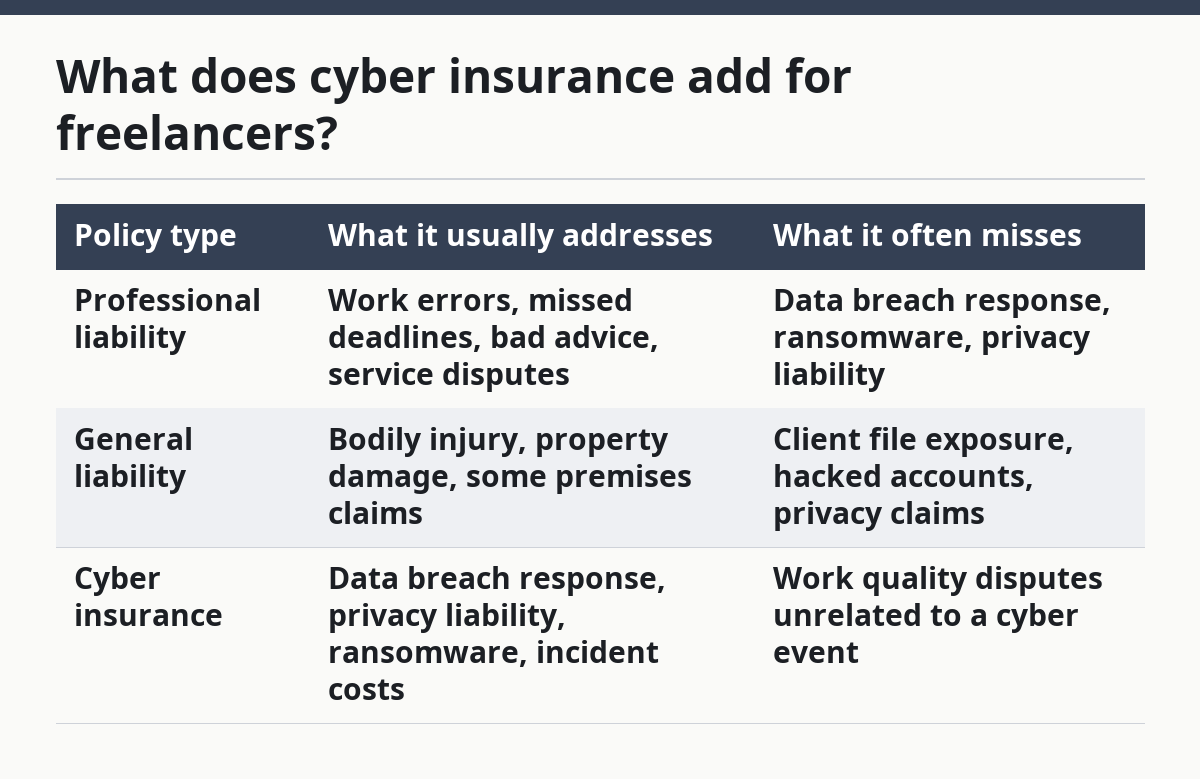
The table below shows the usual difference between policy types. It is not a universal rule, because wording differs by insurer and country, but it is the comparison most freelancers need first.
| Policy type | What it usually addresses | What it often misses |
|---|---|---|
| Professional liability | Work errors, missed deadlines, bad advice, service disputes | Data breach response, ransomware, privacy liability |
| General liability | Bodily injury, property damage, some premises claims | Client file exposure, hacked accounts, privacy claims |
| Cyber insurance | Data breach response, privacy liability, ransomware, incident costs | Work quality disputes unrelated to a cyber event |
A policy can still be narrow even when it says “cyber” on the front page. If the wording excludes social engineering, limits privacy liability, or requires a specific security setup, the coverage may not match the freelancer’s real exposure. That is the main trade-off: cyber insurance can fill a real hole, but only if the definitions line up with how the business actually works.
For background on incident response and breach handling, the U.S. Federal Trade Commission’s guidance on data breach response and the National Institute of Standards and Technology’s Computer Security Incident Handling Guide are both useful reference points. Their standards are not insurance forms, but they show the kind of event a policy may need to react to.
How do you add cyber coverage step by step?
You add cyber coverage by mapping the data flow first, then matching policy wording to the risks in that map. The process is usually done in 7 steps and takes at least one focused review of about 30 to 60 minutes, depending on how many systems the freelancer uses. For a small freelance setup, that first review is often enough to spot the main gaps.
- List every place client data lives. Write down email, cloud storage, payroll tools, invoice software, project apps, password managers, and local devices. Verify that each place is included; if a tool is missing, the exposure map is incomplete.
- Mark the data types handled in a normal month. Separate personal data, payment data, drafts, contracts, and login credentials. Verify whether any of it could trigger privacy liability or notification duties; if not, the list is too vague to guide coverage.
- Identify the cyber events that would hurt most. Focus on ransomware, stolen credentials, accidental file sharing, and a lost laptop or phone. Verify that the policy language names those events or the closest defined terms; if it only covers one narrow event, the protection may be too thin.
- Check whether breach response is included. Look for forensic services, legal review, notice costs, and credit monitoring if the policy offers them. Verify that the policy does not make these optional extras by default; if they are missing, the main reason for cyber coverage is weakened.
- Review how the policy treats client file exposure. Some forms cover the exposure of confidential business records, while others focus only on personal data. Review the wording with a qualified adviser so the file category matches what you actually hold; if it only applies to one category, there may be a blind spot.
- Read the ransomware and extortion wording. Check whether payment, system restoration, and related response costs are covered under the same section or split apart. Verify any conditions on approval or reporting; if the form requires a step you cannot meet quickly, the claims process may be harder in a real incident.
- Compare the cyber form with the rest of the stack. Place it next to professional liability and general liability to see if any event is covered twice or not at all. Verify that one policy is not excluding a risk the other was assumed to handle; if there is overlap with a large exclusion, the stack is weaker than it looks.
- Review contracts and platform rules that mention insurance. Some clients require specific cyber language, not just a generic policy. Verify that the coverage description matches the contract term; if it does not, the policy may be technically present but commercially useless for that job.
The most useful result is simple: after this review, you can explain in one minute what a breach, ransomware event, or privacy claim would trigger. If you still need to guess, the policy stack is not clear enough yet.
What should you check before you add it?
You should check the policy wording, exclusions, and incident duties before you add cyber coverage to a freelance program. A clean premium line means little if the form excludes the very event you worry about.
Start with definitions. “Privacy liability” and “network security liability” are not always used the same way, and “client data” may be defined more narrowly than you expect. If the policy only protects certain named records, the rest of the file set may sit outside the form. Also check whether the policy requires prompt notice, approved vendors, or a minimum level of security such as multi-factor authentication.
A second check is how the insurer treats third-party systems. Freelancers often store work in cloud tools they do not own, so a breach can start with a vendor account, not a device on the desk. The cyber policy should still describe that path clearly. If it does not, ask for the exact wording to be explained in plain language before anything is bound.
The third check is whether the policy covers response costs separately from liability claims. That split matters because a freelancer may need help before any lawsuit arrives. The ISO and NIST material on incident handling makes that sequence plain: detect, contain, investigate, notify, then recover. A policy that only pays after formal legal action can be too late for the first wave of costs.
When should the standard setup change?
The standard setup should change when the freelancer’s data flow, contract terms, or system setup is unusual. A basic cyber form is not the wrong tool for everyone, but it is not enough in every case.
If client work includes regulated personal data: that raises the stakes of a breach and may call for tighter wording around privacy liability — check whether the policy responds to the records you actually hold, not just generic data. If the policy language is vague, the gap can appear only after a loss.
If several contractors share the same accounts: that creates a higher chance of credential misuse — change to stronger account controls and confirm whether the policy distinguishes between authorized users and outsiders. If it does not, the claims path can get messy.
If the freelancer uses a lot of cloud tools: that adds vendor dependency — verify whether the policy treats cloud account compromise as a covered cyber event. If it only addresses malware on a local device, the setup is too narrow.
If a contract demands specific cyber terms: the client may require notice obligations, minimum limits, or proof of coverage wording — match the policy to the contract before the project starts. If the terms do not line up, the issue is not just insurance; it is contract compliance.
If the business has no clear incident process: that means response duties may fail under pressure — set the process first or get help from a qualified adviser. A policy with a 24-hour notice rule is hard to use if nobody knows who calls whom.
A plain limit matters here: cyber insurance is not a fix for weak passwords, poor file sharing habits, or a laptop with open access to everything. It can pay for part of the mess after a cyber event, but it does not prevent the event itself.
What mistakes do freelancers make most often?
Freelancers most often make 5 mistakes when they add cyber coverage, and each one can leave the policy weaker than it looks.
They assume professional liability already handles data loss. The consequence is a false sense of coverage after a breach. The better alternative is to read the cyber section separately and check whether breach response and privacy liability are named.
They focus on the premium instead of the definitions. The consequence is buying a policy that looks similar to another one but excludes the real risk. The better alternative is to compare wording on data breach response, ransomware, and client file exposure first.
They leave out the tools they actually use. The consequence is that a cloud account, phone, or backup system may not be part of the risk map. The better alternative is to list every system touched in a normal workweek, even if it feels minor.
They ignore contract language. The consequence is a policy that exists but does not satisfy a client requirement. The better alternative is to match the policy description to the contract before signing the job.
They treat cyber coverage as a one-time task. The consequence is drift: new apps, new storage, and new vendors appear, but the policy stays the same. The better alternative is a 12-month review cycle, or an earlier check after any major tool change.
How do you know the setup is working?
The setup is working when the freelancer can identify, in plain language, what happens after a breach, a ransomware event, or a privacy claim. That answer should fit in a short note, not a 2-page guess.
A good result usually has 3 parts. First, the data map is current. Second, the policy wording matches that map. Third, the response path is clear enough that someone could act within the first hour of an incident. If any one of those parts is missing, the setup is incomplete.
This is the point where a qualified insurance adviser or broker can be useful, especially if the freelancer has contracts with notice requirements, uses multiple cloud vendors, or handles personal data across borders. Insurance wording changes often, and local rules differ by country, so there is no universal checklist that fits every business. The goal is not to buy more cover by default; it is to make sure the cyber layer matches the actual risk stack.
Do freelancers need cyber insurance?
Freelancers need cyber insurance when a data breach, ransomware event, or privacy claim could create costs that their other policies do not cover. It is most relevant when client data passes through email, cloud tools, or shared platforms. The right answer depends on the work, the contracts, and the data involved, so a qualified adviser should review the situation.
Does professional liability cover data breaches?
Professional liability often does not cover the full cost of a data breach. It is built mainly for work errors, missed deadlines, and bad service claims, while cyber insurance is built for breach response, privacy liability, and ransomware-related costs. The exact split depends on policy wording and country-specific rules.
What does cyber insurance add for freelancers?
Cyber insurance adds coverage for the costs that follow a cyber event, such as forensic review, breach response, and some privacy claims. It can also help with ransomware and client file exposure, depending on the form. The main value is not the label on the policy; it is the set of expenses the other policies leave behind.
Drafted with AI; not yet reviewed by a person.
