

Last updated: November 24, 2026
Quick Answer: In 3 parts, explain How to Explain a Freelance Business With No Prior Insurance History by giving the business formation date, the client-work pattern, and the written risk controls. Explain it as a new venture with a clear business formation date, a real client-work history, and concrete risk controls, not as a gap that needs to be hidden. An underwriter is looking for what the freelance business does now, how long it has existed, and what evidence supports that story. This is information only, not financial advice; for your own situation, a qualified adviser should review the application before you send it.

Key takeaways
- A blank prior insurance record is not the same as a blank business record.
- A careful explanation uses dates, client work history, and written controls, not excuses.
- A business formation date matters because it tells the underwriter when the risk started.
- Prior coverage gaps should be named plainly if they exist, then put in context.
- If the story is inconsistent across forms, invoices, and contracts, that is the real problem.
Who this is for, and what it assumes
This applies to a freelance business with no prior insurance history, including a brand-new new venture and a solo business that has never carried a policy in its own name. It assumes the reader already knows the business name, the business formation date, and the kind of work done for clients.
It also assumes there is something concrete to show: invoices, contracts, a website launch date, a client work history, or written risk controls. If none of that exists yet, the explanation is weak because the business itself is still thin on facts.
For context on underwriting and applications, the freelance insurance application and underwriting page and the freelance insurance for new businesses page can help. This is also the point where a generic article usually goes wrong. It treats “no prior insurance history” as if it were a defect by itself, but the better reading is that underwriters often care more about whether the current profile makes sense than whether the business has a policy file stretching back 5 years; if the form is unclear, consult an insurance professional. For general application guidance, see the NAIC consumer topics.
What should the explanation actually say?
The explanation should say that the business is new, what work it does, when it started, and what has been done to reduce risk. That is the core story a freelance applicant needs to tell an underwriter. The point is not to sound polished; the point is to sound consistent.
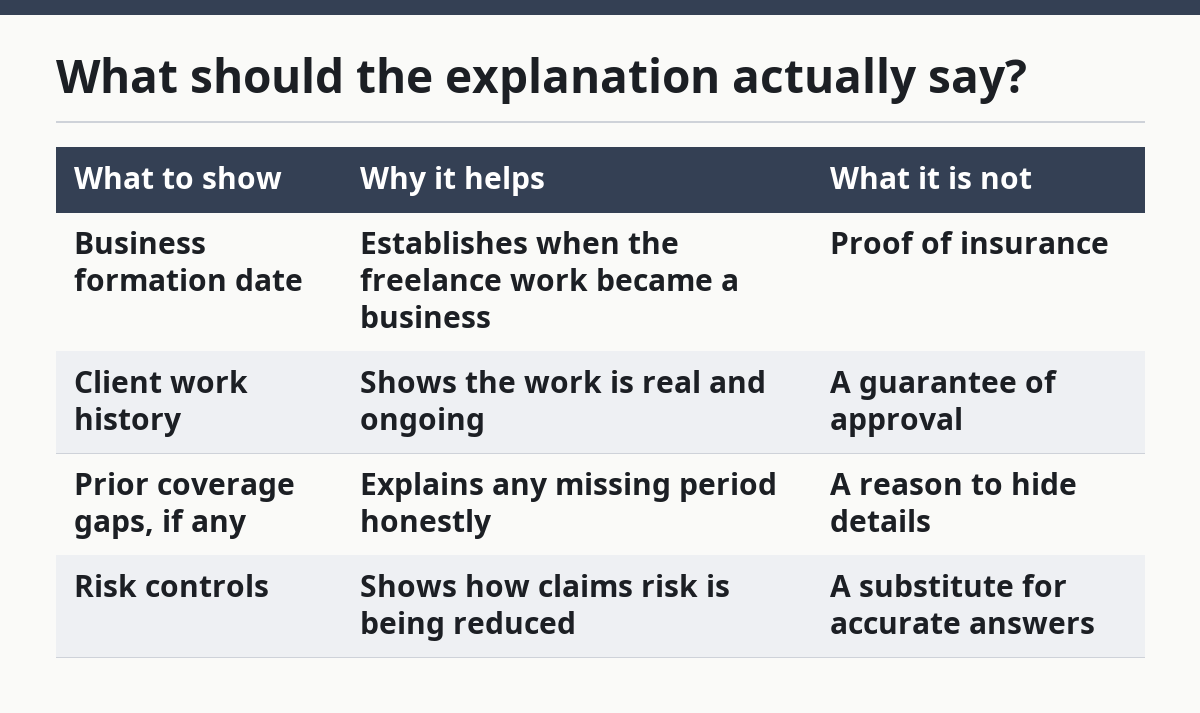
A useful explanation has four parts: the business formation date, the work performed, the client work history, and any prior coverage gaps. If the business started in a specific month and year, say so. If there were no earlier policies because the business did not exist yet, say that directly rather than trying to dress it up.
Here is the logic in plain terms: no prior insurance history gives the underwriter less to inspect, so the rest of the file has to do more work. That means invoices, contracts, and proof of controls matter more than a vague paragraph about “getting started.”
| What to show | Why it helps | What it is not |
|---|---|---|
| Business formation date | Establishes when the freelance work became a business | Proof of insurance |
| Client work history | Shows the work is real and ongoing | A guarantee of approval |
| Prior coverage gaps, if any | Explains any missing period honestly | A reason to hide details |
| Risk controls | Shows how claims risk is being reduced | A substitute for accurate answers |
For background on how insurance forms fit into the wider process, the hub on freelance insurance application and underwriting can help connect this page to the bigger application picture. For plain-language consumer guidance on policies and disclosures, see the Insurance Information Institute.
How do I explain it step by step?
Explain it in a short, factual sequence that matches the application, starting with the business structure and ending with the risk controls. A clean explanation is usually stronger than a long one. The goal is to answer the underwriter’s likely questions in the same order they would ask them.
- State the business formation date. Use the month and year the freelance business began operating, not the date the idea started. Verify that this date matches the application, tax records, and website launch if those exist. A mismatch is a problem because it makes the whole file look unreliable.
- Name the work the business does. Describe the service in one sentence, such as design, writing, consulting, or production support. Verify that the wording matches your contracts and invoices. If the description changes from one document to another, the underwriter may read that as a sign the business model is still unclear.
- Explain the absence of prior insurance history plainly. Say that the business is new, or that this is the first policy in the business’s name. Verify that the explanation matches the actual launch date. If the business had a prior policy under a different name or structure, that is not “no history” and should not be described that way.
- List client work history. Note the type of clients served and the general pattern of work over the last 12 months, or since launch if the business is younger. Verify that the timeline lines up with invoices or signed agreements. If the dates cannot be backed up, the explanation is too thin.
- Identify any prior coverage gaps. If there was a period with no policy before this application, name that gap and explain whether the business was inactive, newly formed, or simply uninsured. Verify that the gap is not hidden inside another answer. A hidden gap is a bigger problem than a short gap stated clearly.
- Describe risk controls. Mention the practical steps used to reduce error or loss, such as written contracts, scope limits, file backups, access controls, or review steps. Verify that the controls are actually in place, not just intended. If the controls are vague, they do not help much.
- Check consistency across the whole application. Read every date, business name, and work description side by side before submitting. Verify that the same facts appear the same way in all fields. One wrong date can create more doubt than a whole missing paragraph.
A good explanation does not sound defensive. It sounds organized. A bad explanation tries to explain away the lack of history instead of showing that the business profile is real enough to assess.
What can I show instead of prior insurance history?
You can show business facts that help replace the missing policy record, and the strongest items are those that tie directly to how the freelance business operates. The aim is not to imitate an old insurance file; it is to give the underwriter enough current evidence to assess the risk.
The most useful items are usually a business formation date, client work history, sample contracts, invoices, a website or portfolio with a clear launch date, and written controls for the work process. A 1-page business summary can also help if it is factual and consistent with the application.
Common examples of useful evidence include:
- a signed contract or statement of work
- invoices dated after the business formation date
- a portfolio page showing the kind of work performed
- client correspondence that supports the work timeline
- written procedures for file handling, revisions, or approvals
What does not help much is a general claim like “I have many years of experience” if the business itself is new and the application asks about the business, not the person’s entire past. That kind of statement can sound true and still fail to answer the underwriting question.
When should I stop and get qualified help?
You should stop and get qualified help when the facts are no longer simple enough to explain cleanly on the form. The issue is not whether the business is small; the issue is whether the application is easy to misstate by accident. A qualified adviser can help if the file is messy, not because the business is new.
Business name changed in the last 12 months: This can make the prior record look split across two entities — get help before submitting anything that mixes the old name and the new name.
The business had a long gap in operation: A gap can change how the work history is read — explain it carefully, or ask a qualified adviser if the dates are hard to reconstruct.
Client work was done before the current business existed: That history may belong to the person, not the business — do not force it into the wrong section.
There were past claims or incidents tied to the work: This can affect how the profile is viewed — leave nothing vague, and get advice if the wording feels uncertain.
The application asks for records you cannot support: If you cannot verify dates, contracts, or invoices, the risk of a bad answer is too high — stop and gather the missing documents first.
This is the right place to be cautious. A short explanation is helpful; a guessed explanation is not.
What mistakes do people make?
People usually make the same few mistakes, and each one creates a different kind of problem. The most common error is trying to make a new freelance business sound older than it is. That usually causes inconsistencies between the business formation date, the client work history, and the insurance form.
Another mistake is treating prior coverage gaps as something to hide. A gap that is plainly described is usually easier to read than a gap that shows up later in another document. If the gap is unclear or hard to document, consult a qualified insurance professional before you submit; a hidden gap can make the file look incomplete even if the business is legitimate. For consumer guidance on accuracy in applications, see the NAIC insurance application guidance.
A third mistake is giving a person-level story instead of a business-level story. The underwriter may care about your background, but the application still needs the business facts. If the file answers the wrong question, the explanation misses the mark.
A fourth mistake is overloading the application with loose language like “various clients” or “some projects.” Those phrases do not tell the reader what the business actually does. The fix is to use the same job title, service description, and dates everywhere.
A fifth mistake is listing controls that do not exist yet. A written policy that was never adopted is worse than no policy at all, because it creates doubt about the whole submission. If the process is still informal, say that plainly rather than inventing structure.
What changes when the business is brand-new?
A brand-new freelance business needs a shorter, tighter explanation, because there may be little or no client history to review. In that case, the business formation date becomes the anchor, and the explanation should focus on what is already active: the service, the first clients or prospects, and the controls in place from day one.
The main trade-off is obvious. A younger business has fewer records, so the underwriter has less history to read. That does not make the application impossible, but it does make consistency more important. One invoice, one contract, and one clear description can matter more than a long paragraph of background.
A brand-new business should not try to borrow the wrong history from the owner’s past job unless the application asks for that level of detail. If the form wants business history, give business history. If the form wants owner experience, answer that separately and keep the two timelines distinct. Mixing them is a common reason a file becomes hard to assess.
FAQ
Does having no prior insurance history hurt a freelance application?
It can make the file harder to assess, but it does not automatically make the application a problem. The underwriter has less past policy data to review, so the business facts have to do more work. A clean business formation date, client work history, and consistent answers usually matter more than the missing policy record itself.
What can I show instead of prior insurance history?
You can show the business formation date, invoices, contracts, a portfolio, and written risk controls. These items help explain what the freelance business does and how long it has been active. The key is consistency: the dates and service descriptions should line up across every document.
How do I explain a brand-new freelance business to an insurer?
Explain it as a new venture with a clear start date, a specific service, and any current client work that supports the timeline. If there is no prior policy because the business is new, say that directly. Keep the wording simple, factual, and matched to the form rather than trying to make the business sound older than it is.
Drafted with AI; not yet reviewed by a person.
