

Last updated: November 25, 2026
Quick Answer: In 3 checks, you can usually respond to How to Respond to a Client Insurance Requirement That Names Its Subsidiaries without agreeing to broader wording: confirm the named insured, compare the clause to the policy, and ask for the exact legal entity in writing. If the clause names subsidiaries, the clean response is to check whether your policy can match that wording and, if not, ask for narrower language tied to the named client entity. Do not treat “subsidiaries” as harmless filler: it can expand the promise beyond the party you actually contracted with, and that can affect your certificate of insurance, additional insured endorsement, and named insured wording. For a YMYL contract issue like this, consider a qualified insurance broker, adviser, or attorney if the wording is broad or unclear.
Key takeaways
- A clause that names subsidiaries is broader than a clause that names only the contract signer.
- The safest reply is usually to ask for the exact legal entity to be listed, but if the wording is unclear or the structure is complex, consult a qualified insurance adviser or attorney before agreeing.
- A certificate of insurance does not rewrite the policy, so it should not be used to “fix” an overbroad contract term.
- Group company wording, affiliate wording, and subsidiary wording are not the same thing, even when clients use them loosely.
- This is information, not financial advice; a qualified adviser should review your own policy and contract language.
What does “names its subsidiaries” mean?
It means the client wants the insurance promise to cover not only the contracting company, but also related companies it owns or controls. In contract language, a subsidiary is usually a separate legal entity under common ownership or control, while the named insured is the entity shown on the policy declarations page.
That difference matters because insurance follows legal names, not business nicknames. If the contract says “Client, its subsidiaries, affiliates, and related entities,” the insurer may not treat all of those as one insured party; for that reason, verify the exact wording with your broker or attorney and compare it to the policy form and endorsement language. A certificate of insurance can list a client name, but it does not change who the named insured is or expand coverage by itself. See also named insured vs. additional insured and certificate of insurance basics.
This is the point where many people get trapped by loose wording. A clause that looks routine can become a request to cover an entire corporate group, including companies you have never heard of and may never work with. That is why the issue is not just paperwork; it is contract scope.
How should I respond step by step?
I respond by narrowing the request, matching it to the policy text, and putting the revised wording back in writing. The goal is to keep the discussion about legal entities, not business labels. Use the following steps in order.
- Read the insurance clause line by line and mark every group term, including “subsidiaries,” “affiliates,” “parents,” and “related entities”; verify whether the clause names one legal entity or a family of entities, and flag it as a problem if the wording reaches beyond the company that signed the contract.
- Compare the clause against your policy declarations page and the additional insured endorsement; verify the named insured, the policy form, and whether any entity besides the named insured is already listed, and treat any mismatch as a sign that the contract needs revision. For reference, review the policy form with your declarations page and the endorsement wording.
- Draft a reply that asks for the exact legal name of the client entity, plus any subsidiary names that truly need to be covered; verify that your wording asks for precision, not a blanket refusal, and notice if the client’s draft still uses group language such as “all present and future subsidiaries.”
- Separate the contract promise from the certificate of insurance; verify that the certificate only reflects the policy as issued, and treat any request to use the certificate to cover unnamed subsidiaries as a red flag. See certificate of insurance requirements.
- Check whether the requirement is asking for additional insured status or just evidence of insurance; verify the exact phrase used, because “additional insured” is a policy status and “listed as certificate holder” is not the same thing, and note any confusion in the client’s draft.
- Replace broad family wording with narrow entity wording where possible; verify that the revised clause names the contracting company only, or names a short, defined list of subsidiary entities, and watch for “including without limitation,” which keeps the scope open-ended.
- Confirm the final text in writing before work starts; verify that the client accepts the revised legal names, and treat silence, partial approval, or side comments in email as unresolved if the final contract is not changed. If the clause is still broad, consult a qualified professional before signing.
- File the signed version with your insurance records and keep the email chain; verify that the final contract, certificate of insurance, and any endorsement requests all match the same names, and note any later change in corporate structure before renewal or a new project begins.
A useful reply is short and specific. “I can provide evidence for the named insured on the policy and the entity listed in the contract, but I need the exact legal name of any subsidiary that must be included.” That line keeps the discussion on the right track without conceding broad group wording.
What should I check before I answer?
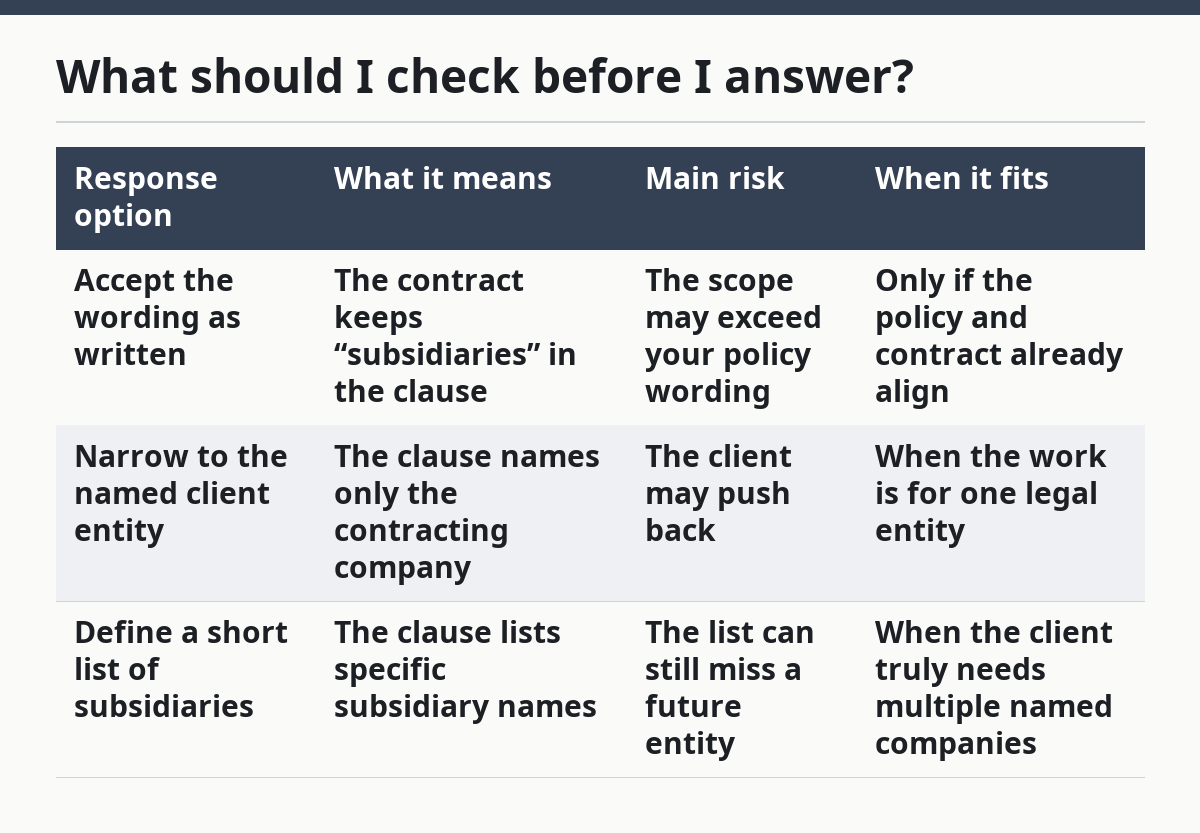
I check three things before I answer: who signed the contract, who is named on the policy, and whether the client is asking for affiliate language or subsidiary language. Those are not interchangeable. A subsidiary is a controlled legal entity; an affiliate can be broader, looser, and sometimes undefined unless the contract says otherwise.
I also check whether the client is asking for a certificate of insurance or an additional insured endorsement. A certificate is evidence of insurance, usually one page or a short form, and it does not expand coverage. An additional insured endorsement is different because it amends the policy itself, which is why the wording matters so much. See additional insured endorsement guidance.
This is where contract negotiation starts to beat guesswork. If the client wants “Client and its subsidiaries” but only one company is hiring you, the cleanest response is often to ask whether the subsidiary is a separate contracting party. If it is not, then the clause may be broader than the deal.
| Response option | What it means | Main risk | When it fits |
|---|---|---|---|
| Accept the wording as written | The contract keeps “subsidiaries” in the clause | The scope may exceed your policy wording | Only if the policy and contract already align |
| Narrow to the named client entity | The clause names only the contracting company | The client may push back | When the work is for one legal entity |
| Define a short list of subsidiaries | The clause lists specific subsidiary names | The list can still miss a future entity | When the client truly needs multiple named companies |
What if the client wants group company language?
Group company language means the contract tries to cover a corporate family instead of one named firm, and that is the point where wording needs discipline. “Group company,” “affiliate,” and “subsidiary” can all point to different legal relationships, so the clause should not rely on casual business terms.
Therefore, the best response is to ask for a definition inside the contract. If the client wants a family clause, the contract should say which entities are included and whether that list is fixed or can change later. Without that definition, the language can keep expanding every time the parent company buys or spins off another business.
A broad group clause also creates a certificate problem. A certificate of insurance usually names the holder and shows policy facts; it does not become a master list of every company in a group. That is why a vague clause can create a mismatch between the contract and the paperwork you can actually produce. For more context, see insurance certificate basics.
When should I stop and ask for help?
I stop and get qualified help when the clause changes the risk beyond a simple naming issue. This is a money-and-contract question, and the wrong answer can leave a gap between what the client expects and what the policy actually says.
The contract names “all subsidiaries now owned or later acquired”: that is open-ended group language — stop and get the wording reviewed before you agree, because future companies are not the same as current, named entities.
The client asks for “additional insured” status for every subsidiary: that may not match the policy form — stop and confirm what the insurer will actually recognize, because certificate language alone will not fix it.
The contract uses “affiliate” without a definition: the term may be broader than subsidiary — stop and ask for a list or a definition, because an undefined affiliate clause can sweep in unrelated entities.
The parent company signs, but the subsidiary will receive the work: that splits the legal party from the operating party — stop and check whether the named insured should match the entity performing the work.
The client wants the certificate to prove coverage for entities not on the policy: that is a paperwork mismatch — stop, because the certificate should describe the policy, not rewrite it. Industry guidance from IRMI and NAIC both explain that certificates do not change coverage.
On a YMYL topic like this, I do not treat guesswork as good enough. A qualified insurance adviser, broker, or attorney can help match the contract text to the policy form if the wording is broad or the corporate structure is complex.
What mistakes do people make most often?
The most common mistake is treating subsidiaries as if they are always covered because they belong to the same corporate family. That can leave the contract broader than the policy, and the fix is to name the actual legal entity instead of relying on ownership alone.
Another mistake is using the certificate of insurance as if it were the contract answer. The certificate is evidence, not a rewrite of the policy, so the correct move is to align the contract wording first and then issue a certificate that matches it.
A third mistake is accepting “affiliate” language without a definition. That can expand the clause beyond the companies you expected, so the better approach is to ask for a defined list or a narrow legal description.
A fourth mistake is ignoring the named insured on the declarations page. If that page does not match the contract party, the paperwork chain is already broken, and the correct alternative is to fix the legal name before the project begins.
A fifth mistake is answering by email only and never changing the contract. Email can show intent, but it does not always replace signed language, so the safer path is to get the revised wording into the final document.
How do I make the wording narrower without starting a fight?
I make it narrower by replacing open-ended group language with a defined legal name, then offering a short list only if the client truly needs it. That approach keeps the tone cooperative and avoids a flat refusal.
A practical reply can sound like this: “I can confirm coverage for the named insured on the policy. If a subsidiary must be included, please list the exact legal name so I can compare it with the policy wording and the certificate of insurance.” That sentence is direct, calm, and specific.
The trade-off is that a narrower clause may slow the contract signature by a day or two while names are checked. That delay is usually better than agreeing to wording that does not match the policy. For a freelance project, that kind of cleanup is part of contract negotiation, not a bonus task.
FAQ
Do subsidiaries count the same as the parent company?
No, a subsidiary is usually a separate legal entity, even when the parent controls it. That means a contract that names the parent may not automatically cover every subsidiary, and the policy’s named insured still controls what the insurance document says.
Can I add affiliates on a certificate?
No, a certificate of insurance does not change the policy or add new insured entities by itself. If the client wants affiliate coverage, the contract and the policy wording both need to be checked, because the certificate should reflect what already exists rather than create it.
Should subsidiaries be negotiated separately?
Yes, when the client wants coverage for more than one legal entity, each subsidiary should be treated as a separate wording issue. That keeps the request tied to real company names and reduces the chance that a broad family clause will outrun the policy or the work arrangement.
Drafted with AI; not yet reviewed by a person.
