
Last updated: November 23, 2026
Quick Answer: use 4 documents — the declarations page, old address, new address, and move date — and update freelance insurance after moving to a new state as soon as the move is final. In How to Update Freelance Insurance After Moving to a New State, the carrier, the policy address, and the policy territory should all be checked together, because a state change can affect which rules apply to your freelance liability insurance.
Key takeaways
- A new state can change more than a mailing address; it can change how the policy is rated, filed, and allowed to respond.
- The carrier is the first call, because it can tell whether the move is handled by an endorsement, a transfer, or a new application.
- Business registration and licensing matter because some policies follow the business location on file, not the place you slept last night.
- If the work crosses state lines, the policy territory needs a close check before the next invoice goes out.
- Keep the move date, old address, new address, and state filing records together so the next renewal does not start from the wrong facts.
What does a state move change on a freelance policy?
A state move can change the policy file, the rating basis, and the territory your freelance liability insurance says it covers. For a freelancer, that usually means the carrier may need a new state record, a revised address, and a fresh look at whether the policy still matches where the business is now registered.
This page is for freelancers who already have liability insurance and are moving their base to a new state. It assumes the policy is active, the move is real, and the business still exists after the move. It is not for someone opening a new business from scratch, adding a second office, or trying to disclose foreign clients; those are separate issues on the broader freelance business changes and policy updates hub.
The key idea is simple: a policy does not follow a person by wish alone. It follows the details on file, and those details may include the state, the address, the business registration, and the carrier’s filing rules. If any one of those changes, the policy should be checked before you rely on it.
How do I update freelance insurance after moving to a new state?
You update freelance insurance after moving to a new state by telling the carrier first, then matching the policy to the new state, address, and business records. The cleanest path is usually to treat the move as a records change, not just a mailbox change; if the filing is complex, consult a licensed insurance professional or attorney.
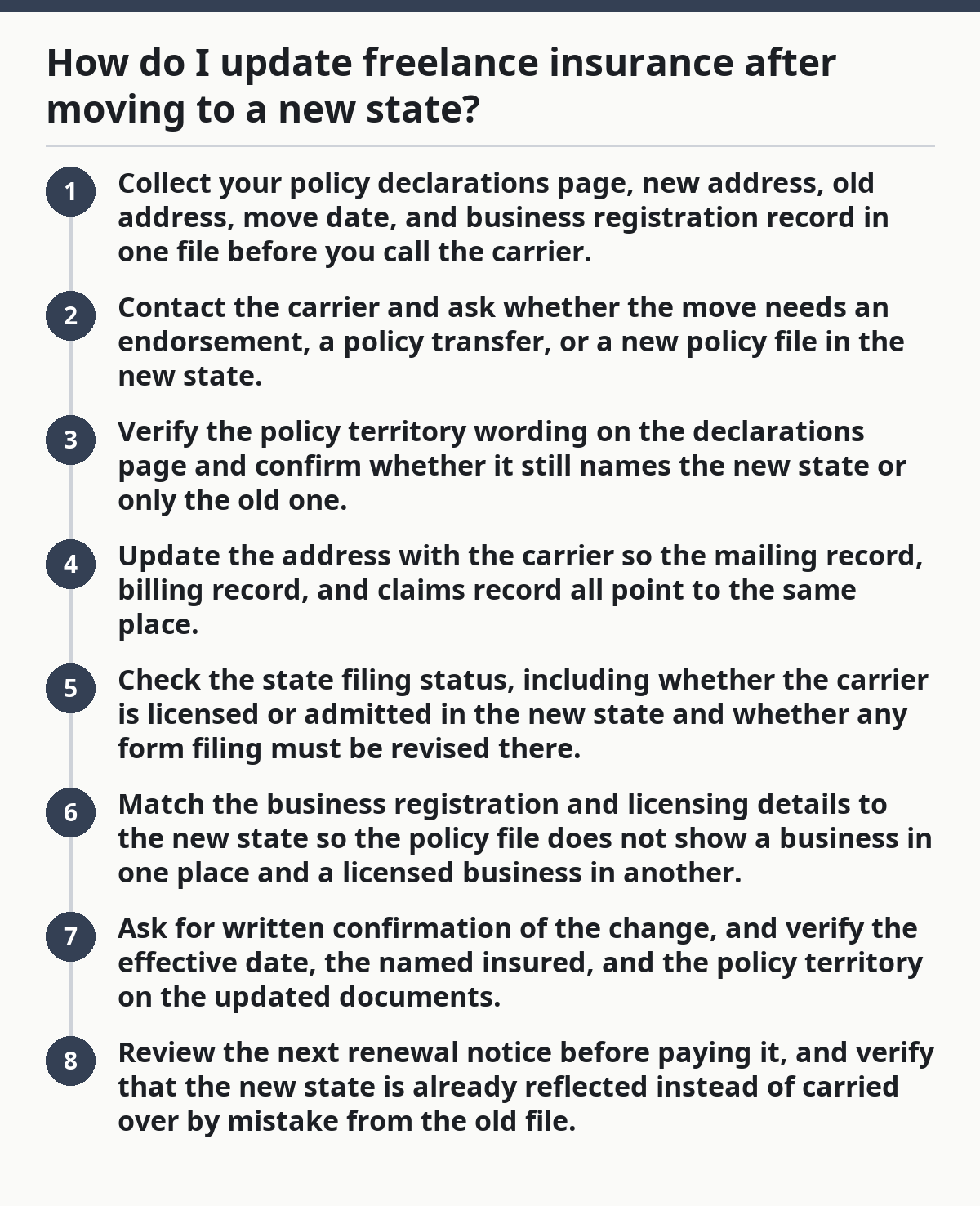
- Collect your policy declarations page, new address, old address, move date, and business registration record in one file before you call the carrier.
- Contact the carrier and ask whether the move needs an endorsement, a policy transfer, or a new policy file in the new state.
- Verify the policy territory wording on the declarations page and confirm whether it still names the new state or only the old one.
- Update the address with the carrier so the mailing record, billing record, and claims record all point to the same place.
- Check the state filing status, including whether the carrier is licensed or admitted in the new state and whether any form filing must be revised there.
- Match the business registration and licensing details to the new state so the policy file does not show a business in one place and a licensed business in another.
- Ask for written confirmation of the change, and verify the effective date, the named insured, and the policy territory on the updated documents.
- Review the next renewal notice before paying it, and verify that the new state is already reflected instead of carried over by mistake from the old file.
The first check is the declarations page, because that page usually shows the named insured, the address, and the policy period. If the state or address is wrong there, the rest of the file can be wrong too. A problem sign is a renewal notice that still lists the old state after the move is complete.
The second check is the policy territory. That term means the geographic area where the policy is written to apply. If the territory does not fit the new state, the move may need more than a mailing update.
What should be checked before the carrier changes anything?
The policy, the state filing, and the business record should all be checked before any change is finalized. A move creates three separate tracks: where the business is based, where it is registered, and where the carrier is allowed to write or keep the policy.
Start with the address on the policy because a wrong address can send notices to the old state. Then check the business registration, since a freelancer may need the new state record to line up with the insured entity name. If the business entity is different from the person, that mismatch can create delays or errors when the carrier updates the file.
Next, check the state filing side. Some policies and forms are tied to state rules, so the carrier may need to confirm that the coverage wording still fits the new state’s requirements. The state department of insurance is the right public office to look at for basic licensing and filing questions, even though the carrier usually handles the actual policy change. For consumer-level background, the NAIC and the IRS change of address page are two credible external sources.
A paper trail is most useful when it stays simple and complete. Keep the declarations page, the change confirmation, the registration record, and the move date in one folder. If the carrier asks for proof, the folder should answer in less than 5 minutes.
When does a move need more than an address update?
A move needs more than an address update when the policy file no longer matches the state, the business status, or the coverage territory. In those cases, an endorsement may not be enough, and the carrier may ask for a transfer or a new policy file.
The carrier is not licensed in the new state: this means the old policy may not be the right fit there — ask whether the carrier can keep the account or whether a new policy must be written in the new state.
The business registration moved to a new state but the policy still shows the old one: this creates a mismatch between the insured business and the record on file — correct the business record first, then update the policy.
The policy territory is limited to the old state or a named area: this means the move changes the risk area on paper — request a review before relying on coverage for work done after the move.
The insured name changed during the move: this can happen when a sole prop becomes an LLC or when the entity is registered differently — the carrier may need more than a simple address correction.
The next renewal is close and the state change is not yet confirmed: this can roll the old state into a new term — stop and get the file corrected before paying the renewal.
These are not problems to guess through. They are file problems, and file problems usually need written confirmation, not a quick promise on the phone.
What mistakes do freelancers make after a state move?
The most common mistake is treating a move like a postal change only. That can leave the policy territory, state filing, or business registration untouched, which means the insurer’s record and the real business no longer match. If the answer is unclear, consult a licensed insurance professional.
Another mistake is waiting until renewal. By then, the wrong address may already have been used for notices, and the old state can stay in the file for another policy term. A move is easier to correct when the carrier hears about it early, not after the billing cycle has closed.
A third mistake is assuming the same carrier setup works in every state. Carriers may handle states differently, so the fix is not to guess; it is to ask how the move is handled in that exact state.
A fourth mistake is ignoring the policy territory wording. If the policy says one state or one area, the move can change the answer without changing the premium right away. The correct move is to ask for the updated wording and keep it with the policy file.
A fifth mistake is leaving business registration out of the conversation. If the registration, mailing address, and policy address do not line up, claim handling can get slower because the file has to be checked line by line.
How do state filings and licensing affect the change?
State filings and licensing affect the change because the carrier may have to keep the policy in a form that fits the new state’s rules. That is why a move is not just an address edit; it can be a compliance edit as well.
The practical question is whether the carrier can keep the policy in force under the new state’s setup. If it can, the change may be handled by endorsement. If it cannot, the file may need a transfer or a new policy in the new state. The difference matters because the paperwork, effective date, and renewal cycle can all change.
For the freelancer, the safe habit is simple: ask for the state-specific answer in writing. A short confirmation email is better than memory, because the move date, the state, and the carrier’s response can all matter later if a claim or audit happens. For background on insurance rules and consumer guidance, the National Association of Insurance Commissioners and the state department of insurance are the right places to start; the IRS also has a change of address page that helps keep business records aligned.
What if I work in more than one state?
If you work in more than one state, the move changes your home base but may not end the need to think about other states. The new state can become the main state on the policy, while the old state still matters if you keep clients, projects, or filing obligations there.
That is where policy territory and business registration need a second look. A policy written for one home state may still need to account for work activity in another state, depending on how the policy is written. The right question for the carrier is not only “Did the address change?” but also “Does the new state version still fit the places where the business actually works?”
If the answer is unclear, stop and get the policy reviewed before a project starts. A move can create a clean records update, but it can also create a mismatch if the business keeps operating across state lines under the old assumptions.
How do I know the update is done right?
The update is done right when the carrier confirms the change in writing and the policy file shows the new state, the correct address, and the right policy territory. That confirmation should match the business registration and the move date without extra corrections.
A good result is simple to spot. The declarations page, the billing record, and the renewal notice should all point to the same state. If one document still shows the old state, the update is not finished. Keep the old and new versions together until the next policy period starts cleanly.
FAQ
Does moving states change my coverage?
Yes, it can change how the policy is written and where it is intended to apply. The move may trigger an endorsement, a transfer, or a new policy file, depending on the carrier and the state. A wrong assumption here can leave the policy record out of sync with the business record.
Do I need a new policy or just an endorsement?
It depends on the carrier, the new state, and the policy territory wording. An endorsement may be enough if the carrier can keep the same file in the new state, but some moves need a transfer or a new policy record. The answer should come from the carrier in writing.
What if I work in more than one state?
Then the move changes your home state, but not necessarily every place your work reaches. The carrier should review the policy territory and the state filing record so the policy still fits the way the freelance business actually operates. If the file does not reflect both states correctly, the update is not complete.
Drafted with AI; not yet reviewed by a person.
