
Last updated: November 23, 2026
Quick answer: in most cases, update freelance insurance within 1 policy term of the name change, and sooner if the old name still appears on certificates, invoices, or renewal forms. How to Update Freelance Insurance After Changing Your Business Name is mainly a records update: ask the insurer for a policy endorsement, then confirm the declarations page and certificate wording match. A name mismatch can cause problems on certificates, invoices, renewal forms, and claim paperwork, even if the work itself has not changed.
Key takeaways
- A freelance business name change is mostly a records job, but insurance needs the new name recorded the right way.
- The policy may need an endorsement if the named insured changes, not just a note in an email.
- Keep proof of the name change ready before you ask for the update.
- Certificates, renewal forms, and tax records should all point to the same business name.
- If the policy covers multiple entities or a side name, do not guess which one belongs on the declaration page.
Who this applies to

This applies to freelancers who changed a business name, use a dba, or need their freelance liability policy to match a new public-facing name. It assumes the policy already exists, the new name is already approved or in use, and the reader knows the old name that appears on the declarations page, billing notices, and certificates. If the old and new names belong to different legal entities, the job is more than a simple typo fix and may need carrier review before the next renewal cycle.
The core issue is simple: insurance follows the named insured, not just the logo on a website. If the name on the policy, the invoice, and the contract signature block do not match, a client can question whether the right business is insured. That is why the policy records matter as much as the name itself.
This page is for name changes, not address changes, extra locations, or side-business disclosures. Those are different updates and belong on other pages in the same freelance business changes and policy updates hub. A name change can be handled cleanly when the legal trail is clear and the policyholder keeps the documents in order.
How do I update a freelance insurance policy after changing my business name?
You update it by giving the insurer proof of the new name, asking for the correct policy change, and checking the revised records before the next certificate request. The practical goal is to make the named insured, any dba, and the paperwork all say the same thing.
-
Review the declarations page and write down the exact business name, dba, and policy number that are already on file. Verify whether the policy names an individual, a sole proprietorship, or a business entity. If the name on the policy is different from the name you now use on contracts, the mismatch is the problem.
-
Gather proof of the name change before you contact the insurer. Keep the document that shows the old name and new name on the same page if possible, such as a filing confirmation, amendment, or updated registration record. If you cannot show the link between the two names, the insurer may not be able to update the record quickly. The IRS notes that business name changes should be supported by the right filing trail, and the SBA also recommends keeping business records current.
-
Contact the insurer or agent and ask for a policy endorsement for the business name change. An endorsement is a formal policy change that amends the policy record without rewriting the whole contract. Verify that the request is for the named insured or dba update, not a different change. If the person helping you treats it like a new policy application, the records may be reset in the wrong way; when that happens, it is safer to ask for a review from the carrier or a licensed insurance professional. For policy wording, see the NAIC consumer guidance on understanding your policy documents.
-
Send the proof of change and the exact new business name in the format you use publicly. Include punctuation, spacing, and capitalization as they appear on your business registration and invoices. Verify that the new name is not shortened or altered in the insurer’s system. A small spelling difference can create a certificate problem later.
-
Check the revised declarations page and endorsement once it is issued. The named insured should match the legal entity or individual that actually owns the freelance work. If the policy shows only the old name, or if the dba was added as a separate entity by mistake, the update is incomplete.
-
Update your certificate request templates, client onboarding forms, and invoice footer to match the new policy wording. This step matters because a client often sees the certificate first, not the policy. Verify that the certificate holder name, if used, still matches the business name your client expects. If the certificate software still pulls the old name, the record behind it may need another correction.
-
Save the endorsement, the revised declarations page, and the proof of the name change in the same business records folder. Keep both the old and new records for at least one policy term so you can answer questions during renewal. If a claim question comes up later, the paper trail shows the continuity between names.
-
Review the next renewal notice and compare it with the corrected policy. A renewal that reverts to the old name means the carrier’s master record was never fully updated. If that happens, the problem is not just cosmetic; it can repeat on every renewal and certificate until fixed again.
For name changes, the right source trail matters. The IRS explains business name changes on its page at Business Name Change, and the Small Business Administration has guidance on updating business records and registrations. Those records help support the insurance update, even though the insurer still controls the policy wording.
What should I check before asking for the change?
You should check the legal form of the business, the policy wording, and the proof you can show the insurer. A freelancer who changes a trade name is in a different position from a freelancer who formed a new company, because the named insured may need a different update in each case.
Start with the policy declarations page and look for the named insured line. That line tells you who the insurer actually covers under the contract. If the policy lists a person’s name and the business now uses a dba, the change may be simpler than if the legal entity itself changed.
Then check your business records. The new name should appear the same way on your registration papers, invoices, and client contracts. If those records use three versions of the name, the insurer may ask which one is official.
A clean file often includes at least three items: the old policy record, proof of the name change, and the updated business registration or filing confirmation. That trio gives the insurer a clear path from the old name to the new one. Without it, the update can stall because the carrier cannot safely guess which entity should be on the policy.
When does a name change mean more than a simple update?
A name change means more than a simple update when the legal person behind the policy changed too. If the old policy named you as an individual and the new business now sits in a company name, the insurer may need to confirm whether the named insured should change, stay, or be added.
It also becomes more than a simple update when you use a dba that does not match the registered legal name. A dba, or “doing business as” name, is a public-facing name, and insurers may treat it differently from the legal owner shown on the policy, depending on the filing and carrier rules. The insurer may list both the legal name and the dba, but the exact format varies by carrier.
| Situation | What it usually means for the policy | What to verify |
|---|---|---|
| Same legal owner, new public name | A policy endorsement may be enough | Named insured, dba, and certificate wording |
| New legal entity, same services | The policy may need a different named insured | Tax and registration records |
| dba added to existing business | The policy record may need both names shown | Whether the dba is attached or separate |
| Client asks for a certificate in the old name | The certificate may no longer match the policy | Whether the old name still has any legal use |
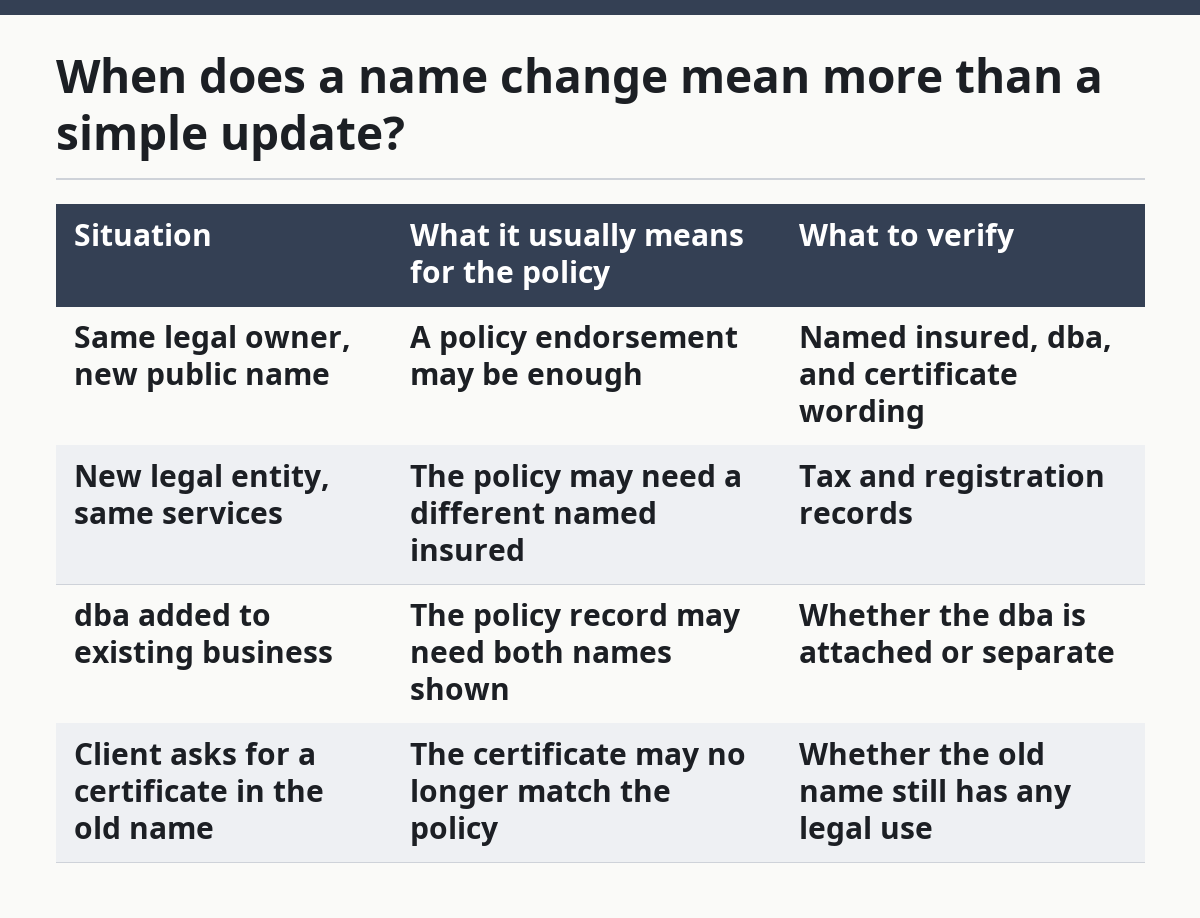
If the policy and the legal records no longer describe the same business, stop treating the update as a clerical fix. That is the point where a carrier may need to review the structure, not just the spelling. A certificate can look fine while the underlying policy still points to the wrong entity.
When should I stop and get help?
You should stop and get qualified help when the name change and the insurance record no longer describe the same legal business. That is especially true on a liability policy, where a mistake can affect a claim file, a certificate, or a renewal.
The old business is still on the contract, but the new name belongs to a different legal entity: this means the named insured may not match the business that now signs client work — pause and have the policy reviewed before relying on it.
The insurer asks for formation papers you do not have: this means the carrier cannot confirm who owns the business — gather the missing records before asking for the endorsement again.
A client wants a certificate issued immediately under the new name: this means the certificate may be generated before the policy record is correct — fix the policy first, then request the certificate.
The policy shows a dba, but your invoices show only the new legal name: this means the business records are split — reconcile the names so the paper trail matches.
The renewal notice still lists the old name after you already sent notice of the change: this means the update may not have reached the master record — follow up before the renewal is bound.
This is also the wrong DIY job if the change happened at the same time as a merger, ownership transfer, or new entity formation. Those changes can alter who is insured, not just what the business is called. If the paper trail is messy, treat the matter as a policy-structure issue, not a rename request, and consider a licensed insurance professional or attorney to help.
What mistakes do freelancers make most often?
Freelancers most often make paperwork mistakes that create a mismatch between the policy and the business record. The problem is not usually the name itself; it is the way the name gets entered, filed, or repeated later.
Then they treat a dba like a legal entity. The consequence is that the certificate or endorsement may name the wrong business, which can confuse clients and claims handling. The better alternative is to confirm whether the policy should show the legal owner, the dba, or both.
For example, they send only a new logo or website screenshot. That proves a public brand change, not a business name change. The better alternative is a filing record, amendment, or other document that links the old name to the new one.
Likewise, they update one place and forget the rest. A corrected policy with an old invoice template can still create problems when a client requests proof of insurance. The better alternative is to update the policy, certificate request form, and business records together.
Because of that, they skip the declarations page and rely on a verbal promise. That can leave the old name in the actual policy record even when the agent sounded certain. The better alternative is to wait for the endorsement and read the revised documents line by line.
Finally, they assume every insurer handles name changes the same way. That is risky because carriers may ask for different proof or may format the named insured differently. The better alternative is to follow the insurer’s exact request and keep copies of every submission.
How long should this take, and what does a correct result look like?
It should take as long as it takes for the insurer to issue the endorsement and for you to confirm the revised documents. The right result is a policy record that matches the name you use in real business life, with no unexplained gap between the old and new names.
A correct result usually has three visible parts. The declarations page shows the right named insured, the endorsement records the change, and the certificate templates use the same wording. If all three line up, the business records are in sync.
A weak result looks different. The insurer may have the right name in one place but not another, or the certificate may still pull the old wording from an out-of-date profile. If that happens, the update is only partly done, and the mistake can repeat at renewal.
Therefore, the goal is not just neat paperwork. The goal is to make sure the policy record, the legal record, and the public-facing business name all point to the same freelancer or business entity. That alignment is what keeps future client requests from turning into avoidable back-and-forth.
What records prove the name change?
The best proof is the record that connects the old name to the new one on the same filing trail, or at least the clearest official record available. That can be a registration update, an amendment, or another official document that shows both names and the date of the change.
Keep the old policy record, the proof of the change, and the revised declarations page together. Those three documents show continuity, which is what an insurer needs when it updates policy records. If the new name appears only on a website or social profile, that is not enough for a policy change.
Will client certificates need updating?
Yes, if the certificate still shows the old business name or the wrong named insured. A certificate is only useful when it matches the policy record and the business name the client expects to see.
The safest move is to confirm the policy update first, then ask for a revised certificate. If the certificate changes before the policy record does, the document may need to be issued again after the insurer updates the file.
Drafted with AI; not yet reviewed by a person.
