

Last updated: November 24, 2026
Quick answer: freelance insurance application and underwriting usually comes down to 3 outcomes — the insurer offers the policy as requested, changes the terms, or declines it. Freelance insurance application and underwriting is the process an insurer uses to decide what cover to offer a freelancer, on what terms, and at what price band. This guide to Freelance insurance application and underwriting — The Complete Guide explains what information is usually requested, how the review works, where freelancers get slowed down, and what to check before you submit anything.
This is information, not financial advice. Insurance rules, tax treatment, limits, and wording vary by country and change often, so a qualified adviser or licensed insurance professional should be consulted for your own situation; for general consumer context, see the UK Financial Conduct Authority and the Insurance Information Institute.
Key takeaways
- The application is the form; underwriting is the insurer’s risk review.
- Freelancers are usually judged on the work they do, the clients they serve, and the claims history tied to that work.
- Small gaps in dates, revenue, or job descriptions can trigger delays.
- Some work types need more scrutiny, such as overseas clients, subcontractors, or work that touches money, data, or professional advice.
- A clean application does not guarantee cover, because the policy wording and exclusions still matter.
What does underwriting mean for a freelancer?
Underwriting means the insurer checks whether your freelance work fits the policy and what terms belong on it. The same form can lead to different outcomes because underwriting looks at risk, not just your business name. A designer, copywriter, bookkeeper, and software consultant may all call themselves freelancers, but the exposure they create is not the same.
The process usually starts with an application form and ends with one of three results: offer the policy as requested, offer it with changed terms, or decline it. The insurer may ask follow-up questions about client types, income sources, contracts, past claims, trading names, years in business, and where the work is performed. Many carriers also want to know whether you use subcontractors, hold client money, or work across borders.
The main point is simple: underwriting is not a test of whether you are “good” or “bad” at freelance work. It is a check on whether your work creates a loss pattern the insurer is willing to cover. A freelancer who handles personal data, gives advice, or signs contracts on behalf of clients will usually be reviewed differently from one who provides low-risk creative services.
A useful place to start is the logic behind professional risk screening, which is described by groups such as the Chartered Insurance Institute and by national regulators like the UK Financial Conduct Authority: the insurer gathers facts, assesses exposure, and sets terms from that evidence. The precise rules vary by market, so a form that is normal in one country may not be normal in another.
Who is this process for, and who needs help first?
This process is for freelancers who need to understand what insurers ask for and why a policy may be quoted, changed, or declined. It assumes the reader already knows the basics of the freelance work being insured: the service offered, the main client type, the annual income pattern, and whether the work is done alone or with subcontractors. It also assumes the reader has at least rough records for the last 12 months, or for the period the insurer asks about.
It is not a good do-it-yourself project when the work is highly regulated, the contract is large, or the risk sits in a gray area. A lawyer, broker, accountant, or licensed insurance adviser may be needed when the work includes regulated advice, data-heavy services, medical or legal touchpoints, or cross-border obligations. The reason is practical: a wrong answer on the application can affect the policy terms later, and a missed exclusion can matter only after a claim.
The process is also harder when the freelancer has a mixed business model. A person who does consulting, training, product sales, and subcontracted delivery may need more than one description of activity, because the underwriting question is not “what do you call yourself?” but “what exactly can go wrong, and how often?” If the business changed shape in the last 12 months, the application should reflect the current business, not the old one.
Freelancers who already have a claim, a lapse in cover, or a history of declined applications should slow down and gather records first. Underwriters often treat a gap, prior loss, or inconsistent description as a signal that the risk is not yet clear, so a qualified adviser may help if the file is hard to explain. That does not mean the application is doomed; it means the file needs to be cleaner than usual.
What information do underwriters ask for?
Underwriters ask for enough detail to match the policy to your actual work, not just your trade name. The application often asks for your legal name, trading name, business start date, country of operation, revenue range, services offered, contract size, client location, and any prior losses or claims. Many forms also ask for the percentage split of services, because a business that is 80% editing and 20% consulting can look very different from one that is the reverse; if the form asks for a split, percentages should total 100%.
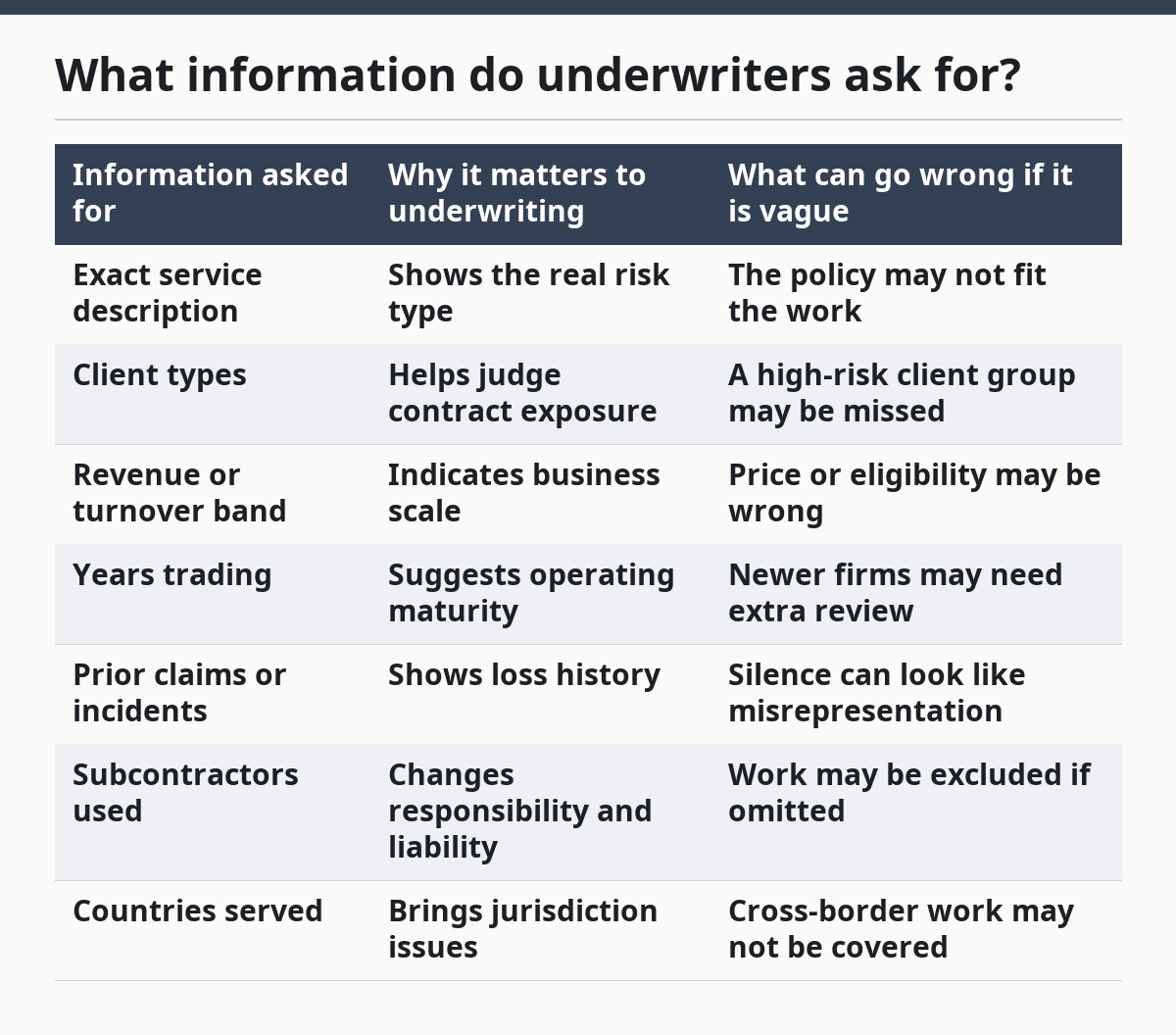
A good application usually includes the following facts in plain language:
| Information asked for | Why it matters to underwriting | What can go wrong if it is vague |
|---|---|---|
| Exact service description | Shows the real risk type | The policy may not fit the work |
| Client types | Helps judge contract exposure | A high-risk client group may be missed |
| Revenue or turnover band | Indicates business scale | Price or eligibility may be wrong |
| Years trading | Suggests operating maturity | Newer firms may need extra review |
| Prior claims or incidents | Shows loss history | Silence can look like misrepresentation |
| Subcontractors used | Changes responsibility and liability | Work may be excluded if omitted |
| Countries served | Brings jurisdiction issues | Cross-border work may not be covered |
A common mistake is to answer in marketing language. “I help businesses grow” tells the insurer very little. “I provide monthly bookkeeping and payroll support to small retail firms, with no client money held in my own account” is far more useful. Underwriters do not need a slogan; they need a risk picture.
The application may also ask about your contracts. That is because contract wording can shift liability between you and the client. If you sign indemnity clauses, accept warranty promises, or agree to hold higher limits, the underwriting file needs to show that. The same is true if you work on a retainer, on fixed-fee projects, or on time-and-materials terms, because each structure creates a different claims pattern.
How does the application and underwriting process work?
The process starts with a completed form and ends with a policy decision, usually after one to several review steps. A strong application is specific, internally consistent, and honest about the work being done. A weak application is vague, mixes old and current figures, or hides part of the business because the freelancer thinks it looks risky.
- List every line of work you do. Write the services separately, such as design, consulting, admin support, or coding, and note which one brings in the most income. If the form asks for a split, use percentages and check that they total 100%. Verify that no service is missing; a blank category is a warning sign that the insurer may return the form.
- Collect the business facts the form usually wants. Gather the legal name, trading name, start date, trading address, client countries, and prior claims history before opening the application. Many forms also ask for the last 12 months of turnover or a current revenue band. A mismatch between the form and your records is a problem because underwriting checks consistency.
- Describe clients and projects in plain terms. State whether clients are individuals, small firms, agencies, charities, or larger enterprises, and say what the work touches: data, money, advice, code, or physical goods. If the work involves a 6-month retainer or a one-off project, say so. A problem appears when the description is too broad to show what can fail.
- Identify any subcontractors or assistants. If someone else helps deliver the work, say what they do and whether they are insured under their own policy. Confirm whether they are used on every project or only on larger jobs. A gap here can matter because some policies treat subcontracted work differently from work done directly by the freelancer.
- Check the contract terms you accept. Look for clauses about indemnity, liability caps, data handling, confidentiality, and country law. If the contract makes you responsible for risks beyond the service itself, that should be visible in the application. The problem is not the clause by itself; the problem is when the insurer learns about it only after a claim.
- Disclose any claims, incidents, or disputes. Include formal claims, demand letters, and known complaints if the form asks for them, along with dates and outcome status. Even if nothing was paid, the event may still matter to underwriting. An omission can be worse than the incident because the policy can be disputed later.
- Review exclusions and endorsements before sending. Endorsements are added policy terms that narrow or expand cover, and exclusions are the parts the policy will not pay for. Read them against your actual work, not against the sales summary. A problem exists if the policy only works for a narrow slice of your business and the rest is uninsured.
- Confirm the final version matches the facts. Before you submit, compare the form with your own records and keep a copy of the final answers. If the insurer later relies on a different version, the paper trail matters. Any contradiction in dates, services, or revenue is a signal to pause and correct the file.
The insurer is trying to map your work to known loss patterns. If your answers point in three directions at once, the file becomes harder to price and may be referred for manual review. Manual review is normal; a clean application often still gets questions.
What should I check before I submit the form?
I should check for three things before submission: factual accuracy, scope fit, and wording that could change the cover. That means checking the numbers on the form, the business description, and the policy language together instead of reading each piece alone.

Start with the facts. Make sure the trading name, legal entity name, start date, revenue band, and client locations match your records. If the form asks for a year and your business has changed in the last 12 months, use the current state, not the old one. A common problem is using an old revenue figure because it is easier to remember, which can distort the underwriting view.
Then check the scope. If you do more than one kind of work, make sure the riskiest part is not hidden inside a general label. “Marketing services” can mean strategy work, ad buying, copywriting, SEO, or client account management, and each carries a different level of exposure. A form that asks one line for the whole business may still need a short note to explain the split.
Then read the policy terms with the form beside them. Limits, deductibles, claims-made wording, retroactive dates, and exclusions matter at the same time. A claims-made policy, for example, responds based on when the claim is made, not just when the work happened, so timing matters. If the policy terms do not match the work pattern, the issue is not price; it is fit.
A helpful external reference for policy basics is the Insurance Information Institute, which explains common liability concepts in plain language. For UK readers, the Financial Conduct Authority also publishes consumer information about insurance conduct and complaints handling. Both are useful as background, but they do not replace the wording of your own policy.
When does standard underwriting not fit?
Standard underwriting does not fit when the work, the contract, or the business shape falls outside the insurer’s usual assumptions. That matters because the form may still look normal even when the risk is not.
Work across several countries: Cross-border work can trigger different legal systems and insurance rules — confirm where each client is based and where the work is delivered. A policy written for one country may not respond the same way in another, so the consequence of guessing is a gap in protection or a disputed claim.
Work that handles money or client funds: Money-handling raises the loss potential — disclose any account access, payment processing, or fund transfer role. A freelancer who can move funds or change payment instructions may be asked for more detail, because the exposure is not just service error but financial loss.
Advice work with professional consequences: Advice can create larger claims than routine delivery — state exactly what advice is given and to whom. The consequence of a vague description is that the insurer may classify the work too loosely, which can lead to exclusions or a referral.
Subcontracted delivery: Delegated work changes who actually performs the service — name the type of subcontractor and how often they are used. If the policy assumes you alone perform the work but you outsource a large share, the result can be a mismatch between the application and reality.
Recent claims, complaints, or cancellations: A loss history can affect terms even when the loss was small — list dates and outcomes clearly. The consequence of hiding a prior issue is not just delay; it can create a later coverage dispute if the omission is material.
Business model changed in the last 12 months: Fast change makes old records unreliable — update the form to the current mix of services, clients, and revenue. A stale application can make the insurer think the business is more stable or less risky than it really is.
When one of these situations applies, the right move is not to force the standard form to fit. The right move is to give the insurer enough detail to price the actual risk, or to seek qualified help where the contract and policy wording are hard to line up.
What mistakes do freelancers make most often?
Freelancers most often make the same 5 mistakes: they underdescribe the work, leave out subcontractors, give old revenue figures, ignore contract clauses, or assume a generic policy fits every project. Each one can cause a different kind of problem, and the fix is usually simple if it happens before submission.
First, many people write a broad label instead of a real description. “Consultant” or “creative services” may be true, but it does not show the underwriting team what can go wrong. The consequence is delay or a quote that does not match the risk. The better alternative is a short list of actual tasks and client types.
Second, some freelancers forget subcontractors or part-time helpers. That matters because the insurer wants to know who is doing the work and who is responsible if something goes wrong. The consequence can be a policy that assumes solo delivery. The better alternative is to name the support role, even if the helper is used only on larger jobs.
Third, people often use a turnover number from the wrong period. A figure from last year may not reflect the current business, especially if a project ended or a new retainer began. The consequence is a mismatch between pricing and risk. The better alternative is to use the period the form asks for, and note if the business changed sharply.
Fourth, some freelancers ignore contract language because they think insurance works the same either way. It does not. If the contract adds obligations, the policy may need to be reviewed against those terms. The consequence is surprise after a claim. The better alternative is to read the clause on indemnity, liability cap, and jurisdiction before the form is sent.
Fifth, people assume that a positive answer on one question means the whole policy is fine. A yes to basic eligibility does not remove exclusions, waiting periods, or claims-made conditions. The consequence is false confidence. The better alternative is to read the final schedule and the policy wording together, not as separate documents.
How long does underwriting take, and what does a good result look like?
Underwriting can take a short manual review or a longer back-and-forth process, depending on how clear the application is and how unusual the work looks. A good result is not just “approved”; it is a policy whose wording matches the work, whose exclusions are understood, and whose details match the application.
A clean result usually has three features. First, the insurer accepts the business description without major correction. Second, the policy schedule reflects the right legal entity, dates, and activity. Third, any limitations are visible and understood before the policy starts. If any of those pieces are missing, the result is weaker than it looks on paper.
The reason timing varies is that underwriting is partly fact-checking. If the form is complete and the business is simple, the process can move quickly. If the business has mixed services, a claims history, or cross-border work, the underwriter may need more detail. That is normal. A delay is not always a rejection; it can also be a request for clearer evidence.
A bad sign is when the final paperwork is short but vague. A policy that leaves too much unsaid can look easy to buy, then become hard to use when a claim appears. The better outcome is a slower review with clear wording than a fast issue with hidden gaps.
What if the policy offer is changed?
A changed offer means the insurer saw a risk it did not want to cover on the original terms. The change might be a higher deductible, a narrower scope, an exclusion, a lower limit, or a request for more information before binding. That is not unusual in underwriting, and it is not the same as rejection.
The first thing to check is what changed. A higher deductible shifts more of the early loss to you. A narrower scope may leave out one service line. A special exclusion can remove a risk that matters to your contracts. If the change affects the core of the business, the offer may no longer fit even if the premium is otherwise acceptable.
The second thing to check is whether the change matches a real business issue or a paperwork issue. Sometimes the insurer is responding to unclear wording, not to the work itself. If the application used a broad label, a clearer description may solve the problem. If the insurer is reacting to a genuine exposure, such as client money or regulated advice, the change may be the normal result of that risk.
A changed offer should be read as a signal, not a surprise. It tells you what the insurer considers material. If the changed term is something the freelancer cannot accept, the practical answer is to compare the wording with the business model and seek qualified help rather than guessing at the meaning.
What are the most common questions freelancers ask?
Do I need to list every service I offer?
Yes, every material service should be listed if it changes the risk profile. A freelancer who does both design and consulting should not hide the consulting work inside a general label. The insurer needs the real mix, because even a 20% side service can change how the policy is underwritten.
Why does the insurer care about client country?
Client country matters because legal rules and claim handling can change across borders. A project for a local client may fall under different assumptions than a project for a client in another jurisdiction. If the form asks for client location, answer it directly, even if the work is remote.
What if my business has only one or two clients?
A small client list still matters because concentration risk can be high. Losing one large client can change the revenue pattern fast, which is useful underwriting information. The insurer may not treat the business as risky just because it is small, but it will want the shape of the revenue to be clear.
Does a claim from years ago still matter?
It can, depending on the form and the policy type. Underwriters often ask about prior claims or incidents because past losses can show how a risk behaves. If the form asks for a history period, answer within that period and explain the outcome plainly.
What if I am not sure whether something counts as a claim?
If the form asks about claims, incidents, or circumstances that may lead to a claim, the cautious answer is to disclose the event and describe it briefly. A client complaint, demand letter, or written allegation may matter even if no payment was made. The safest approach is to answer the question as written and get qualified help if the wording is unclear.
FAQ
What is the difference between application and underwriting?
The application is the form that collects facts about the freelancer and the work. Underwriting is the insurer’s review of those facts to decide whether to offer cover and on what terms. The two steps are connected, but they are not the same thing.
Can a freelancer be declined even with a simple business?
Yes. A simple business can still be declined if the insurer does not want that type of work, that client mix, or that jurisdiction. Decline decisions are not always about complexity; they are often about whether the risk fits the insurer’s appetite at all.
What is the biggest cause of delay?
The biggest cause of delay is missing or inconsistent information. A form that mixes old revenue, vague services, and no client detail usually needs follow-up. Clear, consistent answers are the fastest way through underwriting.
Should I leave out small side work to keep the form simple?
No. Leaving out side work can create a mismatch between the business and the policy. If the side work changes the risk, it belongs in the application. If it is truly minor, describe it briefly rather than omitting it.
What should I do if the policy wording is hard to read?
Read the schedule, exclusions, and key conditions together, then ask a qualified insurance professional to explain anything unclear. Policy wording can be technical, and a wrong reading can matter later. The goal is not to guess what the policy means, but to know what it actually says.
Drafted with AI; not yet reviewed by a person.
