

Last updated: November 25, 2026
Quick Answer: most freelancers should check 3 things first—coverage type, limit, and exclusions—before they rely on a policy. In Freelance Insurance Coverage Gaps and Risk Scenarios — The Complete Guide, the main issue is usually not a missing policy name; it is a mismatch between the work you do and the policy you bought.
This guide is for freelancers who already have, or are considering, liability insurance and want to understand where it can fail them. It assumes you know the kind of work you sell, the clients you serve, and whether you already carry any business policy or add-on. This is information rather than financial advice, and a qualified adviser should be consulted for your own situation.
Key takeaways
- One policy rarely covers every freelance risk. A contract, a device, a data file, and a client deadline can each trigger a different gap.
- The most common failure point is not a missing policy name; it is a limit, exclusion, or definition that does not match the real job.
- Risk changes with the work. A designer, consultant, photographer, developer, and virtual assistant do not face the same loss pattern.
- The cleanest way to spot gaps is to map each client scenario to the policy section that would respond, then check what it excludes.
- Country rules, tax rules, and policy forms differ, so the same answer does not fit every freelancer.
What counts as a coverage gap?
A coverage gap is the space between the loss you suffer and the loss your policy actually pays for. In freelance work, that space often appears because one policy covers bodily injury, another covers professional mistakes, and a third covers stolen gear or lost income.
The tricky part is that the word “liability” can mean different things in different policies. General liability usually deals with third-party injury or property damage, while professional liability, also called errors and omissions or E&O, deals with mistakes in work or advice. Cyber cover, equipment cover, and business interruption can sit beside them, but they do not replace them.
A gap is not always a missing policy; it can also be a low limit, a deductible that is too high for a small job, an exclusion for subcontractor work, or a claim trigger that does not match how the loss happened. A policy that pays only after a formal claim is made, for example, can leave you exposed if the mistake is discovered months later and the policy has lapsed.
Therefore, this matters because freelancers often work with thin margins and short contracts. A single denied claim can affect a month of income, a client relationship, or a whole project schedule. The review process is less about “Do I have insurance?” and more about “What exact event would make this policy pay, and what event would it refuse?”
Which gaps matter most for freelancers?
The gaps that matter most are the ones tied to your actual job, your contract terms, and the kind of harm a client could allege. A copywriter, UX designer, bookkeeper, developer, and video editor each face different losses, even if they all work from home and use the same laptop.
Therefore, here is a practical comparison of common freelance coverages and the gap each one leaves behind.
| Coverage type | What it usually covers | What it often does not cover | Typical gap scenario |
|---|---|---|---|
| General liability | Third-party injury and some property damage | Professional mistakes, advice errors, cyber events | A client trips over a cable at your studio, but the policy does not pay for a bad campaign strategy |
| Professional liability / E&O | Errors, omissions, negligent advice, missed deliverables | Bodily injury, most theft, many cyber events | A deadline slip or a wrong calculation causes a client loss |
| Cyber insurance | Data breaches, network incidents, some response costs | Purely offline mistakes, lost physical items | A stolen password leads to file exposure, but paper records or advice errors are outside the form |
| Business property / equipment | Tools, cameras, laptops, office items | Client loss, professional mistakes, broad business interruption | A laptop is stolen in transit, but the client still expects work on time |
| Business interruption / income cover | Lost income after covered damage | Slow periods, contract cancellations, excluded causes | You cannot work after a fire or flood, but lost bookings alone do not trigger payment |
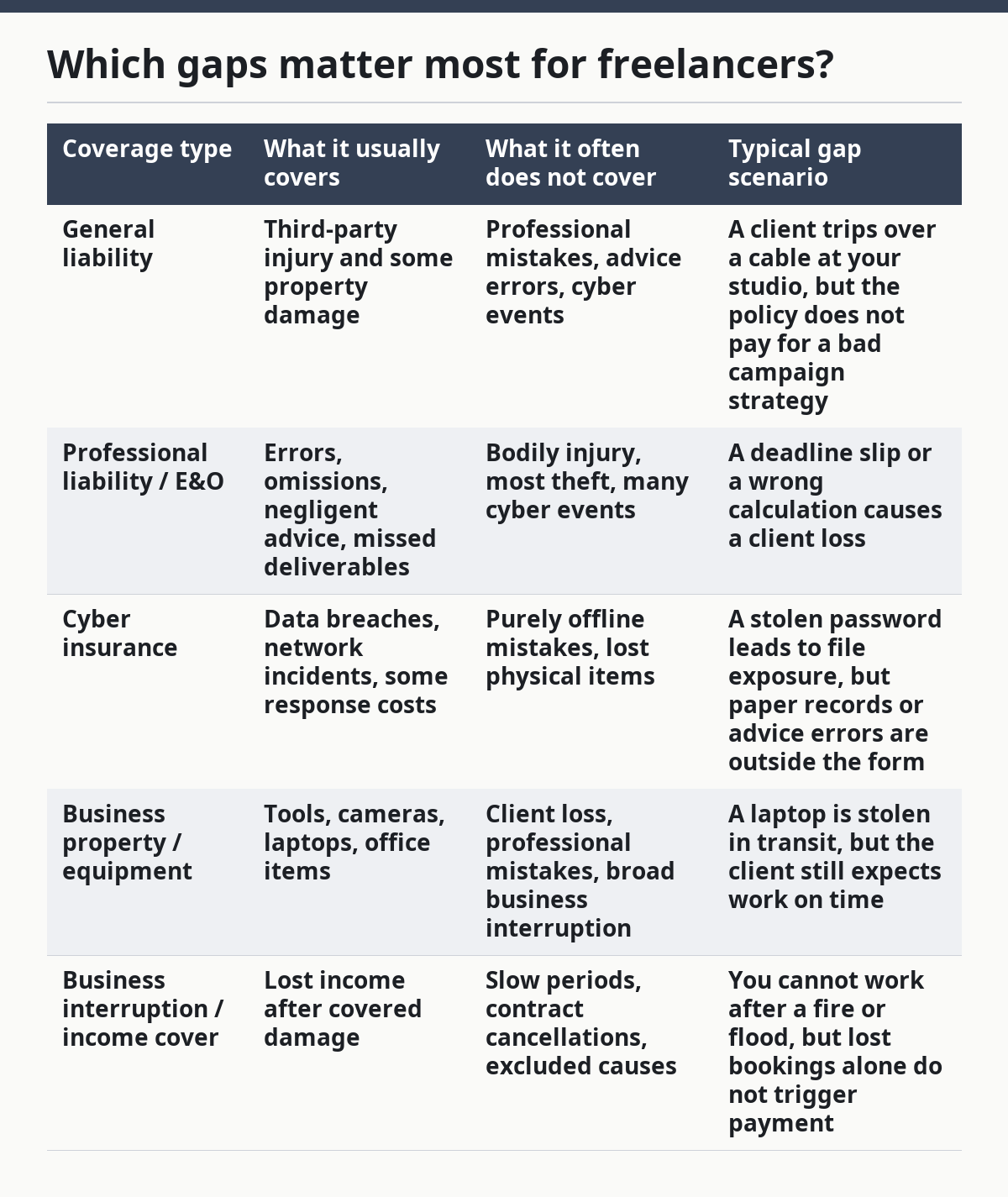
A generic article often gets this wrong by treating all freelance risk as one bucket. That misses the fact that a client complaint over a missed deadline is not the same as a stolen tablet or a privacy breach. It also misses the contract layer: many freelancers agree to indemnity terms, liability caps, or notice requirements that shift risk back onto them.
In contrast, the other blind spot is the “silent gap.” That is when a policy looks broad, but its wording excludes the exact kind of work you do. A consultant who gives business advice, a developer who handles customer data, and a photographer who works on location all need to read the definitions section, not just the policy summary. If a policy says “services as described in the declarations,” work outside that description may sit uncovered.
How do freelance claims usually break through insurance?
Freelance claims usually break through insurance by hitting a policy that does not match the way the loss happened. The claim may be too late, the wrong type, outside the service description, or caused by an excluded event.
So, think in a chain: event, allegation, policy trigger, exclusion, limit, and deductible. A lost file, for example, can become a claim if a client says the loss caused missed revenue or extra costs. But whether the policy responds depends on whether the file loss was physical damage, cyber loss, negligence, or a contract dispute.
A careful review can be done in 8 steps.
- List every service you sell in plain language. Write each one in a single line, such as design, copywriting, tax prep support, coding, coaching, editing, or virtual assistance. Verify that each service matches the wording in the policy declarations. A problem appears if your real work is broader than the description on page 1.
- Map the three most likely loss types to those services. Use one loss for client harm, one for your equipment, and one for data. Verify that each loss points to a different policy section, such as E&O, property, or cyber. A problem appears if all three depend on the same policy clause.
- Check whether the policy is claims-made or occurrence-based. A claims-made policy usually responds when the claim is made during the policy period, while an occurrence policy responds to an event that happened during the period. Verify the wording in the insuring agreement and the retroactive date, if one exists. A problem appears if the work happened before coverage started.
- Read the exclusions line by line. Focus on contract liability, intentional acts, prior knowledge, employment-related claims, cyber exclusions, and work for certain industries. Verify that none of your common client terms are excluded by name. A problem appears if a common service, like advice or data handling, sits inside an exclusion.
- Try to match the limit to the worst plausible single claim you can reasonably foresee. Look for the per-claim limit, aggregate limit, and any sublimit for data or equipment. Verify that the per-claim amount is high enough for one project failure, not just many small claims. A problem appears if one incident could exhaust the whole policy.
- Check the deductible or excess against your cash flow. A deductible is the amount you pay before the insurer pays. Verify that you could cover it without delaying payroll, rent, or vendor payment. A problem appears if a small claim costs less than the deductible but still creates legal trouble.
- Review contract promises before you sign. Look for indemnity, waiver of subrogation, additional insured language, liquidated damages, and uninsured loss clauses. Verify that you can satisfy the promise with the policies you actually hold. A problem appears if the contract asks for cover you do not have.
- Test the timeline with one real scenario. Walk through a claim from incident date to notice to insurer to client dispute resolution. Verify that you know who must be notified and how fast. A problem appears if the policy requires prompt notice but the event sat unreported for weeks.
The point of this process is not to hunt for perfect protection. It is to find where the policy and the job no longer line up. That mismatch is the gap.
For U.S. freelancers, one useful external reference is the IRS publication on business expenses, since tax treatment and insurance treatment are not the same thing: IRS Publication 535. A second useful starting point for small-business filing and records is IRS Publication 334. Those pages do not explain every insurance form, but they do remind readers that business structure and expense rules change how risk is recorded and reported.
What risk scenarios create the biggest gaps?
The biggest gap-producing scenarios are the ones that cross category lines, especially advice plus data, gear plus travel, or contract plus deadline. A single mistake can activate more than one problem, and one policy may cover only part of it.
Therefore, a few examples show how this happens.
A freelance designer sends a file with the wrong logo to a client launch. The client says the launch delay cost them money. That is not a gear problem; it is a professional services problem, so the key question is whether the E&O policy includes media, advertising, or design work.
A consultant gives a recommendation based on incomplete information, and the client says the recommendation led to a bad purchase. That can be a professional liability issue, but if the policy excludes financial performance promises or warranty language, the claim may fall outside coverage.
A developer stores customer data on a personal laptop that is stolen from a car. The physical loss is one event, but the response may require cyber coverage, not just equipment cover. If the laptop policy replaces the device but the cyber policy is absent, the data exposure remains the larger risk.
A virtual assistant books travel incorrectly, and a client misses a meeting. That can become a contract dispute, a negligence claim, or a service failure, depending on the contract wording. General liability is unlikely to help if no injury or property damage occurred.
The most overlooked scenario is a subcontractor mistake. A freelancer often assumes the contractor who did the work is responsible, but the client contract may still point back to the lead freelancer. If the policy excludes subcontractor acts or requires written agreements with subs, the gap opens fast.
When should you stop relying on a standard policy?
A standard policy is the wrong tool when the loss is driven by a special contract, a regulated service, a large data set, or work outside your stated profession. In those cases, the issue is not a small tweak; it is a structural mismatch.
Client contract requires insurance you do not have: The contract may ask for additional insured status, a specific limit, or a special endorsement — do not sign until the wording is reviewed against the policy.
Your work includes advice, recommendations, or calculations: That raises professional liability exposure, not just property exposure — check whether the policy actually covers the service and the industry.
You handle personal, financial, or health-related data: Data exposure can create cyber and privacy claims — verify whether the policy includes breach response, notification, and legal defense.
You use subcontractors or assistants: Their errors can become your problem under the client contract — confirm whether subcontractor acts are included, and whether you need written agreements with them.
You work across borders or for foreign clients: Country rules, liability rules, and policy wording differ — get the jurisdiction checked before assuming coverage follows the work.
You carry expensive gear that travels often: A studio policy may not cover loss in transit or outside the country — look for equipment terms, off-premises limits, and any travel exclusions.
The claim could be larger than a normal project fee: One incident can outstrip a small limit fast — if the limit is close to a single project’s value, the policy may not fit the exposure.
These are the moments when a do-it-yourself reading of the summary page is not enough. The declarations page, endorsements, exclusions, and contract language all need to be checked together.
Which mistakes leave freelancers exposed?
The most common mistakes are simple, and each one creates a very specific exposure. A freelancer usually does not fail because of one dramatic oversight; the failure is often a series of small assumptions.
-
Assuming general liability covers work mistakes. It usually does not. The consequence is a denied claim after a client says your advice, draft, code, or calculation caused the loss. The better alternative is to check for professional liability or E&O wording.
-
Buying a policy that names the wrong business activity. A policy written for graphic design may not fit coaching, consulting, or data work. The consequence is a mismatch between the declared class of business and the real services. The better alternative is to make the service description specific and current.
-
Ignoring exclusions because the premium looked fine. A lower premium can hide a narrow form. The consequence is finding out too late that cyber, subcontractor, or contract claims are carved out. The better alternative is to read the exclusions before the price.
-
Missing the claims timing rule. Claims-made coverage can fail if the claim arrives after coverage ends. The consequence is a gap even when the error happened during the policy period. The better alternative is to understand the retroactive date and reporting rules.
-
Treating equipment insurance as business continuity can be a mistake; replacing a laptop is not the same as replacing income, clients, or deadlines. The consequence is partial recovery and a still-broken project schedule. The better alternative is to separate gear cover from income interruption cover, and to review the wording with a qualified adviser if you are unsure.
-
Signing contracts before checking insurance language. Many freelancers accept indemnity or warranty terms first and ask about coverage later. The consequence is a contractual promise that may exceed the policy. The better alternative is to review the insurance clause before the signature, not after the invoice.
A reader often asks for the “one policy” answer, but there usually is not one. The real job is coordination: one coverage for bodily injury and property damage, another for professional error, another for cyber, and sometimes another for tools or income. The mistake is not buying more insurance; it is buying the wrong map of the risk.
How do edge cases change the answer?
Edge cases change the answer by changing the cause of loss, the client relationship, or the paperwork that governs the job. A freelance risk that looks ordinary on paper can become unusual once a contract or location shifts.
If you work with regulated data, the gap may be larger than a standard cyber form. The policy may respond to a breach, but not to regulatory fines, contractual penalties, or the cost of outside counsel in every country. That means the reader should not assume a privacy add-on is enough without checking the jurisdiction and the definitions.
If you bill through an agency or platform, the policy question changes too. The platform may control the client relationship, but the contract may still leave you named in a claim. A freelancer who assumes the platform’s insurance solves the problem can end up with no direct response from their own carrier.
If you have a home office, a homeowners or renters policy may limit business property and may not treat client-related losses the way a business policy does. The gap appears when the loss happens during paid work rather than normal household use. Many home policies also restrict business equipment or business visitors, so the office at home is not automatically protected; the wording in the policy and guidance from the insurer or a qualified adviser matters here. For a general overview, the National Association of Insurance Commissioners is a helpful starting point.
If you work on a short-term project, the timing can be the edge case. A one-week contract can still create a claim months later if the damage is discovered later. That is why claims-made wording and reporting deadlines matter even for small jobs.
If you rely on one expensive device, such as a high-end laptop or camera setup, the equipment limit can be too low for replacement cost. The result is not just a reimbursement issue; it can stop you from working for days or weeks. A small limit can turn a single theft into a full business interruption.
How do you read your own policy without getting lost?
You read your own policy by checking four pages in order: declarations, insuring agreement, exclusions, and endorsements. Those pages usually tell you more than the marketing summary, and they do it in about 15 minutes if you read slowly.
First, look at the declarations page. It tells you the named insured, the business description, the policy period, the limits, and any deductible. Verify that the legal name and service description match the way you actually work. If the policy names the wrong entity or the wrong trade, that is a red flag.
Second, read the insuring agreement. That is the core promise. Verify whether the policy covers bodily injury, property damage, personal and advertising injury, professional services, cyber incidents, or some combination of those. If the promise is narrower than your risk, the policy is not built for the job.
Third, read the exclusions. This is where most gaps live. Verify whether the policy excludes contract liability, employment issues, securities, data loss, prior acts, intentional acts, subcontractors, or specific industries. A problem appears when an exclusion names the exact loss you are most likely to face.
Fourth, read endorsements. Endorsements change the base form. Verify whether an endorsement adds or removes coverage, changes the deductible, limits a territory, or narrows a definition. If the endorsement and the base form conflict, the endorsement usually controls.
A quick cross-check helps: take one real scenario, such as a bad file sent to a client, and trace which page would respond. If you cannot point to a page and a clause, the coverage is probably not as clear as the summary suggests.
What should a freelancer do before a client signs?
A freelancer should confirm the insurance clause, the service scope, and the risk handoff before the client signs. That step matters because a contract can create exposure that no policy summary mentions.

Start with the scope of work. Make sure the service list is specific enough to match the policy description. A contract for “advisory services,” “data processing,” or “marketing support” can carry different risk from a contract for “design” or “editing,” even when the hourly rate is the same.
Then check the insurance clause. Look for a requirement to name the client as an additional insured, carry a certain limit, or provide proof of coverage within a set number of days. If the policy cannot meet that requirement, the gap is contractual, not just financial.
Then review responsibility language. Terms such as indemnify, defend, warrant, and hold harmless shift risk. A freelancer may agree to pay for the client’s legal costs, lost income, or third-party claims even when the policy would not pay those amounts. That is a major mismatch, not a small wording issue.
Finally, confirm reporting duties. Some contracts require notice within 24 hours, 48 hours, or a similar short window after an incident. If the insurance policy has a different notice rule, the shorter deadline may control the practical response.
This is the point where country differences matter most. The meaning of contract clauses, insurance law, and available endorsements can change by jurisdiction, so a contract that is normal in one country may be risky in another. Rates, limits, and legal standards also change often, which is why a qualified adviser is the right person for the final check.
What questions do freelancers ask most?
Does general liability cover freelance mistakes?
No, general liability usually does not cover a bad recommendation, incorrect file, missed deadline, or coding error by itself. It is more likely to respond to bodily injury or property damage, not the quality of the work. That is why professional liability or E&O is the policy type to examine for service errors.
Is a home office enough protection?
No, a home office does not automatically protect business gear or client claims. A homeowners or renters policy may limit business property and may not treat client-related losses the way a business policy does. The exact answer depends on the policy wording and the country where you live, and a qualified adviser can help confirm the details.
What is the biggest gap for new freelancers?
The biggest gap is assuming one policy solves every problem. Many new freelancers have no clear separation between gear loss, advice errors, and data issues, so they buy the wrong coverage first. A better first check is to match the policy type to the way the work can fail.
Do subcontractors change the risk?
Yes, subcontractors can change both the claim path and the contract exposure. A client may still hold the lead freelancer responsible even if another person made the mistake. The policy and the subcontractor agreement both need to be checked, because one without the other can leave a hole.
When should I get a qualified adviser involved?
A qualified adviser should review the setup when the work involves regulated data, cross-border clients, high contract limits, or language you do not fully understand. This is especially true if one claim could affect your income for months, not just one invoice. That review is about reducing blind spots, not about chasing the cheapest premium.
Freelance insurance gaps are usually not dramatic mysteries. They are ordinary mismatches between what the job demands and what the policy actually says. The safest habit is to read the policy as a tool for specific losses, not as a blanket promise.
Drafted with AI; not yet reviewed by a person.
