
Last updated: November 23, 2026
Key Takeaways
- Keep cover continuous between terms, and preserve the details that protect earlier work.
- Start renewal work at least 30 days before expiry, or sooner if the business changed in the last 12 months.
- Most freelancers should review manually each year; auto-renew fits only when the business has stayed steady.
- Claims-made policies need stricter renewal discipline than occurrence policies because timing can affect the claim.
Freelance policy renewals and continuity — The Complete Guide should be treated as a coverage check, not just a calendar reminder; if you are unsure, consult a licensed insurance professional. The safe default is to renew before the expiry date, verify that the same liability terms still fit the work, and keep proof that there was no gap in cover, which is consistent with general consumer guidance from the NAIC and claims-made policy basics from IRMI. That matters most for claims-made policies, where one missed renewal can affect a claim long after the job was finished.
The phrase Freelance policy renewals and continuity — The Complete Guide is useful because renewal is not just about paying on time. It is about keeping the cover aligned with the work, the paperwork, and the dates.
What does continuity mean at policy renewal?
Continuity means your liability cover stays live from one policy term to the next without a break, and the details that protect past work stay intact. For a freelancer, that usually means no lapse in dates, no missed payment, no change to the retroactive date on a claims-made policy, and no surprise exclusion that wipes out the work you already sold.
That sounds simple, but it is the part most people get wrong. A policy can renew on paper and still fail you in practice if the new terms restart the clock, narrow the covered services, or leave a gap between the old term ending and the new term starting. A gap of even 1 day can matter when a client complaint lands months later.
The key idea is that continuity is not just “I paid again.” It is “the same risk is still covered in the same way.” That is why policy renewal should be checked like a contract change, especially if your work shifted over the last 12 months. A designer who added copywriting, or a consultant who started handling client data, is no longer doing the same job in the same risk band.
For liability insurance, continuity usually protects three things at once: your current work, your older work, and your ability to prove there was no break. If you cannot show those three, a renewals page is not enough. The renewal confirmation, schedule, declarations page, and payment record all matter.
The clean rule is this: if your policy is written on a claims-made basis, continuity is part of the cover itself. If it is occurrence-based, continuity still matters, but the renewal risk is usually about the current term and documentation rather than the old term’s trigger date. The difference is not academic. It changes what happens when a claim appears after the policy year closes.
When should a freelancer start the renewal process?
A freelancer should start renewal work at least 30 days before the expiry date, and earlier if the business changed in the last 12 months. That window gives time to spot a premium change, add a new service line, correct a wrong address or turnover figure, and avoid a late payment that could interrupt cover.
Waiting until the final week is a bad habit because renewal questions tend to stack up. A carrier may ask whether your revenue changed, whether you added subcontractors, whether you handle personal data, or whether any client has threatened a claim. Those requests should be reviewed carefully, not rushed through in 5 minutes on a phone screen. If the answers are incomplete, the renewal can come back with the wrong terms or the wrong start date.
The timing matters even more if your policy uses a retroactive date. If that date is important to the cover, renewal is the moment to confirm it has not moved. A moved retro date can leave older work exposed, even though the policy renewed on time.
A practical renewal timeline looks like this:
- 30 to 45 days out: check the current policy wording, not just the renewal notice.
- 14 to 21 days out: compare the services you sold this year with the services listed on the policy.
- 7 days out: confirm payment method, start date, and any required documents.
- On renewal day: save the new schedule and declarations page in more than one place.
That last step matters because many freelancers only keep the email in one inbox. If that inbox is lost, archived badly, or buried under client mail, the paper trail becomes hard to produce when a dispute starts.
The sensible cutoff is not a fixed rule for every market, but 30 days is a strong baseline. If the business is small and stable, that is usually enough. If the work changed, or if the policy is claims-made, earlier is better because continuity is only useful when the paperwork is clean.
Should you auto-renew or review the policy each year?
Manual review wins for most freelancers, and auto-renew only makes sense when the work, revenue, and risk profile have stayed almost unchanged. Automatic renewal is convenient, but convenience is not the same as fit. A policy can roll forward for 12 months and still become the wrong policy.
Here is the blunt version: auto-renew is good for continuity, but bad for blind spots. Manual review takes longer, but it catches the changes that matter, especially new services, higher income, new subcontractors, or a new client contract that asks for different limits or wording.
The right choice depends on how stable the business is.
| Criteria | Auto-renew | Manual review each year | Winner for this condition |
|---|---|---|---|
| Speed | Fastest, because cover can roll on with little action | Slower, because details must be checked | Auto-renew for a stable one-person business |
| Risk of missing a change | Higher, if the work changed during the year | Lower, because you re-check the facts | Manual review if services changed |
| Paper trail | Can be thin if the freelancer only saves the renewal email | Stronger, if the declarations page and wording are reviewed | Manual review for claims-made cover |
| Chance of wrong limit or exclusion | Higher if the original setup is stale | Lower, because limits and exclusions are checked again | Manual review if clients are larger or stricter |
| Effort | Low | Medium to high | Auto-renew for very simple risk |
| Fit with growth | Poor if revenue, staff, or scope changed | Better because the policy can be adjusted | Manual review during growth |
| Chance of lapse from missed payment | Lower if payment details stay valid | Higher if the freelancer forgets to act on time | Auto-renew for disciplined billing |
| Chance of paying for cover that no longer fits | Higher | Lower | Manual review if the business changed shape |
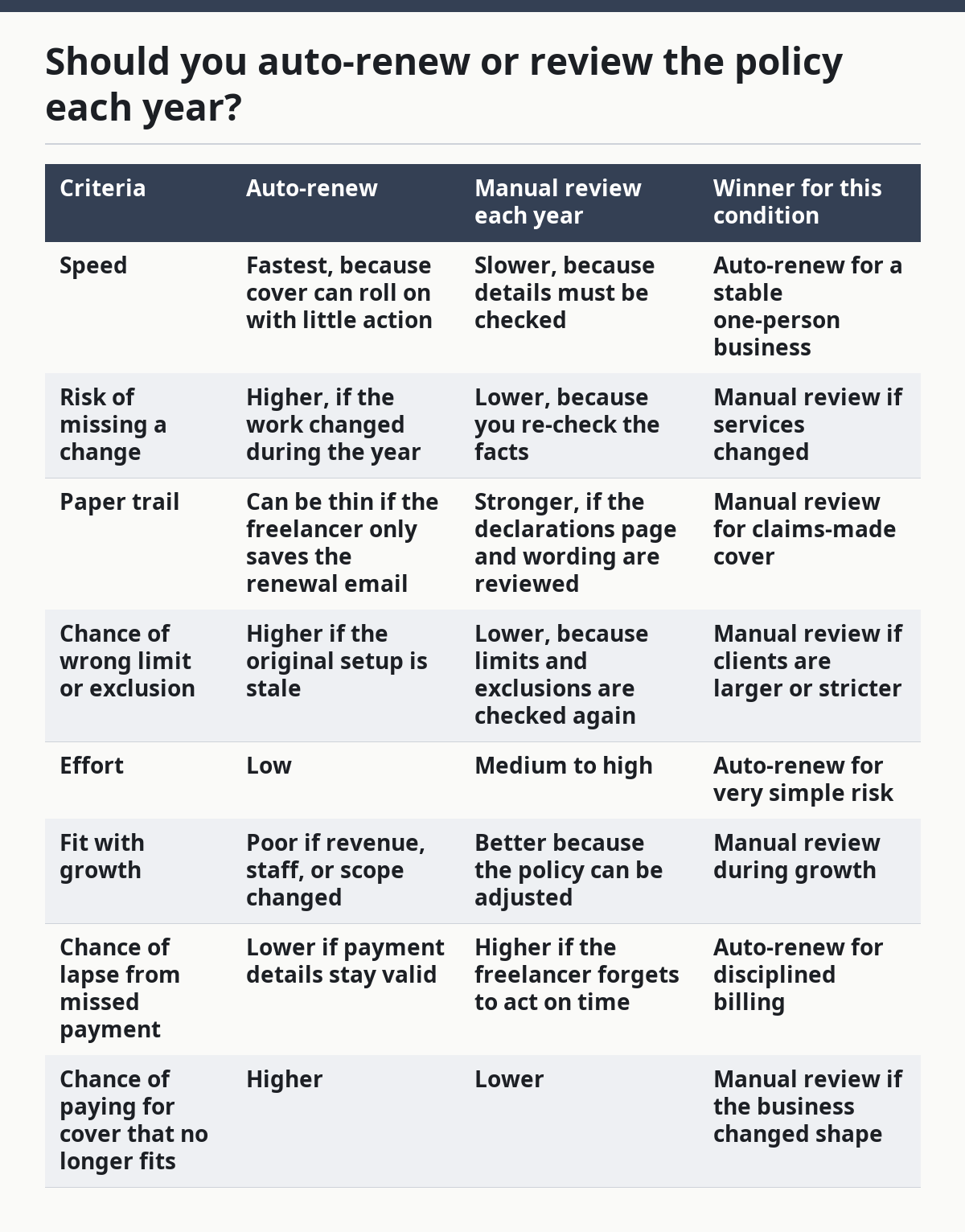
Auto-renew wins when the freelancer does the same kind of work for the same type of client, the policy wording is unchanged, and the insurer has already priced the risk correctly. A web developer who writes code, does not take custody of client money, and has no staff may fit that model fairly well for policy renewal and continuity.
Manual review wins when the freelancer’s work has expanded or the contracts have become stricter. A copywriter who now handles compliance-heavy content, or a consultant who advises on business decisions, has a different risk profile than a freelancer who only edits blog posts. In that case, a stale renewal can become expensive because the policy stays in force, but not for the risk that now exists.
The drawback of manual review is obvious. It takes attention, and busy freelancers often delay it until the renewal notice arrives. The drawback of auto-renew is less obvious but more dangerous: it can hide drift for years. If the policy renews smoothly and nothing ever gets questioned, the freelancer may not notice that the cover no longer matches the business.
A useful rule for freelance policy renewals and continuity is this: auto-renew only if the business is genuinely steady and the declaration details are unchanged; otherwise, review the renewal every year as if it were a new policy.
How do claims-made and occurrence policies behave at renewal?
Claims-made policies need more renewal discipline than occurrence policies because the timing of the claim matters as much as the timing of the work. On a claims-made policy, the claim normally has to be made while the policy is active, and continuity keeps the earlier work connected to the current term. On an occurrence policy, the incident date usually matters more than the renewal date.
That difference is why renewal questions are not the same across policy types. A claims-made form can protect work done 2 years ago if the retroactive date and renewal chain are intact. If that chain breaks, older work can fall into a gap. An occurrence form does not work that way, but it can still leave the freelancer exposed if the wrong activity was listed or the limit is too low.
This is where the fine print matters more than the sales summary. A policy can be described as “renewed” even when the retroactive date changed, the prior acts cover vanished, or the insurer inserted a new exclusion. Those changes are easy to miss if the freelancer only looks at the premium notice.
The practical rule is simple:
- Claims-made: check continuity of dates first.
- Occurrence: check the scope of work and current limit first.
A claims-made policy is not “better” in every case, but it is more sensitive to renewal errors. That makes continuity part of the product, not just part of the administration. If the freelancer expects repeat clients, long project cycles, or delayed complaints, that sensitivity matters a lot.
Occurrence policies are easier to understand at renewal because a claim usually ties back to when the event happened, not when the claim was filed. That said, ease does not remove the need to review the wording. A scope change can still leave a freelancer underinsured, even on an occurrence basis.
The honest trade-off is this: claims-made policies can be cheaper or easier to place in some markets, but they punish sloppy renewal handling. Occurrence policies are simpler on the timeline, but they still need a correct description of the work. Neither type is forgiving if the freelancer stops reading the wording after the first year.
For a reader who wants continuity, the safest habit is to keep the renewal chain intact and save every declarations page. If the policy is claims-made, the retroactive date should be treated like a locked file, not a casual field on a form, and a licensed insurance professional should review any proposed change.
What can break coverage at renewal?
Coverage can break at renewal if there is any gap in dates, any silent change in the policy wording, or any mismatch between the work described and the work actually done. Those are the three failure points that matter most, and they show up more often than people expect.
The most common break is a lapse caused by late payment or a missed renewal notice. Even a short gap can create trouble if a claim or complaint lands during that gap. The second break is a change in business activity that never gets reported. For example, a freelancer who starts handling customer records or giving advice beyond the original scope may now face a different risk profile.
The third break is a missing record. If the freelancer cannot show the old term, the new term, and the payment trail, proving continuity becomes harder. That is a paperwork problem, but the insurance effect is real.
These are the warning signs to treat seriously, and if they appear, consult a professional and compare the renewal against the policy wording:
- the renewal letter uses a new business description
- the retroactive date changes
- a new exclusion appears in the wording
- the limit changes without a clear reason
- the payment receipt is missing
- a subcontractor is added but not declared
- client contracts now ask for higher limits or different wording
The real cost of a broken renewal is often not the premium itself. It is the time spent fixing a gap after a claim has already surfaced. A freelancer who notices the problem before the renewal date can usually act. A freelancer who notices it after a complaint arrives is in a much worse position.
The best defense is to review the declarations page line by line, not just the headline summary. The declarations page tells the story that matters: who is covered, what work is covered, what limits apply, and from what date. If that page is wrong, the renewal is not good enough.
There is also a common false sense of safety around “continuous cover” language. That phrase is only useful if the paperwork supports it. If the contract has changed, continuity on the marketing email is not continuity in the policy.
What should be in a renewal checklist?
A renewal checklist should confirm the dates, the work description, the limits, the exclusions, and the proof of payment before the old term ends. That sounds basic, but a five-point check catches most avoidable mistakes and takes less time than fixing one broken claim file later.
A useful checklist includes these items:
-
Expiry date and start date match with no gap.
Even a 1-day gap can matter if a complaint lands in the wrong window. -
Retroactive date is unchanged if the policy is claims-made.
This is one of the most important continuity points on the page. -
Business description still fits the work actually done.
A freelancer who added consulting, data handling, or subcontracting should not leave the old wording untouched. -
Limit and excess still match the contracts being signed.
The policy may renew cleanly and still be too small for current client terms. -
Exclusions did not shift in a way that cuts out core work.
New exclusions can matter more than the premium change. -
Payment confirmation is stored in more than one place.
One saved PDF and one email copy is far better than a single inbox entry. -
Certificate or schedule can be sent to clients right away.
Fast proof is useful when a contract asks for insurance evidence before work starts.
A freelancer who works with clients that ask for insurance certificates should treat the renewal as a deadline, not a background task. If a certificate is needed on the 1st of the month, the renewal paperwork should be done before then, not after. That kind of missed deadline can stall a project even when the policy itself is fine.
The other reason for a checklist is that renewal changes often look small until a claim appears. A wording tweak, a missing subcontractor, or a mistaken turnover figure can be enough to create a dispute. The checklist is there to catch the small things while they are still cheap to fix.
When should you reconsider the policy entirely?
You should reconsider the policy entirely when the business has changed enough that renewal would only preserve the wrong cover. If the work, client type, headcount, or data exposure has shifted, the right move may be to rewrite the policy instead of renewing it unchanged.
That is especially true after any of these changes:
- you added new services
- you started using subcontractors
- you now handle client data or payment information
- you signed contracts with higher limits
- you moved from low-risk creative work into advice-heavy work
- you had a claim, a complaint, or a near-miss in the last 12 months
A policy should reflect the current business, not the business from 2 years ago. Renewal is the time to ask whether the old structure still makes sense. If the answer is no, pressing “renew” may only preserve an outdated description.
This is where the trade-off gets real. Rewriting or replacing the policy can take more time than letting it roll over, and the premium may change. But the cost of a policy that no longer fits is usually higher than the hassle of a cleaner setup. That is the part many freelancers try to avoid until a claim forces the issue.
A simple test helps: if a new client asked for the same wording and the same evidence you used last year, would the policy still support that request without any edits? If the answer is uncertain, the policy needs a fresh look.
The one exception is when the business is tiny, unchanged, and low-risk. In that case, a straight renewal may be enough, especially if the declarations page is still accurate and the payment trail is clean. For a solo freelancer with one type of work and no major contract shifts, overcomplicating the policy can create more paperwork than protection.
The point is not to rewrite for its own sake. The point is to stop carrying a policy forward after the business has outgrown it.
Which renewal approach fits most freelancers?
Manual renewal review fits most freelancers because income, services, and client demands usually change more often than the owner expects. Auto-renew is a convenience tool, not a strategy. It works best only when the work is steady, the policy wording is still correct, and there is no reason to expect a change in exposure during the next 12 months.
This is the clearest decision rule:
| Situation | Best approach | Why |
|---|---|---|
| Solo freelancer with stable services | Auto-renew with a quick check | Low drift, low admin burden |
| Freelancer with new services this year | Manual review | The old wording may no longer fit |
| Claims-made policy with older projects still active | Manual review | The retroactive date and continuity need checking |
| Freelancer with client contracts that ask for proof | Manual review | Certificates, limits, and wording need confirmation |
| Very simple work and no major change for 12 months | Auto-renew may be enough | The risk profile is steady |
| Any recent complaint or claim | Manual review | Renewal terms should not be assumed |
The honest recommendation is not “always do X.” It is this: if the policy is simple and the business has stayed simple, auto-renew can be fine. If the business is changing, manual review is the safer choice. The more the work changes, the less useful an automatic rollover becomes.
A freelancer who wants continuity should think like a contract checker, not like a subscriber. The aim is not to keep the same policy forever. The aim is to keep the right policy in force with no break in protection.
What are the exception scenarios?
The overall recommendation flips in a few cases, and those cases are important because they are where a generic renewal rule fails. The main advice above assumes the freelancer is protecting ongoing work with a normal liability policy and wants continuity between terms. These exceptions are different.
The first exception is a freelancer whose business is so stable that the policy barely changes from year to year. If the work is identical, the clients are similar, and the declarations page has not moved, auto-renew may be enough. In that case, the risk of over-checking may be greater than the risk of missing a change.
The second exception is a freelancer who has just changed the business in a major way. If the work has moved from one service line to another, or if a new subcontractor now does core work, a renewal is not enough. The policy may need a rewrite, not a continuation.
The third exception is a claims-made policy with a significant history of past projects. Here, continuity is not optional. A 1-day lapse or a moved retroactive date can have long-tail effects, so the renewal deserves more attention than a standard yearly admin task.
The fourth exception is when the client contract itself controls the timing. If a client requires proof of cover before work starts, then the renewal date, certificate date, and contract date all need to line up. In that case, the policy may be fine, but the timing around it is the real issue.
These exceptions matter because they show that continuity is a practical tool, not a slogan. Sometimes the right move is to renew exactly as written. Sometimes the right move is to stop renewing the old setup and build a new one.
FAQ
What is the biggest renewal mistake freelancers make?
The biggest mistake is assuming that a renewed policy automatically means continuous cover. A policy can renew with a payment and still carry the wrong dates, a changed retroactive date, or a new exclusion. That is why the declarations page matters as much as the renewal notice.
How early should I start checking a renewal?
Start at least 30 days before the expiry date, and earlier if your work changed during the year. That gives enough time to fix a wrong business description, update limits, and sort out payment without rushing the process in the final week.
Is auto-renew safe for freelance liability insurance?
Auto-renew is safe only when the business is stable and the policy wording still fits the work. It is weak when the business has grown, the services changed, or the policy is claims-made. In those cases, a manual review is the better choice.
Why does the retroactive date matter so much?
The retroactive date matters because it can determine whether older work stays protected on a claims-made policy. If that date changes or continuity breaks, a claim tied to earlier work may no longer sit inside the cover you thought you had.
What should I save after renewal?
Save the declarations page, the policy wording, the renewal confirmation, and proof of payment. Keep them in at least 2 places. If a client asks for evidence or a claim appears later, those documents are what prove the cover stayed in force.
Drafted with AI; not yet reviewed by a person.
