

Last updated: November 23, 2026
Quick answer: for most freelance work, annual coverage is the better fit over a 12-month policy term; project-based coverage is usually the narrower option for one clearly bounded contract. In this guide to How to Choose Per-Project vs Annual Coverage for Freelance Work, the right choice depends on whether your exposure runs across the year or stops with one assignment. For general small-business planning, see the SBA business insurance overview and the NAIC consumer guidance on insurance.
Key takeaways
- Annual coverage usually fits freelance work that repeats, renews, or overlaps across clients.
- Project-based coverage fits a single engagement with a clear start and finish, especially when the risk is tied to one scope of work.
- The choice is less about the word “cheap” and more about how long your liability risk stays alive.
- A binder can hold temporary proof of coverage, but it does not change the policy term by itself.
- Short-term endorsements can fill a gap, yet they may not solve a longer pattern of work.
- For professional liability basics, the policy term matters as much as the limit.
Which policy term fits freelance work better?

Therefore, annual coverage fits most freelancers because the work usually does not stop and start on a neat calendar. A policy term that follows the year can cover multiple projects, renewals, revisions, and client changes without resetting every time a new contract lands. Project-based coverage is usually a better match only when the exposure is narrow and tied to one engagement with a clean finish line.
The real decision is not “Which is better?” It is “How long is the risk alive?” A design project may end in 30 days, but the claim can still arise later if the client says the work caused loss, delay, or a contract dispute. An annual policy term can be easier to keep in force through those handoffs because the coverage structure stays open across the year instead of ending with one project file.
However, annual coverage is not the right answer for every freelancer. If work is rare, highly bounded, or tied to one-off assignments, a project-based structure may match the actual exposure more closely. The wrong fit is paying for 12 months of protection when the work exists for only a single engagement and there is no second client in sight.
For the broader view on limits and policy structure, this choice sits inside the same framework as deductible size, coverage limits, and renewal timing. See also how deductibles affect premiums and commercial insurance definitions.
What does annual coverage do well?
Because annual coverage treats insurance as part of the business calendar, it works well for freelance work that keeps moving across the year. That matters when several projects overlap in a 12-month policy term, or when new work arrives before the last engagement is fully closed out. A single annual policy can also make renewal timing easier to track because the next review point is fixed.
The main strength is continuity. If one client pauses, another may start. If a project slips, the policy term still exists while the work moves. That continuity can matter more than the name on the contract, because liability risk often appears after delivery, not during the work itself. A binder may show temporary proof for a client file, but it is the active policy term that does the real work over time.
Likewise, annual coverage fits freelancers who do not know which client will come next. A photographer, consultant, editor, or developer with recurring work usually faces more than one project-based risk in a year. In that setting, separate project policies can become a stack of short windows that are harder to track than one year-long structure.
Project-based coverage can feel efficient for a tiny side hustle, but annual coverage is broader than the work may need if the business only exists for one short assignment. It can also tempt a reader to stop paying attention to when the policy renews, which matters because a missed renewal can leave a gap exactly when a client asks for proof.
Annual coverage: pros and cons
Pros
- Covers multiple clients under one policy term.
- Easier to manage when work lasts beyond a single project.
- Better fit for recurring freelance income.
- Less need to restart coverage every time a new job begins.
Cons
- Can be too broad for a one-off assignment.
- Renewal timing matters; a missed date can create a gap.
- May cover months when no project is active.
- Can feel inefficient for a freelancer with only one short contract.
When does project-based coverage make more sense?
Conversely, project-based coverage works best when the risk belongs to one engagement and the engagement has a clear end point. That makes sense for a short-term project, a limited client scope, or a one-time contract where the need for coverage does not continue across the year. If the work is temporary and tightly defined, a project-based term can match the job better than an annual policy.
The strength of this structure is precision. A freelancer who accepts one engagement with one deliverable may not need a 12-month policy term if there is no repeat work lined up. That narrower fit can help a person avoid carrying a policy longer than the project itself. Short-term endorsements may help bridge a narrow gap, but they do not change the basic fact that the coverage is tied to a single project.
The weakness is that project-based coverage can get awkward fast if the job expands. A contract that looks short on paper can stretch across revisions, client delays, or payment disputes. If the work becomes one of several client jobs, the project-based model starts to look patchy. A binder may help prove coverage for the current job, but it does not remove the need to watch the end date closely.
Project-based coverage is not a good fit for a freelancer who works with several clients in the same month. It is also a poor match for anyone who expects repeat work, referrals, or a string of similar engagements. In those cases, the policy structure can become more complicated than the risk itself.
Project-based coverage: pros and cons
Pros
- Matches a single contract more closely.
- Can fit a short-term project with a defined end date.
- Avoids paying for a long policy term when work is brief.
- Works when the exposure is tied to one client and one scope.
Cons
- Less useful for multi-client freelance work.
- Can leave gaps if the project extends.
- Harder to manage if the job changes shape.
- Poor fit when future work is likely but not yet signed.
The honest side-by-side
Therefore, annual coverage is better on continuity, while project-based coverage is better on narrow fit. The table below shows which structure tends to work better under each condition.
| Criteria | Annual coverage | Project-based coverage | Winner for this condition |
|---|---|---|---|
| Multi-client workload | Built for several jobs inside one 12-month policy term | Can become fragmented across separate engagements | Annual coverage |
| Single short-term project | May cover more time than the work needs | Matches one engagement more closely | Project-based coverage |
| Renewal timing | One yearly review point | Multiple start and finish points to track | Annual coverage |
| Temporary policies | Usually not built around a temporary frame | More consistent with short-term work | Project-based coverage |
| Risk that extends past delivery | Better continuity if the issue appears later | Can end before a dispute fully develops | Annual coverage |
| Administrative simplicity | One policy term to track | More job-by-job tracking | Annual coverage |
| Very limited freelance activity | May be broader than needed | Often closer to the actual exposure | Project-based coverage |
| Need for a binder to prove current coverage | Works with ongoing proof during the year | Works only while the project remains active | Annual coverage |
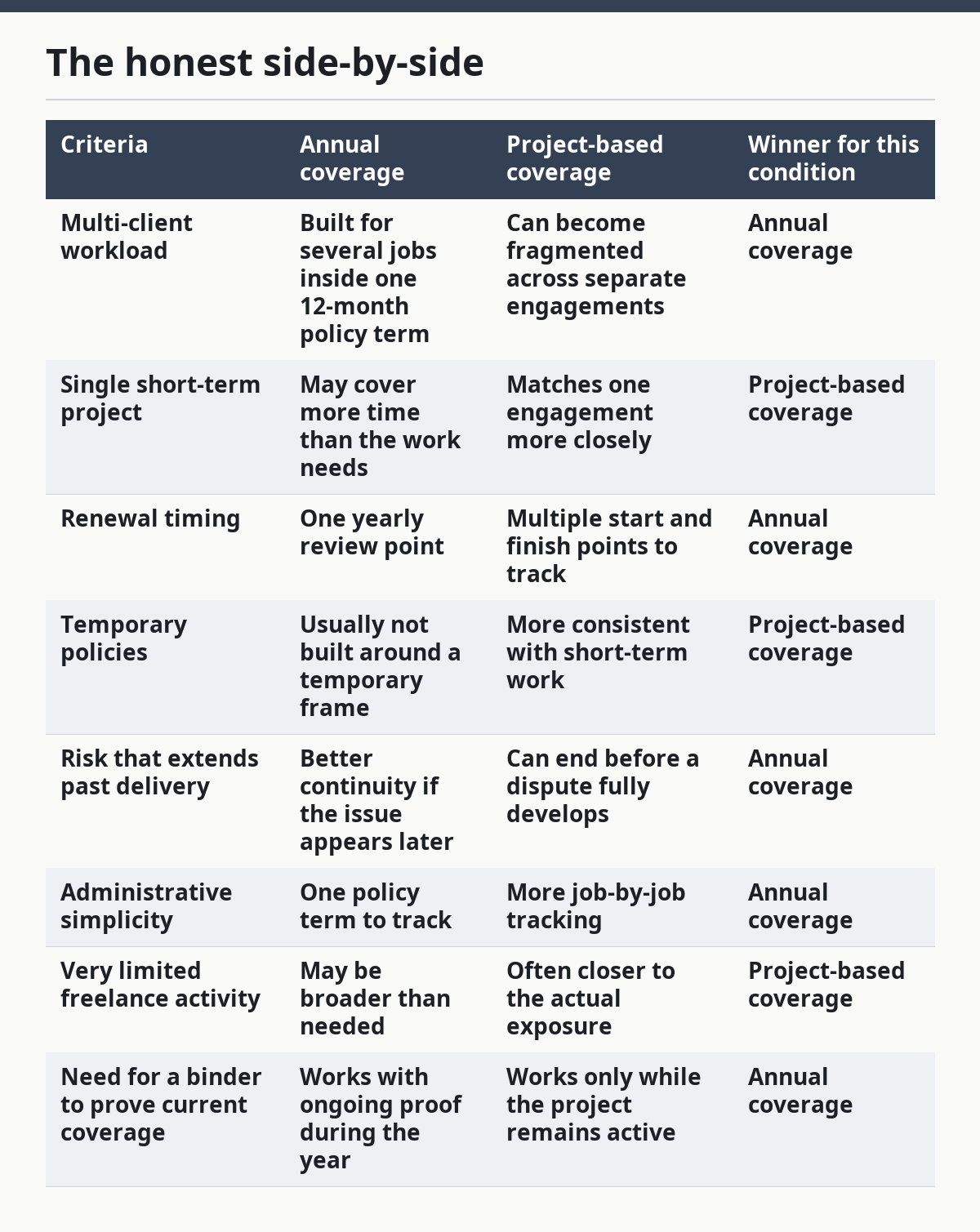
Overall, the table points to the same pattern: annual coverage is better when freelance work behaves like a business year, and project-based coverage is better when the risk behaves like one closed assignment. That distinction matters more than the label on the policy.
Who should pick annual coverage?
Since annual coverage is built for ongoing freelance work, it suits people who expect more than one engagement in the next 12 months. It also fits people whose work changes quickly, because a single policy term can absorb new clients without forcing a new insurance decision every time a contract arrives. If the freelance workload is steady, annual coverage usually aligns better with the way the business actually operates.
The strongest case is a multi-client schedule with overlapping deadlines. In that setup, a project-based structure can leave the freelancer juggling separate short periods of coverage, which makes gaps easier to miss. Annual coverage also fits anyone who wants a cleaner renewal rhythm, because the next policy review usually comes once in the year instead of after each job.
The drawback is that this approach can be overbuilt for a tiny side hustle. If the work is one short engagement and no second contract is likely, annual coverage may include a lot of unused time. That does not make it wrong, but it does make it less efficient. A year-long term can also create the illusion that insurance can be ignored after purchase, which is a bad habit when contract terms, client names, and delivery dates keep changing.
Annual coverage is not for a freelancer who only needs protection around one clearly bounded project. It is also not a fix for someone trying to solve a very specific contract issue that belongs in a separate policy review. For more on business insurance timing, consult a qualified adviser and review NAIC consumer resources.
Who should pick project-based coverage?
Therefore, project-based coverage works for freelancers whose risk lives and dies with one assignment. If the job is temporary, the deliverable is narrow, and the client relationship ends when the scope ends, this structure can fit the work better than a full year of coverage. It is the cleaner match when the freelance business is still small enough that one project is the whole story.
This option also makes sense when there is no realistic expectation of repeat work. A one-off contract can make an annual policy term feel stretched. Project-based coverage keeps attention on the exact engagement, which can be useful when a client only wants protection tied to a specific job. Short-term endorsements may help bridge a narrow gap, but they do not change the basic fact that the coverage is tied to a single project.
The weakness is exposure creep. A “short” project can turn into revisions, scope changes, or delay, and then the insurance term may end before the issue does. That is why project-based coverage is a poor fit for a freelancer with multiple clients, rolling deadlines, or uncertain follow-on work. It is also not ideal when the business wants a simple, year-round structure that covers whatever comes in next.
When should the answer flip?
Therefore, the answer flips in four cases, and each one changes the policy term decision fast.
First, if the project is short on paper but likely to expand, annual coverage becomes safer from a structure point of view because the risk can outlast the original schedule. A 2-week job that turns into months of revisions is no longer a neat project.
Second, if the freelancer already has multiple clients in motion, annual coverage wins even if each job looks small. Two or three active engagements can make project-based coverage messy by the second contract.
Third, if the only work in the year is one clearly bounded assignment, project-based coverage can be the better fit because it tracks the actual exposure instead of a full calendar year.
Fourth, if the client needs proof of coverage for a fixed period, a binder can help show the current arrangement, but the real question is still whether the policy term matches the work. If the work is ongoing, the annual structure is usually the cleaner answer.
Which one should you choose?
Ultimately, choose annual coverage if freelance work is ongoing, if more than one client may be active in the same 12-month period, or if the project could stretch past the original finish date. Choose project-based coverage if one short contract is the only exposure and there is no realistic second job in sight. Neither if the work is unclear enough that the policy term, client scope, and renewal timing still need professional review.
In short, the core split is continuity versus precision. Annual coverage is the better default for most freelancers with recurring work. Project-based coverage is the narrower tool for one-off assignments that truly end when the project ends. For insurance terminology and policy guidance, see the SBA and NAIC.
Therefore, a qualified adviser should be consulted for the reader’s own situation, since policy rules, availability, and contract terms vary by country and change over time.
Drafted with AI; not yet reviewed by a person.
