

Last updated: November 24, 2026
A policy audit notice is a request to compare what your insurer billed against the records for the policy period, then fix any difference before it grows into a larger premium adjustment. This is information, not financial advice; a qualified adviser should review your own situation if the notice changes what you owe, how your income is classified, or how your coverage should be reported.
Key takeaways
- A notice is not the final answer; it is the start of a records check.
- The main job is to match carrier billing to payroll, revenue, and class codes for the same policy period.
- The best file is not a pile of receipts but a clean set of business records that covers every line item the carrier asks for.
- If the notice depends on mixed work, contractor payments, or more than one business activity, the risk of a bad result goes up fast.
- Disputes work best when they point to a specific line, a specific record, and a specific date range.
What is a policy audit notice?
A policy audit notice is the carrier’s request to verify the numbers used to price the policy after the policy period ends. It usually follows a premium audit, which is the review that checks whether payroll, revenue, job class, or other exposure data was right the first time. A premium adjustment notice is the billing change that follows when the carrier decides the final premium should be higher or lower.
For a freelance policy, the notice often turns on 3 things: payroll review, revenue review, and classification check. Payroll review means checking wages or owner pay that were counted in the policy. Revenue review means checking gross receipts or sales figures if the policy was priced that way. Classification check means confirming that the work was placed in the right class code, which is the insurance label used to group similar work for pricing.
| Item | What it does | What to check |
|---|---|---|
| Audit notice | Starts the review | Policy period, request date, due date |
| Premium audit | Reviews the exposure data | Payroll, revenue, class code, contractor records |
| Premium adjustment notice | Shows the bill change | Carrier billing, math, and any credits or additional premium |
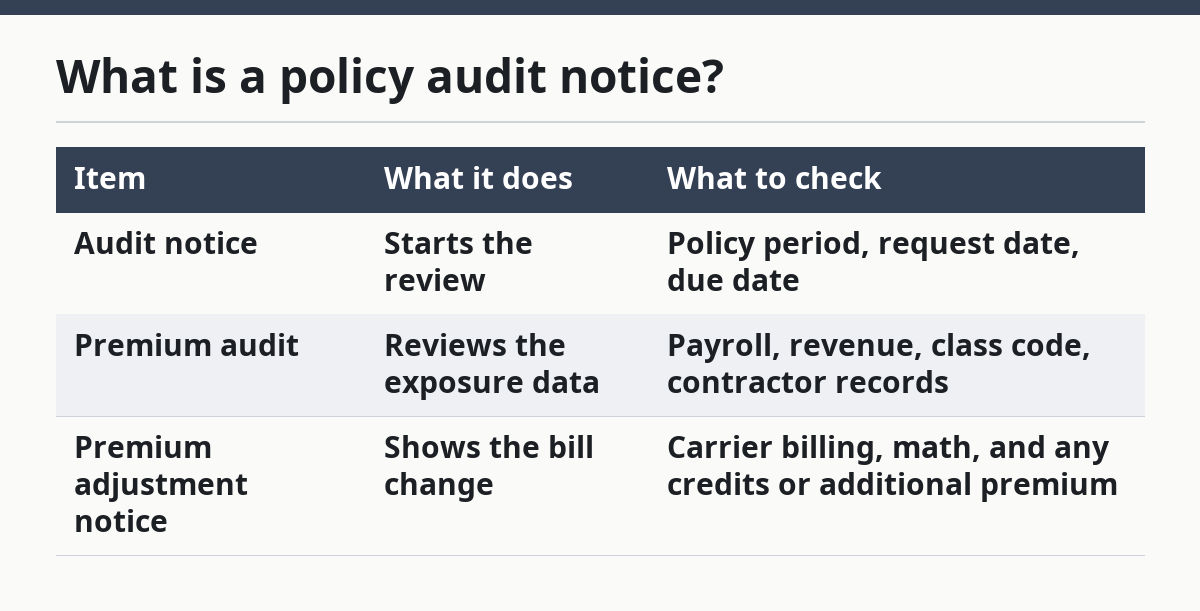
The key point is simple: the notice is not just a bill. It is a reconciliation request, and the final amount should line up with the same 12-month policy period the carrier insured. For recordkeeping help, the IRS has general guidance on keeping business records, and the U.S. Small Business Administration has recordkeeping guidance that can help a business owner organize supporting files. See the IRS recordkeeping guidance and the SBA’s recordkeeping resources on their official sites.
How do you reconcile it step by step?
Reconcile the notice by matching the carrier’s figures to your own records line by line, then correcting only the items that can be supported by documents. Start with the policy period and end with the carrier’s final billing statement, not the other way around.

- Confirm the policy period. Match the start and end dates on the notice to the exact policy term, usually 12 months. Verify that every record you use falls inside that date range. A problem shows up if your files include work from the wrong month or a later renewal period.
- List every data field the carrier is asking for. Pull the requested items into one checklist: payroll, owner compensation, revenue, subcontractor costs, and class code support. Verify that each field has a source document. A problem shows up if the notice asks for a figure that you cannot tie to a ledger, tax form, or invoice.
- Rebuild the payroll view. Use payroll reports, contractor payments, or owner pay records that belong to the policy period. Verify the totals against the carrier’s payroll line, not against a later tax filing from a different year. A problem shows up if the carrier counted payments that were not part of the policy term.
- Rebuild the revenue view. If the policy was based on revenue, total the business receipts that fit the insurer’s definition for that policy. Verify whether the notice is using gross revenue, fee income, or another exposure measure. A problem shows up if you mix personal deposits with business receipts or use a number from the wrong account.
- Check the classification code. Compare your work description to the class code on the policy and on the notice. Verify that the code matches the main freelance activity during the term, not a side task that happened once. A problem shows up if one code was used for design work, but the records mainly show consulting or editing.
- Match supporting records to each disputed line. Attach invoices, contracts, payroll summaries, bank statements, or tax records that prove the corrected number. Verify that each attachment shows the same name, date, and amount. A problem shows up if the file proves the work happened, but not that it belongs to the policy period.
- Recalculate the premium adjustment. Use the carrier’s stated method and compare your numbers with its math. Verify whether the adjustment is a debit or credit and whether fees or minimum premium rules changed the result. A problem shows up if the total on the notice changes when you remove a duplicate item or a misread class code.
- Respond in writing before the deadline. Send the corrected figures, the backup records, and a short note that names each disputed line. Verify that the carrier acknowledges receipt. A problem shows up if the notice expires before your reply, because late responses can weaken the dispute.
That process sounds basic, but the order matters. A lot of bad reconciliations start with a gut reaction to the dollar amount and end with a reply that cannot be traced back to the records.
What records do you need?
You need records that prove the number, the date, and the business purpose for each line on the notice. A premium audit is won or lost on documents, not on general explanations, and the best file is the one that can answer a question in 30 seconds.
The usual set includes 4 types of support. First are business records such as bookkeeping reports, invoices, bank statements, and tax schedules. Second are payroll records if you paid staff or yourself through a payroll system. Third are contractor records if the policy asks for subcontractor or vendor payments. Fourth are classification records, such as a work description, client contract, or invoice language that shows what you actually did.
For freelancers, the most common failure is a mismatch between revenue and work type. A writer, designer, consultant, or photographer may have one client mix on paper and a different one in practice, but the carrier only cares about the exposure that falls inside the policy terms. If the records are split across 2 business accounts, use the account that shows the policy-period activity and separate the personal deposits.
Keep the file clean. A 1-page summary that maps each disputed line to one supporting document is more useful than a 40-page stack of unsorted records. If a number cannot be tied to a dated record, treat it as unproven until it can.
When should you stop and get help?
You should stop trying to force a clean reconciliation when the notice and your records do not describe the same business activity. That is a sign the issue is bigger than a simple correction.
The notice covers more than one business activity: One policy period may include design, consulting, and training, which can fall into different class codes — pause and get the carrier’s rules or a qualified adviser to review the split before replying.
The carrier asks for records you do not keep: Missing payroll reports, contractor files, or bank detail can make the response incomplete — stop and rebuild the file before you send anything.
The numbers cross tax years or policy years: A 12-month policy term can overlap with a calendar year in a way that makes totals look wrong — do not mix the two without a clear reconciliation schedule.
The premium adjustment is driven by a class code dispute: If the core disagreement is what kind of work was insured, not how much work was done, the issue may need a more careful review — ask for the carrier’s written basis first.
The notice includes subcontractors or owner pay you cannot separate cleanly: Blended compensation can distort the exposure base — stop and separate the payments before you answer.
The deadline is close and the file is still incomplete: A rushed reply can lock in an error — send a short extension request or a partial response that says which records are still being assembled.
This is where a generic “just call the insurer” answer falls apart. The real issue is not speed; it is whether the records can support the correction without creating a second problem.
What mistakes cause the biggest problems?
The biggest problems come from using the wrong period, the wrong totals, or the wrong class code. Each mistake changes the premium adjustment in a different way, and each one can be avoided with a slower read of the notice.
The first mistake is replying from memory. That leads to totals that sound right but do not match the records. The fix is to use source documents, not recollection. The second mistake is using tax figures without checking whether the carrier defined exposure the same way. A tax return and an insurance audit can measure different things.
The third mistake is ignoring small line items. A 1-line payroll error or an extra contractor payment can change the final bill. The fourth mistake is failing to flag mixed work. If one client project fits two class codes, the carrier may need a split allocation instead of a single label. The fifth mistake is sending a long explanation with no document map. A carrier reviewer needs line-by-line proof, not a general story.
A sixth mistake is treating the notice like a one-time bill instead of a record of how the policy was priced. That mindset can turn a correctable premium adjustment into a prolonged dispute.
| Mistake | Likely consequence | Better move |
|---|---|---|
| Using memory instead of records | Wrong totals | Pull dated source documents |
| Mixing tax figures with audit figures | Bad comparison | Match the carrier’s definition first |
| Skipping small lines | Hidden premium change | Check every line item |
| Leaving out class splits | Misclassified work | Separate work types with support |
| Sending no document map | Slow review, weak dispute | Attach a line-by-line index |
What if the numbers still do not match?
If the numbers still do not match after one clean pass, the next step is a line-by-line dispute, not a vague objection. A premium audit dispute works best when it names the exact line, the exact record, and the exact correction.
Start with the carrier’s billing summary and mark the items that differ from your records. Then write a short response that says what is wrong, why it is wrong, and what document proves the correction. If the issue is a class code, ask the carrier to show how it assigned the code and what facts it relied on. If the issue is payroll or revenue, ask for the calculation method and the figures used in the adjustment.
The main trade-off is time. A careful dispute takes longer than accepting the first number, but a rushed reply can leave a bad line in place for the full policy cycle. If the file is complicated, keep the response narrow and factual. A narrow dispute is easier to review than a broad complaint that tries to fix every problem at once.
This page sits under the hub Freelance insurance policy administration — The Complete Guide, which covers the wider post-issuance workflow around policies. That broader guide can help place the audit notice in context without turning this page into a renewal questionnaire or a quote guide.
Why did my insurer audit my freelance policy?
Your insurer audited the policy because it needs to verify the exposure data used to price the coverage for that policy period. That can include payroll, revenue, job class, or contractor payments, depending on how the policy was written. An audit is not always a sign of a problem; it is often the carrier’s routine check after the term ends.
What records do I need for an audit?
You need records that tie the policy-period numbers to dated business activity. That usually means invoices, bank statements, bookkeeping reports, payroll records, contractor records, and anything that supports the class code used on the policy. The strongest file shows the figure, the date, and the business purpose on the same page when possible.
Can I dispute a premium adjustment notice?
Yes, if the notice uses the wrong period, the wrong class code, or the wrong support for a line item, a dispute can be raised in writing. The best dispute is short and document-based: point to the line, state the correction, and attach the record that proves it. If the issue is a classification question, a qualified adviser should review the facts before any formal reply.

Drafted with AI; not yet reviewed by a person.
