

Last updated: November 24, 2026
A freelance mistake is a claim if someone is asking for payment, repair, or other relief; it is a notice if the facts may turn into a claim later; and it is an internal fix if you can correct the work, document the issue, and no one outside the job needs insurer action yet. This is information, not financial advice, and a qualified adviser should be consulted for your own situation.
Key takeaways
- A claim usually has a demand attached to it: money, redo work, or a formal allegation.
- A notice is about preserving the date and facts when the issue could grow later.
- An internal fix is for problems you can correct now without putting the insurer into the file yet.
- The same mistake can move from one bucket to another as the facts change.
- Keep one clean record of what happened, what the client said, and what you changed.
Who this is for
This applies to freelancers who already know there was a mistake and now have to decide what bucket it belongs in. It assumes you have the basic facts, the client’s message, and your own notes, even if they are messy or incomplete.
This is not for anyone facing a lawsuit paper, a formal demand letter, or a deadline that could affect legal rights. If a lawyer is involved, if the insurer’s reporting language is already in your contract, or if the issue involves a missed deadline that may wipe out coverage, stop guessing and get qualified help.
How do you sort a freelance mistake into the right bucket?
You sort it by asking one question at a time, in the same order every time: demand, timing, exposure, and fixability. The point is not to label the mistake in the abstract; the point is to decide what action protects your position without overreporting or underreporting.

- Read the client message and mark any demand. Look for words like refund, credit, redo, replacement, payment, or “we expect you to cover this,” and treat that as a possible claim. Verify whether the client is asking for a remedy within the next email or call. If there is no request for relief at all, the problem may still be a notice or internal fix.
- Separate facts from blame. Write down the event in plain language: what was delivered, what was wrong, and what changed after the mistake was found. Verify whether the issue is a factual error, a missed deadline, or a loss caused by something else. If the story depends on assumptions you cannot support, the file is not ready for a clean decision.
- Check for outside exposure. Ask whether the client’s loss seems limited to the project itself or whether it could spread to a third party, another contract, or a legal demand. Verify whether the issue could trigger a reservation of rights, which is the insurer’s written statement that it is reviewing the matter without giving up defenses. If the exposure is broader than the project, a notice bucket becomes more likely.
- Compare the client’s response to a claim threshold. A claim usually has some form of accusation or request for compensation, even if it is informal. Verify whether the client has rejected your explanation, asked for reimbursement, or threatened to escalate. If the client is only asking for a correction and has not tied it to money or fault, the matter may still stay internal.
- Test the fix against the contract and the facts. Decide whether you can repair the work, replace the file, or redo the task without changing the underlying exposure. Verify whether the fix can be completed quickly and cleanly, or whether it would require you to admit fault in writing. If the fix itself creates a paper trail that worsens the position, pause before sending it.
- Record the decision in your internal notes. Save the date, the message, the decision, and the reason you chose claim, notice, or internal fix. Verify that the notes mention the exact client wording and your next step, not a vague summary. If you cannot explain the choice in two or three sentences, the file is too thin to trust.
- Escalate only when the facts cross a reporting line. If the issue could become a claim later, file it as a notice rather than waiting for the demand to grow. Verify whether your policy or client contract uses special reporting language. If you are unsure which bucket applies, the safer move is to preserve the facts now rather than try to polish the label later.
A simple way to think about it is this: claim means someone is already asking for relief, notice means the problem may turn into a claim, and internal fix means you are still inside your own workflow. The hard part is that the same freelance mistake can move between those buckets in a day if the client changes tone or sends a formal demand.
Is this a claim, a notice, or just an internal fix?
It is a claim when there is a demand; it is a notice when there is a risk of future demand; and it is an internal fix when the issue stays inside your own correction process. The difference is not the typo, the missed edit, or the broken file by itself, but the level of exposure attached to it.
| Bucket | What it usually looks like | What it means | Common sign you should not ignore |
|---|---|---|---|
| Claim | The client asks for money, refund, redo, or compensation | A formal or informal demand has started | A request for payment or blame appears in writing |
| Notice | The client has not demanded relief yet, but the facts could later support a claim | You are preserving the record and date | The client says they are reviewing harm or may escalate |
| Internal fix | You can repair the mistake, keep records, and the matter stays within the project | No outside reporting action is needed yet | Fixing it would require you to make a written admission |
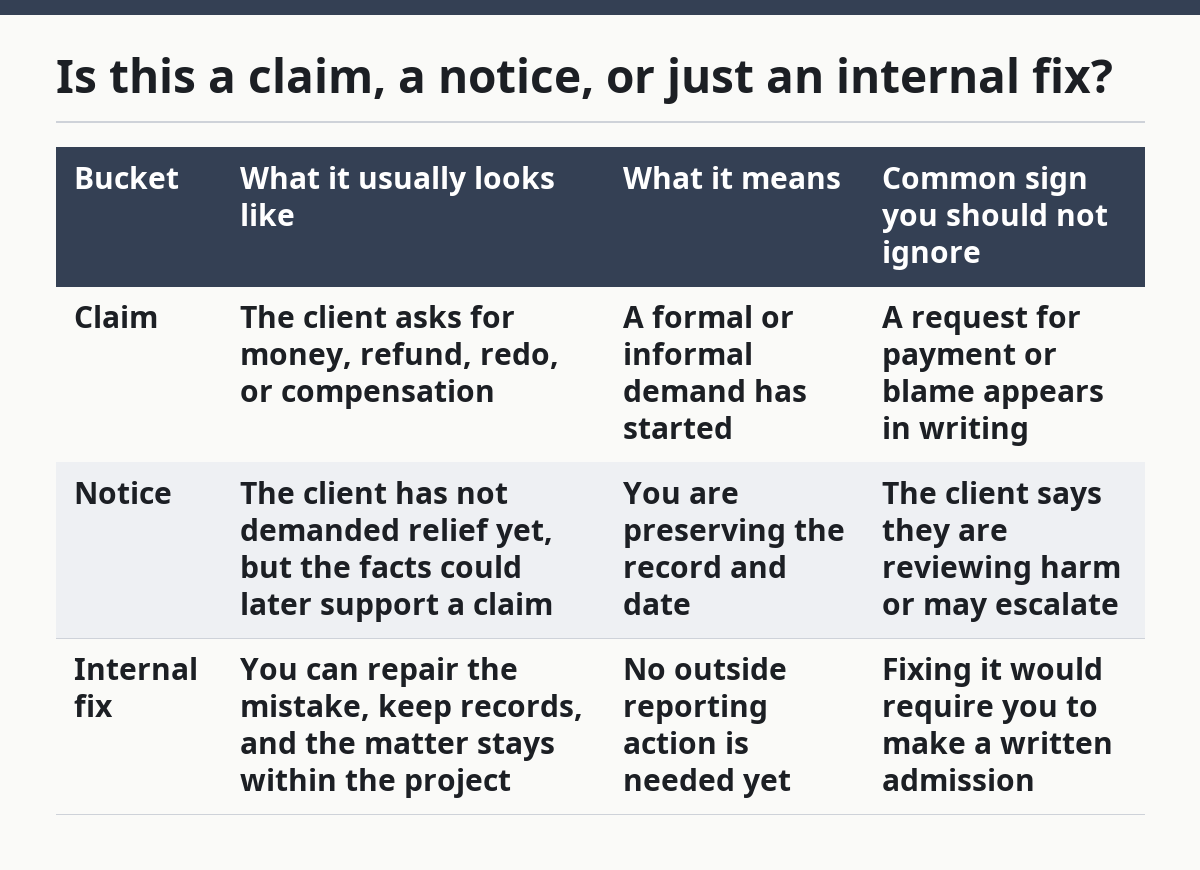
The best test is whether a neutral reader could see a demand in the words already sent. If yes, the file leans claim. If not, but the issue could still mature into one, it leans notice. If neither is true and the work can be corrected without spreading the problem, an internal fix may be enough.
What should you check before you choose?
You should check the client’s exact wording, the size of the error, the likely spillover, and any reservation of rights language already in play. Those four points are enough to keep the decision grounded in facts instead of worry.
Start with the message itself. A casual complaint is not the same as a demand, and a demand is not the same as a lawsuit threat. Then check whether the mistake is isolated to one deliverable or tied to a larger set of work, because a small error can still matter if it affects a deadline, a launch, or a third-party contract.
Next, look at your own policy terms and client agreement if you have them. Many contracts and policies use reporting language that matters more than your own label for the event. If the client or insurer uses terms like reservation of rights, notice, or claim, mirror those terms in your records rather than inventing a friendlier version.
Finally, make sure the fix does not erase the history. Internal records matter because they show what you knew, when you knew it, and how you responded. A clean file is not a long file; it is a clear one.
When should you stop treating it as an internal fix?
You should stop treating it as an internal fix when the issue starts to look like a demand, a legal dispute, or a problem that can grow beyond the job. At that point, the question is no longer “Can I tidy this up?” but “What record do I need to preserve?”

The client asks for money or a refund: that is the first sign of a claim, even if the request is soft — save the message and treat it as a possible claim path.
The client threatens escalation within a short reply chain: that means the issue may mature quickly — stop improvising and document the exact wording.
A third party is involved: a downstream client, vendor, or platform can turn a one-project mistake into a wider exposure — preserve the facts and consider notice language.
You would need to admit fault to fix it: the correction may change your position — get the wording right before you send anything.
The contract mentions reporting or notice duties: the paper trail may control the next step — follow the contract language, not your instinct.
You do not know whether the deadline has passed: timing can change what is reportable — do not rely on memory when the stakes include coverage or rights.
These are the points where an internal fix stops being the whole answer. If the problem crosses any of them, the safer move is to preserve the file and get qualified help about the next step.
What mistakes do freelancers make most often?
The most common mistake is waiting until the client’s tone gets harsher. That turns a possible notice into a late problem and can leave you with a weaker record than you needed. The better move is to save the facts at the first sign of a possible demand.
Another mistake is calling every complaint a claim. That can clutter your records and make you miss the difference between a fixable issue and a real exposure. The correct alternative is to look for a request for relief, not just frustration.
A third mistake is fixing the work first and documenting later. Once the file is changed, it becomes harder to show what the mistake was and why the correction mattered. The correct alternative is to capture the original message, then document the fix.
A fourth mistake is treating a notice like a confession. A notice is often just a way to preserve the date and facts; it is not the same thing as admitting liability. The correct alternative is to keep the language factual and narrow.
A fifth mistake is relying on memory instead of internal records. Even a 3-line note can be better than a detailed story written a week later. The correct alternative is to write down the event, the response, and the decision on the same day if possible.
What changes when the facts are messy?
The standard approach needs adjustment when the client’s message is vague, the project is spread over several deliverables, or the mistake is mixed with older issues. In those cases, the clean claim/notice/fix split can blur, and you need to slow down the classification.
If the client says only that the work “caused a problem,” do not force a claim label just because you feel anxious. Ask what loss they are describing and whether they want money, a redo, or some other remedy. If they cannot state the relief yet, the matter may still be a notice.
If the mistake touches several jobs, treat each deliverable as its own factual unit in your records. A single email thread can hide two different exposures, and the wrong bucket on one can contaminate the other. Keep the notes separate even if the client does not.
If there is already a reservation of rights letter or similar language, that changes the frame. The insurer may be saying it is reviewing coverage while keeping defenses open, so your internal summary should match the real dispute, not your preferred version of it.
How can you keep the file clean without overreporting?
You can keep the file clean by using one written summary, one decision, and one next step. That is enough for most routine freelance mistakes and avoids the mess that comes from scattered texts, half-finished drafts, and duplicate notes.
Put the client’s exact words in your record, then add your own 2-sentence decision: claim, notice, or internal fix. After that, note the action you took and the date. If you later learn the facts were bigger than they first looked, add to the same record instead of starting over.
This is also where internal records matter most. They show whether the issue was handled promptly, whether the correction was real, and whether the problem was ever more than a project-level fix. For general guidance on the larger response process, the hub on freelance claims, incidents, and loss response is the next place to read.
FAQ
When should a freelancer report an issue to an insurer?
A freelancer should report an issue when the facts suggest it could become a claim later, even if no formal demand has arrived yet. If the client is hinting at compensation, blame, or escalation, the safer classification is often notice rather than silence. Because policy terms differ, a qualified adviser should review the specific situation.
What is the difference between a claim and a notice?
A claim has a demand attached to it, while a notice is a way to preserve a problem that may become a claim later. The same freelance mistake can start as a notice and later become a claim if the client asks for money or other relief. The label depends on the facts, not just the mistake itself.
Can I keep a problem internal instead of reporting it?
You can keep a problem internal only when the issue stays inside your own correction process and does not create a demand or wider exposure. If the client wants money, threatens escalation, or the contract requires reporting, an internal fix may no longer be enough. When in doubt, get qualified help before deciding not to report.
Drafted with AI; not yet reviewed by a person.
