

Last updated: November 25, 2026
How to Compare Freelance Insurance for a One-Client Business vs a Multi-Client Business
Quick Answer: In How to Compare Freelance Insurance for a One-Client Business vs a Multi-Client Business, the fastest way to compare cover is to look at one number: how many clients supply most of the income. If one client drives the work, the insurance check is mainly about dependency; if several clients do, the check is mainly about consistency and spread. A one-client freelance business usually needs closer attention to contract dependency, while a multi-client business usually needs more attention to coverage consistency across project work and retainer work.
The main difference is client concentration risk: a one-client freelance business usually needs closer attention to contract dependency, while a multi-client business usually needs more attention to coverage consistency across project work and retainer work.
Key takeaways
- One-client businesses usually face sharper exposure if that client delays, cuts, or ends work.
- Multi-client businesses usually create a steadier picture for an insurer, but the mix of project work and retainer work still matters.
- The right insurance comparison is not only about the policy name; it is about how the insurer reads your dependency on one client.
- Freelance insurance should be judged against the business model, not only the job title.
- A policy that fits one long contract may be awkward for a business that works with several clients at once.
What changes when you only have one client?
Therefore, a one-client freelance business changes the insurance conversation because the insurer sees a stronger link between one client contract and the business’s income stream. That does not mean the business cannot get cover; it means underwriting exposure can look more concentrated, especially if most work depends on one agreement that runs month to month or on a single long project.
Because of that, the practical issue is not just revenue. It is dependence. If one client controls most of the work, then a single dispute, cancellation, or pause can change the risk picture fast. That matters when the insurer is trying to judge how stable the freelance business is and how likely claims issues may become if work stops suddenly.
For example, client concentration also shapes what kind of questions come up on an application. The insurer may care more about the length of the client contract, the kind of project work involved, and whether the arrangement looks closer to steady contract labor or a single, fragile business relationship. If the business is built around one retainer, the insurer may read that differently from a one-off project.
Accordingly, a one-client business often needs insurance that is judged against dependency, not just job title. The page on freelancer insurance for solo businesses on this site goes deeper on the wider policy picture.
How does client concentration affect coverage?
So client concentration affects coverage by changing how much of the business’s risk sits in one place. If one client makes up most of the work, the insurer may focus more on whether the business can absorb interruption, claims disputes, or contract changes without a broader client base to spread the risk.
In particular, a concentrated client base can also change the importance of continuity. For example, if the business only serves one client, then a gap in that contract can leave the freelancer with no active project work at all. That does not automatically change every policy term, but it can affect how the insurer views exposure, renewal questions, and stability over time.
Therefore, the coverage question is not only “Do I need insurance?” It is also “What is this insurer looking at when it prices and underwrites the business?” That is why one-client freelancers should usually ask the insurer, or a qualified adviser, how the client contract is being treated in the underwriting file rather than assuming every policy is assessed the same way. The same policy label can hide very different risk assumptions.
For that reason, two useful public references for the general insurance side are the National Association of Insurance Commissioners’ consumer information pages and the U.S. Small Business Administration’s business insurance guidance. Those pages explain how business insurance is commonly assessed, even though rates and rules vary by country and change over time.
One-client business: where it wins and where it doesn’t
However, a one-client business wins when the work is clearly tied to a single, stable relationship and the insurance question is mostly about keeping that relationship protected. That setup can suit a freelancer who does ongoing project work for one company and has a clear client contract, because the business model is simple and the insurer can see the source of work without a wide mix of accounts.
It also suits people who want a cleaner application. One client often means fewer moving parts in the application, fewer invoice streams to explain, and a cleaner story about how the freelance business operates. If the arrangement is essentially long-term retainer work, the policy conversation can be narrower than for a business juggling many short engagements.
By contrast, the weakness is obvious: client concentration risk. If that client ends the contract, the business may have no buffer. That can make the insurance conversation feel more fragile, because a change in one relationship changes the whole business picture. It is also harder to spread the risk of a dispute or interruption across other clients.
Ultimately, a one-client model is not a good fit for a freelancer whose income shifts often or whose work is already split across several separate jobs. In that case, trying to frame the business as a one-client operation can understate the real risk profile.
Pros
- Simple client structure
- Easier to describe to an insurer
- Often fits steady retainer work
- Fewer contract records to manage
Cons
- High dependency on one client
- Bigger impact if the contract ends
- Less income spread across the business
- Stronger underwriting focus on concentration
Multi-client business: when does it make more sense?
Therefore, a multi-client business makes more sense when the freelancer’s work is spread across several clients, especially if no single client dominates the business. That wider base usually reduces client concentration risk and gives the insurer a clearer picture of a business that can absorb one contract ending without losing all work at once.
This model often fits project work better than a single long relationship. The insurance conversation then becomes less about one contract and more about how the business handles different scopes, deadlines, and client types. If the freelancer uses both project work and retainer work, the mix matters because it shows whether income depends on one file, one client, or several separate jobs.
Meanwhile, the advantage is resilience. A multi-client business can lose one account and still keep operating, which changes the underwriting exposure in a meaningful way. It does not remove risk, but it makes the business less dependent on one decision by one client.
Even so, the drawback is complexity. More clients can mean more contracts, more scope changes, and more places for misunderstandings to begin. A multi-client business may also face more inconsistent coverage questions if the client mix changes quickly or if the work style varies from one project to another. That can make the insurer’s job harder, even when the business itself is healthier.
Pros
- Lower dependence on one client
- Better spread of business risk
- Often easier to show ongoing activity
- More flexible if one account ends
Cons
- More moving parts in the insurance file
- Different contracts can mean different risk questions
- Project mix can complicate underwriting
- More admin around changes in work patterns
The honest side-by-side
Overall, the better comparison is not “which one is cheaper” or “which one has better insurance.” It is which structure creates the cleaner risk picture for the insurer and the more useful coverage fit for the freelancer’s real work pattern.
| Criteria | One-client business | Multi-client business | Winner for this condition |
|---|---|---|---|
| Client concentration | High dependence on one client contract | Work is spread across several clients | Multi-client, when stability matters |
| Underwriting exposure | Closer scrutiny of dependency and continuity | Broader risk profile across accounts | Multi-client, for a smoother risk picture |
| Contract dependency | One agreement may drive most of the file | No single contract usually carries the whole business | Multi-client, for lower dependency |
| Coverage consistency | Usually simpler if the arrangement is steady | Must fit several scopes and client terms | One-client, for simplicity |
| Project frequency | Often one ongoing project or one retainer | More frequent switching between jobs | Depends on whether continuity or variety matters more |
| Admin burden | Lower record keeping | More contracts and more moving parts | One-client, for simplicity |
| Income shock if work stops | High if the client ends the relationship | Lower if other clients remain active | Multi-client, for resilience |
| Fit for retainer work | Often a strong fit | Can fit, but not required | One-client, when the retainer is central |
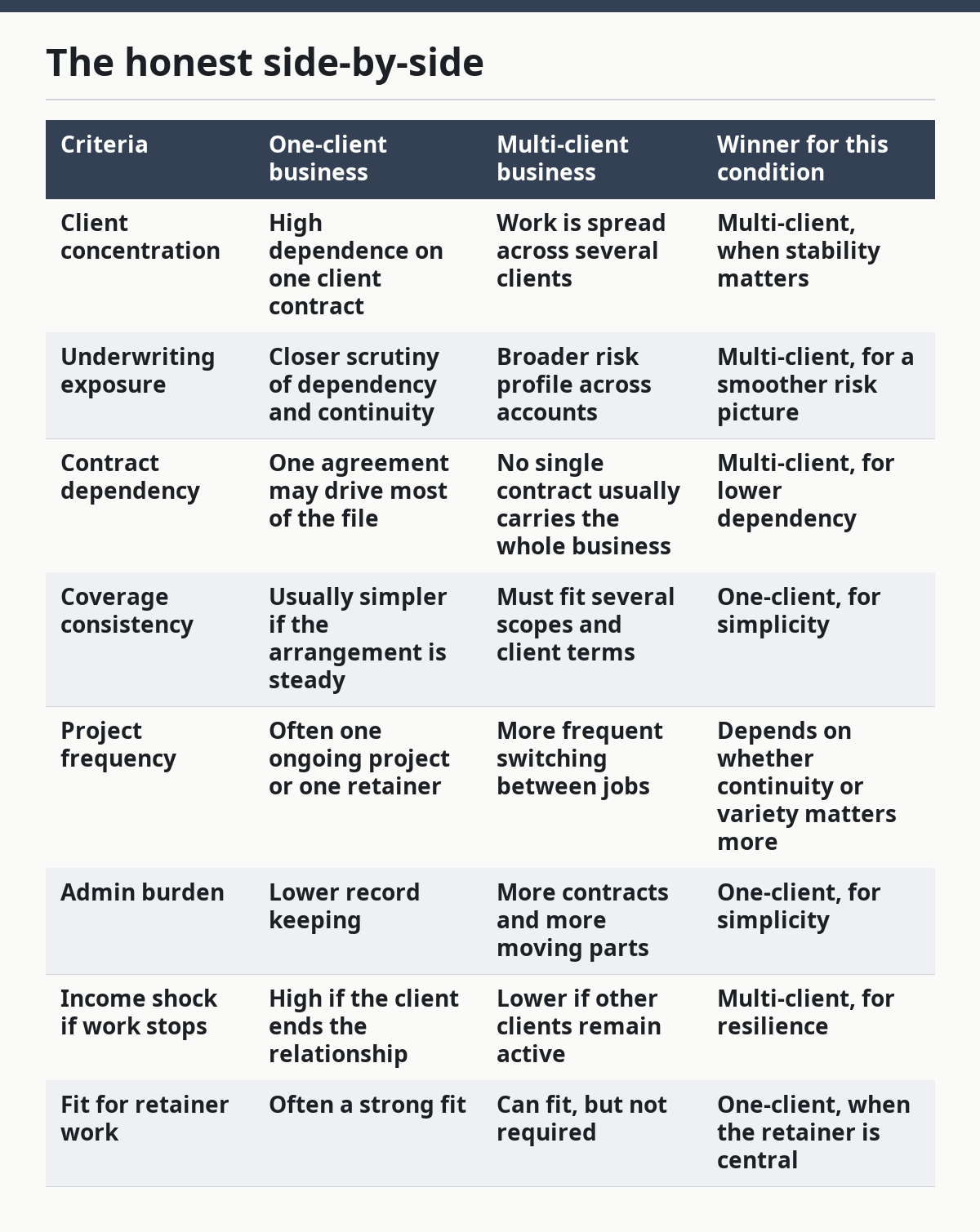
In short, the table points to a simple rule: one-client businesses usually win on simplicity, while multi-client businesses usually win on resilience. That is the core comparison a freelancer should use before looking at any policy details.
What should you compare in the policy itself?
Because the policy should be compared on how well it matches the business pattern, not on the number of clients alone, a freelancer with one client and a freelancer with five clients can both need the same policy type, but the underwriting conversation and the details of how the work is described can differ.

Start with how the insurer handles the client contract, the work description, and the business’s project frequency. If the policy assumes broad, varied freelance work but the business is really one-client retainer work, the fit may be off even if the headline cover looks right. If the business is multi-client project work, the insurer may need a clearer picture of how often jobs change and how much exposure comes from each account.
Likewise, this is where coverage consistency matters. A policy that matches one long client relationship may not fit a business that shifts between contracts every few weeks. A policy that assumes a steady mix of clients may not fit a freelancer who depends on one firm for nearly all revenue. The comparison is about whether the insurer’s assumptions match the business’s actual pattern.
For general business insurance structure, the U.S. Small Business Administration’s guidance is a useful starting point: https://www.sba.gov/business-guide/launch-your-business/get-business-insurance. For consumer insurance basics, the National Association of Insurance Commissioners also publishes public material: https://content.naic.org/consumer/insurance-basics.
For another overview of business insurance basics, see business insurance, and for a broader look at professional liability insurance if your freelance work includes advice or client-facing deliverables.
When should the choice flip?
Therefore, the choice flips when the client count stops telling the whole story. A one-client business can look safer than it is if that client is unstable, while a multi-client business can look riskier than it is if one client still dominates most of the work.

One exception is a long retainer with a large, reliable client and low project churn. In that case, the one-client model may be the better fit because the relationship is stable and the insurance story is simple. Another exception is a business with several clients but one client still accounts for most of the workload. That is still client concentration risk, even if the business technically has more than one customer.
Next, a third flip point is contract type. If the freelancer does recurring project work for several clients, the multi-client model usually fits better. If the freelancer is effectively embedded in one client’s operation for a fixed term, the one-client model may describe the business more honestly than a count of active invoices would suggest.
Finally, a fourth flip point is administrative tolerance. Some freelancers can manage complex, changing client files. Others need the cleanest possible insurance explanation. That does not make one better in general; it makes one better for the business that exists on paper and in practice, not the one a spreadsheet suggests.
Which one should you choose?
Therefore, choose one-client business insurance framing if one contract drives most of the freelance business, the work is steady retainer work, and simplicity is the main goal. Choose multi-client business insurance framing if the business has several active clients, no single client controls the risk, and the goal is to show a broader, more resilient work pattern. If the income picture is too mixed to describe clearly, a qualified adviser should review the facts before any policy decision is made.
That is the blunt answer. A one-client business is not automatically riskier, and a multi-client business is not automatically better; the right choice depends on whether the business is built on dependency or diversification. If the freelance business sits between those two, a qualified adviser should review the facts before any policy decision is made.
FAQ
Does having one client change my freelance insurance needs?
Yes, because one client usually creates client concentration risk. That can change how an insurer views contract dependency, continuity, and underwriting exposure. It does not mean the business cannot get insurance; it means the insurer may look more closely at the client contract and how much of the business depends on that single relationship.
Is freelance insurance different if I work with many clients?
Yes, because multiple clients usually spread the business risk across more than one account. That can make the insurer’s picture less concentrated, but it can also add complexity if the work types and contract terms vary. The policy still has to match the business’s actual mix of project work and retainer work.
How does client concentration affect coverage?
Client concentration affects coverage by changing how dependent the business is on one source of work. If one client dominates the freelance business, the insurer may see higher underwriting exposure and may ask more about continuity. The result is usually not a different category of insurance, but a different way of judging the same policy.
Drafted with AI; not yet reviewed by a person.
