

Last updated: November 24, 2026
Quick Answer: A freelance business with part-time, side-hustle, or sporadic income can usually be insured with a 12-month revenue estimate if the application shows how the work is earned, billed, and projected over a year. The key is to turn uneven client payments into an annualized revenue estimate, then match that figure to the insurer’s form and minimum premium rules. This guide to How to Insure a Freelance Business With Part-Time, Side-Hustle, or Sporadic Income keeps the numbers and paperwork aligned.
This is information, not financial advice. A qualified adviser should be consulted for your own situation, because insurance rules, tax rules, and underwriting standards vary by country and insurer. For general business-record standards, see the U.S. Small Business Administration and the IRS recordkeeping guidance: https://www.sba.gov/business-guide/plan-your-business/write-your-business-plan and https://www.irs.gov/businesses/small-businesses-self-employed/recordkeeping
Key takeaways
- Irregular income is usually a paperwork problem, not a reason to skip insurance.
- Insurers want a yearly picture of the freelance business, not a lucky month or a dry month.
- Project-based billing, side-hustle income, and part-time work can all count if they are part of the same business activity.
- The biggest mistake is guessing low to keep a premium down; that can leave gaps or trigger a rewrite later.
- If your work changes a lot during the year, the cleanest route is often to use a 12-month projection and keep records that show how you got there.
Who this applies to
Therefore, this applies to a freelancer who earns money in bursts, not on a salary schedule, and who needs an insurance application to make sense of that pattern. It fits part-time freelance work, side-hustle income, and sporadic client billing where one month may have 3 invoices and the next may have none.
It assumes you already know the basic shape of your freelance business: what services you sell, how you bill, and roughly how much came in during the last 12 months. It also assumes you can separate freelance income from wages, hobby income, or one-off personal sales. If the business has mixed activity so tangled that you cannot tell what belongs to it, that is a sign to get qualified help before you file anything.
How do you make irregular freelance income insurable?
You make irregular freelance income insurable by turning it into a clear annual pattern that an insurer can read in one sitting. The insurer is not trying to judge your busiest week; it is trying to size the freelance business risk over a full year.
A useful source on why annualized figures matter is the U.S. Small Business Administration’s guidance on business planning and records, which centers on yearly totals rather than isolated transactions: https://www.sba.gov/business-guide/plan-your-business/write-your-business-plan
How do you do it step by step?
You do it by matching the application to the business as it actually operates, then checking that each number has a trail behind it.

- List the freelance business activity you want insured, and keep it to one line of work or a clear set of services. Verify that the activity described on the insurance application matches your invoices, contracts, or website copy. If the description mixes unrelated work, such as design, tutoring, and equipment rental, consult a qualified professional before you file, because the insurer may treat the risk as unclear.
- Add up 12 months of revenue from freelance work, even if it came in unevenly across the year. Verify that the total includes project-based billing, retainers, and small side-hustle jobs only if they belong to the same business. If you are counting personal income or hobby sales, the figure is wrong from the start.
- Convert the total into a revenue estimate for the next policy period, usually 12 months. Verify that the estimate reflects your current workload, not your best month or your worst month. If the estimate drops so low that it no longer fits the work you actually do, the insurer may question whether the application is consistent.
- Separate recurring work from one-off jobs by marking which clients bill monthly, which bill per project, and which appear only once or twice a year. Verify that any seasonal or sporadic client billing is still visible in the yearly total. If one-off work is hidden, the income pattern can look more stable or more fragile than it really is.
- Check the insurer’s minimum premium considerations before you submit the form. Verify whether the insurer uses a minimum charge that does not fall simply because the business is part-time. If the premium floor is higher than expected, the issue is usually the insurer’s pricing structure, not your right to apply.
- Match the billing model to the policy period so the insurer sees how the business earns money over 12 months, not just in a single invoice cycle. Verify that annual billing, quarterly billing, and project billing all land in the same yearly framework. If the policy period and billing pattern conflict, the numbers can look inconsistent.
- Keep one clean record set with invoices, bank deposits, and a simple profit-and-loss summary for the year. Verify that every amount on the application can be traced to a document dated within that 12-month period. If the records cannot support the estimate, the application is too weak to file confidently.
- Review for growth or shrinkage if the business changed in the last 3 to 6 months. Verify that the estimate reflects the current direction of the work, not a stale average from an earlier year. If the business has just started or recently slowed, an old 12-month pattern may be misleading.
The point is not to make the income look even. The point is to make the uneven income legible enough that the insurer can classify the freelance business without guessing.
What should you check before you submit the application?
So you should check four things before the application goes out: the business name, the revenue estimate, the billing pattern, and the policy term. These checks matter because a freelance business with 6 scattered invoices can look very different from one with 1 retainer client, even if the yearly total is the same.
A strong application uses the same identity across documents. The name on the insurance application should match the name on the contract, the invoice header, or the business registration you actually use. Because that registration should stay consistent, if the insurer sees three names for one business, it can slow the review or force a correction.
Since the insurer wants a 12-month estimate, do not feed it a 3-month snapshot and hope it lands well. A short snapshot can understate the work, especially for side-hustle income that appears only during certain months.
For general business-record standards, the U.S. Internal Revenue Service explains why receipts, invoices, and bank records matter in tax records guidance: https://www.irs.gov/businesses/small-businesses-self-employed/recordkeeping
When does the standard approach stop working?
Therefore, the standard approach stops working when the income pattern is too mixed, too thin, or too new for a clean annual estimate. In those cases, the problem is not insurance itself; it is that the freelance business does not yet have a stable enough paper trail for a straightforward application.
First month of trading: there is no 12-month history — use the strongest current documents you have and expect the insurer to rely more heavily on the work description than on past totals.
Income from several unrelated activities: the revenue mix may not belong in one line of business — separate the activities before you apply, or the estimate may confuse the insurer.
Mostly cash or informal payments: the record trail may be too thin — reconstruct the year from deposits, receipts, and invoices before submitting anything.
Business income that swings hard by season: a simple average may hide the real peak months — use a 12-month annualized estimate and keep the seasonal pattern visible in your records.
Very low annual revenue: the policy may still be available, but the insurer may still apply a minimum premium — ask how that floor works before you assume the bill will shrink in proportion to income.
One large project that changed the whole year: the business may look smaller or larger than it is going forward — use the current run rate, not the one-time spike, and be ready to explain why the year was unusual.
When any of those situations applies, the issue is usually not “Can I insure this?” but “Can I describe this accurately enough for the insurer to rate it?” If the answer is no, the form is the wrong place to improvise.
What mistakes do people make with sporadic client billing?
People make the same handful of mistakes, and each one can distort the policy or delay approval. The fix is usually simple, but only if the business owner spots the problem before the application is sent.
Then they quote only the best month. That can make the business look stronger than it is and leave the yearly estimate out of line. The better alternative is to use a 12-month view that includes slow months and zero-income gaps.
Also, they understate revenue to keep the premium down. That can create a mismatch if the insurer later reviews records or renews the policy. The better alternative is to report the estimate that fits the real workload, then adjust the budget around the quote.
Next, they mix freelance income with wages from a job or with personal sales. That muddies the business picture and can put the wrong income into the application. The better alternative is to isolate the business revenue before any estimate is made.
Similarly, they forget irregular but real billing, such as one-off jobs or late-paid invoices. That can make the total too small and distort the annual pattern. The better alternative is to collect the whole year’s invoices, even the odd ones.
Finally, they ignore the insurer’s minimum premium considerations and assume part-time work always means a small bill. That can lead to surprise when the quote does not fall as expected. The better alternative is to ask how the insurer prices low-volume work before the form is finalized.
How do part-time, side-hustle, and sporadic income differ?
They differ in frequency, not in the basic insurance logic. An insurer still wants a yearly business picture, but the billing pattern tells it how stable that picture is.
| Income pattern | What it looks like | What the insurer is really checking | Common risk in the application |
|---|---|---|---|
| Part-time freelance work | Regular but limited hours | Whether the work is ongoing and commercial | Undervaluing the annual total |
| Side-hustle income | Money earned alongside a main job | Whether the side work is a real business activity | Mixing wages and freelance income |
| Sporadic client billing | Invoices appear irregularly | Whether the work still forms a yearly pattern | Using one busy month as the whole story |
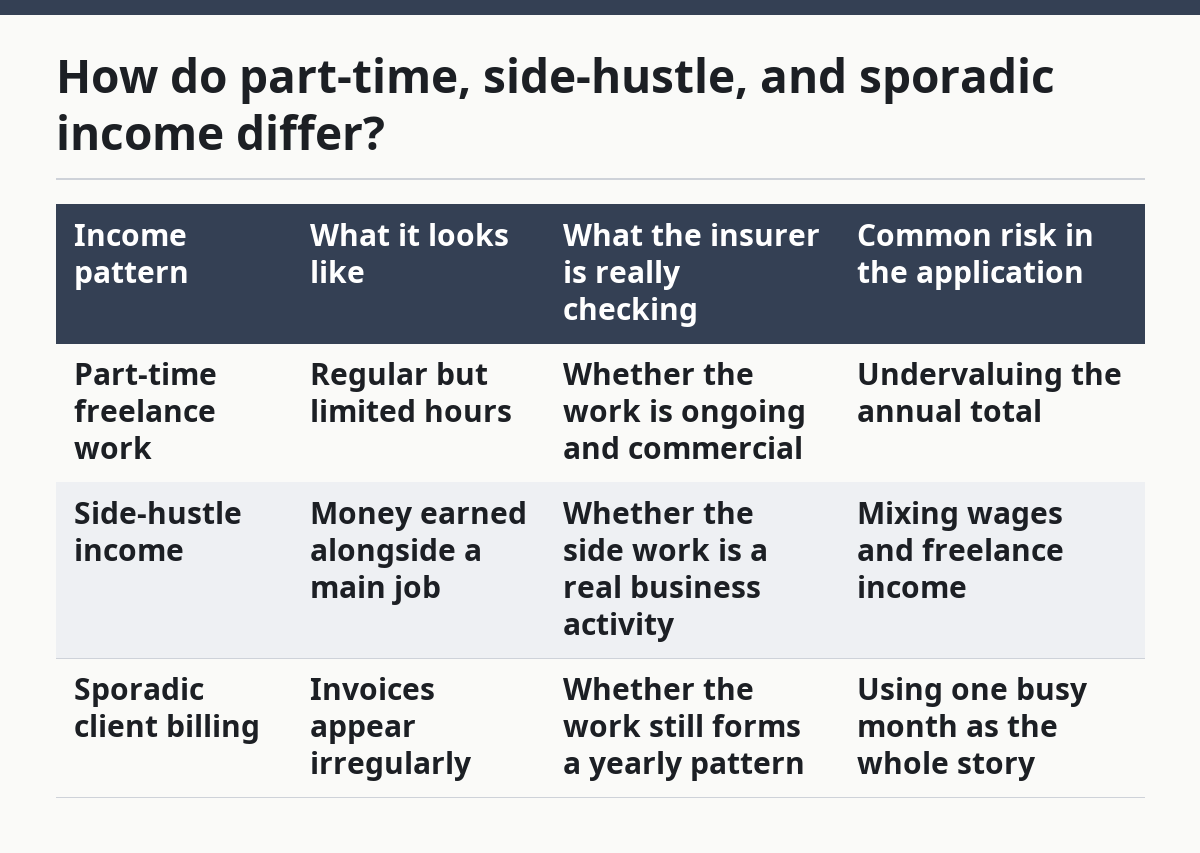
This table matters because the same insurance application can fit all three, but only if the numbers are framed honestly. A business with 2 clients a year is not the same as one with 20 small invoices, even if both are “part-time.”
What does a good result look like?
Ultimately, a good result is an application that reads like a year of business activity, not a lucky snapshot. The insurer can see the freelance business, the annualized revenue estimate, and the way project-based billing and side-hustle income fit together.
You should expect the final figure to feel like a business estimate, not a precise measurement. That is normal. The goal is not mathematical perfection; the goal is a defensible number that matches the records you have now and can stand up at renewal.
If the estimate is simple enough to explain in one sentence and detailed enough to trace to invoices, bank deposits, and dated records, the application is in good shape. If it needs a long story to make sense, it probably needs another pass before submission.
Can I get freelance insurance with low or uneven revenue?
Yes, low or uneven revenue can still fit an insurance application if the work is real and the records are clear. The insurer may still use minimum premium considerations, so the price may not shrink as much as the revenue does.
The main problem is not the amount alone. It is whether the income pattern can be shown as a genuine freelance business with invoices, dates, and a clear annual total.
Do side hustles count as a freelance business for insurance?
Yes, a side hustle can count as a freelance business if it is a repeated money-making activity rather than a one-off sale. The insurer usually cares about the work pattern, the billing method, and the yearly total.
If the side hustle is tiny, irregular, or mixed with personal income, the application may need cleaner records. A qualified adviser should be consulted if you are unsure whether the work belongs in the same business category.
How do I estimate freelance income for insurance if my work is irregular?
Since the freelance business is irregular, you estimate it by using a 12-month view and not by relying on one strong month. That means adding invoices, retainer payments, and sporadic client billing into one yearly total, then using that total as the revenue estimate.
If the business just started or changed sharply in the last 3 to 6 months, the estimate should reflect the current run rate rather than an old average.
Drafted with AI; not yet reviewed by a person.
