
Last updated: November 24, 2026
Quick answer: in most cases, 4 documents are enough to show an active freelance business after a restart — a current contract, one recent invoice, one current portfolio sample, and a live website or registration record. If an insurer asks for proof after a new launch or a gap, the goal is not to prove fame or profit; it is to show the business is real, open, and doing work now. This guide on how to prove a freelance business is active after a new launch or recent restart uses that same document set throughout.
This is information, not financial advice. Insurance rules, tax rules, and document standards vary by country and change over time, so a qualified adviser should be consulted for your own situation.
Key takeaways
- A new launch is proved by current activity, not by how long the business has existed.
- The strongest file usually combines 3 to 5 documents from different dates and sources.
- A contract, invoice, portfolio sample, website, and registration record each prove a different part of the story.
- Gaps, drafts, and unnamed work are common weak spots because they do not show live business activity.
- If the insurer wants continuity after a gap, that is a different question from proving a restart is real.
What counts as proof?
Proof of an active freelance business is any document that shows the business is trading now, not just registered on paper. For an insurer, that usually means evidence from the last 30 to 90 days, plus one older record if the launch is very recent. The point is to show a pattern: the business exists, offers a service, and has recent client-facing activity.
A single item rarely does the whole job. A business registration record shows you formed the business, but not that a client hired you. An invoice shows billing, but not always delivery. A portfolio sample shows work, but not necessarily that it is current. Together, they create a clearer picture than any one item alone.
The term underwriters use is often “evidence of trading” or “trading activity.” That means signs the business is open and functioning, such as contracts, paid invoices, branded contact details, or a live website. For a restart, the evidence should point to current activity after the restart date, not only to old history.
How do I show active freelance work after a restart?
You show active freelance work after a restart by building a dated paper trail that starts with your current launch date and runs forward for at least one billing cycle. A clean file usually has 4 parts: a contract, one or more invoices, a portfolio sample, and registration or website records.
- Gather your client contract in PDF form, ideally signed and dated within the last 30 to 90 days, and verify the client name, service, and start date; a missing signature or an undated draft is a problem because it reads as intent, not active work.
- Export your invoice records from your accounting app or email, keeping the original invoice number, issue date, and line items; verify that at least one invoice connects to the same business name as the contract, and consult a qualified adviser if your records are incomplete or mixed, using current guidance from the IRS on self-employed records as a general reference.
- Save one portfolio sample that matches the service you now sell, such as a design file, article, code sample, or case study, and verify that the sample reflects your present offer; an old sample with no date or context can look inactive.
- Capture your website presence with a homepage screenshot, service page screenshot, or domain record showing the business name and contact details; verify that the site is live and not a parked page, because a placeholder page suggests setup work, not active trading.
- Retrieve business registration records, tax registration, or local sole-trader filing confirmations, and verify that the business name and launch date match your current freelance identity; a mismatch between the legal name and the invoice name often causes follow-up questions.
- Bundle the documents into one dated folder, using clear file names such as contract, invoice, portfolio, website, and registration, and verify that each file is readable on a phone; unreadable scans or cropped screenshots slow review and can trigger a request for better copies.
- Cross-check the dates so they move in one direction from launch to present, and verify that the most recent document is no older than your latest work cycle; if every file stops months before the application, the insurer may decide the business is dormant.
- Prepare a one-paragraph explanation of the restart in plain language, and verify that it names the date of restart, the service offered, and the current client or lead status; vague phrases like “back in business” without dates tend to create more questions than they answer.
If you want a general map of how this fits into the wider insurance picture, the hub on freelance insurance for solo businesses is the right place to start, then return here for the proof file itself.
Which documents matter most?
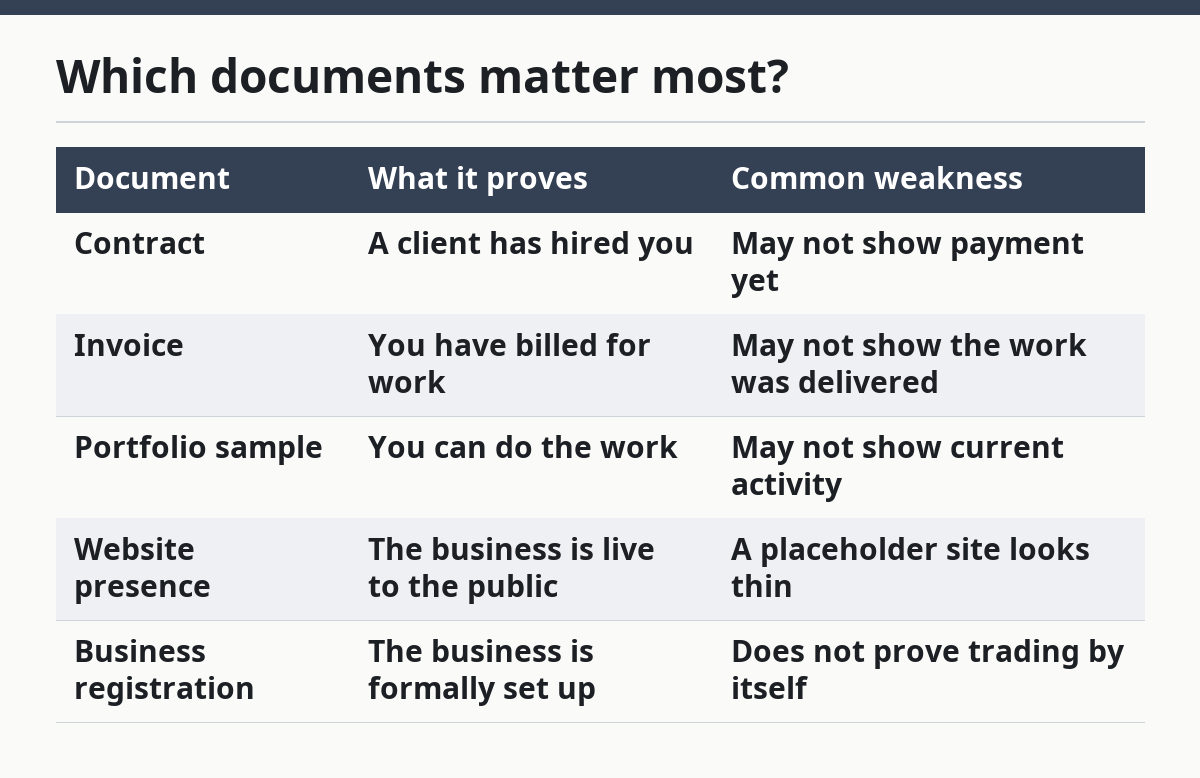
The strongest documents are the ones that show different parts of the same live business. A contract proves a client relationship, an invoice proves billing, a portfolio proves the work exists, and a business registration record proves the business is legally set up. A website or branded email address helps show the business is operating under a real name.
A contract should show scope, dates, and the names of both parties. An invoice should show issue date, amount, service description, and your business details. A portfolio should show examples tied to your current line of work, not just old experiments. Registration records should match the same business name used elsewhere, or at least explain the difference clearly.
Here is a simple comparison of what each item does:
| Document | What it proves | Common weakness |
|---|---|---|
| Contract | A client has hired you | May not show payment yet |
| Invoice | You have billed for work | May not show the work was delivered |
| Portfolio sample | You can do the work | May not show current activity |
| Website presence | The business is live to the public | A placeholder site looks thin |
| Business registration | The business is formally set up | Does not prove trading by itself |
If the insurer wants only one or two items, send the strongest combination you have. If the insurer asks for “proof of trading,” the safer file is one that includes at least one client document and one public-facing record.
What should a new launch file include?
A new launch file should include dated documents that show your freelance business started recently and is already operating. For many insurers, that means a signed contract, one invoice, one portfolio sample, and either a website screenshot or a registration record. If the business has only just opened, even a small set of current documents can still be useful.
The file should make the timeline easy to follow. Put the newest item first, then the earlier ones. If your business registration happened on one date and your first invoice followed 2 weeks later, that sequence makes sense.
Do not bury the key details in long attachments. A 1-page cover note can help, but only if it stays factual. List the business name, launch or restart date, service type, and the documents included. Keep the note short enough that an underwriter can scan it in under a minute.
When should you stop and get help instead?
You should stop and get qualified help if the proof problem is really about your business structure, tax setup, or prior coverage history rather than simple document gathering. That matters because the same file that proves “active” can still fail if the insurer is asking a different question.
Your documents use different business names: This can mean the contract, invoice, and registration do not line up — ask a qualified adviser how the legal name, trading name, and invoice name should match in your country.
You restarted after a long gap and only have old records: Old records may show past experience, not current activity — you may need a fresh paper trail from the restart date forward.
You worked through one platform only: Platform messages and payout records may help, but they can be harder to read than direct client documents — add a contract, invoice, or public portfolio page if you have one.
Your business is brand new and has no client yet: A portfolio and registration record may still help, but they do not prove trading on their own — ask the insurer what it accepts before you send a weak file.
Your insurer asks for tax filings you do not have yet: That can happen when the business is too new for a full filing cycle — do not guess; ask what alternate records they accept.
Your work is seasonal or project-based: A quiet month is not the same as an inactive business — the right proof may need to show the last paid job and the next booked job, not just a blank month.
What mistakes do people make?
People usually fail by sending records that look official but do not show current work. The most common mistake is to rely on business registration alone. Registration shows formation, not trading, and many insurers will still ask for evidence of clients or invoices.
Another mistake is sending screenshots with no dates or names. A cropped chat message or a blank dashboard page may suggest activity, but it leaves too much open to interpretation. The better choice is the original invoice PDF, signed contract, or full webpage capture with visible date context.
A third mistake is mixing personal and business details in ways that create doubt. If your invoice uses one name, your website another, and your registration a third, the insurer may pause the review. The fix is not to hide the mismatch, but to explain it cleanly and keep the paper trail consistent.
People also send too much. A 40-page folder full of draft logos, test invoices, and unused domains can slow a review. A tighter file with 5 to 8 clear items usually does a better job because it shows the current business without noise.
What if your business has almost no history?
A business with only a few weeks of history can still be shown as active if the current records are clean and consistent. The proof set just needs to lean more on registration, live web presence, and the first client documents you have. For some applications, a single signed contract plus a live service page can be enough to show that work has started.
The limit is obvious: no proof can create trading history that does not exist. If there is no contract, no invoice, and no public presence, then the file cannot do the whole job. In that case, the right move is to wait until the business has at least one real client-facing record, or to ask the insurer what it accepts for a very new launch.
For background reading on how self-employed records are generally handled, the IRS page for self-employed individuals and GOV.UK guidance on registering as self-employed are useful examples of how official systems treat business records and registration. Those pages do not replace insurer rules, but they show why dates, names, and filing status matter.
What does a good result look like?
A good result is a file that lets the insurer see, in under 2 minutes, that the freelance business is real and currently operating. The underwriter should be able to match the business name, the service, and the timeline without guessing. If they still ask a follow-up question, it should be about a narrow point, not about whether the business exists at all.
The clearest sign that the file is strong is that it does not need extra explanation. When the documents are clear, recent, and consistent, the insurer has less reason to ask for more. If the file keeps coming back with the same missing piece, the proof set is probably trying to do a job it cannot do.
The mechanism is simple: each document reduces uncertainty from a different angle. A contract shows intent from a client, an invoice shows billing, a portfolio shows work capacity, and registration shows legal existence. Put together, those four points are what make a restart look active rather than theoretical.
FAQ
What proof does an insurer want for a new freelance business?
An insurer usually wants recent records that show the business is open and operating now. That often means a contract, one or more invoices, a portfolio sample, and business registration records, with dates that fit the launch or restart timeline. Exact rules differ by country and insurer, so the safest file is one that matches the business name across all documents.
How do I show active freelance work after a restart?
Show the restart with documents dated after the gap, not just old history. A recent contract, a current invoice, and a live website or portfolio page usually do more than a stack of old records. If the gap is long, add a short factual note that explains the restart date and the current type of work.
What documents prove a freelance business is real?
A real freelance business is usually shown by a mix of registration records, client documents, invoices, and public-facing evidence such as a website or portfolio. No single paper proves everything. The strongest proof is the set of documents that all point to the same business name, service, and current activity.
Drafted with AI; not yet reviewed by a person.
