

Last updated: November 25, 2026
Quick Answer: in most cases, yes — you can insure a freelance business before an LLC exists by applying as a sole proprietor or with a DBA, as long as the application matches the business as it exists today. This page explains How to Insure a Freelance Business With No Registered Entity Yet, and it uses the name you use now, not the entity you plan to form later.
You can usually insure an unregistered freelance business before forming an LLC, because insurance can be written for a sole proprietorship or a start-up business name, not only for a registered entity. If the carrier’s rules are unclear, check them with a qualified adviser before you apply.
Who this is for
This applies to a freelancer who has started, or is about to start, paid work and has not filed business formation papers yet. It assumes you already know your service, your business name, and the date you want coverage to begin, even if that date is only a few days away.
It is a fit for solo work under a sole proprietorship, a doing business as name, or a temporary setup while you decide whether to form a limited liability company. It is not a fit if you need help choosing the right legal structure, sorting tax status, or deciding whether one policy should sit in the name of a separate entity you have not formed yet.
The key point is simple: insurance carriers usually ask who the insured is, what work is being done, and when the policy should start. They often do not require an LLC, but they usually do need a real person or business identity that matches the application. The U.S. Small Business Administration and the IRS both treat sole proprietorship as a real business form; see the SBA’s guidance on business structures and the IRS page on sole proprietors: SBA, IRS.
Key takeaways
- An LLC is not the only way to name a freelance business for insurance, but it may become the right way once you file.
- A sole proprietor can often apply before filing formation papers.
- Your application should match the name you actually use, including any DBA.
- The start date matters because coverage usually cannot fix a past gap.
- If the insurer asks for entity details you do not have yet, the problem is usually the application, not your eligibility.
How does coverage work before the LLC exists?
Coverage can start on a pre-LLC freelance business because the policy insures work, risk, and the named insured, not just a filing status. A new freelancer is often treated as a sole proprietor by default unless another structure already exists; if you are unsure, confirm that status with the IRS or a professional adviser.

That means the application may name you as an individual, your trade name, or both. If you use a business name like “Jordan Lee Design,” the insurer may still want your personal legal name behind it, because a DBA, or doing business as name, is not a separate legal entity. A DBA is a business name you use publicly; it is not the same thing as an LLC.
This matters because the policy has to point to a real party that can sign the application, pay the premium, and receive notices. If the business name is only a concept and not used anywhere, the application can become shaky fast. A common fix is to start with the individual name, then add the business name as the trade name if the carrier allows that format.
A short policy period can also matter here. Many policies run on a 12-month term, so the start date you choose now may carry through a formation change later. If you expect to file an LLC within 30 or 60 days, that does not stop coverage from starting now, but it does mean the policy should be set up so it can be updated cleanly after the filing.
What do you put on the application?
You put the name you are using now, the work you do now, and the start date you need now. Do not wait for the LLC if the carrier lets a sole proprietor or start-up apply in the meantime.
A normal application usually asks for the legal name, any business name, mailing address, type of work, and a start date. If there is a line for entity type, choose the option that matches the business as it exists today, not the entity you hope to form later. If the form asks for an LLC tax ID and you do not have one, that is a sign to stop and check whether the application is meant for formed entities only.
If your only legal name in play is your personal name, use it on the application. Use the business name if you have already started using one in client emails, invoices, or a domain name, and list it as a DBA if the form gives that field. If the form asks for a Federal Employer Identification Number and you do not have one, some applications may still allow you to proceed with your personal details, but the carrier’s rules control that step.
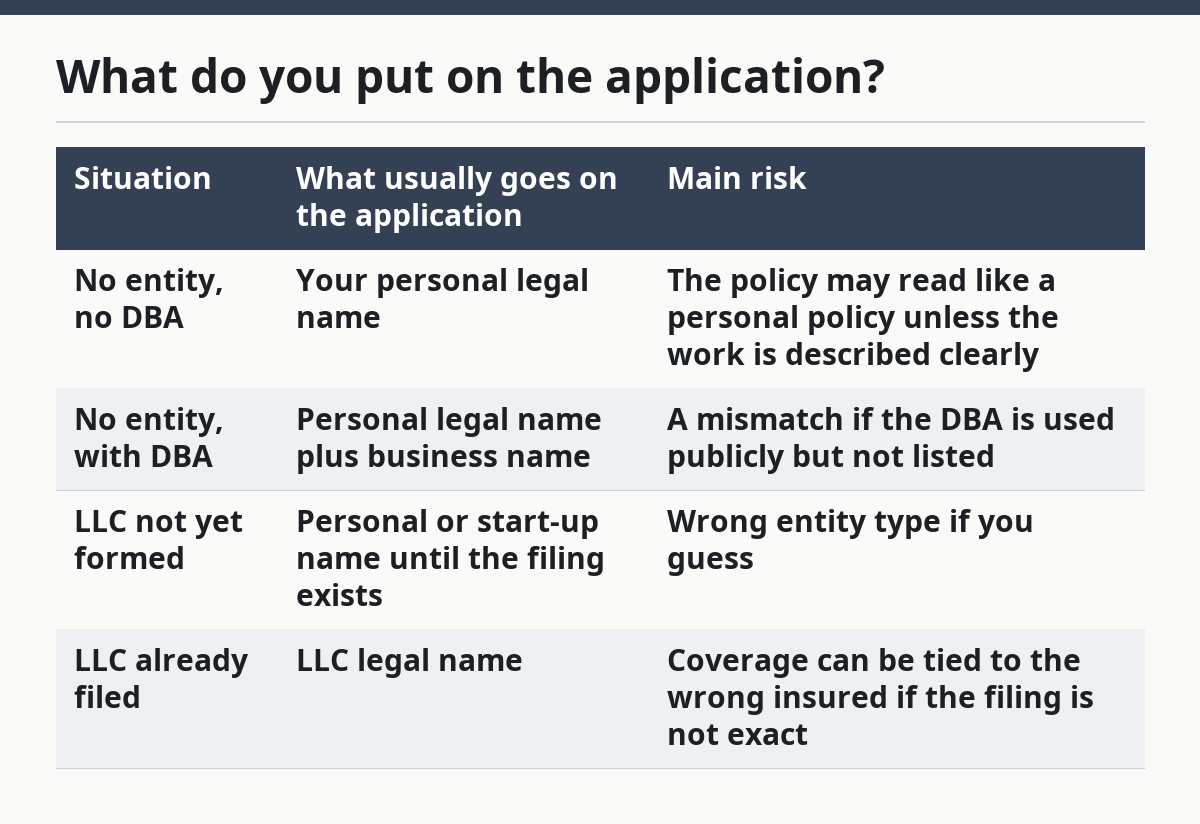
Here is the practical comparison:
| Situation | What usually goes on the application | Main risk |
|---|---|---|
| No entity, no DBA | Your personal legal name | The policy may read like a personal policy unless the work is described clearly |
| No entity, with DBA | Personal legal name plus business name | A mismatch if the DBA is used publicly but not listed |
| LLC not yet formed | Personal or start-up name until the filing exists | Wrong entity type if you guess |
| LLC already filed | LLC legal name | Coverage can be tied to the wrong insured if the filing is not exact |
One authoritative place to confirm the difference between a legal entity and a business name is the SBA’s business-structure guidance. Another useful check is the IRS’s sole proprietor page, which shows how a one-person business can exist without a separate filing.
What should you check before you apply?
You should check that the business name, start date, and work description all match the real business you are running today. That can help prevent the most common application problems before they turn into a rejected form or a policy that does not fit.
First, verify the business name exactly as you want it shown. If you use a DBA, make sure it is spelled the same way on your website, invoices, and application. If the name is not yet in use, keep the application simple and use your personal legal name until the trade name exists.
Second, check the start date. If you want coverage to begin on a specific day, write that down before you submit anything. A start date is not a decoration; it is the date the insurer is being asked to attach the policy to your risk.
Third, check the work description. A freelance writer, designer, bookkeeper, developer, or photographer may each face different questions on an application. If your work has changed in the last 6 months, describe the current work, not the work you used to do.
Fourth, look at the entity type field. If the form offers sole proprietor, LLC, corporation, or partnership, choose the one that fits the business as it exists on the application date. If no entity has been filed, sole proprietor or start-up language is often the better match than forcing an LLC answer into a blank space.
When should you stop and get help?
You should stop when the application asks for facts you cannot honestly provide or when the name on the form no longer matches the business you have in front of you. Those are the points where a wrong answer can create a bad policy record.
The carrier only accepts formed entities: That means the application is not built for a pre-LLC business — you need a form or policy path that allows sole proprietor or start-up status.
You already filed the LLC but do not have the documents yet: That means the legal entity may exist, but the record is incomplete — wait until you can name the entity exactly as filed.
The business name on invoices differs from the name on the form: That means the policy could point to the wrong party — list the DBA or use the exact name you use in client work.
The work category does not match your actual services: That means the insurer may view the application as inaccurate — correct the description before proceeding.
You need retroactive protection for past work: That means a new start date may not solve the gap — check the policy language carefully and get qualified help if timing matters.
You are mixing personal, freelance, and LLC activity in one application: That means the risk profile may be blurred — separate the business facts before you apply.
The rule is not “ask for help with everything.” It is “stop when the form no longer matches reality.” If a question about entity status, tax ID, or business name cannot be answered cleanly in one sentence, the application needs a better setup, not a guess.
What mistakes cost people the most?
The biggest mistake is naming the LLC before it exists. That can create a mismatch if the legal filing is still pending, and a mismatch is the fastest way to delay or distort the policy record.

Another mistake is skipping the DBA line because “it is just a name.” A DBA is not just decoration once clients, invoices, and a website use it. If the policy never reflects the name the market sees, a claim review can become harder to sort out.
A third mistake is using a future start date without checking whether work has already begun. If you already signed a contract or sent an invoice, the insurer may treat the risk as older than the date you wrote. That is why the date should be chosen from the real business timeline, not from optimism.
A fourth mistake is treating “sole proprietor” like a downgrade. For a new freelancer with no filing yet, sole proprietor is often the honest label, not a compromise. It tells the carrier that one person is running the business without a separate entity.
A fifth mistake is assuming the policy will automatically update when the LLC is filed. Sometimes it will not. You may need to ask for a name change, an entity update, or a new policy structure once the filing is complete.
What changes after the LLC is filed?
The policy should be updated to match the new legal entity as soon as the filing exists and the documents are in hand. That is because the insured name, tax ID, and business records should line up after the formation date.
If the application began as a sole proprietor or start-up business, the LLC filing usually changes how the business should be named on the policy. The insurer may need the exact LLC name, the formation date, and any DBA that still applies. If the business keeps the same brand but changes its legal form, the brand name and the legal name may both matter.
Because the business already existed before the filing, the cleanest approach is to update the record in two phases. Phase 1 is the unformed freelance business, where the application uses the real person and the current business name. Phase 2 is the formed entity, where the record should be revised so the policy reflects the new legal structure. That is why this page supports the broader hub on freelance insurance for business formations and ownership changes: the early stage and the post-filing stage are related, but they are not the same problem.
A good result looks boring: the name on the policy matches the name on the application, the work description matches the work you actually do, and the start date matches when the risk began. If any of those 3 pieces drift apart, the setup needs correction.
The mistakes people actually make, and what to do instead
The first mistake is waiting for the LLC before looking at insurance. The consequence is a coverage gap during the first weeks or months of work. The fix is to apply using the business as it exists now, then update the record after filing.
The second mistake is guessing at the entity type. The consequence is a form that says one thing while the business is another. The fix is to use sole proprietor or start-up language if no entity has been formed.
The third mistake is treating the DBA as optional paperwork. The consequence is that the public-facing name and the policy name do not match. The fix is to list the business name wherever the form allows a trade name or DBA field.
The fourth mistake is leaving the start date vague. The consequence is confusion about when the policy should begin. The fix is to choose a clear date and verify it before submission.
The fifth mistake is assuming all countries use the same labels, limits, and entity rules. The consequence is bad fit across borders. The fix is to check local rules, because rates, thresholds, and legal terms differ by country and change often.
Can I buy freelance insurance before forming an LLC?
Yes, you often can, because the policy can be written for a sole proprietor or a pre-formation business name. The key is to match the application to the business as it exists on the start date, not the structure you plan to file later.

If the carrier wants an LLC that does not exist yet, the form is not the right one for this stage. In that case, a pre-formation application path or a different insured name is usually the cleaner route.
What do I put on an application if I have no entity yet?
You put your personal legal name, your business name if you use one, and the work you actually do. If the form asks for entity type, choose the option that fits a sole proprietor or start-up business, not an LLC you have not filed.
If the application asks for a field you cannot honestly complete, stop and check the form design. A blank or inaccurate field is a bigger problem than a short delay.
Is a sole proprietor the same as an unregistered freelance business?
In practice, a sole proprietor is often the default label for an unregistered freelance business run by one person. It means the business is not a separate legal entity like an LLC, even if the work, invoices, and clients all look like a business.
That does not make it informal or fake. It means the business is operating without separate formation paperwork, which is common for new freelancers and solo service work.
Drafted with AI; not yet reviewed by a person.
