

Last updated: November 26, 2026
Quick answer: most freelance tutors usually need 3 coverages — professional liability insurance, general liability insurance, and, if they handle student records online, cyber liability insurance. If tutoring happens in a student’s home, a library, a café, or over video, those three coverages map to the main risks: teaching mistakes, injury or property damage, and data exposure. This is information, not financial advice; a qualified adviser should be consulted for a tutor’s own situation.
Key takeaways
- Teaching errors and injuries are not the same risk, so one policy rarely covers everything.
- In-person tutoring raises slip, trip, and property-damage issues.
- Online tutoring adds privacy and data-handling risk, especially for student records.
- If the tutor stores names, emails, billing details, or lesson notes, cyber cover deserves a look.
- The best mix depends on where lessons happen, what records are kept, and what a client contract requires.
What does a freelance tutor actually need?
A freelance tutor usually needs cover that matches three separate exposures: advice, contact, and data. Professional liability insurance handles claims that the tutoring service caused a student financial loss, such as a bad lesson plan, an inaccurate explanation, or missed exam prep guidance. General liability insurance handles bodily injury or property damage, such as a student slipping on a wet floor or a drink spilling on a laptop.

Cyber liability insurance matters when tutoring services involve email lists, video platforms, cloud folders, payment details, or student records. That coverage is about data incidents, not teaching quality. The cyber liability insurance page is a useful place to compare that risk with other business cover. A tutor who only meets in person and keeps no digital records may still need it less urgently than a tutor who stores assessments, attendance notes, or parent contact details in cloud software.
The exact mix also depends on the place of work. A tutor who sees students in different homes faces a different risk pattern from one who only teaches online. A tutor who works with minors has another layer of sensitivity around student records and communications. A simple rule helps: if the work can lead to a claim about what was taught, what happened during the session, or what was exposed online, the relevant insurance type is different.
For a broader setup view, the hub on freelance insurance for solo businesses can sit above this page and point to the other core coverages. The related professional liability insurance page also explains advice-based claims in more detail.
Which policy covers which risk?
Each policy responds to a different kind of problem, and that separation is the part many generic guides miss. A tutoring mistake is not the same as a broken vase, and a stolen password is not the same as a fall in the hallway.
| Risk | Main policy type | What it is for | What it usually does not cover |
|---|---|---|---|
| Incorrect tutoring advice | Professional liability insurance | Claims about teaching errors, missed guidance, or alleged service failure | Bodily injury and most property damage |
| Student injury at a lesson | General liability insurance | Claims for slips, trips, falls, and similar accidents | Teaching mistakes and data loss |
| Damaged client property | General liability insurance | Claims tied to accidental damage during a session | Advice errors and privacy incidents |
| Lost or exposed student records | Cyber liability insurance | Claims tied to data breach, ransomware, or misuse of digital records | Physical injuries and bad teaching outcomes |
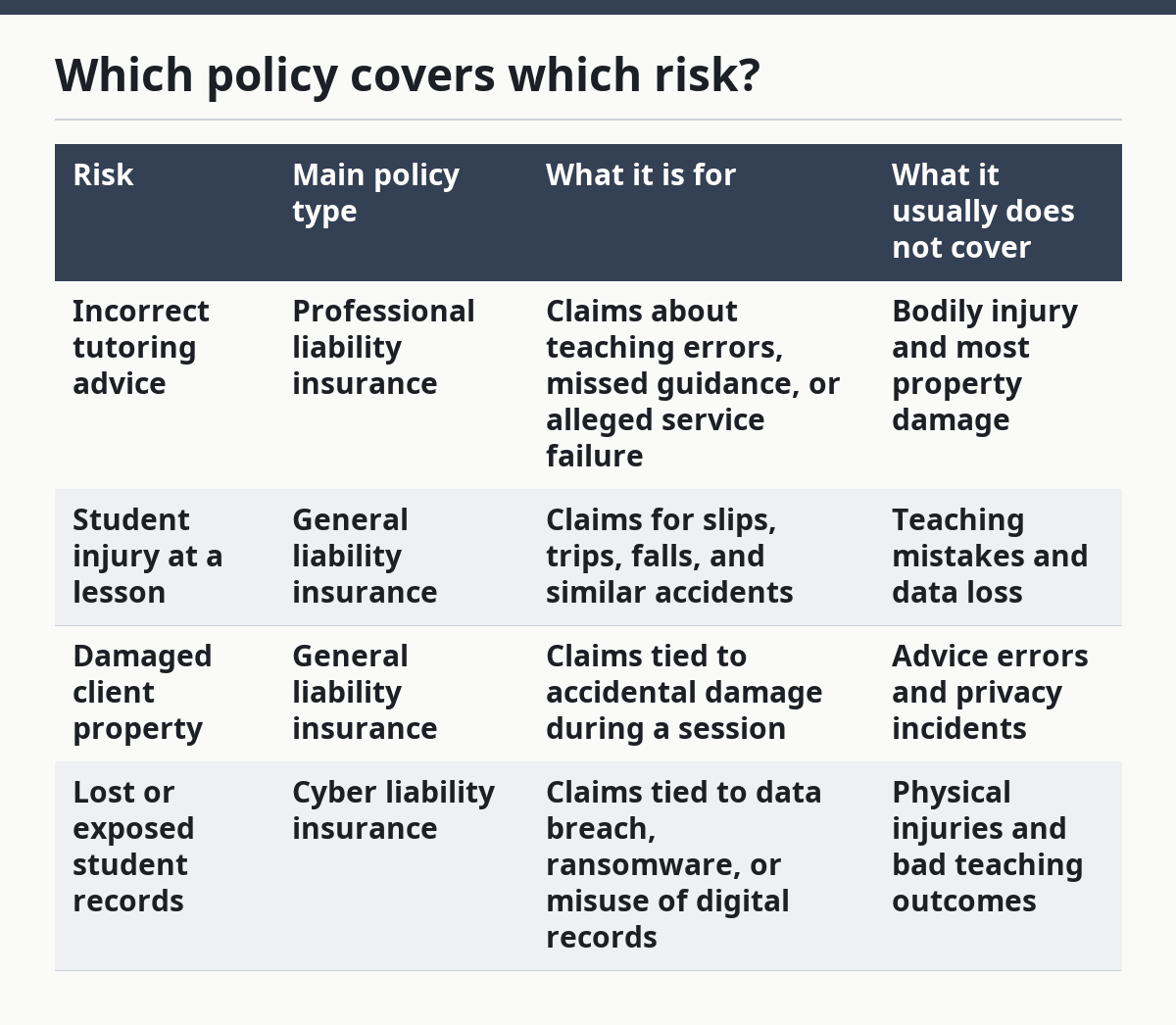
Professional liability is sometimes called errors and omissions insurance, or E&O. That term matters because tutoring is an advice-based service: the harm, if a claim arises, is often blamed on what was said, assigned, or omitted. General liability is the older, broader “third-party injury” cover most clients recognize. Cyber liability is narrower and more technical, but for online tutoring it can matter as much as the other two.
The trade-off is simple. A tutor who only buys one policy may leave a gap. A tutor who bundles all three without checking exclusions may still find that some session types are outside the policy wording. That is why the policy form matters as much as the label. For a broader comparison, see general liability insurance.
How do you pick the right cover?
Start with the way tutoring is actually delivered, then map each risk to a policy in 7 steps.
- List every session setting: write down whether lessons happen in a student’s home, your home, a library, a café, or online. Verify that each setting is named in the policy or not excluded. If a setting is missing, that is a coverage gap.
- Separate teaching mistakes from accidents: note one example of each, such as a wrong explanation versus a spilled drink. Verify that professional liability and general liability are both present if you face both kinds of claim. If only one appears, the other exposure is uncovered.
- Inventory the records you keep: include lesson notes, email addresses, parent contact details, invoices, and any assessment files. Verify whether those records live on a device, in cloud storage, or in a platform with shared access. If records are digital, cyber liability deserves attention.
- Check who the client is: the student, a parent, a school, or a tutoring platform may all demand different wording. Verify whether your contract requires proof of specific insurance or naming an additional insured. If the contract asks for it and the policy cannot provide it, the setup is incomplete.
- Match the session length and frequency: a weekly 1-hour lesson schedule creates a different exposure pattern from short exam-prep blocks or intensive holiday tutoring. Verify that the policy period covers the full span of your paid work. If there is a gap between bookings and cover dates, you are exposed.
- Review tools and devices: if you use a laptop, tablet, webcam, or payment app, verify whether theft, data exposure, or device use is relevant to the policy wording. A problem appears if the policy only covers teaching in theory but not the digital tools used to deliver it.
- Compare exclusions line by line: look for limits tied to minors, subcontractors, online platforms, or home-based work. Verify the exclusions before you rely on the policy. A problem is any phrase that removes the exact work you do most often.
The right result is usually not the cheapest policy. It is a clean match between the way tutoring happens and the risks the policy names. If the wording does not mention online instruction, student records, or tutoring services, pause and get the wording checked by a qualified adviser.
What changes for online tutoring?
Online tutoring shifts the main risk from the room to the screen. The lesson itself may be low-contact, but the tutor may still store names, grades, feedback, homework scans, and payment details. That is why cyber liability insurance becomes more relevant when the tutor uses email, shared drives, learning platforms, or video calls. The FTC and NIST both advise small businesses to control access to stored data and limit avoidable exposure, which fits this setup well. See the FTC’s guidance on business data security and NIST’s Small Business Cybersecurity Corner for practical context.

A common mistake is to assume that general liability covers everything because there is no physical classroom. It does not. General liability is for injury and property damage, not for a compromised account, leaked student file, or phishing incident. If a tutor keeps student records in the cloud, the risk is less about a broken chair and more about access to data.
Online tutoring also changes how professional liability shows up. A student or parent may claim that the tutor gave weak guidance, missed a topic, or failed to prepare them for a test. The medium changes, but the claim about service quality is the same. A tutor who teaches only online may still need the same advice-based cover as a tutor who meets face to face.
There is one more wrinkle: platform use. If the tutor works through a third-party app, the platform’s terms may limit what is covered when sessions are recorded, shared, or stored. That is a contract issue, not an insurance feature. It means the tutor should read both the policy and the platform agreement with the same care. One missing clause can matter more than a 30-minute lesson ever would.
When does the standard advice not fit?
Standard advice does not fit when the tutoring setup carries unusual contract terms, unusual data handling, or unusual contact with students. In those cases, the policy wording needs closer scrutiny, and a qualified adviser should review the details before anything is relied on.
Student data is stored in more than one app: this raises the chance of a shared-access problem — check whether cyber liability covers the full chain of storage, not just one device.
Lessons happen in a client’s home every week: this creates regular third-party exposure — confirm general liability is written for that setting, not just for online work.
The client contract demands proof of insurance wording: this is a document issue as well as a cover issue — verify the exact certificate language before accepting the job.
Minors are involved and parents receive written updates: student records become more sensitive — review privacy handling and whether cyber cover fits the records you keep.
You use contractors or another tutor occasionally: a second person can change who is responsible for a claim — check whether the policy allows subcontracted tutoring at all.
You handle payments, attendance logs, or feedback notes electronically: the digital trail is part of the exposure — look at cyber wording, not just the lesson price or schedule.
The wrong move here is to assume that all tutoring looks the same to an insurer. A one-to-one maths tutor teaching in a kitchen and a tutor running group sessions on video do not have the same risk profile, even if both are called “freelance tutoring.”
What mistakes do tutors make?
Freelance tutors often make the same four mistakes, and each one creates a different kind of gap. The fix is usually simple, but only if the problem is named early.
One mistake is buying professional liability alone because the tutor thinks “I just teach.” That leaves injury and property damage uncovered, so a student slip or broken phone may not fit. The better alternative is to check whether general liability is also needed.
A second mistake is treating online work as low risk because there is no physical space to rent. That can leave cyber exposure untouched, even when student records are kept in email, spreadsheets, or cloud folders. The better alternative is to map every digital file and decide whether cyber liability is relevant, and to consult a qualified adviser if the setup is unclear.
A third mistake is relying on a platform or school contract without reading the insurance clauses. A contract can ask for proof of cover, extra insured status, or notice rules after a claim. If the policy cannot meet those terms, the tutor may have signed up for a job the insurance does not match.
A fourth mistake is keeping old policy wording after the business changes. A tutor who started with in-person lessons may later move to online sessions, record lessons, or store more student data. If the cover was written for a simpler setup, it may no longer fit. A yearly review is the minimum sensible check.
A fifth mistake is assuming one insurer’s “education” label covers all tutoring. Labels are broad; exclusions are not. The correct alternative is to read the actual wording for tutoring services, student records, and the places where sessions happen.
What should a freelance tutor check before buying?
A freelance tutor should check the session setting, the records kept, and the exact wording of the policy before any decision is made. Those three items tell most of the story in under 10 minutes.
First, confirm where lessons happen and whether each location is listed or excluded. Second, list every file or app that holds student records, even if it is only names, emails, and lesson notes. Third, look for the three policy types by name: professional liability, general liability, and cyber liability.
The phrase “good enough” is not useful here. A tutor with one offline lesson a month and no digital records has a different risk than a tutor with daily online lessons and cloud storage. That is why the answer is not a single universal policy for every freelance tutor.
If the wording is unclear, a safer next step is to get a qualified adviser to review the contract, the platform terms, and the tutoring setup together. That is especially true where money, children, or student records are involved.
FAQ
Do freelance tutors need general liability insurance?
Yes, many freelance tutors do, because in-person lessons can create injury or property-damage claims. A student can trip, fall, or have something damaged during a session, and those claims are different from teaching mistakes. If tutoring is only online and no one meets face to face, the need may be lower, but it does not disappear from every setup.
Does online tutoring need cyber liability insurance?
Yes, online tutoring can need cyber liability insurance if the tutor stores or transmits student records, login details, payment data, or lesson files. The risk is not just hacking; it also includes accidental exposure, stolen devices, and account misuse. If the tutor uses cloud tools, email, or video platforms, cyber cover is worth checking carefully.
What insurance protects a freelance tutor from client claims?
Professional liability insurance is the policy that usually responds to client claims about the tutoring service itself. That includes allegations of incorrect guidance, missed instruction, or a service failure that caused a loss. General liability covers different claims, such as injury or property damage, so the two policies answer different problems.
Drafted with AI; not yet reviewed by a person.
