

Last updated: November 26, 2026
Quick answer: five contract clauses usually drive freelance insurance by contract terms — indemnity, additional insured status, certificates of insurance, waiver of subrogation, and liability limits. Freelance insurance by contract terms depends on the contract you sign, the client’s terms, and the work you actually do. The right coverage changes when a client demands higher limits, asks for a certificate, adds indemnity language, or shifts risk onto you in the contract. This guide explains how those terms affect freelancer liability insurance, what to check before you sign, and when the contract itself creates a gap you need to spot early. This is information, not financial advice; a qualified adviser should be consulted for your own situation.
Key takeaways
- Contract language can change your risk even when the job title stays the same.
- The three terms that matter most are indemnity, additional insured, and insurance requirements.
- A client asking for a certificate is not the same thing as a client asking for actual coverage.
- Sole trader, LLC, agency subcontract, and project-based contracts each push risk in a different direction.
- The wrong clause can leave you paying for a claim that started with a small admin mistake.
- If the terms are unclear, it can be wise to pause and get the wording checked before work starts.
Who this guide is for
This guide is for freelancers who already know the basics of liability insurance and need to match it to contract terms that can change from one client to the next. It assumes you may be working under a sole trader setup, an LLC or limited company, or as an independent contractor with project-based client terms. It also assumes you are not looking for a product recommendation, but for a way to read the contract without missing risk.
The main issue is simple: a client can ask for one kind of work and assign a very different kind of risk. A branding job may carry little exposure to bodily injury, while a site visit, a professional advice engagement, or a subcontract under a larger agency agreement can trigger wider liability language. Contract structure matters because insurance responds to what the contract says, not just to what you meant to do.
This is a high-stakes money topic, so some situations call for qualified help rather than guesswork. If the contract contains uncapped indemnity, a duty to defend, a high insurance limit, or cross-border terms, a lawyer or insurance adviser should review the wording before you sign. If the job touches regulated advice, construction, healthcare, finance, or security, the contract can create exposure that a standard general liability policy may not fit.
The terms also differ by country, and even by insurer. A clause that is common in one market may be unusual in another, and requirements can change without warning. Therefore, compare the contract to the policy wording line by line when you can, rather than relying on memory alone.
What contract terms change your insurance?
The contract terms that change your insurance most are indemnity, additional insured status, certificates of insurance, waiver of subrogation, limitation of liability, and any clause that sets a minimum limit or a claim-handling duty. Those words decide who pays first, who gets defended, and whether your policy can respond at all.
Indemnity means one party agrees to cover losses the other party suffers. In a freelancer contract, that can mean you agree to pay for claims, legal costs, or third-party losses tied to your work. Some indemnity clauses are narrow and tie liability to your negligence; others are broader and can reach beyond your direct mistake. The broader the clause, the more likely your policy terms need careful review.
An additional insured is a person or company added to a policy so they can get some protection under it. Clients often ask for this in agency or contractor agreements. That is not a free extra; it can change who gets defended and in what order claims are handled. If the contract requires additional insured status but your policy does not grant it for that client or that type of work, the paperwork and the coverage do not match.
A certificate of insurance is proof that a policy exists on a given date. It does not rewrite the policy. A client may ask for a certificate with a certain limit, but the certificate only shows what is already in force. If the policy itself does not meet the contract requirement, the certificate does not fix the gap.
A waiver of subrogation means the insurer gives up the right to recover from another party after a claim. Clients sometimes ask for this in shared-work settings. That can matter when equipment, property, or a site accident is involved. If the contract asks for it and the policy does not allow it, the issue needs attention before the job starts.
A limitation of liability clause does the opposite of indemnity. It tries to cap what you owe. A strong cap can limit your exposure to a fee amount, a fixed sum, or direct damages only. A weak one may leave you exposed to legal costs, third-party claims, or losses that are much larger than the contract value. The difference can be material even on a short project.
Which freelance contract type changes the risk?
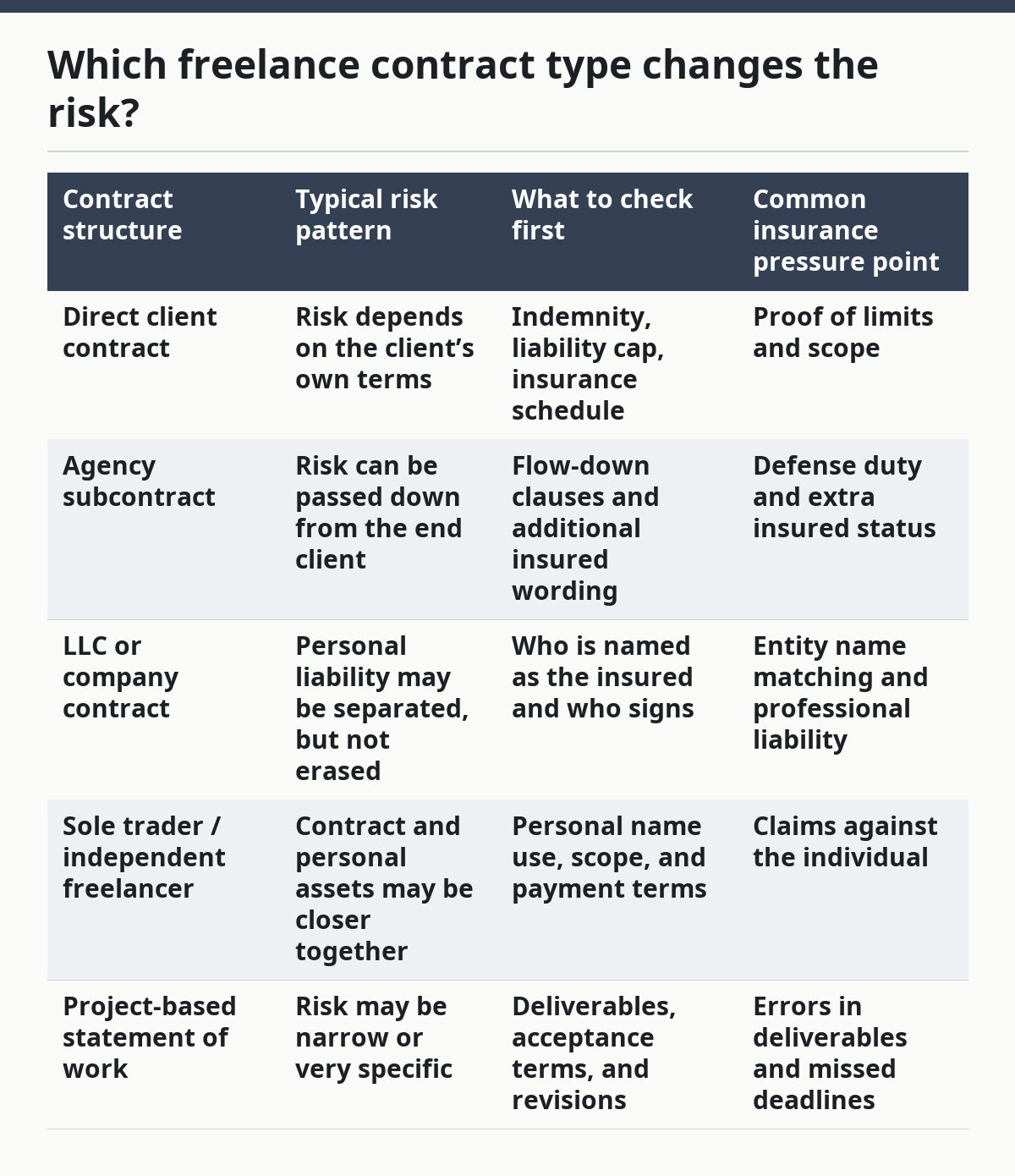
Different contract structures change the risk in different ways, even when the work sounds similar on paper. The main question is who controls the project, who hires whom, and whose contract terms take priority.
| Contract structure | Typical risk pattern | What to check first | Common insurance pressure point |
|---|---|---|---|
| Direct client contract | Risk depends on the client’s own terms | Indemnity, liability cap, insurance schedule | Proof of limits and scope |
| Agency subcontract | Risk can be passed down from the end client | Flow-down clauses and additional insured wording | Defense duty and extra insured status |
| LLC or company contract | Personal liability may be separated, but not erased | Who is named as the insured and who signs | Entity name matching and professional liability |
| Sole trader / independent freelancer | Contract and personal assets may be closer together | Personal name use, scope, and payment terms | Claims against the individual |
| Project-based statement of work | Risk may be narrow or very specific | Deliverables, acceptance terms, and revisions | Errors in deliverables and missed deadlines |
A direct client contract often looks simpler, but simple does not mean low risk. The client may have a standard vendor pack with insurance minimums, indemnity language, and a claims notice deadline. If the work is purely advisory, professional liability becomes more relevant than property or bodily injury cover.
An agency subcontract adds another layer because the agency may pass down terms from its own client. That is where flow-down clauses matter. A flow-down clause means the subcontractor accepts obligations from a separate upstream agreement. If you never saw the upstream contract, you may still be bound by it if the subcontract says so.
A company contract can help keep business and personal identity separate, but only if the contract names the right entity and the policy follows that same name. If the paperwork names “Jane Smith” but the insurance is written to “Smith Creative Ltd,” the mismatch can create avoidable friction at claim time.
Project-based statements of work often feel short and harmless, yet they can hide the sharpest edges. A fixed deliverable, a 10-business-day acceptance window, or a “rework at no charge” clause can create disputes if the client rejects work late or claims the output caused a loss. In those cases, the issue is not the size of the project; it is how the acceptance and correction terms shift blame.
How do I check a client contract against my policy?
You check a client contract against your policy by matching the named insured, the work described, the insurance clauses, the limits, and the exclusions line by line. The goal is to see whether the policy actually answers the contract’s demands, not whether the certificate looks tidy.

- Identify the exact legal name on the contract. Match the name, trading name, and entity type to the policy declarations page. Verify that the policy names the same person or company; a mismatch signals trouble if a claim is filed under the wrong name.
- List every insurance term in the client paper. Pull out indemnity, additional insured, waiver of subrogation, minimum limits, and notice deadlines. Verify that each term is written in plain language; a vague “standard insurance” request is a problem because it can hide later demands.
- Compare the work description to the policy scope. Check whether the job is advice, design, site work, media work, software, or physical handling of property. Verify that the policy is built for that type of work; if the job type falls outside the policy wording, there is a coverage gap.
- Check the limit language carefully. Note whether the contract asks for one limit, separate limits, or a per-claim structure. Verify that the policy limit format matches the request; if the client wants a structure the policy does not use, the request may be impossible to satisfy as written.
- Read the indemnity clause in full. Look for words like “defend,” “hold harmless,” “all claims,” and “arising out of.” Verify whether the clause is tied to your negligence or extends further; a broad clause can require broader coverage than the policy offers.
- Check who must be added as an additional insured. Identify whether the client, agency, landlord, or end customer is named. Verify that the policy permits that addition for the right relationship; if it does not, consult a professional and use the insurer’s wording guide or policy endorsement terms to confirm what is allowed.
- Look for claim timing rules. Some contracts require notice within a short period, such as 5 or 10 business days. Verify that you can meet that timeline with your insurer; if you cannot, a late notice may complicate the claim.
- Confirm exclusions that matter to the job. Search for exclusions tied to professional services, subcontracting, digital services, bodily injury, property damage, or contractual liability. Verify that the exclusion does not remove the main risk in your work; if it does, the policy may not fit the contract at all.
A good result is not just “the client accepted the certificate.” A good result is that the policy wording and the contract wording point in the same direction. If one says the client must be defended and the other says the policy only covers certain claims after the fact, the gap is real even if the paperwork looks complete.
The cleanest check is to line up the contract in one column and the policy in another. If you cannot explain each clause in one sentence, the work is not ready to start. A 20-minute review can prevent a dispute that shows up only after an invoice is unpaid or a claim is filed.
What should I check before I sign?
You should check the clauses that shift cost, defense, and delay before you sign anything with insurance language in it. The most important items are the liability cap, indemnity scope, notice deadline, additional insured request, and the exact description of deliverables.

A liability cap matters because it sets the ceiling on what you may owe. If the cap is missing, too broad, or tied only to fees paid, the client may still try to claim more through indemnity or third-party loss language. If the cap is low but the work has high downstream impact, the contract may push more risk onto you than you intended.
The notice deadline matters because insurance claims often fail at the admin stage, not only at the coverage stage. If the contract says the client must be told within a short period after an incident, you need a way to alert your insurer quickly too. If the contract and policy timelines do not match, one delay can create two problems.
The additional insured request deserves special care. If the contract asks for it, check whether it applies to the client only, or also to related companies, landlords, agencies, and end users. A broad request can expand your exposure beyond the party you actually hired for. That is a red flag when the contract uses “and affiliates” or similar language.
The deliverables section also matters. A vague scope can cause a claim over quality, timing, or missed expectations instead of a simple payment dispute. If the job involves revisions, acceptance testing, or third-party approval, those steps should be written clearly. A contract that says “reasonable revisions” without a limit can become a moving target.
If the contract includes a governing law clause, check that too. Governing law tells you which jurisdiction’s rules control the contract. That does not change the policy by itself, but it can affect how a dispute is interpreted. Cross-border work raises this issue quickly, and a local insurer may not respond the way you expect if the contract points elsewhere.
When does the standard approach not apply?
The standard approach does not apply when the contract transfers risk that your usual policy was never meant to carry. In those cases, the right move is to slow down, not to rely on a certificate and hope for the best.
Uncapped indemnity: This means you may owe losses without a fixed ceiling — stop and get the wording reviewed before signing. An uncapped promise can outgrow the value of the entire project, and that is a bad match for short freelance jobs.
Duty to defend language: This means you may have to pay legal defense costs as soon as a claim is made — pause and check whether the policy treats defense costs the same way. Some policies handle defense differently from indemnity, so the contract and policy can disagree on timing; a lawyer or insurance adviser should confirm the fit.
Cross-border work or a foreign client: This means the contract may sit under another country’s law — verify the insurer is comfortable with the location, jurisdiction, and tax setup. If the policy is written for one market and the contract points to another, the coverage may not follow cleanly.
Subcontracting under a larger agency chain: This means you may inherit terms you never negotiated — ask for the upstream clauses before agreeing. A flow-down chain can turn a small subcontract into a much larger risk package.
Regulated or specialist advice: This means the work may trigger professional liability issues beyond ordinary general liability — get the policy wording checked before you begin. Finance, legal, health, engineering, and security work often sit in this category, even when the contract looks routine.
Client requires a specific limit or endorsement you do not have: This means the contract and policy do not match — do not assume a certificate will solve it. If the contract wants a named endorsement or a higher limit, that is a policy issue, not a paperwork issue.
These are not abstract warnings. They are the moments when a freelancer can sign a short clause and inherit a long dispute. If the contract reads like it was copied from a larger vendor agreement, treat it as a signal to slow down and, if needed, consult a professional.
What mistakes cost freelancers the most?
The most expensive mistakes are the ones where the contract looked routine but quietly changed who pays, who defends, or what kind of claim can be made. A few words can matter more than the project fee.
The first mistake is treating a certificate of insurance as proof of full compliance. A certificate only confirms that a policy exists; it does not rewrite exclusions, limits, or endorsements. The correct alternative is to compare the contract terms to the actual policy wording, not the certificate alone.
The second mistake is signing a broad indemnity clause without checking what losses it covers. That can expose you to another party’s losses, legal fees, and third-party claims that are wider than your direct mistake. The correct alternative is to limit indemnity to your negligence or to the part of the loss you actually control, where that is negotiable.
The third mistake is ignoring the exact name of the insured. A freelancer may sign as a personal name while the policy sits in a company name, or the reverse. The result can be a slow claim process or a denial if the wrong entity is treated as the insured. The correct alternative is to make the contract name and policy name match as closely as possible.
The fourth mistake is accepting a client’s “standard terms” without reading the subcontract or vendor schedule. Standard terms are often where the sharpest clauses sit. The correct alternative is to review the whole packet, including attachments, schedules, and linked terms, before work begins.
The fifth mistake is assuming all freelance work fits the same insurance pattern. A writer, designer, consultant, photographer, developer, and site-based contractor do not face the same risks. The correct alternative is to match the policy to the actual work, not to the general label “freelancer.”
The sixth mistake is missing notice deadlines after a problem starts. A client complaint, delivery dispute, or accident can sit unresolved for days while the clock keeps running. The correct alternative is to report potential claims early, even when the matter still looks informal.
Which questions should I ask before work starts?
You should ask direct questions about limits, names, and claim handling before any work starts, especially if the client has a standard vendor form. Those questions are faster than fixing a contract after a dispute.
First, ask whether the client requires specific cover types such as general liability, professional liability, or cyber cover. Those are not interchangeable. A creative project with no physical site risk may still need professional liability because the claim is about advice or work product, not injury.
Second, ask whether the client needs additional insured status, and if so, for whom. One clause can cover the client only, or it may try to cover parent companies, affiliates, and contractors. That difference matters because the broader the request, the more carefully the policy should be checked.
Third, ask whether the client’s contract includes flow-down terms from another agreement. If it does, ask for the upstream terms before you sign. A subcontract that borrows another company’s obligations can create a risk the short form never mentions.
Fourth, ask how the client wants claims or incidents reported. Some want immediate notice; others want notice within a set number of business days. That timeline should be compared to your own insurer’s reporting rules so the two do not conflict.
Fifth, ask whether the client accepts your own limitation of liability language. If they do not, the contract may be trying to move all downside onto you. That does not always mean the job is wrong for you, but it does mean the risk is not standard.
A practical way to think about these questions is simple: if the client’s answer would change the insurance needed, ask before signing. The earlier the question, the cheaper the correction usually is. Once the work starts, the room to fix contract terms narrows fast.
How do I handle contract changes without overcomplicating it?
You handle contract changes by redlining only the clauses that move risk, then checking whether the insurer can live with the revised wording. The goal is to keep the scope and the insurance aligned without turning every contract into a negotiation battle.

Start with the clauses that matter most: indemnity, additional insured, liability cap, notice, and governing law. If the client’s form is 15 pages and only 5 sentences affect liability, focus on those 5 first. A short list is easier to review and easier for the client to accept.
If the client changes the contract after you already sent a certificate, re-check the policy before you proceed. The certificate may still show the old terms, but the contract now says something different. If the new language adds a duty to defend, expands the indemnity, or requires a higher limit, the old certificate is no longer enough.
If the client refuses to change a clause, decide whether the issue is structural or just wording. A wording issue might be solved by clarifying terms. A structural issue, like taking on another company’s losses, is different. That is where qualified legal or insurance help is worth more than a quick guess.
The best result is a contract that is boring in the right way: the scope is clear, the insurance demand is specific, and the clause set does not try to move hidden risk onto the freelancer. If the contract needs three pages of explanation to understand the insurance section, that is usually a sign the terms are too broad for a standard freelance setup.
For tax handling related to self-employment, official guidance from the IRS Self-Employed Individuals Tax Center can help with the broader business context, and the FTC Business Guidance pages are useful for general business compliance topics. Those are not substitutes for advice on your own contract, but they are credible places to start checking the rules that touch your work.
FAQ
Do I need a different policy for every client contract?
No, but you may need different terms or endorsements depending on what the contract asks for. A single policy can sometimes fit several clients if the work type, limits, and wording stay within the policy’s scope. The problem starts when one client adds indemnity, additional insured, or a higher limit that the policy does not already support.
Is a certificate of insurance enough to satisfy a client?
No, a certificate of insurance is only proof that a policy exists on the date shown. It does not change exclusions, add coverage, or fix a mismatch between the policy and the contract. If the client’s clause asks for something specific, the policy wording has to support it too.
What is the biggest red flag in a freelance contract?
A broad indemnity clause with no clear limit is one of the biggest red flags. It can shift defense costs and third-party losses onto you in a way that is much larger than the project itself. If the clause is unclear, it can be wise to get it reviewed before signing.
Why does the contract name matter if I have insurance?
Because the policy responds to the named insured, and the contract should match that name. If the paperwork uses your personal name while the policy names your company, or the other way around, a claim can become harder to process. The match does not have to be perfect in every case, but it should be close and deliberate.
What should I do if a client wants terms that my policy does not support?
Stop before you sign and ask for the clause to be revised or for the requirement to be removed. If that is not possible, a qualified lawyer or insurance adviser should review the gap. The worst choice is to assume the certificate will cover a promise the policy does not actually make.
Drafted with AI; not yet reviewed by a person.
