
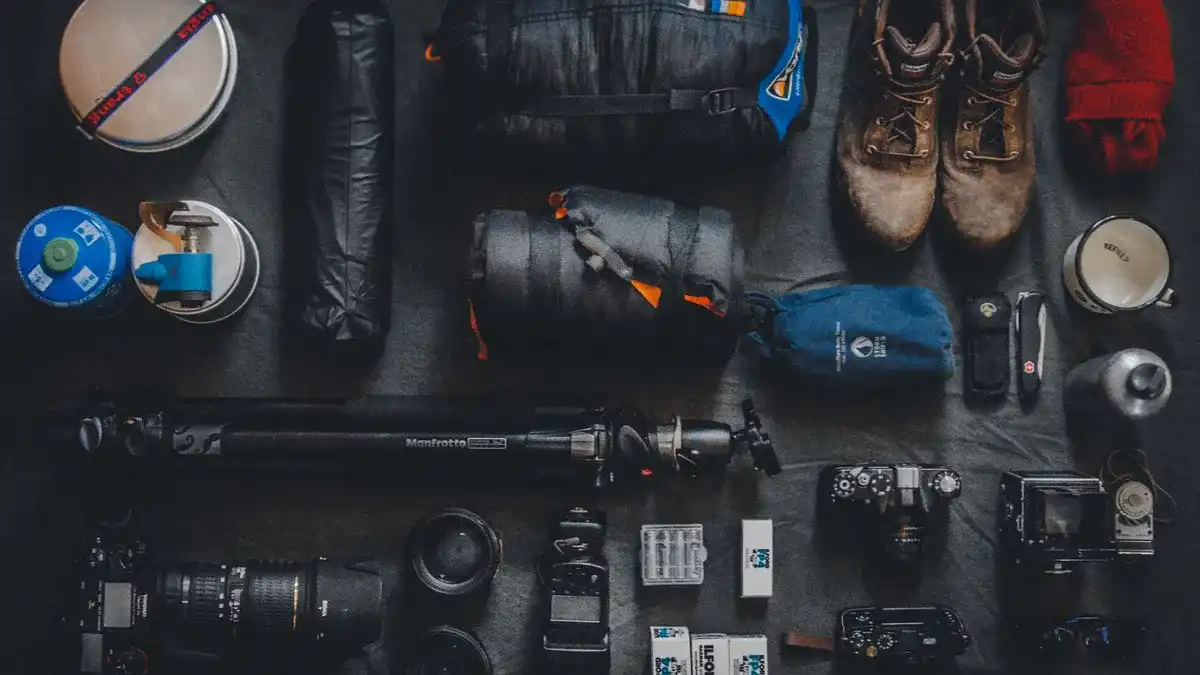
Last updated: November 26, 2026
Quick answer: in 1 rule, choose an inland marine policy when your freelance gear leaves one place and travels with you; choose personal property coverage when the equipment mostly stays at one fixed address. This article on How to Choose Between a Personal Property Policy and an Inland Marine Policy for Freelance Gear is about that choice. The difference is simple: one form is built for movable gear, and the other is built for property tied to a location. This is information, not financial advice; a qualified adviser should be consulted for your own situation. See the Insurance Information Institute and the NAIC for general guidance.
Key takeaways
- Portable tools are the main test, not the kind of work you do.
- Personal property coverage usually fits gear that lives at a studio, home office, or shop.
- Inland marine insurance is the cleaner fit when the same camera, laptop, light, or audio kit moves between jobs.
- Scheduled equipment and a blanket property limit are different ways insurers set limits, and they can change what gets paid after a loss.
- Off-premises theft matters because many standard property forms are narrower once equipment leaves the covered address.
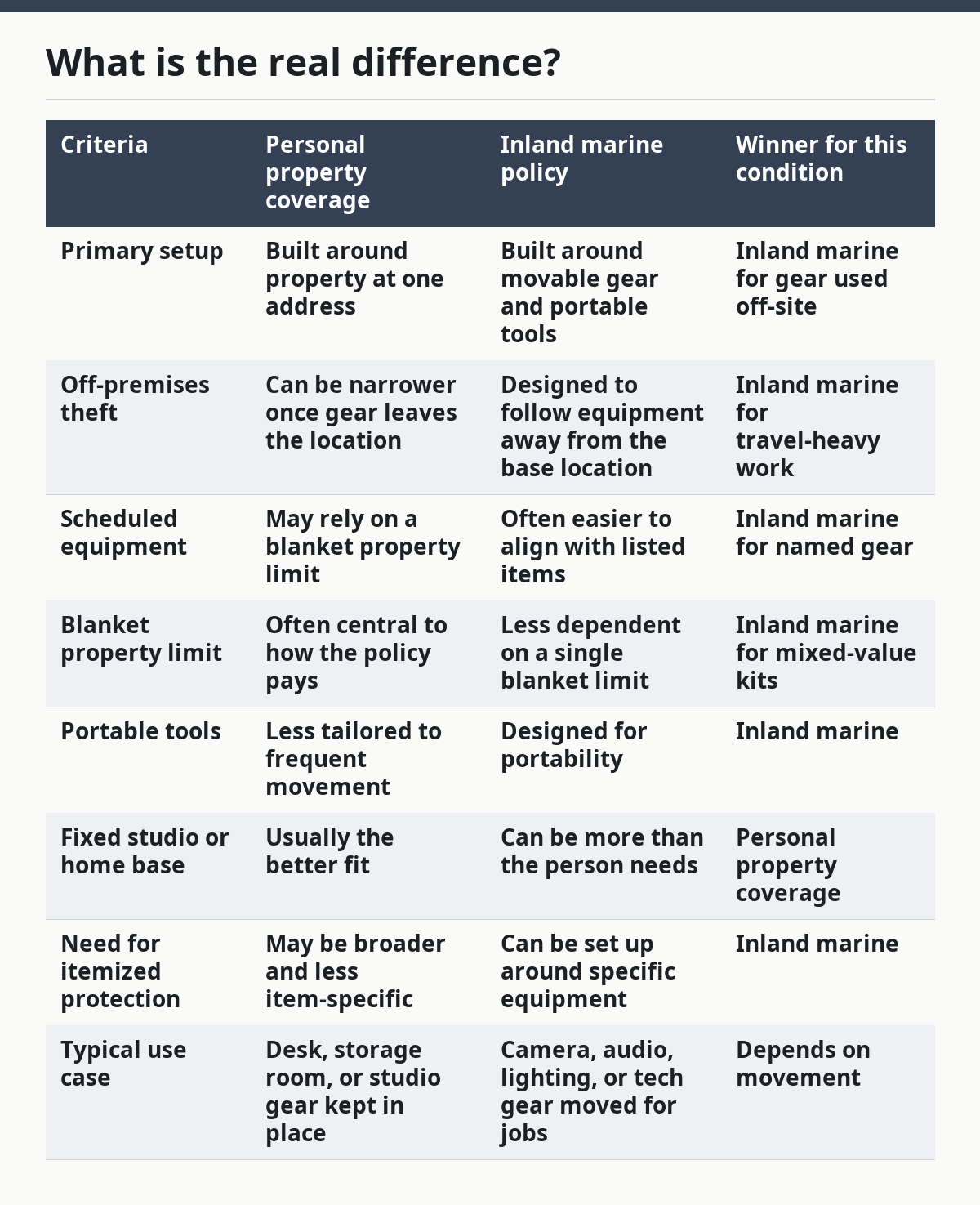
What is the real difference?
The real difference is where the gear is expected to be when a loss happens. Personal property coverage is usually built around property at a listed location, while inland marine insurance is built around equipment that is portable, mobile, or used away from that one spot.
For a freelancer, that distinction matters more than the label on the policy. A laptop that stays on a desk most days may fit personal property coverage better than a lighting kit that rides in a car three times a week. The same item can be treated differently depending on whether it is scheduled, covered under a blanket property limit, or left under a more general limit; because policy terms vary, consult a licensed insurance professional and review the form.
Here is the clean comparison:
| Criteria | Personal property coverage | Inland marine policy | Winner for this condition |
|---|---|---|---|
| Primary setup | Built around property at one address | Built around movable gear and portable tools | Inland marine for gear used off-site |
| Off-premises theft | Can be narrower once gear leaves the location | Designed to follow equipment away from the base location | Inland marine for travel-heavy work |
| Scheduled equipment | May rely on a blanket property limit | Often easier to align with listed items | Inland marine for named gear |
| Blanket property limit | Often central to how the policy pays | Less dependent on a single blanket limit | Inland marine for mixed-value kits |
| Portable tools | Less tailored to frequent movement | Designed for portability | Inland marine |
| Fixed studio or home base | Usually the better fit | Can be more than the person needs | Personal property coverage |
| Need for itemized protection | May be broader and less item-specific | Can be set up around specific equipment | Inland marine |
| Typical use case | Desk, storage room, or studio gear kept in place | Camera, audio, lighting, or tech gear moved for jobs | Depends on movement |
For a quick outside reference on the concept of inland marine insurance, the Insurance Information Institute has a consumer explainer, and the National Association of Insurance Commissioners is a useful place to check your state’s insurance department links. Both are general references, not substitutes for your policy language.
When does personal property coverage fit freelance gear?
Personal property coverage fits freelance gear when the equipment mostly stays put and the main risk is at the insured address. If the gear spends most of its life in a home office, a locked studio, or a storage room, this form can make more sense than a more mobile policy.
This option is strongest when the loss pattern is stationary. A desktop setup, a printer, lighting stored on shelves, or backup equipment kept in one place are all examples of gear that may fit this structure better. The point is not the job title; the point is the movement pattern.
The weakness is just as clear. If the gear moves off-premises often, the protection may be thinner exactly when you need it. Off-premises theft, damage in transit, or a loss at a client site can create a gap if the policy was written for a fixed location first and a mobile workflow second.
A freelancer whose equipment mostly stays at one base, who has one studio address, or who rarely carries the gear to client locations should lean this way. The downside is not minor. A blanket property limit can look generous on paper and still fail to match the value of the specific items you actually carry. If the gear list is uneven, the limit may not line up with the most expensive item, especially when several small losses happen in the same year or one high-value item is taken alone.
Why does inland marine insurance win for mobile gear?
Inland marine insurance wins for mobile gear because it is designed for things that move. That makes it a better fit for freelance cameras, lenses, microphones, lighting stands, laptops, tablets, drones, and other portable tools that do not live in one place.
The practical advantage is coverage logic. Instead of asking, “Was this at the named location?” the policy is usually built to follow the equipment. That matters for off-premises theft, gear in a vehicle between shoots, and equipment handled by a freelancer who works across multiple sites in a week.
That does not make it perfect. Inland marine coverage can be narrower than people expect if a loss falls outside the exact wording, and a scheduled equipment setup can still leave out unscheduled items. It can also feel like extra paperwork if the kit is small, low value, or rarely leaves home.
Photographers, videographers, audio techs, designers with high-value laptops, and anyone with equipment that spends more time in transit than on a shelf are the best fit here. Someone with a mostly stationary setup and little need to protect gear away from a listed address should usually skip it.
A common mistake is assuming “portable” means “automatically covered.” It does not. The policy still depends on the exact form, the limit, and whether the item is scheduled. If the gear list changes often, the paperwork can become the weakest part of the protection.
Which policy handles scheduled equipment and a blanket property limit better?
Inland marine insurance usually handles scheduled equipment more cleanly, while personal property coverage often leans more heavily on a blanket property limit. That is the point that changes the decision for many freelancers.
Scheduled equipment means the insurer lists specific items, often because those items carry the most value or move most often. That can be a better fit for a freelance kit with a few expensive pieces and several smaller accessories. A blanket property limit, by contrast, puts a broad cap over a group of property rather than isolating each item.
That difference matters after a loss. If one camera body, one lens, or one laptop takes the hit, a scheduled approach can make the path from loss to claim easier to understand. If the gear is scattered across a studio and a home office, a blanket property limit may feel simpler, but it can blur the value of the individual items.
This is where a lot of generic advice gets it wrong. It talks about “insurance for gear” as if the phrase itself decides the outcome. It does not. The real question is whether the policy can match the way the equipment is used, stored, and listed.
The drawback of scheduled equipment is maintenance. If the kit changes every few months, the schedule can go stale. The drawback of a blanket property limit is that it can be too broad to describe the risk well, especially when one item is worth much more than the rest of the set.
The honest side-by-side
The honest side-by-side is that personal property coverage is simpler for fixed gear, and inland marine insurance is more precise for moving gear. That is why the better choice depends on whether the equipment behaves like furniture or like travel gear.
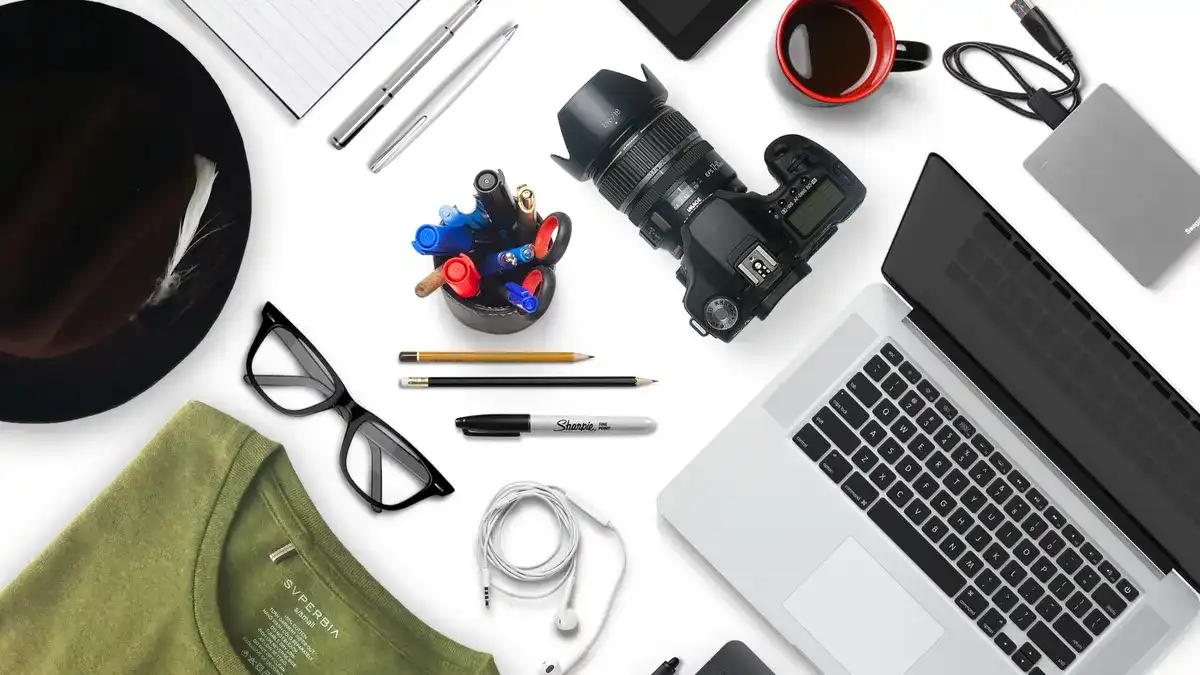
Personal property coverage can be easier to understand when the freelancer works from one base and the loss concern is local. Inland marine insurance can be better when the gear leaves the base often enough that off-premises theft and transit become normal risks rather than rare exceptions.
Here is the head-to-head view that matters most:
| Criteria | Personal property coverage | Inland marine insurance | Winner for this condition |
|---|---|---|---|
| Fixed address dependence | Higher | Lower | Personal property for one location |
| Mobility of gear | Lower fit | Higher fit | Inland marine for portable tools |
| Off-premises theft | Often weaker fit | Built for it | Inland marine for travel |
| Need for item-by-item listing | Less central | More natural | Inland marine for specific kits |
| Blanket property limit reliance | More common | Less central | Personal property for simple inventories |
| Studio-only workflow | Good fit | Often more than needed | Personal property |
| Multi-site freelance work | Weak fit | Stronger fit | Inland marine |
| Changing gear list | Easier in theory, but less precise | Can require updates | Personal property for static gear |
The strengths of personal property coverage are simplicity and fit for one place. The weakness is that it can miss the real pattern of freelance work, where the job moves and the gear moves with it. The strength of inland marine insurance is that it tracks that movement. The weakness is that it asks the owner to keep the schedule and the policy details current.
For a reader who wants one clear rule: if the gear is mostly stationary, the simpler location-based form usually makes more sense. If the gear is part of the jobsite itself, the mobile form is usually the better match.
What are the exception scenarios that change the answer?
The answer flips in 3 or 4 common situations. A freelancer may still want inland marine insurance even with a small kit if the gear is routinely taken to client sites, stored in a vehicle, or used in more than one location each week.
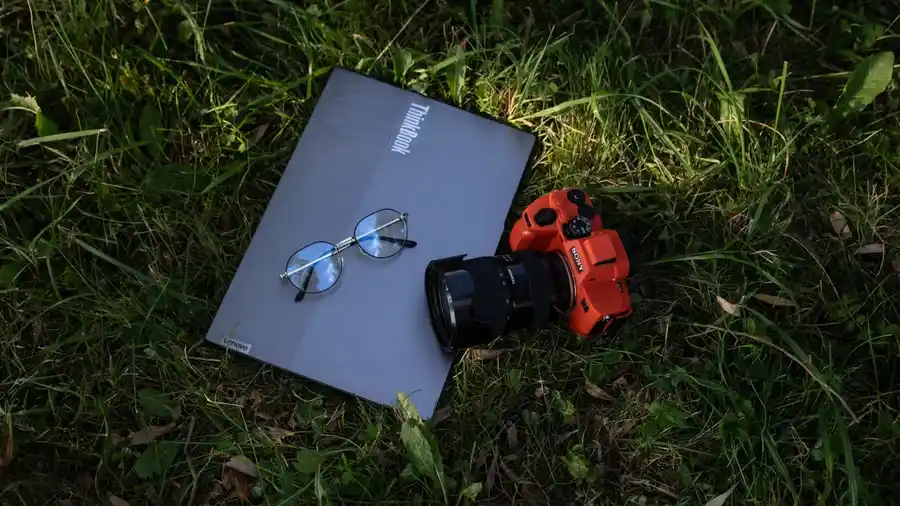
The first exception is a high-value single item. One expensive camera body, one top-end laptop, or one specialty device can justify a more targeted policy structure even if the rest of the kit is modest. The second exception is frequent transit. If the gear spends half the month in motion, a fixed-location policy starts to look mismatched.
The third exception is a mixed workflow. A freelancer may keep some gear at home and some gear on the road. In that case, one blanket property limit may not describe the risk well enough. The fourth exception is contract wording that creates a separate insurance requirement for a specific item or mode of transport; that issue belongs on a separate page and should be reviewed on its own.
None of these exceptions erase the basic rule. They just show where the rule breaks. That is why the policy form matters more than the industry label.
The Verdict: which one should you choose?
Choose personal property coverage if your freelance gear mostly stays at one address and the main loss risk is at that location. Choose inland marine insurance if your gear is portable, travels to shoots or jobs, or faces off-premises theft and transit risk. Neither if you need the policy to solve a separate contract requirement, or if you do not know the actual value and list of the items you are trying to protect.
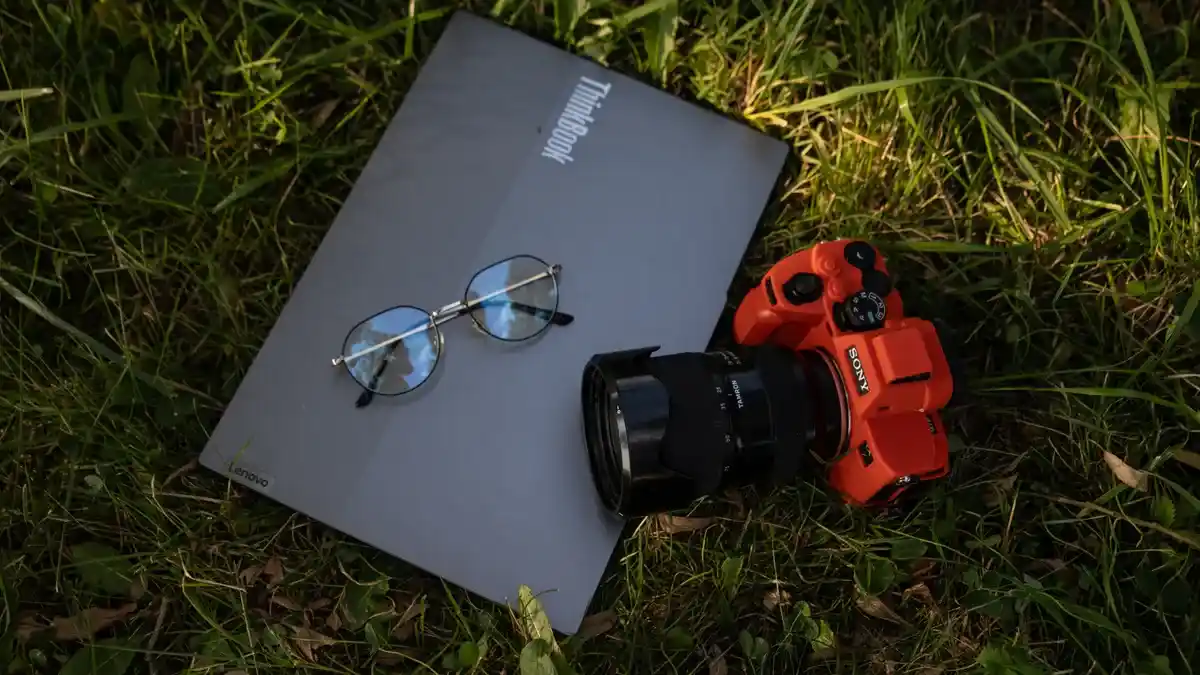
For readers comparing freelance insurance policy options and buying decisions, the cleanest rule is this: fixed gear points to personal property coverage; moving gear points to inland marine insurance. If the equipment is the tool of the trade and it leaves the base regularly, inland marine is the better match. If it sits in one place most of the time, the location-based form is usually enough to start the conversation with a qualified adviser.
Drafted with AI; not yet reviewed by a person.
