

Last updated: November 26, 2026
Mobile freelance business insurance usually starts with general liability, then adds inland marine for tools in transit and, if a vehicle is part of the job, commercial auto. For a freelancer who works at multiple client sites in the same region, the main task is matching the policy’s territory, off-premises work, and equipment cover to how the work actually moves from one location to the next. This is information, not financial advice; a qualified adviser should review the reader’s own situation.
Key takeaways
- Job-site travel changes the risk profile even when every address sits in the same city or region.
- The two most common gaps are off-premises liability and damage to tools while they are being moved.
- A policy can look fine on paper and still fail if its territory limit or vehicle wording does not match the route.
- The cleanest setup is usually a mix of liability, equipment, and auto cover that all use the same work area.
- A policy review should follow the work pattern, not the other way around.
Who is this for, and what does it assume?
This is for a freelancer whose paid work happens at more than one job site in the same region, such as a contractor, installer, technician, photographer, stylist, or consultant who carries gear between addresses. It assumes the reader already has or is shopping for basic business cover, knows the names of a few core products, and wants to avoid a gap when work leaves a home base and lands at a client site.
It also assumes the work stays within one region, not across a state line or into a separate franchise territory. That matters because territory limits, certificates, and vehicle rules can change by country and by insurer, and state or local rules can differ too. If the work uses a leased van, a rented box truck, or employees, the setup gets more complex than a solo policy package and may need qualified help before anything is bound.
The main terms are simple. General liability insurance is the cover that responds to third-party bodily injury or property damage claims. Inland marine insurance is the cover often used for tools and equipment that move away from a fixed location. Additional insured means a client is added to a policy, usually by request, so they get certain protections under the policy wording.
A generic business policy can be wrong for this setup because the loss may happen in a driveway, a parking lot, a lobby, or on the way between sites. That is exactly why mobile freelance business insurance exists as a category: it is built for work that travels. One useful starting point is the hub on freelance insurance for solo businesses, which sits above this page and helps place this topic in the wider solo-business picture.
How does mobile freelance business insurance work?
Mobile freelance business insurance works by splitting the risk into three parts: what happens to other people, what happens to the gear, and what happens in the vehicle. The policy only fits if those parts match the real route, the real tools, and the real client site exposure.
The first part is liability at the client location. A dropped tool, a wet floor, or a damaged fixture can trigger a claim even if the freelancer is there for only 20 minutes. The second part is equipment cover, usually through inland marine or tools and equipment coverage, which follows items away from a single premises. The third part is auto exposure, which matters if the job requires driving from site to site in one day.
A common mistake is to think “same region” means one blanket answer. It does not. Two addresses 8 miles apart can create a different risk than one fixed office, because the tools are in motion and the work area changes every time the door closes behind the freelancer. That is why the policy needs to say where the work happens, where the gear is kept overnight, and whether the work includes transport as part of the day’s routine.
The setup is also different from remote-only work. A freelancer who never carries gear to a client site may need a different structure than someone who loads tools into a car 5 days a week. The policy wording, not the business card, decides whether a claim belongs to the cover.
Which cover pieces usually matter?
The cover pieces that usually matter are general liability, inland marine, tools and equipment coverage, and commercial auto. Each one handles a different piece of the same trip between job sites, and one does not replace the others.
| Cover type | What it usually addresses | Where it matters most | Common weak spot |
|---|---|---|---|
| General liability insurance | Injury or property damage to a third party | Client site, hallway, shared space | May not protect the freelancer’s own gear |
| Inland marine insurance | Tools and equipment that move off premises | Car trunk, job site, temporary storage | Can have territory or item limits |
| Tools and equipment coverage | Named tools, kits, or trade gear | Frequent travel between sites | May exclude wear, breakdown, or unattended loss |
| Commercial auto insurance | Vehicle use for business | Driving between job sites | Personal auto may not fit business use |
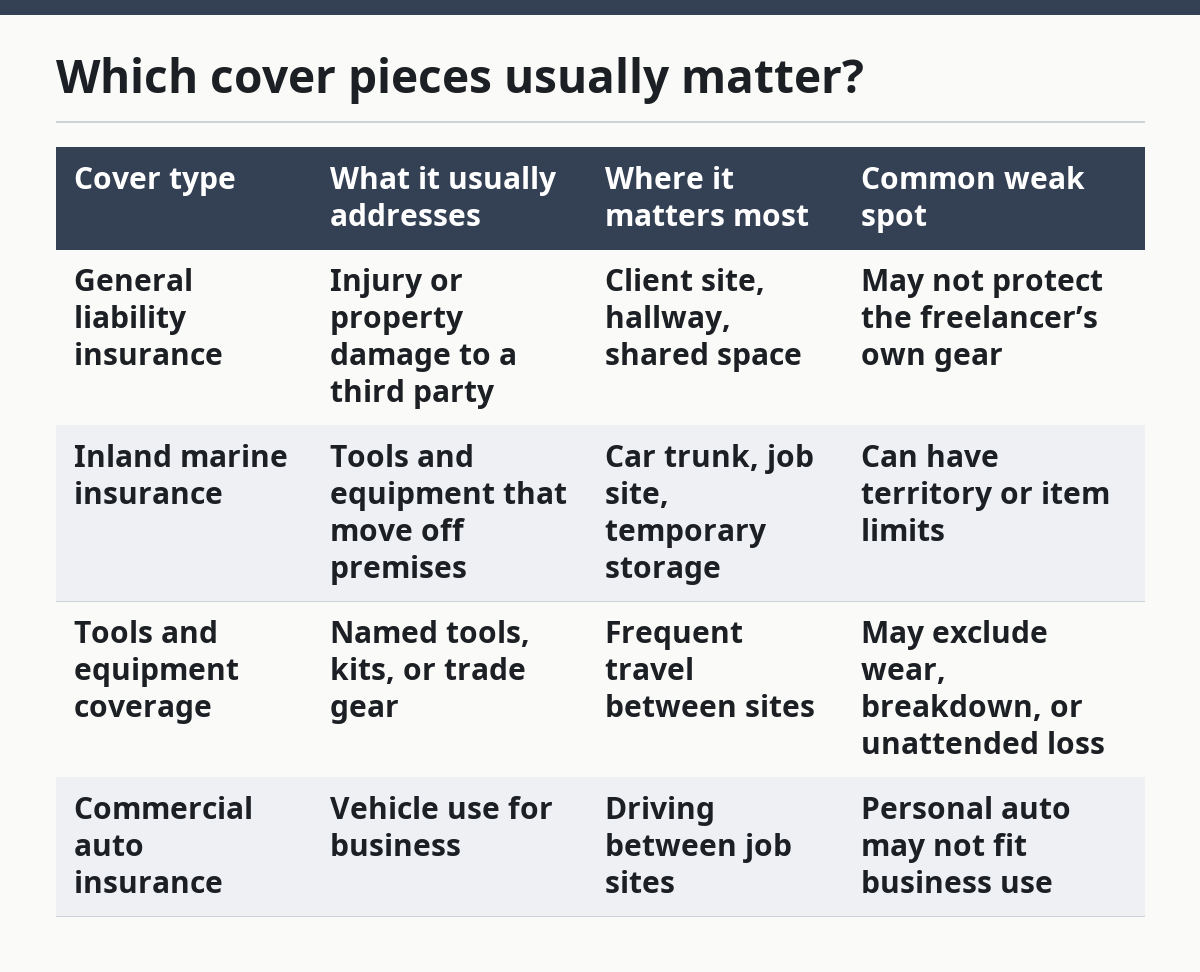
The practical issue is not which label sounds better. It is whether the policy matches the way the work moves. If the freelancer carries a camera bag, power tools, sample cases, or measuring gear, the equipment needs to be listed or covered in a way that fits how often it leaves the storage place. If a vehicle is used daily for the work, the auto policy needs to reflect that business use.
Client requests can change the picture too. Some clients ask for additional insured status on a certificate before work starts. That is common in many contracts, but it should be checked against the policy language rather than assumed to be automatic. A certificate is evidence of cover, not a magic fix for a policy that does not actually fit the job.
How do I set it up step by step?
Set it up by mapping the route first, then matching each policy feature to one specific risk. The goal is to make the policy follow the work pattern across 1 region, not to force the work pattern to fit a generic business form.
- List every job-site movement. Write down the normal route between 2 or more sites, the parking situation, and where tools are loaded and unloaded; verify whether the work always starts from the same storage point, and watch for any leg that is outside the region or involves overnight parking away from home base.
- Match general liability insurance to the client setting. Confirm that the policy covers third-party injury and property damage during off-premises operations; check whether client sites, common areas, and temporary workspaces are included, and flag any wording that only mentions one fixed location.
- Match inland marine insurance to the gear. Make a list of tools, cases, and equipment that leave the storage place, then confirm the policy treats them as movable property; verify the stated territory and any item limits, and note any exclusion for unattended vehicle storage.
- Match tools and equipment coverage to the replacement pattern. Check whether the cover responds to loss, theft, or damage while tools are in transit or on site; verify whether the form names each item or covers a class of tools, and watch for a gap if the kit changes every month.
- Match commercial auto to the actual driving. Confirm that the vehicle use is business use, not just personal errands with work gear in the back; verify whether the policy insures the specific car, van, or truck that moves between sites, and look for a mismatch if a second vehicle is sometimes used.
- Match additional insured needs to the contract. Read the client requirement and confirm whether the policy can add the client the way the contract asks; verify the wording for primary and noncontributory treatment if it appears, and treat any promise that the certificate alone solves the issue as a warning sign.
- Match the territory limit to the real region. Confirm that every regular job site falls inside the covered territory and that the route between them does too; verify whether the policy follows county, metro, or state lines, and stop if one frequent client sits outside the limit.
- Match the deductible to the most likely loss. Review the deductible on the equipment and liability parts together, then verify that a single moderate loss would still be manageable for cash flow; if the deductible is larger than the likely repair or replacement cost, the setup is probably out of balance.
A good result is simple: the policy wording and the work pattern describe the same business. A bad result is a policy that sounds broad but leaves the freelancer guessing about a tool bag, a fender bender, or a claim at the second site of the day.
What should I check before I bind anything?
The first thing to check is whether the policy uses the same map as the work. That means the same region, the same storage spot, and the same kind of travel that happens on a normal week, not just a rare busy day.
Check for 4 items in the quote or declarations page. First, the policy should say what territory it covers, because a local route can still fall outside a narrow wording. Second, it should say whether tools in transit are covered, since a claim often happens between the van and the door. Third, it should say whether additional insured requests are allowed. Fourth, it should show how the vehicle is used for business if the work depends on driving.
The key question is not “Is there cover?” It is “Is there cover for this movement, this site, and this bag of tools?” A policy can protect one part of the trip and ignore another. That is why the wording for inland marine, liability, and auto should be read together, not one at a time.
A quick comparison helps.
| Situation | What should be checked first | Why it matters |
|---|---|---|
| 2 job sites in the same city | Territory and off-premises liability | The claim may happen away from the storage place |
| Tools carried every day | Inland marine and tools in transit | The gear is exposed while being moved |
| Client demands an extra certificate | Additional insured language | The contract may require a named status |
| Driving between sites is daily | Commercial auto wording | Personal use language may not fit business travel |
A policy that looks complete but has a 1-location mindset is the most common trap here. That trap matters because the loss often happens in the handoff between locations, not inside either one.
When should I stop and get help?
The standard approach stops working when the work pattern is no longer a simple solo route within one region. In those cases, the policy choice can turn on wording, territory, or vehicle use that should be reviewed by a qualified adviser.
The work crosses a state line: the territory and auto rules may change — pause and get a professional review before relying on a policy that was built for one region.
A client demands specific certificate wording: the contract may ask for more than a normal policy note — check the policy language before promising anything to the client.
The freelancer uses a hired or borrowed vehicle: the auto exposure may not fit the usual policy form — do not assume the vehicle is covered just because the tools are.
The gear is left in a vehicle overnight: the theft and storage risk changes — confirm whether the inland marine form treats that as covered storage or a gap.
The job involves large or high-value equipment: the item limit or deductible may not match the loss size — review the schedule before a claim exposes the mismatch.
The worksite rules are set by a general contractor or property manager: site-specific requirements can override the freelancer’s normal setup — verify those rules before the first day on site.
These are not reasons to overbuy blindly. They are signs that the wording matters more than the label. A short review now is better than discovering a gap after a loss.
What mistakes do freelancers make most often?
The most common mistake is treating general liability as if it covers the tools too. It does not work that way. The consequence is a claim where the third-party damage is one part of the problem, but the lost or damaged gear is left to another policy, or to the freelancer’s own pocket.
A second mistake is forgetting that tools move during the day. A bag left in a car between sites is not the same risk as a kit stored in a locked room. The correct alternative is inland marine or tools and equipment coverage that clearly includes transit and temporary storage.
A third mistake is ignoring the territory limit because every client is “nearby.” Nearby is not a policy term. The correct alternative is to check the covered area against the full route, including the furthest regular site and any parking or storage stop.
A fourth mistake is assuming a certificate solves a mismatch in the base policy. A certificate shows evidence of cover; it does not create cover that the policy does not grant. The correct alternative is to make sure the underlying policy can actually support the client request.
A fifth mistake is using a personal car for business travel without checking the commercial auto issue. That can leave a gap if the driving is part of the job rather than a side trip. The correct alternative is to match the vehicle use to the policy wording before the work starts.
What if the work only moves inside one metro area?
A single metro area can still need the same core cover, just with a tighter territory check. The issue is not distance alone; it is whether the policy wording matches the addresses, loading points, and driving pattern.
If the work stays inside one metro area, the most important check is whether the insurer defines territory by city, county, region, or something else. A freelancer can be 12 miles from home and still fall outside the policy if the wording is narrower than the real route. The same is true for equipment kept in a car or at a temporary storage point.
The simpler the route, the easier it is to match the policy. But simple does not mean automatic. A policy that is designed for one fixed site can still miss the exact thing that changes every day: the move from one client door to the next.
FAQ
Does moving between job sites change my policy needs?
Yes. Moving between job sites usually changes the risk because the work is no longer fixed to one address. That means the policy needs to address travel, off-premises operations, and tools in transit, not just a single client location. The key is whether the wording follows the work route you actually use.
Do i need extra coverage for tools in transit?
Usually, yes, if the tools leave the storage place and travel from site to site. Tools in transit are exposed to theft, damage, and loss in a way that fixed-property cover may not handle. Inland marine insurance or tools and equipment coverage is the place to check first, along with any limits on vehicle storage.
What if i only work within one metro area?
You may still need the same kinds of cover, just with a territory that fits that metro area. The distance is less important than the policy wording and the real travel pattern. A short route can still create a gap if the policy assumes one fixed premises or a different territory limit.
How do I insure freelance work that travels between job sites?
The answer is to map the route, then make the policy follow it. For a freelancer who works at several sites in the same region, the usual structure is general liability for third-party claims, inland marine or tools and equipment coverage for movable gear, and commercial auto if the vehicle is part of the job. The fit matters more than the label.
Drafted with AI; not yet reviewed by a person.
