

Last updated: November 20, 2026
A freelance insurance coverage stack is a layered set of policies that starts with general liability and professional liability, then adds cyber, commercial umbrella, or inland marine only when the work creates those exposures. This guide on How to Build a Coverage Stack for Solo Freelancers shows how to match each layer to the real risk. The right stack closes gaps without paying twice for the same risk. This is information, not financial advice; a qualified adviser should review your own situation, and a licensed insurance professional should confirm what fits your work, contracts, and location. Rates, limits, tax treatment, and policy forms vary by place and change often, so consult a professional and check current guidance from sources such as the U.S. Small Business Administration and the NAIC.
Key takeaways
- Start with the risk your client can name first: bodily injury, client loss, data loss, or gear loss.
- General liability and professional liability are not the same policy, and one does not replace the other.
- Cyber liability matters when you store client data, use payment tools, or send files online.
- Umbrella coverage sits above other policies; it does not fix missing base coverage.
- Inland marine is about movable tools and equipment, not office furniture left in one room.
Who is this stack for?
This stack is for solo freelancers who want to line up several policies in a clear order instead of buying them one by one at random. It fits people with client contracts, portable gear, online work, or a real chance of being blamed for mistakes that cost money. A 1-person design studio, a freelance photographer, and a consultant may need different layers, but the logic is the same.
It assumes the reader already knows the kind of work they do and can name the assets they rely on. A laptop, camera kit, hard drives, and access to client files are the usual starting points. It also assumes the reader can tell the difference between a general claim and a professional mistake, because that split drives the stack.
This is not the right starting point for someone who wants a quick answer to “what should I buy?” without thinking through exposure. It is also not a substitute for local rules, contract terms, or a licensed adviser who can match coverage to a country’s rules. Rates, limits, tax treatment, and policy forms vary by place and change often.
What goes in the core stack?
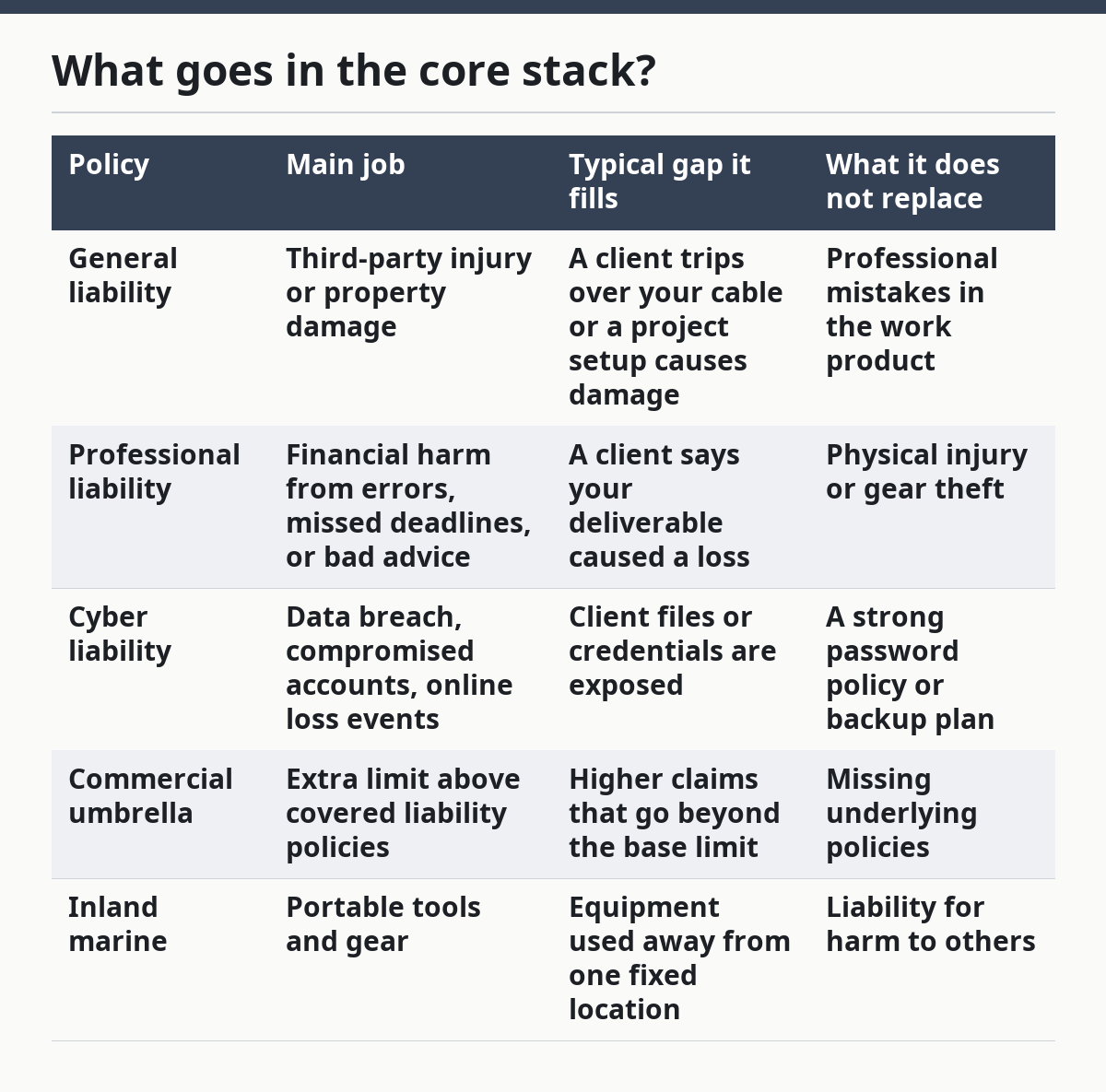
The core stack usually starts with 2 policies: general liability insurance and professional liability insurance. General liability deals with third-party bodily injury, property damage, and some personal injury claims. Professional liability, sometimes called errors and omissions insurance, responds when a client says the work itself caused a financial loss.
A third layer is cyber liability insurance if the work touches data, logins, or online payments. That policy can address breach response, data recovery, and some notification costs, depending on the form. A fourth layer, commercial umbrella insurance, can sit above underlying liability policies when a higher claim limit makes sense for the client or contract.
Inland marine insurance is the portable-gear layer. It is for tools that move from place to place, such as camera bodies, lenses, microphones, or other equipment carried to shoots or jobs. It is not a replacement for liability coverage, and it does not turn a business policy into personal property insurance.
| Policy | Main job | Typical gap it fills | What it does not replace |
|---|---|---|---|
| General liability | Third-party injury or property damage | A client trips over your cable or a project setup causes damage | Professional mistakes in the work product |
| Professional liability | Financial harm from errors, missed deadlines, or bad advice | A client says your deliverable caused a loss | Physical injury or gear theft |
| Cyber liability | Data breach, compromised accounts, online loss events | Client files or credentials are exposed | A strong password policy or backup plan |
| Commercial umbrella | Extra limit above covered liability policies | Higher claims that go beyond the base limit | Missing underlying policies |
| Inland marine | Portable tools and gear | Equipment used away from one fixed location | Liability for harm to others |
The stack is thinner for some freelancers and thicker for others. A writer who works in a browser may need less inland marine coverage than a photographer with several pieces of gear. A consultant who holds sensitive client data may need more cyber attention than a local trades freelancer with little online storage.
How do you build a freelance insurance coverage stack?
You build a freelance insurance coverage stack by ranking risks, mapping each risk to one policy, and then checking for overlap before you add anything else. The cleanest method is a 7-step pass that turns vague worry into a usable list.
- Name the work in one sentence. Write the job on a single line, such as “I design logos and manage client files” or “I photograph events and carry camera gear.” Verify that the sentence includes both the service and the asset base. If it takes 3 lines to explain the work, the risk list is probably too fuzzy to stack well.
- Split the risks into 4 bins. Sort each exposure into bodily injury, property damage, professional mistake, or data loss. Verify that each item fits one bin before you move on. If one risk sits in 2 bins, the policy choice is unclear and the stack may duplicate coverage.
- Put general liability first if there is any client contact. That policy is the base when people visit your space, you work at a client site, or your setup could damage someone else’s property. Verify that the policy language fits the actual work setting. If the work never leaves a laptop and never brings outsiders into the space, this layer may be less central than the others.
- Add professional liability when the service can cause financial loss. If a client can say a mistake in advice, design, editing, coding, or scheduling cost money, this policy belongs in the stack. Verify that the policy language names the kind of work you do. If the policy excludes the service you sell, the stack has a hole even if the premium looks attractive.
- Check for cyber exposure whenever data moves online. If you store client files, use shared drives, send attachments, or accept online payments, cyber risk is part of the picture. Verify whether the policy mentions breach response, privacy claims, and digital asset recovery. If it only talks about a narrow event and leaves out your main tools, the layer is too thin.
- Test whether umbrella coverage adds anything. Ask whether the claims you fear could outrun the base limit on general liability or professional liability. Verify that the umbrella follows the correct underlying policies and does not sit alone. If the base policies are missing or mismatched, umbrella coverage is the wrong next step.
- List the gear that moves. For cameras, laptops, audio kits, or other portable tools, check inland marine coverage for equipment used off-site. Verify that the items, locations, and use pattern fit the policy form. If the gear stays fixed in one room, this layer may be unnecessary or too broad for the job.
- Compare the stack against one contract. Read a client contract, then match its insurance demands to the stack line by line. Verify that every required policy is present and that the wording does not ask for a limit, endorsement, or additional insured status you do not have. If the contract asks for something the stack cannot supply, pause before the work starts.
The value of this method is that it stops the common mistake of buying a policy because it sounds protective. A policy that sounds right but covers the wrong risk is just expensive paper. The right stack is built from the work, not from a slogan.
How do freelancers layer insurance coverage?
Freelancers layer insurance coverage by placing the broad, physical-risk policies at the base and then stacking the narrower or higher-limit policies above them. General liability usually sits at the bottom because it handles the most basic third-party harm. Professional liability, cyber, and inland marine sit beside or above it because each covers a narrower slice of exposure.
Layering matters because one policy often will not stretch across the whole job. A freelancer might need general liability for a client visit, professional liability for the advice itself, and cyber liability because all project files live in cloud storage. That is not redundancy; it is a 3-part answer to 3 different claim types.
Commercial umbrella insurance is the clearest example of a true layer. It does not replace the underlying policy; it sits on top of it and can extend protection when the base limit is used up, subject to the policy terms. If the base layer is weak or missing, the umbrella does not close that gap.
Think in this order: base exposure, work-product exposure, digital exposure, equipment exposure, then excess limit. That sequence helps keep the stack from turning into a pile of overlapping forms. A freelancer who works entirely online may lean harder on professional liability and cyber, while a field-based freelancer may need more attention on general liability and inland marine.
What mistakes do freelancers make?
The biggest mistake is treating general liability and professional liability as the same thing. They are not. The consequence is a gap that shows up only after a claim, when the policy meant for a client injury does nothing for a client alleging a bad deliverable. The SBA and the NAIC both stress matching coverage to the business risk, so a licensed insurance professional should help you verify the fit before you buy. The better choice is to map each risk to the correct policy before paying for it.
A second mistake is buying cyber liability only after a breach scare. That can leave the most useful parts of the policy unavailable for the event that already happened. The better choice is to check the trigger points before data leaves your laptop or reaches a shared drive.
A third mistake is stacking umbrella coverage on top of missing base coverage. That creates a false sense of thickness without the required foundation. The better choice is to confirm the underlying policies, their limits, and the exact wording before adding excess coverage.
A fourth mistake is forgetting inland marine because the gear seems “just tools.” Portable equipment is often the part most likely to travel, be dropped, or be stolen away from home. The better choice is to list the items that move, then decide whether the policy form matches the way they are used.
A fifth mistake is ignoring contract language. If a client asks for a certificate, additional insured wording, or a specific limit, the stack needs to fit that demand before the work starts. The better choice is to review the contract first, not after the invoice.
When should you stop and get help?
You should stop DIY stacking and get qualified help when the policy language, contract terms, or risk profile no longer fit a simple solo setup. In a finance topic, that is the point where a wrong answer can cost real money. A licensed adviser or broker is the right next step when the stack stops being obvious.
Your client contract names a limit, endorsement, or certificate you do not understand: that means the policy wording matters as much as the premium — get help before accepting the work. A mismatch can leave the contract unfulfilled even if you have insurance on paper.
Your work involves regulated advice, sensitive records, or high-value client decisions: that means professional liability and cyber wording may need special review — do not guess at the fit. A bad match can leave the main exposure uncovered.
You use expensive portable gear across multiple locations: that means inland marine details matter — confirm item lists, use location, and claim rules before relying on it. If the policy is written for the wrong kind of equipment, the protection can be thinner than it looks.
You need umbrella coverage but do not know what sits underneath it: that means the foundation is unclear — do not add excess until the base policies are identified. An umbrella without the right base can fail at the exact moment you expect it to work.
You work in more than one country or serve clients across borders: that means local rules may change what counts as valid coverage — pause and get country-specific guidance. One stack rarely fits every jurisdiction.
What changes the stack for special cases?
The standard stack changes when the freelancer’s work changes the kind of loss that is most likely. A photographer, for example, often puts more weight on inland marine because cameras move, travel, and get handled in different places. A designer or consultant may focus more on professional liability because the main risk is a bad recommendation, missed deadline, or flawed deliverable.
A freelancer who stores client data in shared drives or accepts digital payments should treat cyber liability as a core layer rather than a bonus layer. The trigger is not company size; it is data movement. Even one lost login can create a path into client files, so the online side of the stack needs its own check, and a qualified insurance professional should confirm the cyber wording before purchase.
A freelancer who signs larger client contracts may need a stronger eye on umbrella coverage. The key question is not “is umbrella good?” but “does the base layer make the umbrella usable?” If the base policies are too thin or the contract asks for a specific structure, the stack has to be adjusted before the project starts.
A freelancer who works from a fixed home office may need less inland marine than a traveling freelancer. That does not remove the need to think about equipment; it just changes the weight of the layer. The stack should match where the assets actually spend most of their time, not where they sound valuable on paper.
What is a coverage stack?
A coverage stack is the order and mix of policies that work together to protect one freelance business from different kinds of loss. It starts with the risks the work creates, then assigns each risk to the policy that handles it best. The point is fit, not volume.
A good stack is usually clear enough to explain in 2 minutes. If it takes 10 minutes and a long list of exceptions, the stack is probably doing too much or too little. For a solo freelancer, the smallest stack that still covers the real exposures is usually the right starting point, though the exact mix should be checked against the work and the contract.
What policies should a solo freelancer start with?
A solo freelancer should usually start with the policy that matches the most immediate third-party risk, then add the policy that matches the work-product risk. For many people that means general liability first and professional liability second, with cyber added when data is handled online. The order changes with the job, so the work itself should drive the stack.
How do freelancers layer insurance coverage?
Freelancers layer coverage by placing basic liability at the bottom, then adding policies for service errors, digital exposure, movable tools, and higher limits. Each layer should fill a different gap, not repeat the same one. If two policies answer the same risk in the same way, one of them may be unnecessary.
What is a coverage stack?
A coverage stack is the set of policies arranged to cover a freelancer’s main risks without obvious duplication. It is a planning tool, not a single policy name. The stack works best when each layer has a clear job: injury, mistakes, data, equipment, or excess limit.
Drafted with AI; not yet reviewed by a person.
