

Last updated: November 22, 2026
Quick Answer: in most freelance setups, the first policy decision is often one or two core coverages, not five; a 10-minute contract review and a 3-step risk map usually tell you more than a generic package. This article, Freelance Insurance Policy Setup and Coverage Design — The Complete Guide, is information, not financial advice, and a qualified adviser should review your own situation before you bind coverage. For many freelancers, the right design starts with liability protection, then adds property, cyber, or professional coverage only where a real gap exists.
Key takeaways
- Start with the work you do, not with a generic “freelancer package.”
- Coverage design is mostly about exclusions, limits, and the names on the policy.
- A low premium can hide a bad fit if the policy excludes the exact mistake you are most likely to make.
- Client contracts can force you into certain limits, endorsements, or certificate wording.
- Some freelancers need one policy. Others need a small stack of policies that fit together without overlap.
- The wrong setup can leave a gap even if you paid for insurance.
What actually determines the right setup?
The right setup depends on three things: what you do, what you touch, and what your contracts demand. A freelance designer who only delivers digital files faces a different risk map than a photographer who rents gear, or a consultant who gives advice that a client may rely on for money decisions. The policy design changes when the work changes.
If your work can cause bodily injury, property damage, or damage to a client’s space, then general liability is usually the first layer people look at. If your work can cause financial loss through bad advice, missed deadlines, or incorrect specs, then professional liability or errors-and-omissions coverage becomes the more relevant layer. If you store client data, process payments, or work in shared systems, cyber risk may matter more than a wall of office furniture.
A generic article often gets this wrong by treating “freelance insurance” as one product; a qualified adviser can help separate the parts if the setup is unclear. It is not one thing. It is a design problem with separate parts, and the parts interact. A policy can be cheap because it is thin, or expensive because it covers a risk you do not actually have.
For a quick reality check, look at the difference between these paths:
| Situation | Best path | Why other options fail |
|---|---|---|
| You visit client sites and could damage property | General liability plus any contract-required endorsements | Professional liability alone does not answer a broken-item or injury claim |
| You give advice, plans, edits, or specifications | Professional liability first | General liability often excludes pure financial-loss claims |
| You handle client files, logins, or payment data | Add cyber coverage | General liability usually does not fix a data breach |
| You own camera gear, laptops, or other tools | Property coverage or a business property form | Liability coverage does not replace stolen equipment |
| You work only from home on low-risk admin tasks | A smaller, simpler setup may be enough | Buying several layers you do not need can waste cash |
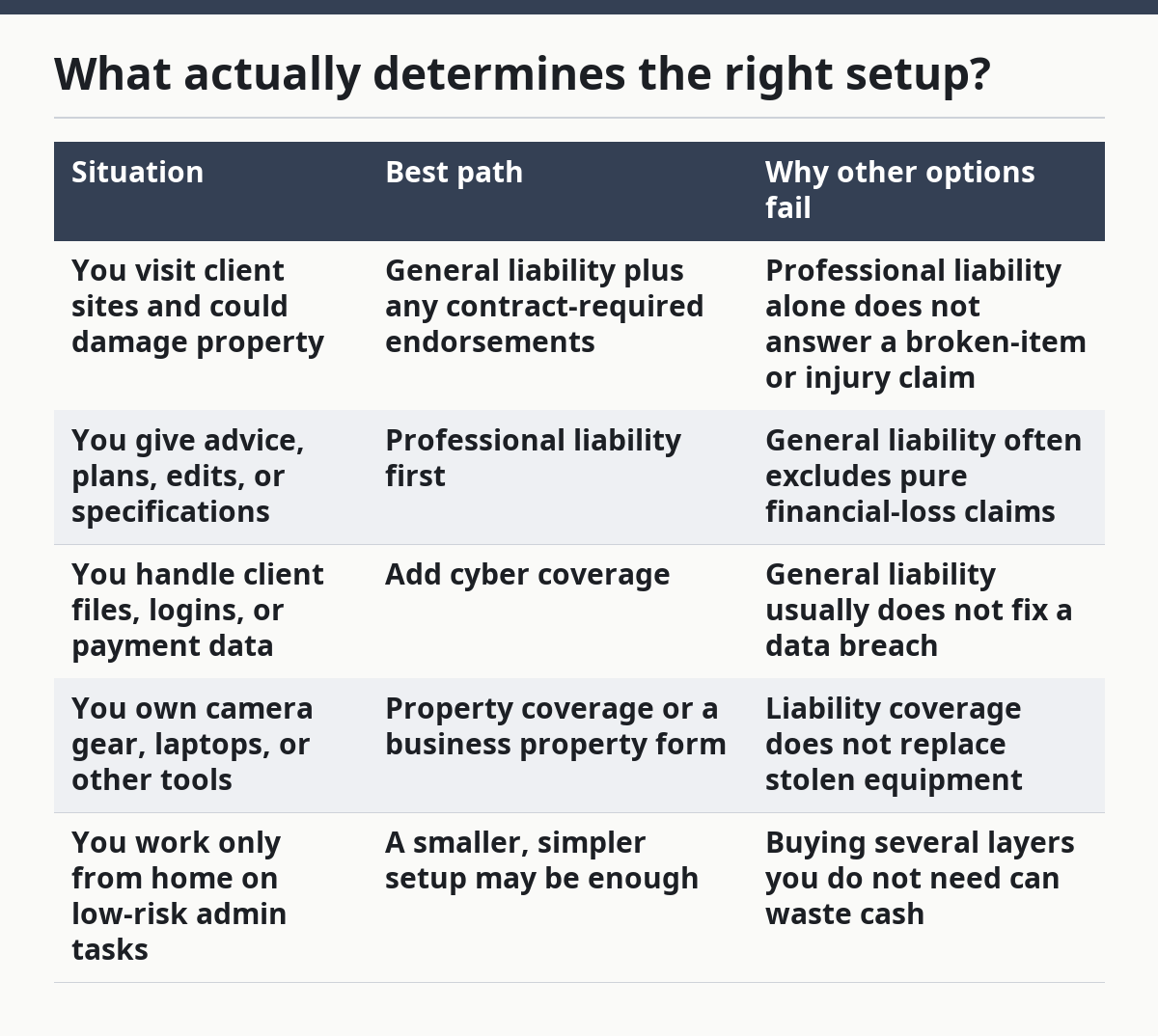
If you are unsure which camp you are in, list your last 10 paid jobs and mark every task that could trigger a claim. The result usually points to one or two primary policies, not five. The U.S. Small Business Administration also gives a plain-language starting point on business insurance choices.
So, if your work is mostly advice, mostly equipment, or mostly client-site visits, the policy design changes in a different direction each time.
Which policy type covers which risk?
Each policy type solves a different problem, and the mistake is assuming one fills every hole. General liability, professional liability, business property, cyber, and workers’ compensation are not interchangeable. A freelance writer, for example, may need a different mix than a freelance contractor, even if both work alone.
General liability is about third-party injury and property damage. Professional liability is about mistakes in your service or advice. Business property covers tools and equipment. Cyber addresses data-related events. Workers’ compensation only matters if your country or state treats you as an employer or requires it for certain arrangements; rules differ by country and change often, so a qualified adviser or local regulator should confirm the rules that apply to you. The National Association of Insurance Commissioners is a useful consumer source for insurance basics and state-level regulation.
The cleanest way to set coverage is to map each risk to the policy that actually answers it. If the problem is “I spilled coffee on a client’s laptop,” liability may be relevant. If the problem is “my recommendation caused a financial loss,” professional liability is the more likely fit. If the problem is “my laptop was stolen,” property coverage is the layer that matters.
A lot of freelancers overbuy one policy and underbuy another. That often happens when the person asks, “What is the cheapest insurance I can get?” Instead, ask, “Which claim would hurt me most, and which policy type actually responds to that claim?” That question usually changes the answer.
How do you design limits and deductibles?
You design limits and deductibles around the size of the claim you could reasonably face, not around what sounds comfortable today. A low deductible lowers out-of-pocket pain after a claim, but it can raise the premium. A higher limit can protect against a bigger claim, but it can also cost more and may not be required for every freelance business.
If your contracts demand a specific limit, that requirement comes first. If a client asks for proof of coverage with a stated limit, then your policy has to match that number or the job can fall apart before it starts. If no contract requires a number, then the right limit depends on how large your work is, how likely a claim is, and how much cash you could absorb without disruption.
Coverage limits also need to fit together. A freelancer may carry one limit for each claim and another for the policy period, and those are not the same thing. Read the declarations page and the insuring agreement before you assume a figure means what you think it means. A policy with a high-looking number can still run out sooner than expected if the structure is tight.
Deductibles matter too. A deductible of even a modest amount is not just a line item; it is the amount you must pay before the policy responds. If your cash buffer is thin, a deductible that looks manageable on paper may be awkward in practice. If your work is steady and claims are rare, a somewhat higher deductible can make the premium easier to carry.
One practical way to decide is to run three questions in order:
- What is the most likely claim in my line of work?
- What contract limit do my clients ask for, if any?
- How much could I pay out of pocket before I would miss rent, payroll, or a project deposit?
If the answer to the third question is “not much,” then a high deductible may be a bad fit even if the premium is attractive. If the answer to the first question is “a small claim from a routine mistake,” then excess coverage is less urgent than clarity on exclusions.
Quick check: if the deductible would hurt your cash flow more than the premium would help it, the setup needs another look.
If you’re freelance and work from home, what changes?
If you work from home, the main change is that your personal home policy may not protect business activity the way you expect. A lot of freelancers assume the home policy automatically covers business tools, business visitors, or client work, but that assumption can fail. The risk is bigger when you store inventory, equipment, or client records at home.
This is where setup gets specific. A home-based freelancer may need to separate personal property from business property, or add an endorsement that addresses business use. If clients never visit and you only use a laptop and cloud tools, the setup can be simpler. If you keep cameras, lighting, printers, or stock at home, the property side gets more important.
The standard advice is wrong when it says, “You work from home, so you do not need business insurance.” The home office setting does not erase liability. It just changes where the risk sits. You can still face claims tied to advice, files, intellectual property disputes, or a visitor injury if someone comes to your home for work.
A workable setup usually follows this order:
- List every business asset kept at home, including laptop, phone, camera gear, and paper files.
- Check whether your home policy says anything about business property or business use.
- Separate personal items from business items on a simple inventory sheet.
- Ask whether your client work could trigger a professional claim, not just a physical-loss claim.
- Review whether client visits, deliveries, or contractors create a third-party injury risk.
- Match the policy form to the actual home setup instead of assuming one home policy does it all.
A home-based editor with no visitors and no gear has a different need than a home-based photographer with several thousand dollars of equipment. The difference is not cosmetic. It changes which policy matters first.
Quick check: if your business and personal life share the same room, the policy design has to separate the risks even if the address is the same.
What should client contracts change?
Client contracts should change your limits, wording, and sometimes the endorsements on the policy. If a contract asks for additional insured status, specific limits, or a certificate of insurance, the policy setup has to support that before the work starts. If the contract has indemnity language or a hold harmless clause, the insurance review gets even more important.
This is where many freelancers get trapped. They buy a policy first, then read the contract later. That reverses the order. The contract may require a particular limit, a named party, or proof that a subcontractor arrangement is covered. If the policy cannot produce that, the insurance may be fine on paper but useless for the job.
The right move is not to guess. Read the insurance section of the contract line by line. Look for words like “additional insured,” “primary and noncontributory,” “certificate,” “waiver of subrogation,” and “minimum limit.” Those phrases are not decoration. They affect whether the policy fits the work.
Here is the basic workflow:
- Pull the insurance clause before signing the contract.
- Mark every stated requirement, including limit, certificate, and endorsement language.
- Compare those terms to the declarations page and endorsements.
- Check whether the contract names the client, the landlord, or another party in a special way.
- Confirm the policy period covers the full term of the project, not just the start date.
- Save the final certificate and policy documents together for the job file.
If the client is small and the contract is loose, the insurance setup may stay simple. If the client is large, the contract often drives the design more than the freelancer’s own preference. That is normal, and it is one reason the same freelancer may need different setups for different jobs.
Quick check: if the contract has a full insurance page, the policy has to be built around that page, not around a generic template.
How do you compare policies without getting fooled?
You compare policies by reading what they exclude, how they define the work, and when they respond, not by comparing the premium alone. The cheapest quote can be a poor fit if the exclusions swallow the main risk. A higher premium can still be wrong if it pays for broad features you do not need.
For freelancers, three comparison points matter most. First, check whether the policy covers the exact service you provide. Second, check whether the claim trigger is occurrence-based, claims-made, or another structure that affects timing. Third, check whether the policy covers subcontractors, digital work, or off-site work if those are part of the business.
A lot of comparison shopping fails because the buyer compares “limits” but not “conditions.” Two policies can show the same headline limit and still behave very differently once a claim starts. If one policy has narrow wording around service mistakes, and another covers the broader service type, the second may be the more useful fit even if it costs more.
The comparison table below shows where policies often diverge:
| Policy feature | What to check | Common failure point |
|---|---|---|
| Coverage trigger | When the claim must be made or the incident must happen | The policy looks fine, but the timing rule blocks the claim |
| Exclusions | What work, act, or client type is left out | The exact freelance service is excluded |
| Named insured | Which person or business entity is protected | The policy lists the wrong name or business form |
| Subcontractor handling | Whether outside help is included | A subcontractor mistake falls outside the policy |
| Territory | Where the work is covered | Cross-border or out-of-state work is not covered the way you assumed |
| Certificate wording | What proof the client needs | The certificate does not satisfy the contract language |
If you do not know how to compare forms, ask for the actual wording, not just a summary. Summaries hide too much. The policy form and endorsements are where the answer lives.
Quick check: if two quotes look similar but one has fewer exclusions on your exact service, the “cheaper” option may not be the better one.
What are the edge cases that break normal advice?
The normal advice breaks down when your work crosses into unusual risk, unusual contracts, or unusual timing. These cases need a different setup because the standard freelancer model is too simple. Four or five common edge cases account for a lot of bad fits.
-
You freelance through a platform.
What changes: the platform may control the client relationship, but that does not always transfer your liability away.
What to do instead: check who is named in the contract, who owns the deliverables, and whether the platform’s insurance, if any, actually responds to your work. -
You subcontract part of the job.
What changes: another person’s error can become your problem if the contract points back to you.
What to do instead: verify whether the policy covers subcontractor work or whether you need separate wording for that arrangement. -
You work across borders or in more than one country.
What changes: insurance rules, policy territory, and required wording can shift fast.
What to do instead: confirm territorial limits and do not assume a policy sold for one country fits another. A claim can be blocked by the wrong geography even when the work looked ordinary. -
You hold client funds or handle payment flows.
What changes: money-handling creates a different risk than simple service work.
What to do instead: ask specifically about coverage for theft, social engineering, or funds transfer issues, because general liability often does not solve that problem. -
You have a short project with a long tail.
What changes: the work may end in 30 days, but a claim can show up later.
What to do instead: check whether the policy covers the timing of the claim, not just the project start date. Timing matters as much as the dollar limit. -
You are just starting and have little revenue.
What changes: cash flow is tight, so a large deductible may be more painful than it looks.
What to do instead: focus on the highest-risk gap first and avoid paying for layers that do not match the work yet.
These cases are where a generic “just get liability insurance” answer falls apart. The policy design has to match the work pattern, not the job title.
Quick check: if your work is cross-border, subcontracted, money-handling, or platform-based, the standard freelancer setup may miss the real exposure.
How should a freelancer build the policy setup step by step?
A freelancer should build the setup by mapping work, reading contracts, comparing policy forms, and checking how the policies fit together before purchase or renewal. The process is mechanical, and the order matters. If you skip the mapping step, you can easily buy the wrong type of coverage first.
Here is a simple path that works better than shopping from the homepage of an insurer’s site:
- Write down every service you sell, including advice, drafting, design, visits, storage, and subcontracted work.
- Mark the three biggest claim sources: injury, property damage, and financial loss.
- Collect the insurance clauses from your last 3 to 5 client contracts.
- Sort those clauses into required limits, endorsements, and certificate needs.
- Check which policy type answers each risk: general liability, professional liability, property, cyber, or another form.
- Compare the exclusions, deductible, territory, and timing rules on each quote.
- Make sure the named insured matches your business form and tax or registration setup.
- Keep the policy documents, endorsements, and certificates in one place for renewal and claims.
This process looks simple, but skipping one step can break the whole thing. If the named insured is wrong, the rest may not matter. If the policy territory is wrong, the limit may not help. If the contract wording is wrong, the client may reject the proof of insurance even if you are covered.
The HealthCare.gov self-employed guidance is not about liability insurance, but it is a good reminder that self-employed coverage questions often split into separate buckets. Health coverage, liability coverage, and business property coverage do different jobs, and mixing them up creates bad decisions.
Quick check: if you cannot explain your coverage in one sentence per policy type, the setup is probably not clear enough yet.
FAQ
Do freelancers always need general liability insurance?
Not always. General liability is most relevant when your work can injure someone or damage property, such as client-site visits, rented spaces, or jobs with physical tools. If your work is purely advisory or digital, professional liability may be the more relevant starting point.
Is professional liability the same as general liability?
No, they cover different risks. General liability is usually about injury and property damage, while professional liability is about service mistakes, bad advice, missed specs, or other financial-loss claims. A freelancer can need one, the other, or both, depending on the work.
Can my home insurance cover my freelance work?
Sometimes partially, but often not fully. Home policies may have limits or exclusions for business property and business activity, especially if clients visit or you store equipment. The exact answer depends on the policy wording, so the home policy should be checked line by line.
What if a client contract asks for insurance wording I do not understand?
Do not guess. Ask for the exact clause to be explained in plain language and compare it with the policy form and endorsements before signing. The contract can change what insurance you need, and the wrong wording can make the proof of insurance unusable for that job.
Should a new freelancer buy the same setup as a long-time one?
No, not automatically. A new freelancer with one laptop and a few small projects may need a simpler setup than someone with staff, gear, subcontractors, or larger contracts. The right design depends on the work, the contracts, and the assets at risk, not on how long the business has existed.
What is the bottom line?
The bottom line is that freelance insurance policy setup is a matching exercise, not a shopping exercise. The right design depends on your work, your contracts, and the kind of claim that would hurt you most. If you treat every policy as a generic product, you can end up paying for coverage that looks solid but misses the real risk.
The best setup is the one that answers the claim you are most likely to face, fits the contract you actually signed, and does not leave the named insured, territory, or timing rules out of alignment. That is the part generic advice often misses. A freelancer does not need “more insurance” in the abstract; a freelancer needs the right policy shape for the job at hand.
Quick check: if your coverage does not match your contracts, your work type, and your business structure, the design still needs work.
Drafted with AI; not yet reviewed by a person.
