

Last updated: November 23, 2026
Quick answer: a client insurance requirement is standard when it matches the project’s risk, scope, and market norm; if the clause shows 3 or more red flags in this article, treat it as potentially excessive until you can verify it. A client insurance requirement standard or excessive question usually turns on the project, not the policy form. This page is information, not financial advice, and a qualified adviser should be consulted for your own situation. A freelancer reviewing a statement of work can usually judge this by looking at the job size, the venue, the deliverables, and who could be harmed if something goes wrong.
Key takeaways
- Start with the project, not the policy language: the work itself tells you whether the demand is ordinary or heavy-handed.
- A certificate of insurance is only proof of coverage; it does not tell you whether the requirement fits the job.
- Bigger limits are not automatically unfair. A tighter deadline, on-site work, or client assets can justify more protection.
- The clearest red flags are vague wording, broad extra-insured asks, and requirements that shift unrelated risk onto a small job.
- If the demand changes the economics of the project more than the project’s own risk, it deserves a hard look.
What counts as standard?

A standard client insurance requirement is one that fits the scope of work and the usual risk allocation for that kind of project. For a freelancer, that means the requirement is tied to the actual work in the statement of work, not to a generic template the client copies into every contract.
The quickest test is to ask whether the requirement would still make sense if the project were described in one sentence. If the job is short, remote, low-touch, and low-risk, a demand for broad coverage can be a sign the client is using a one-size-fits-all clause. If the work involves site access, client property, or advice that could cause a real loss, the same clause may be ordinary.
Market norm matters, but it is not a single number you can apply everywhere. Insurance requirements differ by country, industry, and project type, and they also shift with the client’s own risk policy. That is why the phrase “standard” should mean “common for this kind of job,” not “common in every contract.” A certificate of insurance, or COI, only shows that a policy exists; it does not prove the demand is proportional. For background on COIs and basic contract insurance terms, IRMI’s certificate-of-insurance definition and ACORD’s standards pages are useful starting points, and the certificate of insurance explanation and ACORD forms pages are authoritative references.
How do I tell if a client insurance requirement is excessive?
A requirement is excessive when the risk it demands you cover is larger than the work you are actually doing. The cleanest way to judge that is to compare the clause against five things: the scope of work, the project size, the place where the work happens, the kind of harm that could occur, and who is asking you to absorb the risk.
Use this 7-step check before you agree to anything:
- Pull the exact insurance language from the statement of work. Copy the clause into a separate note and mark every requirement: policy type, limit, additional insured request, waiver of subrogation, and notice period. Verify that you are reading the same wording that will govern the project. A problem shows up when the client says one thing on a call and another thing in the contract.
- Match the clause to the actual deliverables. Write the deliverables in plain English, then ask what could go wrong with each one. A logo file, a short copy package, and a site visit do not carry the same project risk. If the clause covers harms that have no link to the deliverables, that is a warning sign.
- Check the work setting. Remote work usually creates less physical risk than on-site work in a client office, warehouse, or event space. If the project includes access badges, equipment, or public-facing work, the need for coverage is easier to justify. If the job is fully remote, a broad premises-style demand can be harder to defend.
- Look at the client’s reason for asking. A public company, landlord, venue, or government body may use a fixed risk template. That alone does not make the clause fair, but it explains why it is there. If the client cannot connect the requirement to the work, the clause may be a copy-paste rule rather than a real risk control.
- Compare the burden to the project size. If the insurance demand adds more complexity than the job itself, the requirement may be out of scale. A one-off assignment with a short statement of work should not carry the same risk structure as a multi-month engagement with site access and repeated deliverables. Excess often shows up as paperwork that far outweighs the job.
- Check whether the clause shifts unrelated risk to you. A clause becomes excessive when it asks you to insure losses you do not control, such as the client’s own operations, building conditions, or other contractors. That is a risk-allocation problem, not just an insurance problem.
- Decide whether the requirement changes the deal. If the clause would force a freelancer to change pricing, decline work, or spend significant time untangling coverage for a small project, the requirement may be excessive for the engagement. That does not prove it is wrong, but it means the clause is not routine for the job as written.
The better check is not “Can I possibly get this?” It is “Does this clause fit the project’s risk in a way a reasonable client could explain in one paragraph?” If the answer is no, the requirement may be excessive even if it appears often in contracts.
What makes an insurance requirement look ordinary or heavy-handed?

A requirement looks ordinary when it is narrow, tied to the work, and easy to explain in the statement of work. It looks heavy-handed when it is broad, vague, and detached from the project’s actual risk.
| Sign of a standard requirement | Sign of an excessive requirement |
|---|---|
| Tied to a named project or deliverable | Written as a blanket rule for every job |
| Focused on the work site or direct work product | Covers broad harm with no link to your work |
| Clear policy type and purpose | Vague catch-all wording |
| Risk matches the setting, such as on-site access | Remote work treated like high-risk construction |
| Limited extra-insured request tied to the client | Broad additional-insured language with no limits |
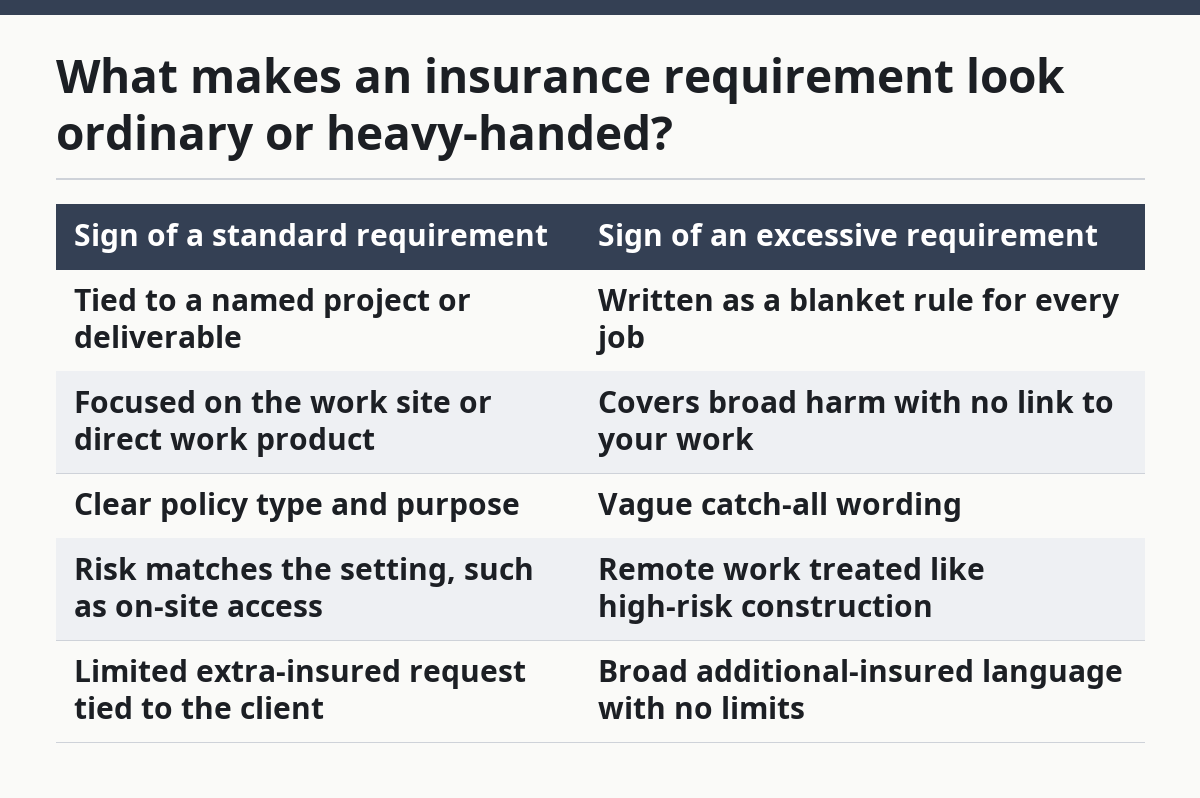
Two details matter more than most readers expect. First, a request for a certificate of insurance is not the same as a request for unusual coverage; COIs are common in contract administration. Second, a demand can be ordinary in one setting and excessive in another. A 1-day event shoot, a 6-month retainer, and a one-off consult do not carry the same risk allocation, even if the client uses the same contract template for all three. For contract basics, see our certificate of insurance and risk allocation pages.
Which red flags usually mean “push back”?
A requirement usually deserves pushback when it creates risk that is far broader than the project itself. These are the situations that most often point to an excessive demand:
Broad wording that covers “any and all” losses: That language often reaches beyond the actual project risk — Ask what harm is really tied to your work and ask for narrower wording.
Requirements that treat a small remote project like a high-risk site job: That usually means the clause was copied from another contract — Ask whether the work setting and the risk really match, and if needed consult a professional who can review the language and source it against the project facts.
Extra insured language with no project limit: That can shift your policy toward the client’s broader operations — Ask whether the request can be tied only to the named project or the named location.
Insurance demands that do not match the statement of work: A mismatch between the clause and the deliverables means the contract is overreaching — Bring the two documents side by side and ask the client to align them.
Requirements that make the job uneconomical before the work starts: If the clause adds too much cost, admin, or delay for a small project, it may be too heavy for the engagement — Treat that as a contract problem, not a personal failure, and consult a professional if you need help deciding whether the burden is justified.
If a client cannot explain the need in terms of project risk, the clause is probably using insurance as a catch-all shield. That does not make the client dishonest, but it does mean the requirement is not automatically standard.
When is a higher limit still reasonable?
A higher limit can be reasonable when the project creates a larger path to loss, even if the work is simple. The key is not the number itself; it is the size of the exposure. A 2-day on-site assignment around expensive equipment, a job with access to confidential records, or work that could affect public-facing operations may justify more coverage than a purely remote task.
Higher limits are also more understandable when the client is asking for consistency across many vendors. Large organizations often use one set of contract rules for multiple supplier types, and that can make a requirement look bigger than the freelance job alone. That is not a free pass for the clause, but it does explain why the demand might be routine inside the client’s system.
The downside is obvious: a higher limit can be perfectly normal for the client and still be too heavy for the freelancer’s role. If the clause is much broader than the work, the fact that the client uses it often does not make it proportionate. The decision point is still project risk, not the client’s habit.
When should I stop treating it as routine?
Stop treating the requirement as routine when any of these situations appears.
The clause is tied to a larger project than the one you were hired for: That means the insurance demand may belong to the client’s bigger program, not your task — Ask for a clause that matches the named statement of work.
The client wants coverage for someone else’s risk: That means you may be underwriting operations you do not control — Ask the client to separate your exposure from other vendors or site risks.
The wording is too vague to map to the work: That means you cannot tell what the clause is actually asking — Do not treat it as standard until it is specific enough to review.
The requirement would change the economics of a small job: That means the clause is not just administrative; it affects whether the deal makes sense — Raise it early, before any work starts.
The client refuses to connect the demand to project risk: That means the clause may be a template, not a reasoned request — At that point, the safer move is to pause and get qualified help from an adviser who can look at your own contract and policy.
What mistakes make freelancers judge this badly?
The most common mistake is judging the clause by size alone. A big-sounding requirement is not always excessive, and a small-sounding one is not always harmless. The correct alternative is to judge the clause against the work setting, the deliverables, and the risk allocation in the statement of work.
Another mistake is assuming a certificate of insurance answers the question. A COI only proves the policy exists on that date; it does not show whether the requirement fits the job or whether the wording is broad enough to create a problem. The better move is to treat the COI as proof of coverage, not proof of fairness. See also our COI guide and business insurance basics page for context.
A third mistake is ignoring how the client’s role changes the analysis. A landlord, venue, enterprise buyer, and solo founder may all use insurance language, but they are not asking for the same thing. The correct alternative is to ask what the client is trying to protect: property, operations, data, or third-party claims.
A fourth mistake is waiting until the project is about to start. Once the statement of work is signed, the clause has more weight in the deal and less room for adjustment. The better alternative is to flag the issue before you agree to the scope, especially if the contract uses a 1-size-fits-all template.
FAQ
What makes an insurance requirement excessive?
An insurance requirement is excessive when it asks you to cover risk that is not really yours. That usually means broad wording, a weak connection to the statement of work, or a burden that is far bigger than the project itself. If the clause reads like a client-wide shield instead of a project-specific rule, it deserves pushback.
Are higher limits always unreasonable?
Higher limits are not automatically unreasonable. A 2-day site job, access to client property, or work that could affect operations may justify more coverage than a fully remote task. The real question is whether the limit tracks the project’s risk, not whether the number looks large on its own.
When should I push back on a client requirement?
Push back when the clause is vague, broad, or disconnected from the work in the statement of work. Push back early if the demand changes the economics of the project or shifts unrelated risk onto you. If the client cannot explain the need in terms of project risk, the requirement is worth challenging.
Drafted with AI; not yet reviewed by a person.
