

Last updated: November 23, 2026
Quick answer: send 3 specifics in 1 short message — claim number, current stage, and next step. If you need a freelance claim status update, ask in writing first, keep it to 5 to 7 lines, and request the last action taken plus anything still pending.
For How to Ask an Insurer for a Freelance Claim Status Update, use the insurer’s portal, email, or phone only after you have the claim number handy. State the claim number, the date of the last update, and the exact question you want answered. For record-keeping guidance, see the Consumer Financial Protection Bureau and the National Association of Insurance Commissioners.
Key takeaways
- A status request works best when it names the claim number and asks for one clear update.
- The claim notes, pending items, and next steps matter more than a vague “any news?”
- Use the carrier portal first if it exists, then email, then phone if the file goes quiet.
- Ask for what changed since the last update, not for a full rehash of the claim.
- Short follow-ups are better than long messages that bury the question.
What should the first status request say?

Your first status request should ask for the current stage, the last action on the file, and anything still waiting from you. A message with 3 specific asks is easier to answer than a long paragraph. It also helps the claims adjuster pull up the right claim notes faster.
A good first request is short enough to send by email, portal message, or phone script. It usually includes the claim number, the date of the last update you received, and one direct question about next steps. If your insurer uses a carrier portal, put the claim number in the subject line or the first line so the file is easy to find.
Use the same structure every time:
- Identify the claim by number and, if needed, the client name or project name.
- Ask for the current status in one sentence.
- Ask whether anything is pending from you or from a third party.
- Ask what the next step will be and whether there is a target date.
- Thank the adjuster and keep the note under 6 sentences.
That format works because it narrows the reply. A vague “just checking in” can force the adjuster to hunt through the file, while a structured note can often be answered with one clear response. If the file has been quiet for 10 business days or longer, the same message still applies; it just needs a firmer request for a written update.
How do you ask an insurer for a freelance claim status update?
You ask for a freelance claim status update by using the insurer’s preferred channel, stating the claim number, and asking for the current status in plain language. The point is to get a fresh read on the file without reopening the whole history. A status update should tell you where the claim stands, not restart the claim from day one.
Follow this order if you want the request to land well:
- Check the carrier portal first. If the insurer posts updates there, look for the latest note, document request, or reserve review entry before you send a message. A portal check can save you a day of waiting.
- Send one written request. Email or portal messaging gives you a record for the file, and the NAIC advises consumers to keep copies of insurance communications. Keep the message to about 5 to 7 lines.
- Include the claim number at the top. That small detail reduces back-and-forth and helps avoid confusion if you have more than one open file.
- Ask about pending items and next steps. Those two questions usually get a more useful answer than “what’s happening?”
- Follow up once by phone if needed. If the written reply does not answer the question or if the file stalls, call the adjuster and restate the same request in 2 sentences.
- Record the reply. Save the email, note the call date, and write down any due date mentioned by the adjuster.
The cleanest request is one that gives the insurer a simple choice: answer the status, name the missing item, or tell you when the next review will happen. That is much better than asking for every detail at once. A detailed claim summary belongs on another page, not in a status request.
What details should be in the message?

Your message should include the claim number, the adjuster’s name if you have it, the date of your last contact, and the exact update you want. A request with those four pieces gives the insurer enough context to answer without digging through old emails. If you leave out the claim number, you risk delay, especially when a file has several notes from different dates.
Here is a simple template you can adapt:
Subject: Claim status update request — [claim number]
Hello [adjuster name],
I’m checking on claim [claim number]. Could you let me know the current status, any pending items, and the next step? If there has been a reserve review or a change in the claim notes, I would appreciate the latest update.
Thank you,
[Your name]
That template works because it asks for 3 concrete things: status, pending items, and next step. It also signals that you know the file may have claim notes or a reserve review in progress, which can prompt a more complete answer.
A few details help even more:
- The date of the last reply you received.
- The project or client name tied to the claim.
- Any document you already sent, with the date.
- Whether you want email only or are open to a portal reply.
Do not add a long explanation of the loss unless the adjuster asked for it. A status update is not the place to restate the whole claim. If the insurer needs more facts, it will ask for them. Your job is to ask for the current stage and the next action.
Who should you contact for a claim update?
You should contact the claims adjuster first, then the carrier portal or a main claims phone line if the adjuster is not responding. The adjuster has the file most directly tied to your claim, so that is often the quickest path to a real answer. If the insurer assigned a different contact for document intake or diary follow-up, use that person only if the adjuster told you to.
Here is the usual order:
| Contact method | Best use | Speed of reply | Main drawback |
|---|---|---|---|
| Carrier portal | Written record and file updates | Often quickest if the file is active | May not explain why the claim is stalled |
| Email to the claims adjuster | Clear status request and paper trail | Good for routine follow-up | Easy for messages to sit unread |
| Phone call | Urgent clarification or silence after a written note | Fast if someone answers | Harder to prove what was said |
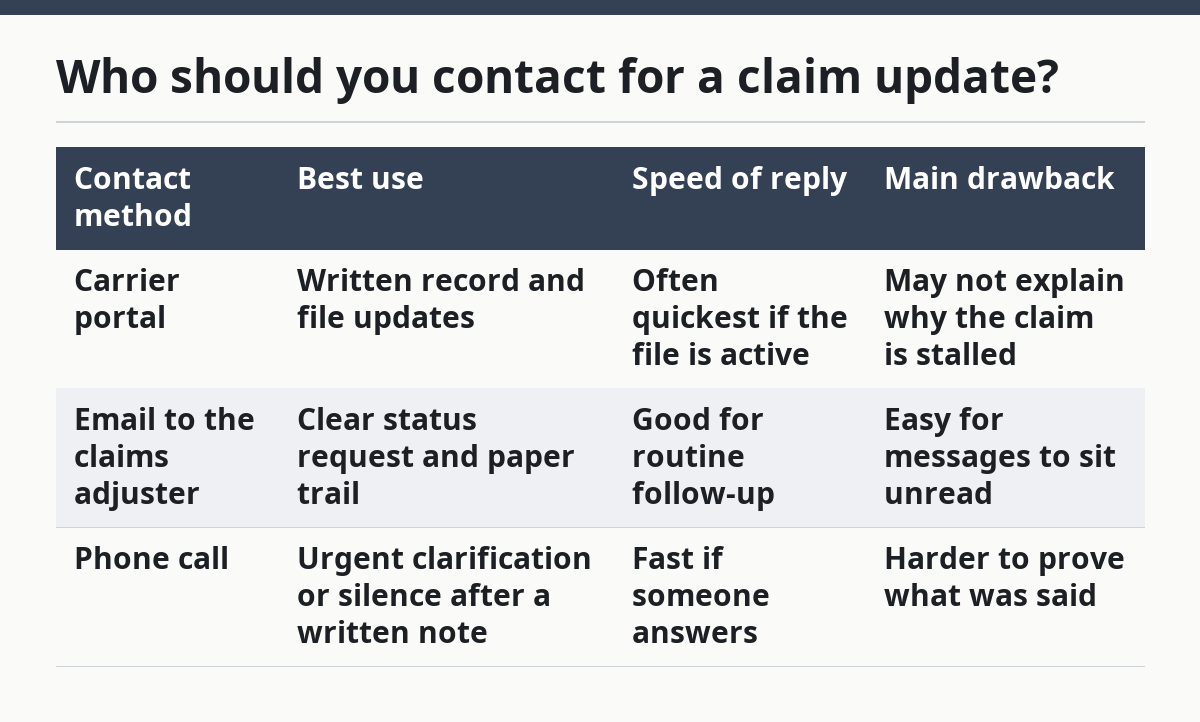
The adjuster is the person to ask when you want to know what changed in the file. The portal is the place to check when you want a timestamp or a document upload. A phone call makes sense if the reply has been delayed for several business days or if the note in the portal is too brief to explain what is pending.
If you do not know the adjuster’s name, ask the insurer’s claims line for the assigned contact on your claim number. Keep the request short. A 30-second call that gets you the right name is better than a 10-minute call that turns into a general complaint.
What does a status update usually include?
A status update usually includes where the claim sits, whether anything is pending, and what the next review will be. On a freelance claim, that may also include whether the insurer is reviewing the reserve, waiting for documents, or checking a coverage issue. You are not asking for the full file; you are asking for the current point in the process.
A useful update often answers some version of these questions:
- Has the claim moved since the last note?
- Is anything still needed from the freelancer, the client, or a third party?
- Has the reserve changed or is it still under review?
- When is the next action expected?
- Is there anything blocking closure or payment?
The phrase “reserve review” matters because it can explain why a file looks active but still has no final answer. You do not need to request a reserve update here; you only need to know whether that review is affecting the timeline. If the adjuster says the reserve is under review, the next thing to ask is what that means for the next step.
A good update also tells you what not to expect. For example, the adjuster may say the claim is waiting on a document, or that no new action can happen until another party replies. That is still useful. It tells you whether to wait, resend a file, or ask again after a set period such as 5 business days.
How often should you follow up?
You should follow up after a reasonable gap, not every day. A daily ping can make the file harder to manage, while a long silence can let a simple issue sit for weeks. If you already sent one written request, give the insurer time to answer, then follow up once if the file still has no clear next step.
A practical rhythm is:
- one written request,
- one reminder if the reply is incomplete,
- one phone call if the written channel goes quiet.
That keeps the pressure light but real. If the insurer gives you a date for the next step, wait for that date before following up unless the deadline passes.
The cost of over-following up is simple: your message can get ignored because it looks like noise. The cost of under-following up is slower movement on a file that may only need one prompt. The middle path works best. Ask, wait, check the portal, then ask again with the claim number and the last date you heard from the adjuster.
One useful rule is to match the follow-up to the promise made. If the adjuster said “I’ll check and get back to you,” give that person a fair window. If the file has no promised date and no reply in the portal, a fresh request is justified.
What mistakes slow the update down?
The biggest mistakes are sending a vague message, forgetting the claim number, and asking for the same thing in three different places at once. Those habits can cost time because the insurer has to sort out which note matters and what you actually want. A status request should point to one file and one question.
Common mistakes and what they cost:
- No claim number: the adjuster may need extra time to find the file.
- Too much background: the real question gets buried.
- Multiple contacts at once: the reply can split across email, portal, and phone.
- Asking for everything: the insurer may answer nothing useful.
- No record kept: you lose track of who said what and when.
The fix is simple. Use one channel first, keep the message short, and ask for the current status, pending items, and next step. If the insurer needs more information, it will ask. If the file is still in claim notes review or reserve review, a clean follow-up keeps the conversation focused on progress rather than frustration.
A status update request is not the place to argue coverage or to reopen the loss details. That kind of message often leads to a slower reply. Stay with the claim number, the date of the last contact, and the specific update you need.
When is a status update request the wrong move?
A status update request is the wrong move when you have not yet given the insurer the information it asked for or when the file is waiting on you. If the claim notes already show a missing document, sending another “any update?” message will not help much. The better step is to send the missing item first, then ask for a fresh status 1 to 2 days later.
It is also the wrong move if you are trying to use the request to argue the whole claim. A status update is for progress, not for a full dispute. If the issue is actually about coverage terms, payment amount, or a formal claim decision, that needs a different conversation than a simple check-in.
There is one honest trade-off here: a short status request is useful, but it can feel too plain when the file has been quiet for a long time. That is still the right tool for the job. A calm, specific note tends to get better results than a long complaint, especially when the insurer already knows the claim number and the last action taken.
For a broader look at how these conversations fit together, the hub on freelance claim communication is the next place to read. This page is just for getting the status update itself.
FAQ
How often should I ask for a status update?
Ask only when you have something new to check, such as a missed date, a pending item, or a quiet file. If the adjuster gave you a timeframe, wait for that window to pass before following up. A request every few business days is usually more reasonable than daily messages.
What information should I include in a status request?
Include the claim number, the adjuster’s name if you have it, the date of your last contact, and the exact question you want answered. If possible, mention the carrier portal or the last document you sent. That gives the insurer enough context to answer quickly.
Who should I contact for a claim update?
Contact the claims adjuster first, because that person usually has the latest claim notes and next step. If you do not get a reply, use the carrier portal or the insurer’s claims line with the same claim number. Keep the request consistent across channels so the file stays easy to track.
Drafted with AI; not yet reviewed by a person.
