
Last updated: November 24, 2026
Freelance insurance add-ons and endorsements change what a base policy covers, who it protects, and when it pays. They matter when a client contract asks for extra protection, when your work touches data or deadlines, or when your main policy leaves a gap you can name in plain English.
Key takeaways
- Endorsements are changes to a policy; add-ons is the everyday word many people use for them.
- A freelancer usually sees them on general liability, professional liability, cyber, commercial property, or auto coverage.
- The point is not to stack every option. The point is to close the exact gap in the work you do.
- A contract can demand wording such as “additional insured,” “waiver of subrogation,” or “primary and noncontributory.”
- The wrong add-on can cost money and still leave the real risk open.
- This is information, not financial advice; a qualified adviser should review your own situation, policy form, and contract terms.
What are add-ons and endorsements?
Add-ons and endorsements are policy changes that expand, narrow, or reshape your insurance coverage. An endorsement is the legal term most insurers use; a rider is a close cousin in some lines, and many freelancers use “add-on” as the plain-language version. The change might be a small schedule update, a new named person, or a clause that rewrites part of the policy.
A freelancer’s base policy is often not the full story. A general liability policy may handle bodily injury or property damage, but not professional mistakes; a professional liability policy may handle advice errors, but not a client’s slip-and-fall in your office. That is why endorsements exist: they fill a gap, but only the gap they are written to fill.
The detail that trips people up is that two endorsements can sound similar and do different jobs. “Additional insured” extends certain liability protection to another party, often a client or landlord, while “waiver of subrogation” limits the insurer’s right to seek money back from another party after a claim. A certificate of insurance is only proof that a policy exists; it is not the same thing as the endorsement itself.
One useful reference point is the Small Business Administration’s insurance guidance on business coverage, and the National Association of Insurance Commissioners’ consumer education materials. A freelancer reading those pages is usually trying to answer the same question: “What part of my work is actually covered?”
Which endorsements do freelancers see most often?
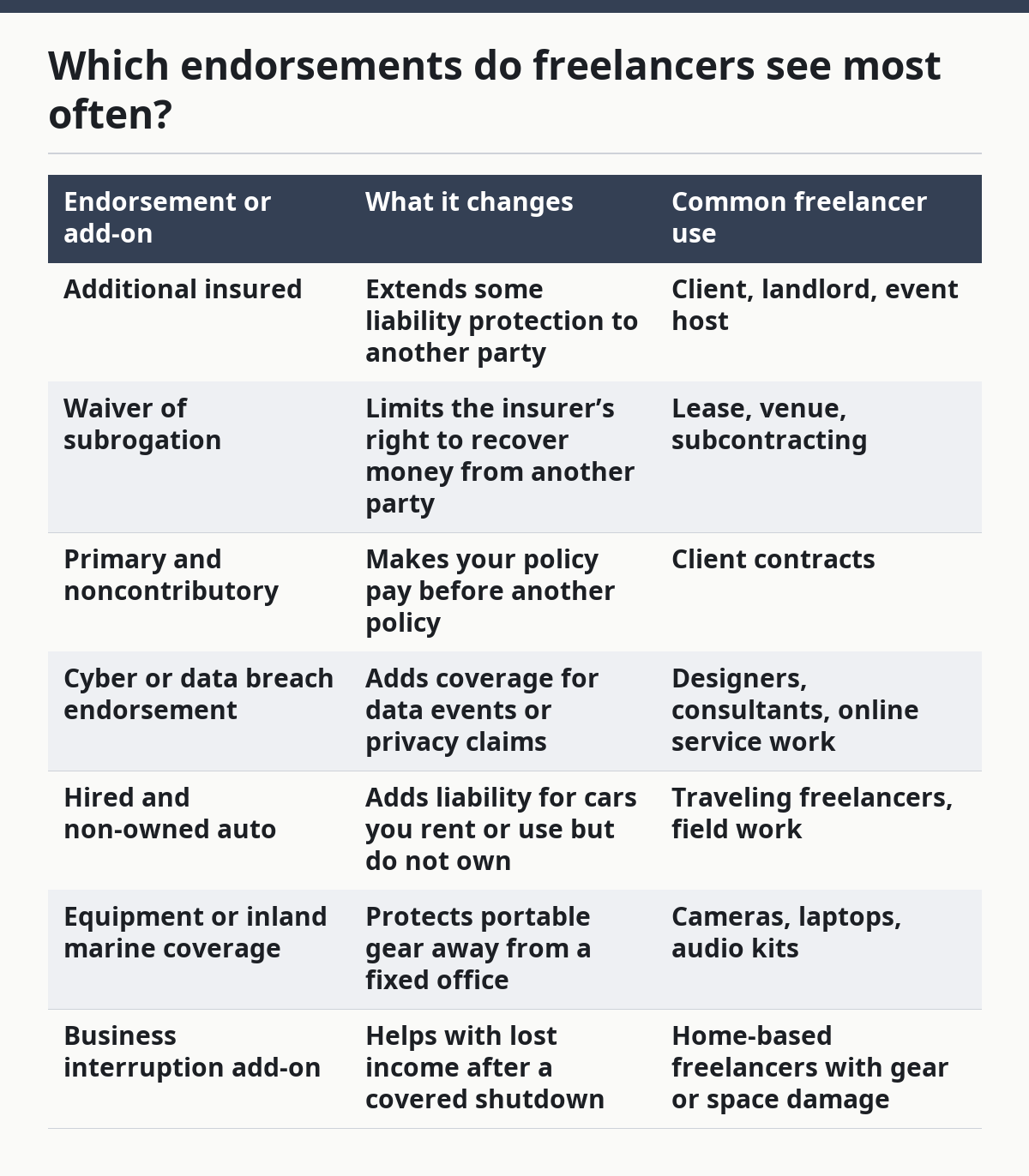
Freelancers most often run into a short list of endorsements tied to client contracts, rented space, and digital work. The common names change by insurer, but the functions repeat. A contract that asks for “additional insured status” or “primary and noncontributory” is usually trying to move risk away from the client and onto your policy.
| Endorsement or add-on | What it changes | Common freelancer use |
|---|---|---|
| Additional insured | Extends some liability protection to another party | Client, landlord, event host |
| Waiver of subrogation | Limits the insurer’s right to recover money from another party | Lease, venue, subcontracting |
| Primary and noncontributory | Makes your policy pay before another policy | Client contracts |
| Cyber or data breach endorsement | Adds coverage for data events or privacy claims | Designers, consultants, online service work |
| Hired and non-owned auto | Adds liability for cars you rent or use but do not own | Traveling freelancers, field work |
| Equipment or inland marine coverage | Protects portable gear away from a fixed office | Cameras, laptops, audio kits |
| Business interruption add-on | Helps with lost income after a covered shutdown | Home-based freelancers with gear or space damage |
The names matter because the same word can hide a different result. “Additional insured” does not mean the client gets full protection for every mistake you make, and “cyber” does not mean all online problems are covered. Many policies also exclude intentional acts, contract disputes, and known issues that predate the endorsement.
A good freelancer reads the contract first, then the policy language, then the endorsement form. That order matters because the contract may ask for something the policy cannot give, or only give at a higher cost and with narrow terms. If the contract says the client needs to be named on a specific form, the exact wording can matter more than the broad category.
How do you add the right endorsement?
You add the right endorsement by matching the contract, the work, and the policy form line by line. The goal is to avoid both underinsuring and buying a clause that does not solve the real exposure. That process is usually slower than clicking one box, because the detail sits in the wording.

- Collect the contract, certificate request, and policy declarations page. Put the contract, any insurance requirements, and the declarations page side by side before you request a change. Verify the named parties, required coverages, and any deadline such as 5 business days or 30 days before work starts. A problem shows up when the contract asks for wording your policy never mentions.
- List the exact risk you need to change. Write one sentence for the exposure, such as “client wants additional insured status” or “I carry a laptop to shoots.” Verify that the need is tied to liability, property, income loss, or data. A problem shows up when the request is vague, because vague requests often lead to the wrong endorsement.
- Match the endorsement to the line of insurance. Use the liability line for liability changes, property coverage for gear, and cyber coverage for data events. Verify the line by reading the policy heading and the form number, not just the salesperson’s label. A problem shows up when the fix is placed on the wrong policy and never reaches the loss.
- Check the exclusions and sublimits. Look for words like “professional services,” “electronic data,” “scheduled property,” or “hired auto” and note any cap written into the form. Verify whether the endorsement has its own limit or only borrows the base limit. A problem shows up when the endorsement exists but the limit is too small for the contract or the gear.
- Confirm who is named and how. If a client needs to be an additional insured, check whether the form names the party directly or only through a blanket clause. Verify spelling, legal entity name, and whether the endorsement applies to current and future contracts. A problem shows up when the certificate looks fine but the endorsement names the wrong company.
- Check when the change takes effect. Ask for the effective date in writing and compare it to the date you start work or enter the venue. Verify that retroactive dates, if any, are not leaving early work outside the policy period. A problem shows up when coverage starts after the work or event already began.
- Compare the endorsement wording with the contract wording. Read the phrases “primary and noncontributory,” “waiver of subrogation,” and “additional insured” exactly as written in both places. Verify that the policy form actually supports the contract duty. A problem shows up when the contract demands a broader duty than the form grants.
- Save the final form and keep the certificate with it. Keep the endorsement pages together with the declarations page and certificate in one file. Verify that the form number and policy number match the active policy term. A problem shows up when you can prove you had a certificate but cannot prove the clause itself.
A freelancer does not need a 30-page insurance file to do this well. Three documents usually do the heavy lifting: the contract, the declarations page, and the endorsement form. The mistake is not missing every detail; it is missing the one detail that the client, landlord, or platform later uses to deny the claim.
Which add-ons does a freelancer actually need?
The add-ons that matter most are the ones tied to your work method, not to a generic checklist. A writer, graphic designer, consultant, photographer, bookkeeper, and app developer can all need different clauses. The right choice depends on whether your main risk is advice, data, gear, face-to-face work, or rented space.
A professional liability endorsement matters when your work can cause a financial loss without any physical damage. A cyber add-on matters when you hold customer data, client files, or login access, even if your office is just a laptop and a phone. A hired and non-owned auto endorsement matters if you drive, rent, or occasionally use a car for work tasks.
Equipment coverage is where many freelancers underread the details. A laptop, camera, microphone kit, tablet, and hard drives may need to be scheduled or covered under inland marine, which is a business term for movable property that travels. If the policy treats gear as ordinary personal property, a loss outside the home office may not land the way the owner expects.
There is also a trade-off that generic articles often skip: some add-ons make the certificate look better while barely changing the real risk. If a contract wants a client named as an additional insured, but your work risk is actually data leakage, the endorsement may satisfy a form requirement and still leave the core exposure open. That is why the right question is not “What add-on sounds strongest?” It is “What event would force the claim?”
What do contracts usually ask for?
Contracts usually ask for a specific clause, a specific proof document, or both. The language is often short and can be easy to skim past. In freelance work, the frequent requests are additional insured status, waiver of subrogation, primary and noncontributory wording, and a certificate sent before work begins.
A client often wants additional insured status when the client wants its own liability exposure reduced. That does not mean the client is covered for every mistake; it means the policy extends some protection linked to your work. A landlord may ask for a waiver of subrogation so the insurer does not later seek reimbursement from the landlord after a covered loss.
Primary and noncontributory wording is another phrase that sounds technical because it is. “Primary” means your policy pays first; “noncontributory” means another policy does not have to share the loss first. That clause often appears in venue rentals, subcontractor agreements, and larger client contracts that were copied from a corporate template.
The problem is that a certificate of insurance can list a promise the policy does not fully support. A certificate is a snapshot, not the insurance contract itself. If the underlying form does not match the wording, the certificate may create false comfort and a later dispute over 1 line of text.
When should you stop and get qualified help?
You should stop and get qualified help when the contract, the policy form, or the claim exposure is more specific than a standard add-on can handle. This is where a broker, insurer representative, or other qualified adviser can help you read the wording against your own facts. Rates, limits, and policy rules also differ by country and change often, so no general page can replace a review of your own documents.
The contract uses custom wording: If the client demands language that is not a standard endorsement title, the policy may not match it — get the exact clause reviewed before you sign. A mismatch can leave you exposed even if the certificate is issued.
The work crosses into several coverage lines: If one project touches liability, cyber, auto, and equipment, the endorsement set can conflict — get help so one clause does not cancel another. A problem here can be an endorsement that helps in one loss and harms coverage in another.
The policy has a sublimit you cannot ignore: If the add-on carries its own smaller cap, the loss may run out quickly — review the limit before the project starts. A low sublimit can make the coverage appear broader than it really is.
The client wants to be named on every project automatically: If the request extends across future jobs, the blanket language may not fit the contract — get the exact naming rule checked. A broad promise can be rejected later if the policy only supports one project at a time.
You already had a claim, incident, or known loss: If the issue happened before the endorsement date, the endorsement may not fix it — pause and check the effective date and reporting rules. Old facts often control new coverage.
The policy language is unclear on exclusions: If the form uses terms like “professional services,” “media liability,” or “data breach” without a plain definition, stop and read the exclusions carefully. Ambiguous wording is where denials often start.
This is also the point where DIY ends if the money at stake would hurt your business for months. A freelancer who can replace a $20 cable may not need the same process as one whose work depends on a $4,000 camera kit or a client contract with a long liability clause. The right test is not confidence; it is whether a bad reading would create a loss you cannot absorb.
What mistakes do freelancers make with endorsements?
Freelancers usually make the same 5 mistakes, and each one creates a different kind of hole. The most common error is treating the certificate as the coverage itself. A certificate is evidence, not the policy language, and a claim is paid from the policy and its endorsements, not from the certificate header.
The second mistake is buying one endorsement because it sounds official. “Additional insured” does not solve a data breach, and “cyber” does not solve a contract that demands waiver of subrogation. The correct alternative is to identify the trigger event first and then match the clause to the trigger.
The third mistake is ignoring effective dates and renewal dates. A policy that renews on a 12-month cycle can still leave a gap if the endorsement was added after the contract started. The correct alternative is to verify the date on the endorsement page, not just the month on the invoice or certificate.
The fourth mistake is forgetting that some endorsements add conditions. A hired auto endorsement may still rely on the policy’s definition of business use, and equipment coverage may still depend on where the item was stored or how it was scheduled. The consequence is a claim that looks covered from the outside but falls apart at the form level.
The fifth mistake is leaving the client contract unread after the insurance quote arrives. That reverses the order of the work. The contract sets the target, and the policy should be measured against that target, not the other way around.
What changes when you work across borders or online?
Cross-border and online work often needs more attention to where the risk occurs. A freelancer serving clients in more than one country can face different wording, different compulsory rules, and different contract norms. A policy sold in one country may not respond the same way if the loss, client, or lawsuit sits somewhere else.
Digital work also changes which endorsement matters most. A designer storing 3 years of client files, a consultant handling payroll data, and a developer with admin access to a platform do not face the same exposure as a photographer carrying gear to one studio. Cyber coverage, privacy wording, and data-breach response services become more relevant when the main asset is information rather than equipment.
A remote freelancer should also watch the definition of “business property” and “off-premises.” Some property clauses cover only a home office, while others follow the gear outside the house. A laptop used at home, a café, and a client site may need different wording depending on the policy form and the loss type.
The same is true for rented studios, co-working space, and temporary event sites. A venue may require additional insured status and a waiver of subrogation on a 1-page rental form, while your insurer only issues one of those two changes on the line you carry. That is not a reason to guess. It is a reason to compare the contract to the policy, line by line, before you accept the booking.
How do you check if the add-on worked?
You check whether the add-on worked by reading the endorsement itself, not only the sales summary. The form should show the policy number, effective date, named insured, and the exact wording added or changed. If those items are missing, the endorsement may not match the active policy you think you hold.
A clean result has 3 parts. First, the contract request and the endorsement wording line up. Second, the declaration page shows the correct policy period. Third, the certificate, if one is used, matches the policy and does not promise more than the endorsement allows.
A bad result is easy to spot once you know what to look for. The endorsement name may sound right, but the named party is wrong, the date is off, or the policy line is not the one that covers the loss. A second problem is when the endorsement adds a form of protection but the limit is too low for the contract, the venue, or the equipment value.
A good practice is to keep a simple 3-document file for each project: contract, declarations page, endorsement. That habit is boring, but it is cheaper than reconstructing coverage after a loss. The file does not need to be long; it needs to be complete.
FAQ
What is the difference between an endorsement and a certificate of insurance?
An endorsement changes the policy, while a certificate of insurance only shows that a policy exists and lists some facts about it. The endorsement controls the claim; the certificate does not. If a client asks for both, the endorsement is the part that actually changes the coverage terms.
Does every freelancer need additional insured status?
No, because additional insured status is tied to the contract and the exposure, not to the word “freelancer.” A solo bookkeeper, a photographer, and a consultant can face different requests from clients, landlords, and venues. If no contract asks for it, the need may not exist.
Is cyber coverage the same as professional liability?
No, they protect different problems even though both can matter to freelancers. Professional liability usually addresses alleged mistakes in the service or advice itself, while cyber coverage is aimed at data, privacy, and certain technology-related events. A freelancer who handles client data may need to look at both lines separately.
Can one add-on fix every contract request?
No, because contract language and insurance forms do not always line up. A waiver of subrogation request, an additional insured request, and a primary and noncontributory clause are not the same thing. If the contract uses more than one phrase, each one needs to be checked on its own.
What should a freelancer read first: the quote, the policy, or the contract?
The contract should come first, because it sets the insurance demand. The policy and its endorsements come second, because they show what the insurer is actually willing to cover. The quote is useful, but it is not the final word if the policy form says something narrower.
Drafted with AI; not yet reviewed by a person.
