

Last updated: November 23, 2026
Quick Answer: In about 30 minutes, review 4 documents — the declarations page, policy form, endorsements, and exclusions — before accepting a freelance insurance renewal offer for coverage changes and exclusions. A freelance insurance renewal offer is worth keeping only if the declarations page, endorsements, exclusions, and limits still match the work being covered. This guide is for a freelancer who already has a renewal notice in hand and wants to spot coverage reductions, new exclusions, or wording changes before the term starts. This is information, not financial advice; a qualified adviser should review your own situation if the policy terms are unclear or your risks have changed.
Key takeaways
- Read the renewal as a contract change, not as a price update.
- Check the declarations page first, then the endorsements, then the exclusions.
- A small wording change can narrow a claim even when the premium stays the same.
- If the carrier changed a material term, assume the scope may have changed too.
- Stop and get qualified help when the renewal is unclear, incomplete, or does not match the work you do now.
Who is this for?
This is for a freelancer who can compare two insurance documents side by side and wants a practical way to review a renewal offer in about 30 minutes. It assumes you have the renewal notice, the declarations page, the policy form, and any endorsement pages from the current term. It also assumes you know the basic business you insure, such as design, writing, consulting, coding, or media work.
It is not for someone who has just changed the business itself, moved into a new field, added staff, or started taking on work with a different risk profile. Those changes can alter the meaning of a renewal, because the carrier may keep the same policy title while changing the covered activity. It is also not for someone trying to decide whether a new policy type is needed; that is a different question from reviewing a renewal offer.
The main job here is to spot three things in the 1 or 2 pages that matter most: coverage reductions, new exclusions, and endorsement wording that trims the promise the carrier made before. A renewal is not automatically the same policy for another term. The paper can look familiar and still cover less.
What should I check first?
So start with the declarations page, because it shows the named insured, policy period, limits, deductible, and form numbers in one place. If the declarations page is wrong, the rest of the review can be misleading. The policy period should match the dates you expect, and the named insured should match the business name used on contracts and invoices.
Then compare the form numbers and endorsement list line by line. The form number tells you which policy wording applies, and the endorsements show what was added, removed, or replaced. If a form number changed but the carrier did not flag it, that is a warning sign. A different form can change the meaning of a claim trigger, an exclusion, or a defense duty.
The most useful check is simple: compare the current renewal package against the prior term using the same 4 items every time — declarations page, policy form, endorsements, and exclusions. If one of those is missing, ask for the complete set before you keep reading. A partial package can hide a coverage reduction. For a broader overview of policy structure, see the freelance business insurance basics guide.
How do I review the renewal step by step?
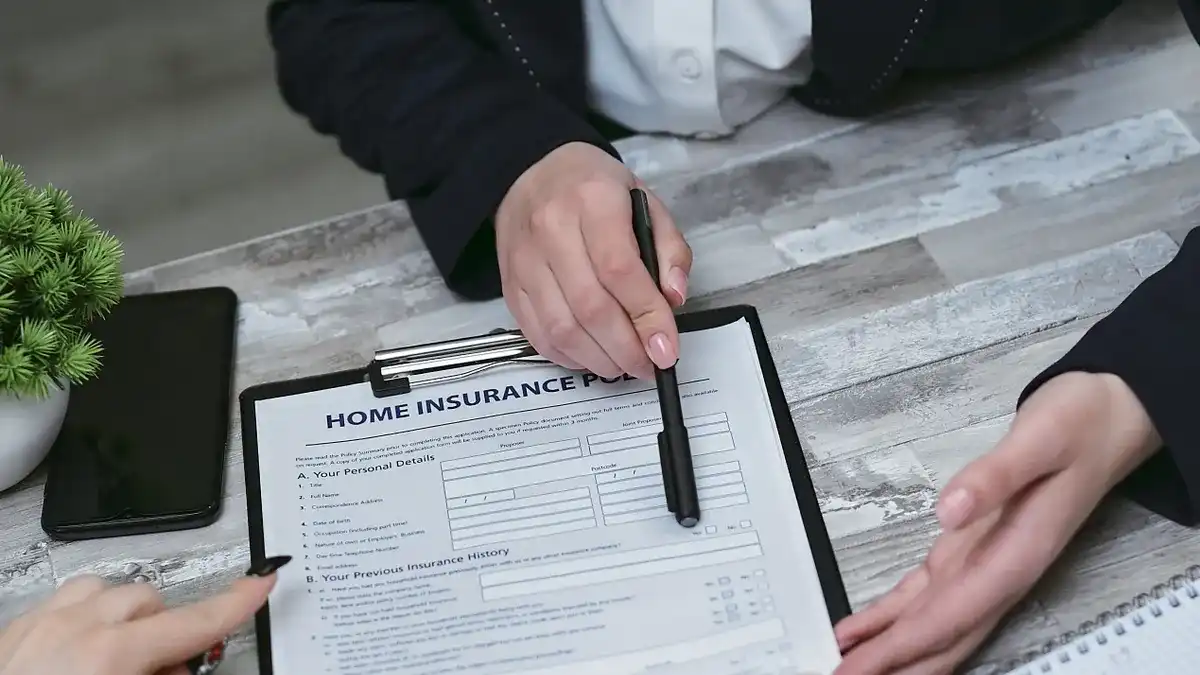
Because the renewal is a document review, not a quick skim, read each page in order, and mark anything that changes the scope of coverage, not just the cost.
- Match the policy period to your work calendar. Verify the effective date and expiration date on the declarations page, and check that the renewal starts the day after the current term ends. If there is any gap, overlap, or odd midterm date, the problem is administrative at best and a break in coverage at worst.
- Check the named insured and business description. Verify that the legal name, trading name, and described occupation are the same as last term, or changed exactly as your business changed. If the wording no longer fits the work you do, the carrier may argue the claim falls outside the policy.
- Compare limits and deductibles line by line. Verify each limit on the declarations page, including any sublimit, and check whether the deductible changed even if the premium did not. If a limit dropped or a deductible rose, that is a coverage change, not just a billing change.
- Read every endorsement title and form number. Verify whether the renewal adds, removes, or replaces any endorsement, and look for words like “amended,” “revised,” “excluded,” or “subject to.” If the renewal list includes a new endorsement you do not recognize, treat it as material until you read it or a qualified adviser confirms the effect, because endorsements can amend policy terms. See the NAIC consumer guidance on buying and understanding insurance policies and this IRMI overview of endorsements for background.
- Scan the exclusions for new categories. Verify whether any exclusion names a service, platform, project type, jurisdiction, or technology that was not excluded before. If the exclusion now matches part of your work, the policy may still be active but no longer useful for that part of the business.
- Check for reduced defense or claims wording. Verify whether the carrier changed the duty to defend, reporting window, consent to settle language, or related claims wording. If the wording is narrower, you may lose protection even though the policy title stays the same.
- Compare the renewal notice against the policy pages. Verify that any summary on the renewal notice matches the actual policy form. If the notice says coverage is unchanged but the endorsements say otherwise, the policy pages control, and if the notice and policy pages conflict, a qualified adviser or the carrier should review the discrepancy. See the NAIC consumer resources for general policy-review guidance.
- Mark anything described as a material change. Verify whether the carrier called out a material term, because that is often where the real shift lives. If the term affects when a claim is covered, what is excluded, or how defense works, it deserves a second read.
A good review ends with a short list: what stayed the same, what changed, and what is unclear. If you cannot say those three things in plain language after 20 to 30 minutes, the renewal needs more attention before it is accepted.
Which changes matter most?
The changes that matter most are the ones that narrow the claim, not the ones that change the label. A policy can keep the same title and still protect less if the carrier trims the insuring agreement, adds an exclusion, or rewrites an endorsement. The key is to compare the promise, not just the premium. For more on that distinction, see the professional liability insurance page.
| Change in the renewal | What it may mean | Who should slow down | What to skip |
|---|---|---|---|
| New exclusion for a service you now offer | That service may be outside cover even if the policy is active | Freelancers who added a new service line | Any assumption that the old wording still applies |
| New endorsement that replaces a form | The old protection may have been narrowed or reshaped | Anyone whose work depends on defense or claim wording | Skimming only the declarations page |
| Lower limit or new sublimit | Less money may be available for one claim type | Anyone with higher-value contracts | Assuming the premium stayed the same means coverage stayed the same |
| Higher deductible | More cost before coverage responds | Small businesses with thin cash flow | Treating the renewal as unchanged because the policy number stayed the same |
| Changed claims wording | A claim may need faster notice or stricter conditions | Freelancers with long project cycles | Ignoring the policy form because the renewal notice looks clean |
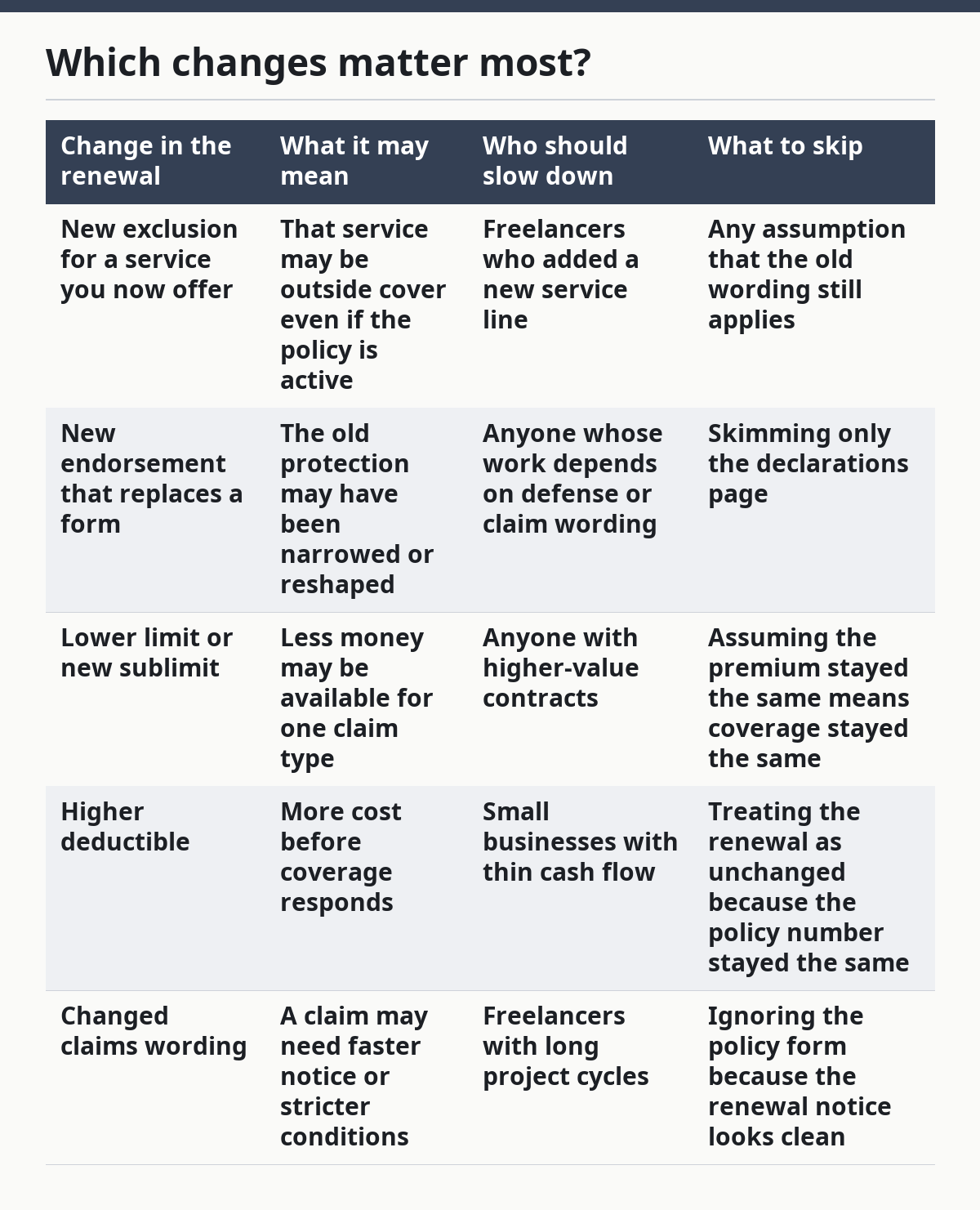
A good rule is this: if the change affects who is covered, what is covered, when the claim is covered, or how defense works, it is material. If it only changes formatting, label order, or billing text, it is usually not the issue. The hard part is that carriers often bury the real change in a short endorsement title rather than in the renewal notice.
What exclusions should I look for at renewal?
Look for any exclusion that names a service, a client type, a platform, a profession, or a risk that fits your actual work. An exclusion is the part of the policy that takes something out of coverage, even if the rest of the policy still applies. If the exclusion is new, broader, or rewritten in a way that reaches more of your work, that deserves immediate attention.
The most common mistake is reading only the word “exclusion” and not the scope around it. One sentence can look harmless until it names “arising out of,” “related to,” or “in connection with,” which can pull in more claims than the headline suggests. The real question is not whether the exclusion exists, but what it now reaches. For a basic explanation of policy wording, see the claims-made policy guide.
Watch for exclusions that are added through endorsements, because they may not be in the base policy form at all. That matters on renewals, since the carrier can keep the main policy familiar while adding a single page that changes the result. If the renewal package has a 1-page endorsement that was not there before, read it twice. A phrase like “arising from” can cast a wider net than a shorter, narrower phrase, and that may change how a claim is analyzed, so a qualified adviser should review the wording if it is unclear.
When should I stop and get help?
You should stop the DIY review and get qualified help when the renewal no longer reads like the old policy with a new date on it. The reason is simple: once the wording shifts on a material term, the real risk is not a missed price change but a missed exclusion, limitation, or defense condition. This is especially true on a money topic where the wrong reading can affect your legal rights and claim outcome.
The declarations page lists a different named insured: That can change who is actually covered — Ask for the policy to be checked before accepting the renewal.
A new exclusion matches the work you do now: That may remove the very claim you expect the policy to handle — Do not assume the old protection still applies.
An endorsement replaces the main policy form: That may rewrite the promise itself — Read the replacement form or get help interpreting it.
The renewal notice and policy pages conflict: The summary may be incomplete or plain wrong — Treat the policy pages as the controlling language, and consult a qualified adviser or the carrier if the mismatch matters.
You cannot tell whether a change is material: That means the renewal is not clear enough for a safe sign-off — Pause and have a qualified adviser review it.
If the renewal is missing the full endorsement list, the policy form number, or the exclusions page, stop there. A 5-minute pause is cheaper than discovering after a claim that a key page was never in the file. See the business owners policy page if you need a broader policy comparison.
What mistakes do people make with renewals?
The biggest mistakes are fast ones. They happen when someone reads the renewal notice, sees the same policy name, and assumes the rest is identical.
One common error is checking only the premium. A lower or higher price does not tell you whether the coverage narrowed, and a flat premium does not prove nothing changed. The better alternative is to compare the declarations page and endorsement list line by line. Premium alone is just one number; the declarations page gives the limits, deductibles, and dates.
Another mistake is ignoring small wording changes in exclusions. A phrase like “arising from” can cast a wider net than a shorter, narrower phrase, and that can change how a claim is treated. The better alternative is to read the full sentence, not just the heading. If a clause looks familiar but the wording changed, slow down and verify the exact effect with a qualified adviser if needed.
A third mistake is skipping the form numbers. If the renewal package shows a new form number, the policy language may have changed even if the title stayed the same. The better alternative is to match each form number against the prior term.
A fourth mistake is treating the renewal notice as the whole policy. The notice is a summary, not the contract itself. The better alternative is to use the notice only as a map and then verify the actual policy pages.
A fifth mistake is assuming an endorsement is minor because it is short. One short endorsement can change a coverage trigger, a defense duty, or an exclusion. The better alternative is to read every endorsement as if it changes the claim outcome, because sometimes it does.
What if the wording is unclear?
If the wording is unclear, do not guess; read the exact phrase against the declarations page and the endorsement list, then flag the point for clarification. Unclear wording usually shows up in three places: a defined term, an exclusion, or an endorsement that replaces earlier language. When the policy uses a term like “related,” “arising out of,” or “professional services,” the meaning can widen or narrow coverage in ways that are not obvious from the headline.
A useful method is to write down 3 things for the unclear clause: the exact sentence, the page it appears on, and the practical effect if the carrier reads it narrowly. If you still cannot tell whether the clause reduces coverage, the document is not clear enough for a confident renewal decision. That is the point to ask for qualified help rather than assume the nicer interpretation will win later.
The same rule applies when the renewal package is incomplete. If you have only the notice and the declarations page, but not the endorsements or full policy form, you do not yet have enough to judge exclusions or material terms. A complete review needs the whole 4-part set, not a partial summary.
How do I know the renewal reduced coverage?
A renewal reduced coverage if the carrier changed the policy so a claim could now fall outside the policy where it would have fit before. The most reliable signs are a new exclusion, a replaced form number, a lower limit, a higher deductible, or a narrower claims condition. If any of those changes affect a service you provide, the scope has likely shifted.
The simplest test is this: ask whether the same claim, based on the same work, would be read differently under the new wording. If the answer is yes, the renewal changed more than the date and premium. If you cannot answer that question from the papers alone, the policy needs closer review before acceptance.
A renewal review is not about finding a perfect policy. It is about spotting the 1 or 2 pages that quietly change the deal. The declarations page tells you the structure, the endorsements tell you what was altered, and the exclusions tell you where the gaps are. When those three line up, the renewal is easier to accept. When they do not, the safest move is usually to slow down and get the wording checked before the new term begins.
Drafted with AI; not yet reviewed by a person.
