

Last updated: November 24, 2026
Quick answer: In this comparison, the choice usually comes down to 2 dates—the work date and the claim date. Pick occurrence coverage if you want protection tied to the work date. Pick claims-made coverage if you can keep the policy active, track the retroactive date, and deal with tail coverage later if you switch carriers. This is the core question in How to Choose Claims-Made vs Occurrence Coverage for Freelance Work, and the right answer depends on when your work happens, when claims might show up, and whether you expect to change insurers. A qualified adviser should review your own situation. For related buying decisions, see freelance professional liability insurance, tail coverage, retroactive date, and prior acts coverage.
Key takeaways
- Occurrence coverage follows the date of the work, so a claim can still fit even after the policy ends if the incident happened during the policy period.
- Claims-made coverage follows the date the claim is first made, which means timing matters as much as the mistake itself.
- The retroactive date is the hidden date that can protect earlier freelance work under a claims-made policy.
- Tail coverage, also called an extended reporting period, matters most when you stop, switch, or pause a claims-made policy.
- For many freelancers, occurrence is simpler; claims-made can work well if the policy stays in force and the retroactive date is protected.
What is the real difference between claims-made and occurrence coverage?
The real difference is the trigger date: claims-made coverage responds when the claim is made, while occurrence coverage responds when the work happened. That one detail changes how long protection lasts, what happens after you cancel, and how risky a carrier switch can be.
With occurrence coverage, the policy year matters because the act or error must happen during that year. If a client complaint arrives years later, the policy can still respond as long as the covered event happened while the policy was active. That makes the timing of the mistake more important than the timing of the claim.
With claims-made coverage, the policy must usually be active when the claim is filed, and the work must fall on or after the retroactive date. That means a 2023 project might be covered under a 2026 claim only if the policy was already in force with the right retroactive date and stayed continuous. For freelancers who may pause work, move carriers, or let coverage lapse, that difference is not minor.
Authoritative starting points on claims-made language and policy trigger mechanics include the National Association of Insurance Commissioners and the Insurance Information Institute. The terms are standard insurance terms, but the exact wording still depends on the policy form.
Why does the trigger date matter so much for freelance work?
The trigger date matters because freelance errors often surface after the project ends. A logo revision, website copy change, consulting note, or missed instruction can cause a complaint months later, not the same day the file is delivered.
That delay is why occurrence coverage is easier to think through. If the work date is inside the policy period, the claim can still fit later. There is less risk that a later policy switch or a 6-month gap will break the link between the work and the protection.
Claims-made coverage is more sensitive to timing. If a claim shows up after a lapse, the policy may not respond unless tail coverage or another qualifying arrangement is in place. That is why claims-made can be efficient for freelancers who expect to keep coverage steady, but awkward for anyone who changes carriers often or stops work for a while.
The retroactive date is the second timer inside claims-made coverage. It sets the earliest work date the policy will consider. If the retroactive date is too late, older projects may fall outside the policy even when the policy is active today.
Occurrence coverage: who should actually use it?
Occurrence coverage wins for freelancers who want simpler long-term protection and less dependence on future policy timing. It is the cleaner fit when the main worry is, “What if a client complaint comes after this policy is gone?”
That strength matters most for people who may not keep insurance continuously for years. A claim can arise after a project is finished and after the policy term ends, and occurrence coverage is built around the date of the event, not the date of the complaint. For a freelancer with a one-off project, a long client relationship, or an uneven income cycle, that is a practical advantage.
The weakness is price and availability structure, which can vary by market and country. Occurrence coverage can be less common in some professional liability lines, and the policy form may be less flexible than a claims-made policy. The other drawback is that the protection is tied to the exact period of the work, so old work from before the policy started usually is not covered.
Use occurrence if you want the least moving parts and you are mainly worried about past work showing up later. Skip it if you need a policy that can more easily follow a changing business, changing carriers, or a start-and-stop freelance schedule.
Pros of occurrence coverage
- Protection is tied to the work date, not the claim date.
- No tail coverage decision is usually hanging over the end of the policy.
- Easier to understand for a freelancer who wants one basic rule.
Cons of occurrence coverage
- Earlier work before the policy started is usually outside the policy.
- It may be harder to find in some markets than claims-made coverage.
- A later carrier switch matters less, but the policy period itself still has to match the work date.
Claims-made coverage: when does it win?
Claims-made coverage wins for freelancers who can keep a policy continuous and want protection that can follow them from one insurer to another with the right setup. It is especially useful when the retroactive date is clear and the freelancer expects to maintain coverage without gaps.
The main advantage is that claims-made can protect work done before the current policy term, as long as the retroactive date reaches back far enough and the policy stays active. That makes it useful for established freelancers with an ongoing book of work. It also allows a cleaner transition if the new policy honors prior acts coverage from the right date.
The weakness is simple: if the claim is made after the policy ends, the coverage can disappear unless tail coverage is in place. That is the part many generic articles skip. The policy can look fine on paper and still fail the timing test if the freelancer cancels, switches late, or lets the policy lapse.
Claims-made is often a better fit for a freelancer who tracks dates carefully, expects to keep buying professional liability insurance, and knows how the retroactive date works. If you are unsure about those timing rules, consult a licensed insurance professional or broker before you choose. It is a weaker fit for a freelancer who may stop insuring for a year, change carriers without planning, or assume old work stays covered automatically.
Pros of claims-made coverage

- Can reach back to older work through the retroactive date.
- Often easier to structure around an ongoing freelance practice.
- Can work well if the policy stays continuous year after year.
Cons of claims-made coverage
- Coverage can fail if the claim is made after the policy ends.
- Tail coverage may become important when switching or stopping.
- The retroactive date can quietly limit older jobs.
What should you compare side by side before you choose?
The best practical comparison is the policy trigger, the retroactive date, and what happens if you switch carriers after 1 policy term. Those are the pieces that change the result for a freelancer.
| Criteria | Claims-made policy | Occurrence policy | Winner for this condition |
|---|---|---|---|
| What event starts coverage | Claim is first made | Work or incident date | Occurrence, for simpler timing |
| Need to keep policy active | Yes, especially for later claims | Less dependent on future continuity | Occurrence, for stop-and-start work |
| Retroactive date matters | Yes | Usually no | Occurrence, for less date tracking |
| Tail coverage risk | Can matter when the policy ends | Usually not the same issue | Occurrence, for fewer end-of-policy traps |
| Prior acts coverage | Can be built in through the right date | Not usually the key mechanism | Claims-made, if older work needs protection |
| Carrier switch sensitivity | High | Lower | Occurrence, if a switch is likely |
| Ease of understanding | Harder | Easier | Occurrence, for plain-language simplicity |
| Fit for a long-running freelance practice | Often strong if continuous | Also strong, but less date-sensitive | Claims-made, if continuity is reliable |
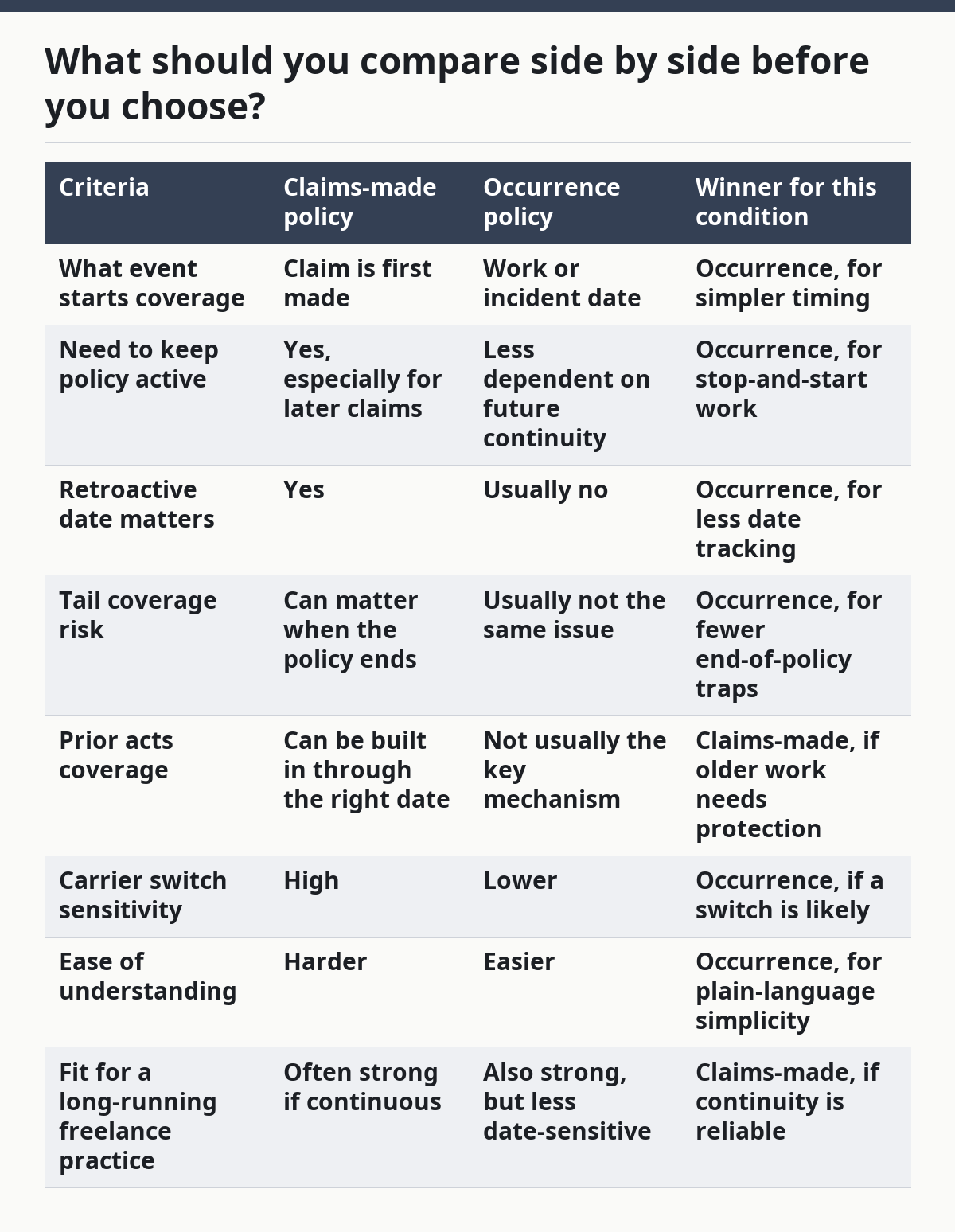
The table leaves out premium, deductible, and limit choices on purpose. Those are separate decisions and can distract from the trigger question. For this page, the buying choice turns on timing, not on the size of the deductible or the dollar limit.
When does tail coverage matter?
Tail coverage matters when a claims-made policy ends but old work can still generate a claim later. It is the bridge that can keep a later claim from falling through the gap after cancellation, nonrenewal, retirement, or a carrier change.
This is the part generic comparison pages often flatten too much. A claims-made policy may cover the work, but if the claim arrives after the policy period ends, that protection may not exist unless an extended reporting period applies. That is why tail coverage is not a side note; it is part of the total cost and timing plan.
Tail coverage usually matters less if the freelancer is staying with the same insurer and keeping the policy uninterrupted. It matters much more if the freelancer is closing the business, taking a long break, or moving to another carrier with no prior acts transfer. The practical question is not “Do I like tail coverage?” The question is whether there is any realistic chance of a claim arriving after the policy ends.
For freelancers who may keep the same coverage for years, claims-made can work well. For freelancers who do not want a second decision at the end of the policy, occurrence is easier.
Which trigger type is better for freelance professional liability?
Occurrence is the better default for freelance professional liability if the goal is simple, durable protection tied to the work date. Claims-made is better only when the freelancer can keep the policy continuous, protect the retroactive date, and manage tail coverage if the policy ends.
That is the clean recommendation. Choose occurrence when you want fewer timing traps and less dependence on future renewals. Choose claims-made when your freelance work is ongoing, your insurer is likely to stay the same, and your older projects need a path to coverage through prior acts.
Neither is right for every case. If the freelancer expects to stop insuring, switch carriers often, or has a pile of older work with unknown dates, claims-made can become the wrong fit fast. If the freelancer is building a long-term practice with continuous coverage and needs prior acts treatment, occurrence may be too blunt a tool.
For a broader policy-selection map, this page fits under the larger guide on freelance policy selection and coverages, which covers the other buying decisions without rehashing the trigger question. See also freelance professional liability insurance and occurrence vs claims-made for the related decision tree.
When should the choice flip?
The recommendation can flip in a few specific situations. A 2-year gap in coverage is one of them, because a claims-made policy can leave old work exposed unless the tail arrangement is handled correctly. A freelancer who is about to retire, pause, or switch carriers also needs to treat claims-made with more caution and should consult a licensed insurance professional before deciding.
Another flip happens when the freelancer already has older work that still matters. If that work falls before the retroactive date on a claims-made policy, the policy may not reach back far enough. In that case, occurrence may be the cleaner fit, because the question becomes the date of the act, not the date the current policy began.
A third flip is when simplicity matters more than flexibility. A solo freelancer juggling invoices, client emails, and project deadlines may not want an extra layer of timing rules. Occurrence trims that risk.
A fourth flip is when the policy market in the freelancer’s country makes one trigger type much more common than the other. Rates, forms, and policy language differ by country and change often, so the local market matters as much as the theory. A qualified adviser should review the exact form before a decision is made. See also freelance insurance cost and professional liability insurance for the pricing side of the decision.
What is the bottom-line recommendation?
Choose occurrence coverage if your priority is straightforward protection tied to the date of the freelance work. Choose claims-made coverage if your priority is broader reach for older work and you can keep the policy active, protect the retroactive date, and plan for tail coverage if you leave the policy. Neither if you are unsure about the policy timing, have a likely coverage gap, or need tailored advice for your own market.
What is the difference between claims-made and occurrence coverage?
Claims-made coverage responds when the claim is made, while occurrence coverage responds when the work or incident happened. That means claims-made depends on the policy being active at the time of the claim, while occurrence depends more on the date of the actual event. The trigger date is the core difference.
When does a claims-made policy need tail coverage?
A claims-made policy needs tail coverage when the policy ends but the freelancer still wants protection for claims that may arrive later. That often comes up after cancellation, nonrenewal, retirement, or a carrier change. The key issue is the claim date, not just the work date.
Which trigger type is better for freelance professional liability?
Occurrence is usually the better default for freelance professional liability because it is easier to understand and less sensitive to future policy lapses. Claims-made can be better for freelancers who need prior acts treatment and can keep coverage continuous. If you are not sure which timing rule fits your practice, consult a licensed insurance professional before you buy.
Drafted with AI; not yet reviewed by a person.
