

Last updated: November 25, 2026
Quick answer: in most cases, you insure freelance work by matching the policy’s named insured to the legal entity that actually does the work—your personal LLC, your sole proprietorship, or, in some cases, both your personal name and a DBA. For context, the IRS explains business structure basics, and the SBA explains sole proprietorships and LLCs in plain language. The topic here is How to Insure Freelance Work Through a Personal LLC or Sole Proprietorship, and the policy then has to describe the freelance business in a way the insurer can recognize, or a claim can get messy.
Key takeaways
- The legal name on the policy matters as much as the coverage type.
- An LLC and a sole proprietorship are not written the same way, even if the work is identical.
- A DBA is a trade name, not a separate legal business.
- The cleanest policy is the one that matches the entity on your tax, banking, and contract records.
- If the name on the invoice, contract, and policy do not line up, claim handling can slow down.
What does “insured through an LLC or sole prop” mean?
It means the policy is written for the business form that earns the freelance income, not just for the person doing the work. A sole proprietorship is usually the simplest setup: the business and the person are the same legal taxpayer in many places, so the policy often names the person and may also list the business name if one exists. A limited liability company, or LLC, is a separate legal entity, so the policy often needs the LLC’s exact legal name. The IRS and SBA both describe that distinction in their business-structure pages.
This matters because insurance papers are not just labels. They tell the insurer who can make a claim, which name should appear on certificates, and which contracts are covered. If your work appears under a trade name, a DBA—“doing business as”—the insurer still needs to know the legal owner behind that name. The SBA’s guidance on business names is a useful starting point.
For a quick reference on sole proprietorships and business structure basics, the IRS and SBA both explain the difference between a person, a trade name, and a business entity. Those pages are useful starting points, but your policy still has to follow the wording on the actual declarations page.
How do I match my policy to my freelance entity?
You match the policy by lining up the legal name, the trade name, and the work description before the policy is issued. Here is the cleanest way to do it.
- List the legal entity name. Write the exact name from your formation papers or tax records, including “LLC” if it appears there. Verify that the spelling matches bank records and contracts. A problem sign is any variation such as missing punctuation, a shortened company name, or an old legal name.
- Identify the insured party. Decide whether the policy should name the person, the LLC, or both where the policy form allows it. Verify that the declarations page uses the same entity that signs client contracts. A problem sign is a policy that names only a personal nickname or only a DBA with no legal owner behind it.
- Record the DBA separately. If you use a DBA, give the insurer the trade name and the legal entity behind it. Verify that the DBA appears as “doing business as” or an equivalent trade-name field when the form has one, not as the only insured name. A problem sign is when the insurer may treat the DBA as if it were a separate business.
- Describe the freelance services precisely. Use the exact service category the insurer asks for, such as design, consulting, writing, or development, rather than a vague label like “creative work.” Verify that the description covers every client-facing service you actually sell. A problem sign is a policy that leaves out one service line you invoice for regularly.
- Check the contract name against the policy name. Compare your proposal, invoice, and policy for the same legal name or trade name pattern. Verify that a client can trace the work from contract to policy without guessing. A problem sign is a contract signed by the LLC while the policy names only the individual.
- Ask for the exact named insured wording. Tell the insurer to use the wording the form requires, including any commas, suffixes, or entity designations. Verify that the final draft repeats that wording on every page that names the insured. A problem sign is an endorsement that changes the wording without explanation.
- Confirm who the policy protects besides the business. Some forms extend to owners, members, or employees only when the wording says so. Verify that you understand whether the LLC member or sole proprietor is covered for business acts, not just the entity itself. A problem sign is assuming personal protection exists because the business is named.
- Keep a copy of the final declarations page. Save the issued version, not just the quote, with the policy number and effective date. Verify that the final copy reflects the same entity name used on the application. A problem sign is a quote that looks right but an issued policy that changed one line.
That process sounds fussy, but it can help prevent one of the most common failures in freelance insurance: the work is insured under the wrong name. If the entity name on the policy and the entity name on the freelance contract do not match, the insurer may still investigate the claim, but the review gets harder. A qualified insurance professional can help confirm the wording before issuance.
How is an LLC different from a sole proprietorship for insurance?
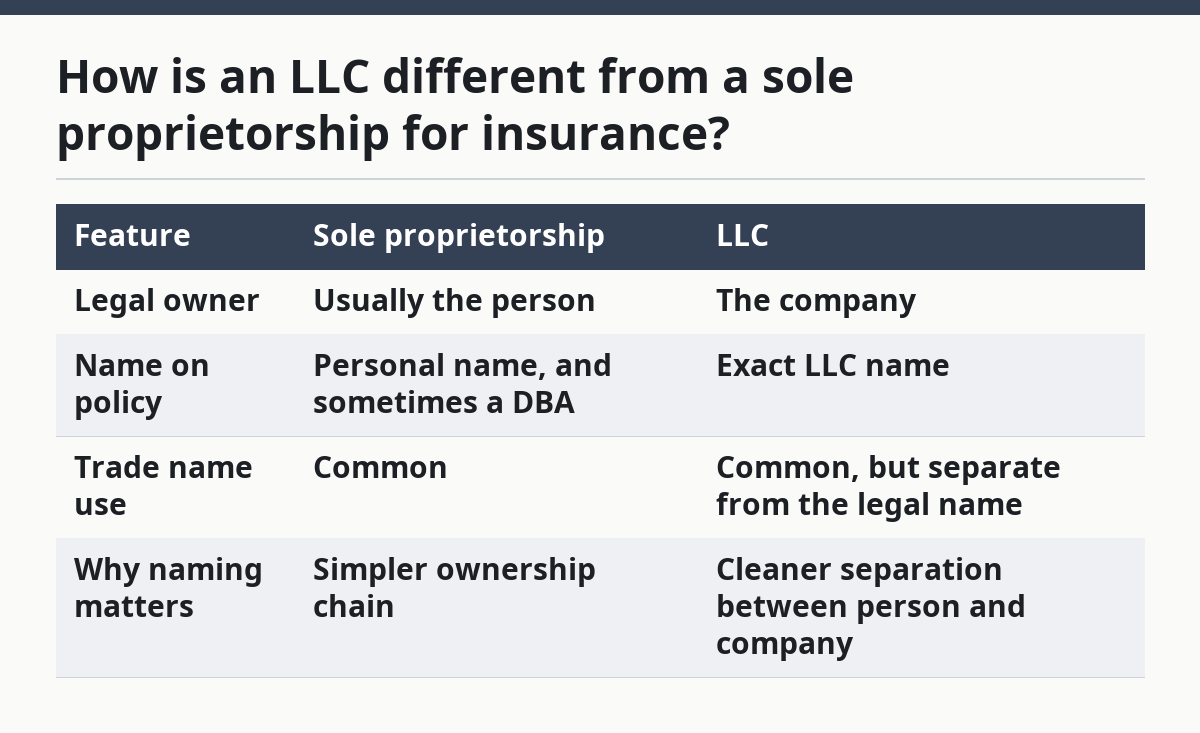
An LLC is different because it is a separate legal entity, while a sole proprietorship usually is not. That difference changes whose name should appear on the policy and how the insurer reads the contract.
With a sole proprietorship, the person and the business are often treated as one legal owner. That means the policy may name the individual, with or without a trade name, and still be written correctly. With an LLC, the insurer usually expects the LLC’s exact legal name, because the company itself is the insured business. The IRS and SBA both describe that ownership difference.
| Feature | Sole proprietorship | LLC |
|---|---|---|
| Legal owner | Usually the person | The company |
| Name on policy | Personal name, and sometimes a DBA | Exact LLC name |
| Trade name use | Common | Common, but separate from the legal name |
| Why naming matters | Simpler ownership chain | Cleaner separation between person and company |
The practical trade-off is simple. A sole proprietorship is easier to explain, but the naming still has to be accurate. An LLC gives a more distinct business identity, but that only helps if the insurance paperwork follows the LLC name exactly. The IRS and SBA both have plain-language pages that explain the entity difference, which is useful when you are checking your documents before you ask for a quote.
What should I check before the policy is issued?
You should check four things before the policy is issued: the legal name, the DBA, the service description, and the policy period. A policy that is right in three of those areas can still cause trouble if the fourth is wrong.

Then look at the declarations page. That is the summary page that usually shows the named insured, policy number, and effective dates. After that, compare the insured name to your formation paperwork or sole proprietor records. Third, make sure the DBA, if you use one, appears as a trade name and not as the only legal owner. Finally, read the service description line by line.
The common mistake is treating a quote as if it were the policy. A quote can be close and still leave out the suffix, the DBA, or the exact business entity. The issued policy is the document that matters, and even a small name mismatch can create a delay if you need to prove the business was the insured party on the date of the work. A qualified adviser can help you check the declarations page before you rely on it.
When should I stop and get qualified help?
You should stop and get qualified help when the entity record and the policy record no longer point to the same business. Here are the situations that change the answer.
Your LLC and your freelance contracts use different legal names: That can make it unclear which business is responsible for the work — ask a qualified adviser or insurance specialist to review the documents before the policy is issued.
Your DBA is the only name you use on invoices: A DBA is a trade name, not a separate legal person — get help making sure the legal owner is listed correctly.
You changed from sole proprietorship to LLC during the policy term: The insured entity may have changed, not just the brand name — do not assume the old policy carries over cleanly.
Your clients require specific insured wording in the contract: Some contracts ask for a precise named insured or additional insured wording — have someone check that the policy form can actually support it.
You are unsure whether the policy is for the person or the business: That is a naming problem, not a guessing problem — review the declarations page with a qualified adviser before a claim ever happens.
For money and legal questions like this, the safe move is not to guess. Insurance language is short, but the consequences of a bad fit can be slow and expensive to unwind.
What mistakes do freelancers make with LLCs, DBAs, and sole props?
Freelancers usually make the same five mistakes, and each one has a clear cost.
- Using a nickname instead of the legal name. The cost is a naming mismatch on the policy, bank file, or contract. The correct alternative is the exact legal name from your records.
- Treating a DBA like a separate business. The cost is confusion over who actually owns the work. The correct alternative is to list the DBA as a trade name tied to the real owner.
- Leaving the LLC suffix off the policy. The cost is a policy that may not match the legal entity. The correct alternative is to use the full registered name, including “LLC” if that is part of the name.
- Assuming sole proprietor coverage works the same as LLC coverage. The cost is wrong expectations about whose name belongs on the paperwork. The correct alternative is to match the policy to the legal form, not the brand.
- Ignoring the service description. The cost is a policy that sounds right but misses one service you actually perform. The correct alternative is to describe the freelance work as specifically as the insurer’s form allows.
These mistakes are easy to make because the names look similar on a screen. When a claim is filed, though, a one-line difference can matter.
When does the standard approach not fit?
The standard approach does not fit when the policy form cannot reflect the way the freelance business actually operates. In those cases, the issue is not the coverage type alone; it is the business structure and the naming chain.
You operate under more than one business name: One policy may need clearer trade-name wording — check whether each name points back to the same legal owner.
You work through both a personal LLC and a separate sole proprietorship: Those are two different legal structures — a single name on the policy may not capture both activity streams.
Your client contract names a different entity than your tax records: That mismatch can create confusion about who the insured party is — align the records before relying on the policy.
Your state or country uses different entity rules: Insurance naming conventions are not universal — local business law can change how the legal owner should appear.
The insurer’s form does not accept your trade name the way you use it: The form may need a different wording structure — ask for the issued wording, not the marketing version.
This is where a generic answer fails. A freelancer with one name, one service, and one bank account has a much simpler path than a freelancer who uses a company name, a DBA, and a separate LLC.
What should a good result look like?
A good result is a policy that names the same legal entity that signs the freelance contract, with any DBA shown as a trade name rather than a separate owner. It also uses the same service description you use in real client work, and the declarations page matches the issued quote without surprise edits.
If the policy is right, you can hand the declarations page to a client, compare it to your invoice, and see the same business identity at a glance. That is the point: a clean paper trail, not a fancy label.
For a broader view of freelance liability coverage choices, the hub page on freelance insurance for solo businesses is the right next stop after this one.
Should my LLC or my personal name be on my freelance policy?
The policy should follow the legal owner of the freelance work, not whichever name is easier to type. If the work is done through an LLC, the LLC’s exact legal name usually belongs on the policy. If the work is a sole proprietorship, the personal name may be the correct insured name, sometimes with a DBA attached.
Is a sole proprietorship different from an LLC for insurance?
Yes. A sole proprietorship and an LLC are usually written differently because the legal owner is different. A sole proprietorship often points back to one person, while an LLC points to the company. That difference changes the named insured field and can change how the policy is read.
Can I insure freelance work under a DBA?
Yes, but a DBA should usually sit on top of the real legal owner, not replace it. The insurer still needs to know who owns the business behind the trade name. A DBA by itself is a brand, not a separate legal entity.
Drafted with AI; not yet reviewed by a person.
