

Last updated: November 25, 2026
Quick answer: a client insurance requirement is a dealbreaker when 1 of 3 things happens — the cost is too high, the coverage terms do not fit, or the proof the client wants makes the job unworkable. In this guide to how to decide whether a client insurance requirement is a dealbreaker, the question is whether the contract still works for your business after the clause is counted. If the premium, endorsement, or coverage limit turns a small project into a bad risk trade, the right move is often to walk away or pause until a qualified adviser helps you review the contract.
Key takeaways
- Judge the requirement against the project value, not in isolation.
- A clause can fail because it is too expensive, impossible to place, or mismatched to the work.
- The main question is not “Can I get insurance?” but “Can I meet this contract without distorting my business?”
- If the clause affects your legal rights, tax position, or liability exposure, get qualified advice for your own situation.
- This is information, not financial advice.
A client insurance requirement shows up in a client contract as a condition you must meet before you start work or before you get paid. It may ask for a certificate of insurance, a named client as additional insured, a minimum coverage limit, or a specific endorsement. If that condition changes the economics or the risk of the job enough, it can be a dealbreaker.
What does the clause actually ask for?
A client insurance requirement is only a dealbreaker after you break it into parts, because the words in the clause matter more than the word “insurance” itself. One clause may ask for a general liability policy with a coverage limit you already have, while another may require an endorsement, a waiver, or proof of workers’ compensation that does not fit your setup. See also the certificate of insurance basics and additional insured endorsement pages.
Read for four items first: the type of policy, the coverage limit, any endorsement, and the proof deadline. A certificate of insurance is just a document that shows coverage exists; it is not the policy itself. An endorsement is a change to the policy, and it can add time, cost, or limits on what the insurer will accept. For a plain-English definition, see the NAIC glossary.
The question is whether the clause matches your actual work. A writing project, for example, should not be judged the same way as on-site installation, because the client’s exposure is different. If the clause treats every freelancer like a construction subcontractor, the problem may be fit, not just price; if that sounds familiar, consult a qualified insurance or legal professional before you sign.
A good reading habit is simple: underline every mandatory word in the client contract, then mark anything that demands a number, a named party, or a special form of proof. If the clause uses vague phrases like “adequate insurance” but gives no coverage limit or policy type, that vagueness itself can be a problem because it leaves the standard open-ended.
How do I judge the cost against the project value?
I judge the cost against the project value by asking whether the insurance burden is small enough that the job still makes sense after the premium and any endorsement cost. The project value matters because a $500 job and a $50,000 job can absorb the same clause very differently. For a general overview of policy terms, see the Insurance Information Institute.
Use a simple comparison table before you decide, and consult a qualified professional if the contract or policy language is unclear:
| Check | Accept more easily when | Treat as a warning when |
|---|---|---|
| Premium | It fits comfortably inside the project value | It eats a large share of the fee |
| Endorsement | Your insurer can add it without delay | The insurer will not add it or adds a major restriction |
| Coverage limit | It matches your current policy or a normal increase | It requires a much higher limit than your work creates |
| Proof deadline | You can provide it before work starts | You need time just to fix the paperwork |
| Contract scope | The clause fits the actual work | The clause imports risk from someone else’s business |
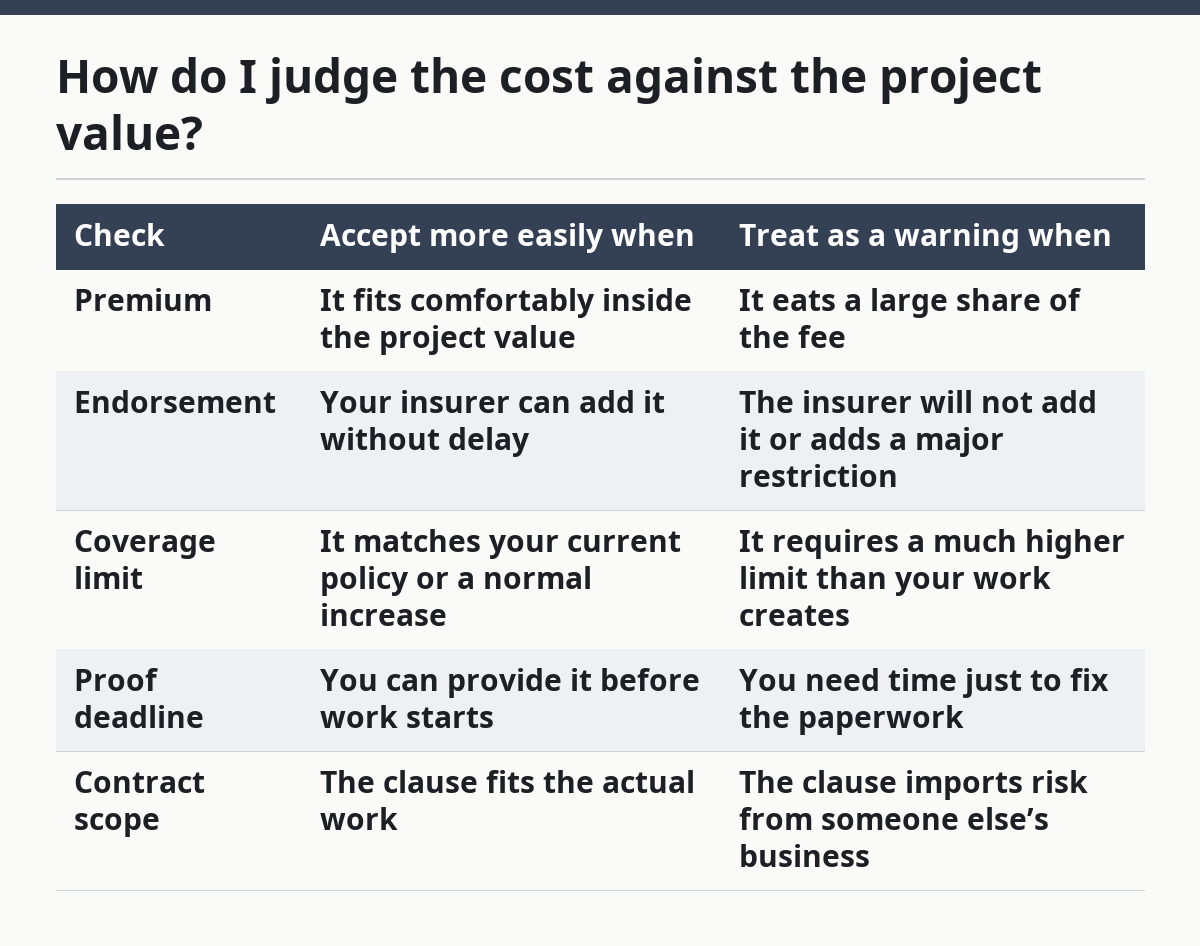
This is where many people miss the real cost. The premium is often not the only expense. A requirement can also force a higher coverage limit, a special endorsement, or a change in how your policy is written. If the clause pushes you into a longer approval process or a policy change for a one-off job, the friction may outweigh the fee.
The cleanest test is this: after every insurance cost is counted, does the project still pay enough for the time, risk, and admin? If the answer is no, the clause is not “just paperwork.” It changes the deal.
Is the coverage even possible?
A client insurance requirement is a dealbreaker if you cannot place the coverage at all, because a promise you cannot perform is not a manageable risk. Some clauses ask for terms your insurer may not offer, or only offer with limits that do not fit your business model.
Coverage feasibility includes more than whether a policy exists. It includes whether your insurer will issue the endorsement, whether the named client can be added, whether the coverage limit is available on your policy, and whether the policy language matches the work. If the client wants a form of proof that your insurer does not issue, the requirement is not just expensive; it is structurally mismatched. For policy wording and endorsements, see IRMI.
This matters most when a client contract shifts risk in a way your business was not built to carry. A small consultant may be able to show general liability coverage, but a clause that requires broad contract liability or very high limits may be out of scale. The issue is not that the clause is automatically bad; it is that the clause may be asking your insurer to cover a risk it did not price for.
A useful question is: can the requirement be satisfied by a standard policy change, or does it require a special arrangement that changes the whole deal? If it is the second one, the requirement may be a signal to stop and reassess.
How do I decide step by step?
You decide by testing the clause against seven checks in order, because one failed check can make the whole requirement a dealbreaker. Start with the contract language and end with the project value, not the other way around.

- Copy the exact clause into a notes file. Keep the full wording, not a summary, and mark every insurance term, amount, and deadline. If you cannot restate the clause in one sentence, the clause is too muddy to judge yet.
- Identify the policy type required. Look for general liability, professional liability, auto, workers’ compensation, or an endorsement request. If the clause names a policy you do not carry, that is the first sign of a mismatch.
- Check the coverage limit named in the contract. Compare the required limit with the limit on your current policy. If the contract asks for a higher limit than your policy provides, verify whether your insurer can raise it without changing the rest of the coverage in a harmful way.
- Look for endorsement language. An endorsement can add the client as additional insured, change notice rules, or alter cancellation terms. If the insurer will not issue the endorsement, or only issues it with limits that weaken your protection, the clause may be unworkable.
- Estimate the full cost to comply. Include premium, endorsement fee if any, and the time cost of issuing a certificate of insurance or revising paperwork. If the total burden comes close to, or overtakes, the project value, the job may not justify the requirement.
- Match the clause to the scope. Ask whether the insurance demand tracks the actual work. If you are providing advice for a 2-week project but the clause reads like a construction subcontract, the scope and risk do not line up.
- Check the timing. See whether the client needs proof before kickoff, before invoice, or before final payment. If the deadline is immediate and your insurer needs time to process the endorsement, the job may stall before it starts.
- Decide whether the business case still works. After the coverage limit, premium, endorsement, and timing are counted, ask whether the contract still fits your risk tolerance. If the answer is no, the requirement is a dealbreaker for this project, even if it looks normal on paper.
The point of the sequence is discipline. A clause that looks manageable at step 1 may fail at step 5. That is the kind of failure that turns a profitable job into an administrative trap.
When should I stop and walk away?
I stop when the clause creates a problem I cannot fix inside the contract or with ordinary insurance paperwork. On a money issue like this, forcing a bad fit can leave you carrying more risk than the fee can justify. If you want a deeper checklist, see the client contract insurance requirement guide.
The insurer will not issue the endorsement: the contract asks for proof you cannot get from your policy — do not sign until a qualified adviser reviews whether any other route exists for your situation.
The required coverage limit is far above your normal work: the client is pushing risk beyond the scale of the project — walk away unless an adviser confirms the exposure is workable.
The premium makes the project value thin or negative: the job no longer pays enough after compliance costs — decline the work or redesign the fee structure before you commit.
The clause changes your legal exposure in a way you do not understand: contract wording can expand what you owe after a claim — pause and get professional help before signing.
The timing makes compliance impossible before the start date: if the proof is due in 48 hours and the insurer needs longer, the project can fail before it begins — ask for a reset or stop.
The insurance demand does not match the work: a low-risk digital job should not carry a clause built for higher-risk site work — that mismatch is a reason to step back.
When one of these shows up, the right response is not to guess. A client contract can move money and liability around in ways that are hard to reverse once signed.
What mistakes cost freelancers the most?
The biggest mistake is treating the requirement as a checkbox instead of a costed risk. That can lead to signing a contract you cannot satisfy, then scrambling for coverage after the deadline. The fix is to price the insurance term as part of the job from the start.
Another common mistake is assuming a certificate of insurance solves everything. A certificate only proves a policy exists on a certain date; it does not repair a bad endorsement, a missing named client, or a coverage limit that is too low. If the contract needs more than a certificate, the paperwork alone will not save the deal.
A third mistake is comparing premium to income and ignoring the endorsement. An endorsement can matter as much as the premium because it can change what the insurer will actually stand behind. If the endorsement is unavailable or narrow, the premium number is only half the story.
A fourth mistake is ignoring scope alignment. A client can ask for broad insurance because that is their standard form, not because your work truly needs it. If you sign without checking scope, you may take on a requirement that belongs to a different kind of job.
A fifth mistake is waiting until after the contract is signed. Then the clause has already locked in the deadline, and your room to decide is much smaller. Once the signature is on the page, the requirement becomes a compliance problem instead of a deal question.
How does the hub topic fit here?
This page fits the broader topic by helping you decide if a clause is worth keeping before you get into negotiation details. The hub on freelance client contract insurance requirements can cover the larger map, while this page focuses on the judgment call: accept, pause, or walk away.
That separation matters because a dealbreaker question is not the same as a negotiation question. Here, the issue is whether the contract still works for your business after the insurance demand is counted. If the answer is no, the next step is not more theory; it is a different decision.
For a working reader, the useful test is plain: can the requirement be met without blowing up the project value, the scope, or the coverage feasibility? If yes, it may be workable. If no, it is a dealbreaker for that job.
When should I walk away from an insurance requirement?
Walk away when the requirement cannot be met, cannot be priced fairly, or changes the job into a different risk category. That includes cases where the insurer will not issue the needed endorsement, the coverage limit is out of scale, or the premium makes the project value too thin.
If the clause creates legal or financial exposure you do not understand, stop and get qualified advice for your own situation. Insurance language can change who pays, when a claim is covered, and how much risk remains outside the policy.
What makes a client insurance clause unreasonable?
A client insurance clause is unreasonable when it asks for coverage that does not match the work, cannot be obtained in practice, or pushes the cost far beyond the project value. A clause can also be unreasonable if it is vague, because vague terms can turn into open-ended demands later.
The word “unreasonable” does not always mean “illegal” or “standard” in contract review. It means the clause does not fit your business in a way that you can manage with ordinary insurance tools.
How do I decide if a contract is worth the insurance cost?
A contract is worth the insurance cost when the project still makes sense after the premium, endorsement, and any added coverage limit are counted. The key is the full burden, not just the quoted premium.
If the total cost is small relative to the fee and the scope fits your work, the clause may be manageable. If the total cost is large, the deadline is tight, or the policy change is awkward, the contract may not be worth it for this project.
Drafted with AI; not yet reviewed by a person.
