

Last updated: November 27, 2026
Quick answer: use 1 clear business description, 1 matching pattern note, and the exact month or 12-month period the form asks for. Explain it as variable freelance workload: name the work, show how the mix changes, and report the income pattern exactly as it appears on your records. On an insurance application, the underwriter is usually trying to understand whether your freelance revenue is steady enough to describe clearly, not whether every month looks the same.
Key takeaways
- Describe the business in plain terms, then add the reason your months differ: seasonal work, project mix, or activity changes.
- Use the same labels on the application that appear in invoices, contracts, and tax records.
- Put the main pattern in the notes, not in a guess about next month.
- If the form asks for an average, use the period the form specifies and keep the math simple.
- If the insurer asks for updates later, answer with the new mix, not a long story.
This is information, not financial advice. A qualified adviser should be consulted for your own situation, especially if the application affects underwriting, coverage terms, or another legal or financial decision. For general consumer guidance on insurance wording, see the NAIC and SBA self-employment resources.
What does an insurer need to know?
Therefore, an insurer needs to know what you do, how often you do it, and why your freelance revenue changes month to month. That is the core of the file, and it is more useful than trying to force a flat monthly figure where none exists.
A simple description usually works best: “freelance graphic design with seasonal campaign work” is clearer than “self-employed creative services.” The first version gives the underwriter a real activity, a revenue pattern, and a clue about why income shifts. The second version is too broad to help.
The goal is not to make your work look constant. The goal is to show that the changes have a pattern the insurer can understand, such as 3 busy months followed by quieter ones, or a project mix that moves between short jobs and longer contracts. If your work changes because of seasonality, say so directly.
If the application asks for supporting detail, use the same wording across the form, invoices, and tax documents. That consistency matters because underwriters compare the application to the rest of the file. A mismatch in job titles or service names can create a follow-up question.
How do I describe variable freelance income?
Since variable freelance income is the issue, describe it by naming the work, naming the pattern, and giving the period the form asks for. The safest approach is usually to keep each answer short and specific, then let the numbers or notes do the rest.
-
Open the application and write the main service first, such as writing, design, coding, consulting, or photography. Verify that the label matches your invoices and tax records. If the name changes from one document to another, that is a problem because it makes the work look inconsistent.
-
List the last 12 months of freelance revenue in the format the form requests, month by month or as an average. Verify that you are using the same time window the application asks for, not a different period. If you use the wrong window, the figure can look inflated or too low.
-
Add a plain-language note about the change pattern, such as seasonal work, project mix, or uneven client demand. Verify that the note explains why the months differ without predicting next month’s income. If the note sounds like a sales pitch, it is too vague for underwriting.
-
Separate service types if your mix changes during the year, such as client work, retainers, and one-off jobs. Verify that each type is listed only if the form has room for it. If you blend them together when the form asks for detail, the underwriter loses the pattern.
-
Use the same business name every time you are asked for the trading name or sole trader name. Verify that the name on the application matches your bank, invoices, and tax paperwork. If the name shifts from one section to another, the file can look like it belongs to more than one business.
-
Explain seasonal work directly if your volume rises and falls around certain months, holidays, product launches, or client cycles. Verify that the seasonality is described as a pattern, not an excuse. If the change is tied to a specific client type, say that instead of hiding it.
-
Check underwriting notes before submitting, if the form includes a notes box. Verify that the note answers one question: why does the revenue move? If the note adds unrelated details, the underwriter may focus on the wrong part of the file.
The best result is often a form that reads the same way a bookkeeper would describe your business: same service, variable months, clear reason. The wrong result is a file that looks improvised, with one income figure in the form and a different story in the notes.
Should I average the numbers or list each month?
Use the format the application asks for, and if it allows both, give the average and the monthly pattern. Averages are useful because they turn a fluctuating year into one usable figure, but monthly detail shows the underwriter where the change comes from. For a practical guide to documenting income, see how to prove freelance income and self-employed income records.
| What the form asks for | Best way to answer | What it shows | Common risk |
|---|---|---|---|
| Monthly income | List each month as requested | Clear variation over time | One odd month can look bigger than it is |
| Average income | Use the stated period, such as the last 12 months | A general level of revenue | It can hide seasonality |
| Notes box | Explain the pattern in a sentence or two | Why the income moves | Too much detail can blur the main point |
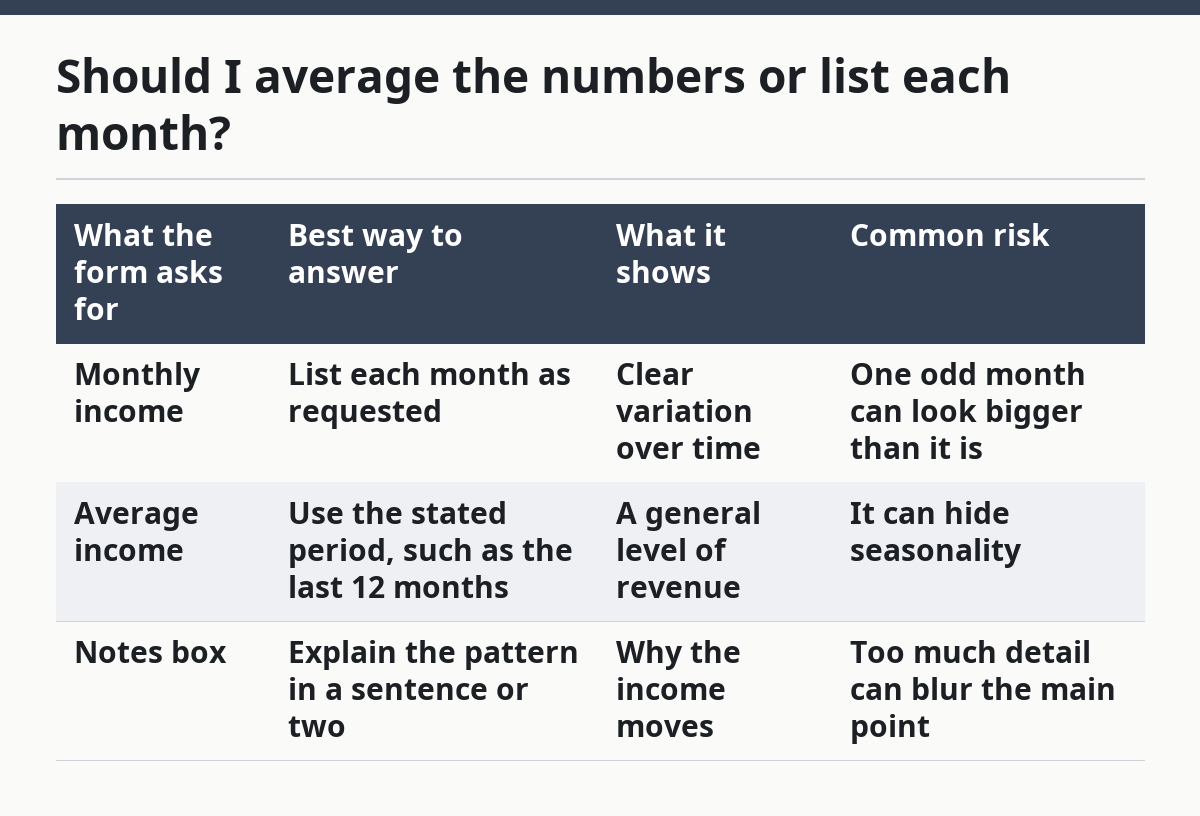
If the form gives only one field, answer that field and use the notes box for the rest. If it gives space for both, keep the average and the monthly pattern consistent. A mismatch between those two can create a follow-up question.
This is also where a lot of people over-explain. A long paragraph about every client change is rarely better than a clean line about seasonal work and project mix. The underwriter usually wants enough to classify the file, not a 2-page memoir of every invoice.
What should go in the underwriting notes?
Therefore, underwriting notes should explain the cause of the change, not the whole history of the business. A short note that names seasonal work, project mix, and activity changes is usually more useful than a long paragraph about every assignment.

Good notes often answer three points in one or two sentences: what the work is, why the revenue moves, and whether the change is normal for the business. For example, “Freelance marketing projects vary by client launch schedule; revenue is stronger in some months and lighter in others” gives the underwriter a clean pattern without guessing.
The note should also stay close to the documents. If your invoices show design work but your note says consulting, the file starts to split. If your work includes several service lines, describe the main one first and the smaller ones second.
A note can help when the application asks about recent activity changes. If you dropped one service and picked up another, say that in plain terms. The key is to show a real business shift, not to polish the story until it no longer matches the records.
When should I stop and ask for help?
So stop and get qualified help when the application stops matching your records or when the questions move beyond simple description. Insurance forms are not the place to guess at legal or accounting terms. For broader guidance on self-employed recordkeeping, see the IRS guidance for the self-employed.

Your services changed completely this year: the application may now need a different business description — pause and have the records reviewed before you submit. If you call old work “current” or the new work “temporary” without a basis, the form can become misleading.
Your income comes from 2 or more very different services: the mix may need separate treatment — consult a qualified professional before compressing everything into one line if the form has a better place for detail. A blended description can hide the real risk profile.
Your revenue only exists in a few months: the business may look seasonal rather than steady — make sure the form uses the right time window and note the seasonality clearly. If you pick the wrong months, the result can be distorted; a tax or insurance professional can help if the pattern is unusual.
Your records disagree with each other: the application may need correction before filing — fix the mismatch between invoices, tax records, and the form. If the underwriter spots the difference first, expect follow-up.
The insurer asks for proof you do not have: the file may need an alternative document — do not invent a document or guess what it should say. If you are missing records, get help on what the insurer will accept instead.
What mistakes cause the most trouble?
The most common mistakes are easy to make and hard to undo once the file is submitted. Most of them come from trying to make irregular work look simpler than it is.
First, people often average income across the wrong period. That can make the application look inconsistent if the form asked for a specific window. The better option is to use the exact period requested and label it clearly.
Second, people use vague labels like “freelance” or “self-employed” and stop there. That tells the insurer almost nothing about the actual work. A better label names the service and the pattern, such as project-based design or seasonal consulting.
Third, some people leave out seasonal work because they think it looks weak. That usually backfires, because the underwriter then sees the fluctuation without a reason. The better option is to state the seasonality plainly and let the file explain itself.
Fourth, some people mix different services into one figure without saying so. That can make the file look unstable when the real issue is just a changing project mix. The better option is to separate the main services if the form allows it.
Fifth, some people try to predict next month’s revenue too confidently. A forecast can be useful if the form asks for one, but a guess is not the same as a record. The better option is to describe the pattern you can document.
How does seasonal work fit into the form?
Therefore, seasonal work fits best when you describe it as a recurring pattern tied to your business cycle. That means saying when the work rises, when it slows, and what kind of projects create the swing.
If your months change because of holidays, campaign schedules, event dates, or client budgeting cycles, say that in one line. The underwriter does not need a long explanation of the market; the underwriter needs a reason the numbers are not flat. A note that names the season is usually enough.
If the form has a date field, use the exact dates requested rather than a general season name. If it has a revenue field, keep the number tied to the same date range. Mixed date ranges are a common source of confusion in insurance applications about variable freelance income.
Seasonal work is not a problem by itself. The problem is when the application makes it look unplanned, undocumented, or inconsistent with the rest of the file. Clear notes and matching records usually do more for the application than a polished explanation ever will. See also seasonal business income and how insurers review self-employed income.
How should I talk about changes after I submit?
Since changes can happen after submission, talk about them by updating the insurer only when the form, policy, or follow-up request asks for current information. If your services or revenue pattern changes materially, the record should match the new reality, not the old one.
The useful rule is simple: if a future question asks what you do now, answer with the current mix and current pattern. If the insurer is only reviewing the original application, do not send extra detail that was never asked for. Too much unsolicited detail can create a new issue where none existed.
If the change is small, such as a short project spike, it may not need special treatment on the application itself; if you are unsure, ask the insurer or a qualified adviser before changing anything. If the change is larger, such as a new main service or a full shift in project mix, the file may need to be updated. The exact rule depends on the insurer and the application, so this is a good place to ask a qualified adviser or the insurer directly before changing anything.
FAQ
How do I describe variable freelance income?
Describe it as freelance revenue that changes because the project mix changes, then note whether the pattern is seasonal, client-driven, or tied to shorter and longer contracts. Keep the wording close to the records, and use the time period the application asks for. If the form has a notes box, add the reason for the swings in one short sentence.
Will changing projects affect my quote?
Changing projects can affect how the insurer reads the application, because the underwriter may see a different mix of work, different frequency, or a different level of activity. The quote itself depends on the insurer’s process and the details in the form, so the safer move is to describe the change plainly rather than minimize it.
Do I need to update the insurer if my services change?
If the form, policy, or insurer asks for current business details, then yes, the information should match your current services. A small project shift may not matter, but a real change in your main work can matter to underwriting. When in doubt, check the application instructions or a qualified adviser before sending an update.
Drafted with AI; not yet reviewed by a person.
